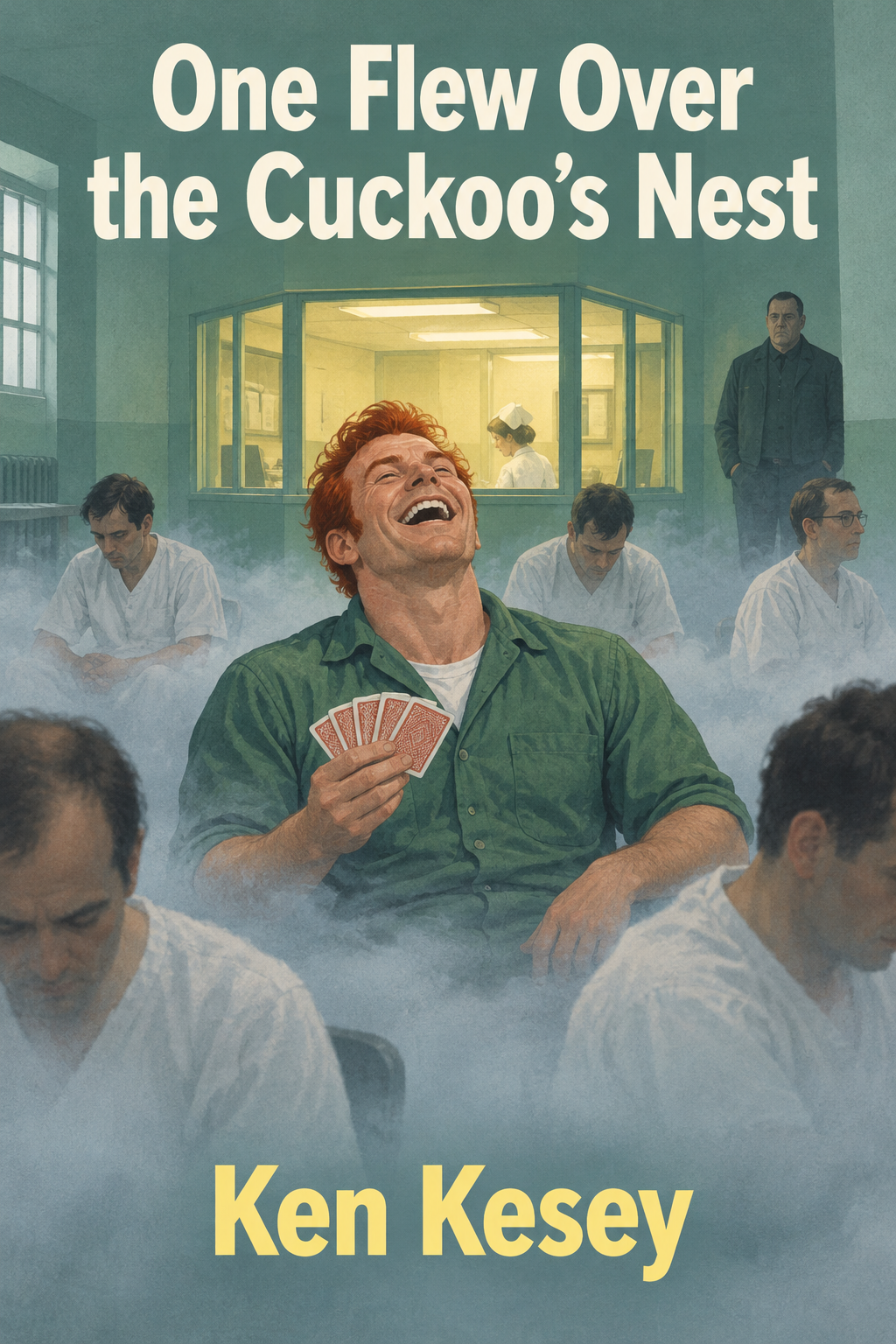
One Flew Over the Cuckoo's Nest
by Ken Kesey
One Flew Over the Cuckoo's Nest is a 1962 novel about a battle of wills inside an Oregon mental hospital. The narrator, Chief Bromden, is a giant, half-Native American patient who pretends to be deaf and mute. When Randle McMurphy, a brawling gambler who faked madness to get out of a prison work farm, arrives on the ward, he bets he can rattle Nurse Ratched, the calm, controlling Big Nurse. His card games, jokes and small rebellions slowly wake the other men up, but the nurse holds more power than he knows.
The Big Idea
"On a locked psychiatric ward run by a smiling, iron-willed nurse, one loud rebel teaches frightened men to laugh and push back. The novel asks what freedom costs, and who pays for it."
Key Insights
Control and the Combine
Bromden's Combine is his name for every system that turns people into parts: the hospital, the government that took his father's land, the towns of identical houses he sees on the drive to the coast. The ward is a small model of that system. It works less by force than by routine, shame and men agreeing to be managed.
Group meetings look like therapy, but the nurse uses them to turn patients against one another. Harding's picture of the men as rabbits shows they have learned to police themselves.
Laughter as power
McMurphy's loudest weapon is his laugh. The ward is silent because the men have stopped believing anything can change, and laughter breaks that spell. Kesey suggests that a person who can still laugh at the rules has not been fully controlled by them.
On the fishing trip the boat falls into chaos as the men fight fish they cannot handle, and McMurphy simply laughs. Soon everyone is laughing, and for the first time they look like free men.
Freedom and its price
McMurphy begins as a con man looking out for himself. Once he learns he can be held for as long as the staff like, every act of defiance costs him something real. Kesey frames him as a reluctant saviour who spends his own freedom so others can find theirs.
Strapped to the shock table, he jokes about whether he gets a crown of thorns. Echoes of Christ like this make his fall feel like a sacrifice rather than a defeat.
Coming out of the fog
The story is McMurphy's, but the change is Bromden's. At the start he hides in fog and silence and calls himself small despite his size. As he watches McMurphy, the fog thins, and he speaks, fights and finally acts on his own. His narration grows clearer as he gets better.
After his shock treatment, the Chief notices he has come out of the fog faster than before. At the end he lifts the panel McMurphy could not, which shows how far he has come.
Chapter Breakdown
Chapter-by-chapter summary
Spoiler warning: this section covers the whole plot, including the ending.
The novel is divided into four parts.
Part One: A New Man on the Ward
Chief Bromden tells the story from the ward where he has lived for years. He believes a hidden machine he calls the Combine runs the world, and when he is afraid he sees fog pour into the room. Nurse Ratched rules through routine, three day-shift aides and group meetings where patients are pushed to expose one another's secrets. Then McMurphy arrives from a work farm, shakes every hand and laughs out loud, a sound the ward has not heard in years. Dale Harding tells him the patients are like rabbits and the nurse is like a wolf, and McMurphy bets the men he can make her lose her cool within a week. He plays poker, sings in the shower and asks to change the TV schedule so the men can watch the World Series, but only a few dare to vote with him. He then bets he can lift a heavy steel control panel in the old tub room, fails, and walks off saying that at least he tried. At the next vote twenty patients raise their hands, but the nurse says he needs a majority of the whole ward, including the chronic patients who barely move. The Chief, almost without meaning to, lifts his hand too. Ratched still refuses, so McMurphy sits in front of the blank screen and the others join him. Why it matters: Kesey sets up the contest the whole novel turns on, and the men, the Chief among them, act together for the first time.
Part Two: Committed
At the swimming pool a lifeguard tells McMurphy something he did not know. Unlike a prison sentence, his stay has no end date: he is committed, and he leaves only when the staff decide to let him go. McMurphy turns quiet and obedient. Cheswick, who had counted on him, is crushed, and soon after he drowns at the pool with his fingers caught in a drain grate. McMurphy then learns that Harding and most of the other men signed themselves in and could walk out any day, yet stay out of fear. Finally he puts his hand through the glass of the Nurses' Station, saying he only wanted his cigarettes. Why it matters: McMurphy now fights knowing it may cost him his freedom, so his rebellion becomes a choice rather than a game.
Part Three: The Chief Speaks and the Fishing Trip
One night McMurphy gives the Chief a stick of gum, and the Chief thanks him out loud, breaking years of silence. He talks about his father, a chief worn down by the government and by his white wife, and McMurphy promises to make him big again. McMurphy then organises a deep-sea fishing trip on the coast. Candy, a young woman he knows from outside, comes along, and so does Dr. Spivey. George, an old patient who once captained a fishing boat, takes the wheel. At sea the men hook fish they can barely handle, panic, take charge and laugh until they cannot stop. Why it matters: for one day the patients live like ordinary men, yet the Chief notices how tired McMurphy looks as he carries everyone's hopes.
Part Four: The Shock Shop, the Party and the Ending
The day after the trip, the nurse posts a record of the money McMurphy has won from the men, and some start to wonder if he has been using them. He even bets that the Chief can lift the control panel and wins, and the Chief refuses his share. Then the aides roughly try to force George, who is terrified of dirt, into a delousing shower. McMurphy fights them, and the Chief joins in. Both are sent to the Disturbed ward and given electroshock treatment. The Chief comes out of the fog faster than ever, while McMurphy jokes through each session but is slowly worn down. Back on the ward, he keeps a promise to Billy Bibbit, a shy young patient with a stutter. He bribes Mr. Turkle, the night aide, and lets Candy and her friend Sandy in for a late-night party. Billy spends the night with Candy, and McMurphy falls asleep instead of escaping. In the morning the nurse threatens to tell Billy's mother. Billy breaks down and kills himself. McMurphy attacks Ratched and tears open her uniform. He is later brought back after a lobotomy, his spirit gone. Ratched has lost her voice, and many patients sign themselves out. The Chief smothers McMurphy with a pillow so no one will see him that way, throws the control panel through the window and runs free. Why it matters: McMurphy loses everything, but the men he woke up, above all the Chief, leave changed.
Characters
Chief Bromden
The narrator. The son of a Native American chief and a white mother, he is huge but feels small. He has pretended to be deaf and mute for years, and he sees the hospital as part of the Combine, a machine that grinds people down. His slow recovery is the novel's real story.
Randle Patrick McMurphy
A red-haired gambler and brawler who faked madness to get out of a prison work farm, thinking the hospital would be easier. Loud, funny and self-interested at first, he becomes the patients' champion, and learns too late how much power the staff hold over him.
Nurse Ratched
The Big Nurse who runs the ward. She never shouts. She controls the men through schedules, medication, group meetings and shame, and she can send patients for shock treatment. Kesey presents her as the human face of the Combine.
Dale Harding
An educated, nervous patient who chairs the Patients' Council and speaks for the men before McMurphy arrives. He is ashamed of his marriage to his wife Vera and of feelings he hides. He explains how the ward works to McMurphy, and he signs himself out at the end.
Billy Bibbit
A shy patient with a stutter who looks like a boy although he is in his thirties. His mother is a friend of Nurse Ratched, and his fear of both women shapes his whole life. McMurphy tries to help him grow up, with tragic results.
Charlie Cheswick
A loud patient who complains about the rules but always backs down. McMurphy gives him courage, so when McMurphy turns obedient, Cheswick feels abandoned. His death at the pool shakes McMurphy into fighting again.
George Sorensen
An old patient with a fear of germs who once captained a fishing boat. McMurphy persuades him to steer the fishing trip, and later fights the aides to protect him in the shower room.
Dr. Spivey
The ward doctor, a timid man who usually goes along with whatever Nurse Ratched decides. McMurphy's energy gives him a little courage: he backs the fishing trip and comes along himself.
Candy
A cheerful young woman from McMurphy's life outside the hospital. She joins the fishing trip and comes back for the late-night party, where McMurphy asks her to spend the night with Billy.
The aides and Mr. Turkle
Washington, Williams and Warren are the day-shift aides who enforce the nurse's rules, often cruelly. Mr. Turkle, the easygoing old night aide, lets McMurphy throw his party in exchange for money and drink.
Writing about this book
Start by deciding whose story you think this is. McMurphy drives the action, but Bromden tells it and changes the most. Choosing one of them as your focus gives an essay a clear spine.
Questions to work with:
- Is Nurse Ratched simply a villain, or is she a product of the system she serves?
- Why do the voluntary patients stay, and where do you see the same pattern in real life?
- Does McMurphy save the men or harm them? Use Billy's fate as evidence either way.
- How does Bromden's claim that something can be true even if it did not happen change the way you read the fog and the Combine?
Keep your evidence tight: one or two scenes, read closely, beat a list of events. Pairing McMurphy's failed attempt to lift the control panel with Bromden's success at the end makes a strong frame for an essay about courage passed from one person to another.
Finally, many critics point out that the novel's women are mostly controlling or seductive, and that its Black aides are drawn as crude stereotypes through the narrator's eyes. Saying what has aged badly, and why, shows you have thought about the book as a product of 1962.
Take Action
Practical steps you can implement today:
-
Look at how the rules work in a place you know, such as a school, a job or a team, and ask who gains when nobody questions them.
-
Don't treat laughter as trivial. Keeping your sense of humour under pressure can protect your sense of who you are.
-
Courage spreads. One person who refuses to go along can give quieter people permission to speak up.
-
Watch the narrator. Ask how Bromden's fear and illness shape what he describes, and what changes as he recovers.
Notable Quotes
"“They're out there.” (Part One)"
— Ken Kesey
"“It's the truth even if it didn't happen.” (Part One)"
— Ken Kesey
"“Man, when you lose your laugh you lose your footing.” (Part One)"
— Ken Kesey
"“But I tried, though... Goddammit, I sure as hell did that much, now, didn't I?” (Part One)"
— Ken Kesey
Who Should Read This
High school and college readers studying American literature, and anyone curious about power, conformity and mental health care in the nineteen-fifties and sixties. Best for ages 16 and up: the novel includes violence, suicide, sexual content and racist language that reflects its narrator and era. Readers who know only the 1975 film will find a very different, stranger book.
Frequently Asked Questions
Who narrates One Flew Over the Cuckoo's Nest?
Chief Bromden, a patient on the ward who has pretended to be deaf and mute for years. Because the staff think he cannot hear, he overhears everything. His narration mixes facts with hallucinations such as the fog and the Combine, so readers see the hospital through a frightened, unwell mind that slowly becomes clearer.
What does the title mean?
It comes from a children's rhyme Bromden's grandmother sang to him: one flew east, one flew west, one flew over the cuckoo's nest. Cuckoo is slang for crazy, and the nest stands for the hospital. The line suggests a bird rising above the madhouse.
Was the book based on a real hospital?
Partly. Kesey worked night shifts as an aide at a veterans' hospital in Menlo Park, California, where he also took part in paid drug experiments. He talked with patients and drew on what he saw there. The hospital in the novel is fictional and set in Oregon.
Why does McMurphy go to the hospital?
He was serving time at a prison work farm for fighting and gambling, and he acted crazy because he thought a hospital would be easier than hard labour. He expects to leave when his sentence ends, which is why learning that he is committed with no release date shocks him.
How is the novel different from the 1975 film?
Milos Forman's film, starring Jack Nicholson, won the five major Academy Awards but drops most of Bromden's narration, the fog and the Combine. The novel is told from inside the Chief's mind, so his recovery is the centre of the book, while the film puts McMurphy at the centre.
Check Your Understanding
Pick an answer for each question to see if you were right.
-
Who narrates the novel?
Chief Bromden — Chief Bromden tells the story, and the staff let him hear everything because they believe he is deaf.
-
Why did McMurphy come to the hospital?
He faked madness to get out of a prison work farm — He thought the hospital would be easier than the hard labour of the work farm.
-
What does McMurphy try and fail to lift in the tub room?
A heavy control panel — He fails to lift the control panel, but insists that at least he tried.
-
What news makes McMurphy turn quiet in Part Two?
He is committed and can be held until the staff release him — A lifeguard tells him that, unlike a prison sentence, his commitment has no end date.
-
What does Bromden call the system he believes controls the world?
The Combine — The Combine is Bromden's name for the huge system he believes turns people into parts.
About Ken Kesey
Ken Kesey (1935–2001) was an American novelist who grew up in Oregon and studied creative writing at Stanford. Night shifts as an aide at a veterans' hospital in Menlo Park, California, gave him the material for this first novel. He later wrote Sometimes a Great Notion and became a leading figure of the nineteen-sixties counterculture.
Summary Written By

Software Engineer & Writer
Software engineer with a passion for distilling complex ideas into actionable insights. Writes about finance, investment, entrepreneurship, and technology.
View all summaries →Reviews
No reviews yet. Be the first to share your thoughts!
Write a Review
Keep reading
Explore the topic: FictionSummaries

Out of My Mind
Sharon M. Draper
“Out of My Mind” by Sharon M. Draper is a poignant narrative that explores the life of Melody Brooks, a…

Ender’s Game
Orson Scott Card
“Ender’s Game” by Orson Scott Card is a riveting science fiction novel that transports readers into a future where humanity…

Pachinko
Min Jin Lee
“Pachinko”, a spellbinding multigenerational historical saga by Min Jin Lee, explores the lives of a Korean family trying to make…

The Perks of Being a Wallflower
Stephen Chbosky
The Perks of Being a Wallflower by Stephen Chbosky is a profound coming-of-age novel, told through the intimate letters of…
Articles
The Enlightenment Explained: Ideas, Thinkers and Legacy
The Enlightenment was an 18th-century European movement that trusted reason and evidence over tradition and authority. Its thinkers, from Locke…
World History 1700–1918: Revolutions, Industry, Empire and War
Between 1700 and 1918, revolutions, factories, empires and a world war reshaped societies across Europe, the Americas, Asia and Africa.…

A Christmas Carol themes: generosity, isolation and responsibility
Dickens's novella is usually read as a story about a man who changes his mind. Its themes are sharper than…