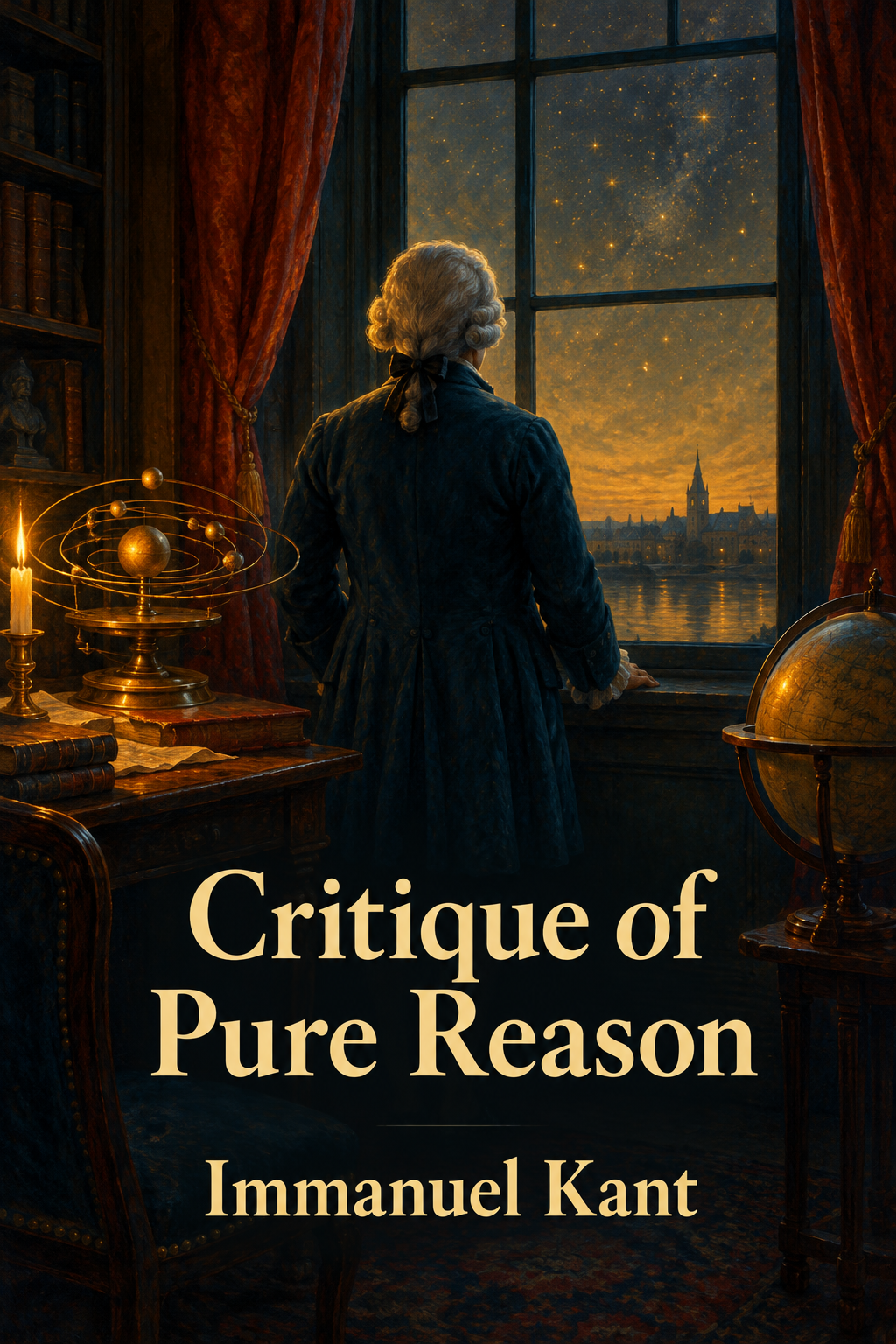
Critique of Pure Reason
by Immanuel Kant
Critique of Pure Reason is Kant's attempt to find out what human reason can and cannot know. Before him, philosophers argued either that knowledge comes from experience or that it comes from reason alone. Kant says both are needed: the senses supply material, and the mind supplies the frame, namely space, time and twelve basic concepts. So we know things as they appear to us, not as they are in themselves. Beyond experience, reason runs into puzzles it cannot settle.
The Big Idea
"We can only know the world as it appears to a mind that shapes experience through space, time and categories. Reason overreaches when it tries to prove God, the soul or the universe's beginning."
Key Insights
The Copernican turn
Copernicus made progress by assuming that the observer moves, not the stars. Kant tries the same trick on knowledge: instead of assuming that our minds must conform to objects, he assumes that objects, as we experience them, must conform to the way our minds work. This is why he says some things can be known before any experience.
You know without checking that any event you will ever observe happens in time and has a cause. That is not because you have seen every event, but because anything you could observe must pass through the mind's frame.
Experience needs both senses and concepts
Neither empiricists nor rationalists had the whole picture. Without the senses there is nothing to think about, and without concepts the senses give only a blur. Knowledge appears when the two work together.
Looking at an unfamiliar tool, you see its colours and shape but cannot make sense of it until you have the concept of what it is for. The raw sight and the concept must meet.
We know appearances, not things in themselves
Because space, time and the categories come from us, what we know is the world as it appears to beings like us. This is not a claim that the world is an illusion; our experience is real and lawful. It is a claim that we cannot step outside our way of knowing to compare it with reality as it is.
A colour-tinted pair of glasses is the usual picture, though Kant's point is stronger: we can never take the glasses off, so we cannot even say what lies beyond them.
Reason has limits, and that makes room for faith
When reason tries to prove God, the soul or the world's beginning, it ends up with arguments that cannot be settled. Kant sees this as a gain: if these claims can be neither proved nor disproved, then the denial of God cannot be proved either, and moral faith stays open.
The antinomy of freedom shows both sides: every event has a natural cause, yet people can act from duty. Kant lets each hold in its own domain, as appearance and as moral agent.
Chapter Breakdown
Chapter-by-chapter summary
The book is long and dense, so this guide follows its seven main parts. Page references use the standard A (1781) and B (1787) editions, which every translation prints in the margins.
Part 1: Prefaces and Introduction — Can metaphysics become a science?
Kant opens by noting that metaphysics, the study of God, the soul and the world as a whole, has been a battlefield of endless arguments, while mathematics and physics move forward steadily. He asks why. His answer is to examine reason itself before trusting it. In the Introduction he separates knowledge that comes from experience from knowledge that holds independently of it, which he calls a priori. He also separates judgments that merely unpack a concept (analytic) from those that add something new (synthetic). His central question is how synthetic a priori judgments are possible, since mathematics and physics seem to rely on them. Why it matters: this one question organises everything that follows.
Part 2: The Transcendental Aesthetic — Space and time
Here Kant studies sensibility, our ability to receive impressions. He argues that space and time are not things we find in the world, and not ideas we learn from experience. They are the built-in forms through which every experience reaches us. This explains why geometry and arithmetic are certain: they describe the structure of our own way of perceiving, so they must hold for everything we can ever encounter. The price is large, because space and time then belong to how things appear to us, not to things in themselves. Why it matters: this is the first step toward his claim that we know appearances, not reality as it is apart from us.
Part 3: The Analytic of Concepts — The categories
Receiving impressions is not yet knowledge; the mind must also think what it senses. Kant lists twelve pure concepts of the understanding, the categories, such as unity, substance, and cause and effect, and draws them from the basic forms of judgment. In the Transcendental Deduction he argues that these concepts are justified because without them no unified experience would be possible. All my perceptions must be able to belong to one consciousness, which he calls the unity of apperception, and the categories are the rules that make that unity work. Why it matters: it explains how concepts we never learned from experience can still apply to every experience.
Part 4: The Analytic of Principles — Bridging mind and world
Kant now asks how abstract categories connect to concrete perceptions. The Schematism says time provides the bridge: the idea of cause and effect, for example, is tied to one event regularly following another in time. The principles then state rules for all possible experience, including that substance persists and that every event has a cause. The section ends by drawing a limit. The categories yield knowledge only when applied to what the senses give. The thing in itself, or noumenon, can be thought but never known. Why it matters: this is his answer to Hume, who doubted that cause and effect could be justified at all.
Part 5: The Dialectic, first half — The soul
The Dialectic studies the illusions that arise when reason tries to go beyond experience. First come the paralogisms, faulty arguments about the soul. Earlier philosophers moved from the fact that the thought I think accompanies all my thoughts to the claim that I am a simple, lasting substance. Kant replies that this I think is only a formal feature of thinking, not an object I observe. Nothing about the soul's nature, or its immortality, follows from it. Why it matters: a proof of the immortal soul by pure reason falls away.
Part 6: The Dialectic, second half — The world and God
Next come the antinomies: four pairs of opposed claims, each seemingly provable. Does the world have a beginning in time, or none? Is matter made of simple parts, or endlessly divisible? Is there freedom, or only natural causes? Does a necessary being exist? Kant argues that both sides fail because they treat the world as a finished thing in itself. For freedom he leaves room for both: as appearances we are bound by causes, yet as moral agents we may still be free. He then rejects the three classic proofs of God: the ontological, the cosmological and the physico-theological. Why it matters: he removes certain proof of God while keeping God as a coherent idea.
Part 7: The Doctrine of Method — What reason is for
The final, shorter part asks how reason should work. The Discipline warns philosophers against imitating mathematics. The Canon says what reason can legitimately do: guide our practical lives by asking what I can know, what I ought to do and what I may hope. The Architectonic sketches philosophy as one system, and a short history of pure reason surveys earlier schools. Why it matters: it points ahead to Kant's moral philosophy, where freedom, God and immortality return as matters of rational faith.
Key people and terms
- Immanuel Kant (1724–1804): German philosopher from Königsberg. He was in his late fifties when the first edition appeared in 1781, and he published a revised second edition in 1787.
- David Hume: Scottish philosopher who doubted that we can justify the link between cause and effect. Kant said Hume pushed him to rethink the foundations of knowledge.
- Leibniz and Wolff: rationalist philosophers who believed pure reason could reach truths about God and the world. Their confident metaphysics is Kant's main target.
- A priori and a posteriori: a priori knowledge does not depend on experience, as in the claim that seven plus five is twelve. A posteriori knowledge rests on experience, as in the claim that water boils.
- Synthetic a priori judgment: a statement that adds new content yet holds without being checked against experience. Kant thinks arithmetic, geometry and the basic laws of physics are of this kind.
- Sensibility, understanding, reason: the three faculties. Sensibility receives impressions, understanding forms concepts and judgments, and reason reaches for the whole and the unconditioned.
- Categories: the twelve basic concepts of the understanding, including substance and cause, which structure every possible experience.
- Phenomenon and thing in itself: things as they appear to us, versus things as they might be apart from our way of perceiving. Only the first can be known.
- Transcendental: concerned with the conditions that make experience possible, not with objects themselves.
- Antinomy: a pair of contradictory claims that reason seems able to prove equally well when it ignores the limits of experience.
Writing about this book
This is a hard text to write about, so choose one idea and follow it all the way through. Three starting points work well. First, take the Copernican turn and ask what is gained and lost when the mind is treated as the source of experience's structure. Second, take the thing in itself and ask whether it is a useful limit or a puzzle Kant never solved. Third, take the antinomies and ask why reason keeps producing questions it cannot answer.
To keep the essay concrete, build it on one example: a clock, a cause, or the claim that a line is the shortest path between two points. Say plainly what Kant claims, what the strongest objection is, and what you think. Some questions to test your argument: if space and time come from us, why does science work so well? Are there questions you cannot stop asking, even though you suspect they have no answer? Keep a short glossary of terms beside you, and define each one the first time it appears.
Take Action
Practical steps you can implement today:
-
When you disagree with someone, ask what framework each of you assumes. Many disputes come from different frames, not different facts.
-
Pair every idea with an example, and every example with an idea. Kant's own warning is that concepts without experience are empty.
-
Notice which of your questions can be answered with evidence and which cannot, and spend your effort on the first kind.
-
Read hard books in layers: first the structure, then one part in depth, then the whole again.
Notable Quotes
"“But, though all our cognition begins with experience, it does not follow that it arises from experience.” (Introduction, section I)"
— Immanuel Kant
"“Thoughts without content are void; intuitions without conceptions, blind.” (Transcendental Logic, Introduction)"
— Immanuel Kant
"“I must, therefore, abolish knowledge, to make room for belief.” (Preface to the second edition)"
— Immanuel Kant
Who Should Read This
Suited to university students and curious adults, and to strong high-school readers who already like philosophy. Read this summary first for the map, then try the Prolegomena, Kant's shorter 1783 introduction to the same ideas, before taking on the full text.
Frequently Asked Questions
What is Critique of Pure Reason about?
It asks what human reason can know without relying on experience alone, and where it overreaches. Kant argues that space, time and twelve categories shape all experience, so we know the world as it appears to us. He also argues that pure reason cannot prove God, an immortal soul or the world's beginning.
What does the Copernican turn mean in Kant?
It is Kant's own comparison with Copernicus. Instead of assuming that the mind must adjust to objects, he assumes that objects, as we experience them, adjust to the mind's built-in forms. This reversal explains how we can know things such as the laws of geometry before experience.
What is the thing in itself?
It is the way something would be apart from our way of perceiving it. Kant says we can think of such things but never know them, because all knowledge needs space, time and the categories. The idea sets a limit on what claims about reality can responsibly say.
Why is the book so hard to read?
Kant invents precise technical terms, writes long sentences, and builds a tightly linked system in which each part depends on the others. He also revised the book in 1787, so two versions exist. A summary or a short companion text helps a lot before you start.
Where should a beginner start?
Start with a summary like this one, then read the Introduction and the Transcendental Aesthetic, which are short. Kant's Prolegomena to Any Future Metaphysics (1783) is a good next step, since he wrote it to explain the Critique more plainly.
Check Your Understanding
Pick an answer for each question to see if you were right.
-
In what year did the first edition appear?
1781 — Kant published the first edition in 1781 and a revised second edition in 1787.
-
What does Kant say space and time are?
Built-in forms of how we perceive — He argues they are forms of sensibility, which is why geometry holds for all experience.
-
What are the categories?
Basic concepts of the understanding such as cause — The twelve categories are the pure concepts, such as substance and cause, that structure experience.
-
What happens in the antinomies?
Opposed claims about the world each seem provable — Kant shows that reason, going beyond experience, can seemingly prove both sides of four basic questions.
-
What is the thing in itself?
Reality apart from how we perceive it, which we cannot know — It is thinkable but not knowable, because knowledge needs the forms the mind supplies.
About Immanuel Kant
Immanuel Kant (1724–1804) was a German philosopher who spent almost his whole life in Königsberg, in East Prussia, where he taught at the university. Critique of Pure Reason (1781, revised 1787) made his name and changed how later thinkers approached knowledge, science and metaphysics. He went on to write major works on ethics, aesthetics and politics.
Summary Written By

Software Engineer & Writer
Software engineer with a passion for distilling complex ideas into actionable insights. Writes about finance, investment, entrepreneurship, and technology.
View all summaries →Reviews
No reviews yet. Be the first to share your thoughts!
Write a Review
Keep reading
Explore the topic: Personal DevelopmentSummaries

Educated by Tara Westover
Tara Westover
A memoir about a young woman born to survivalists in Idaho who, despite having no formal schooling, teaches herself to…

Atomic Habits: An Easy & Proven Way to Build Good Habits & Break Bad Ones
James Clear
No matter your goals, Atomic Habits offers a proven framework for improving–every day. James Clear, one of the world’s leading…
Think and Grow Rich
Napoleon Hill
What if the secrets to wealth and success weren’t hidden in complex financial strategies, but within the power of your…

Melbourne
Alex Ng
Sophie Cunningham's Melbourne is a deeply personal exploration of Australia's cultural capital, weaving together history, architecture, weather patterns, and personal…
Articles

The Enlightenment Explained: Ideas, Thinkers and Legacy
The Enlightenment was an 18th-century European movement that trusted reason and evidence over tradition and authority. Its thinkers, from Locke…

World History 1700–1918: Revolutions, Industry, Empire and War
Between 1700 and 1918, revolutions, factories, empires and a world war reshaped societies across Europe, the Americas, Asia and Africa.…

Best Stoicism Books for Beginners: Where to Start and Why
Looking for the best stoicism books for beginners? Discover a clear reading route comparing ancient classics like Marcus Aurelius with…