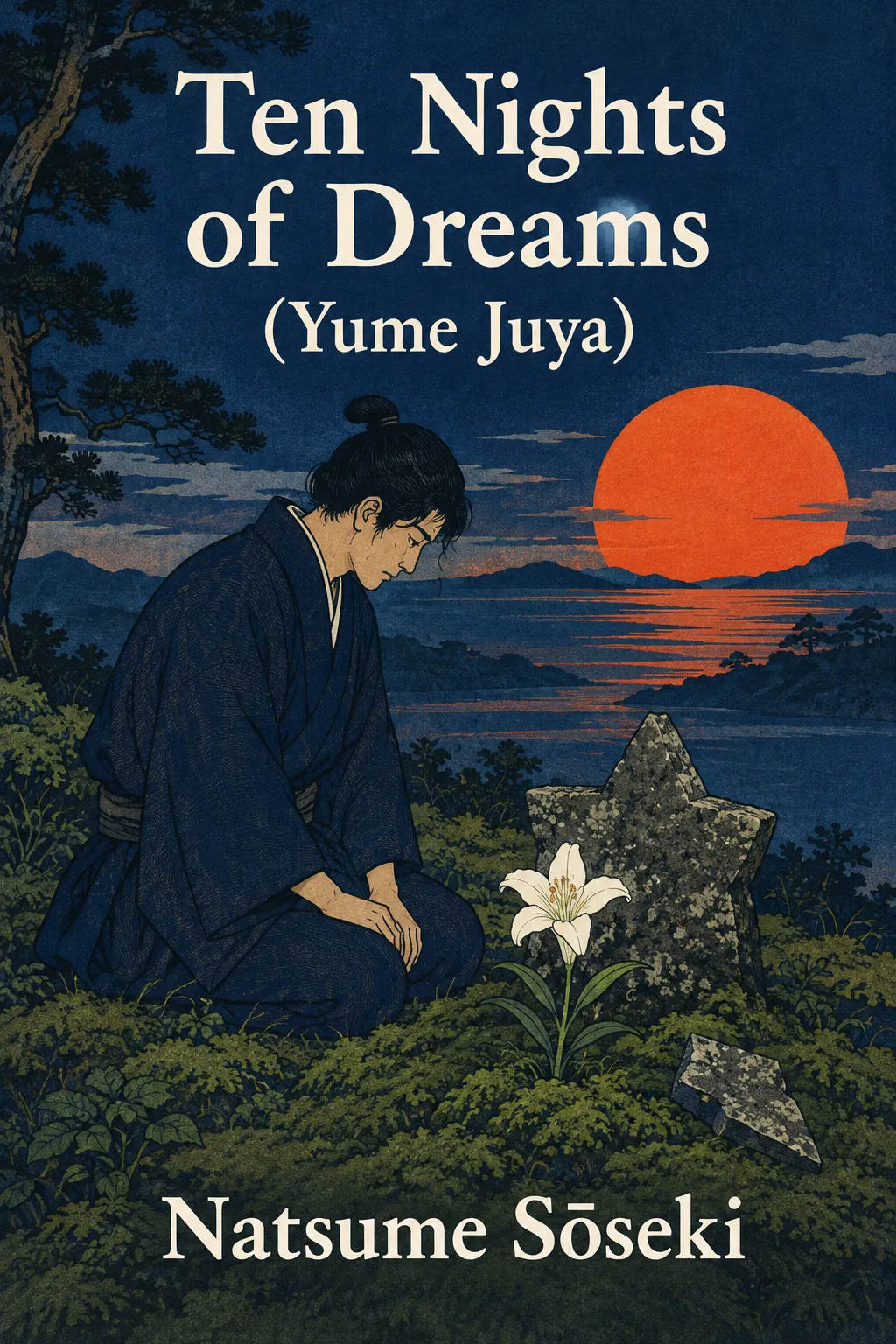
Ten Nights of Dreams (Yume Juya)
Tác giả: Natsume Sōseki
Ten Nights of Dreams is a set of ten short prose pieces by Natsume Soseki, printed in Japanese newspapers in 1908. Each night is a separate dream, and many begin with the plain sentence “I had this dream.” A woman asks for a hundred years of waiting, a samurai is pushed toward enlightenment, and a sculptor seems to find a statue inside wood. The dreams are strange but concrete, and they circle around waiting, guilt, fear and the limits of understanding.
Ý Tưởng Chính
"Ten short dreams show a mind facing love, guilt, death and the wish to understand itself. Soseki never explains them, so the reader has to work out what each dream means."
Những Hiểu Biết Cốt Lõi
Waiting is an act of trust
In Night 1 the whole story rests on a promise nobody can check. The narrator keeps his side by counting days, but counting also feeds his doubt. Soseki shows trust not as certainty but as the habit of continuing to wait while doubt grows.
He suspects he has been tricked, and at that moment the lily opens and shows him that the hundred years are already over.
Guilt outlasts memory
Night 3 suggests that a wrong does not disappear when the person who did it forgets. The blind child carries the memory for him, and it returns only when he reaches the place of the crime. The dream treats guilt as something physical that has to be carried.
When the child names the murder, the narrator remembers it and the boy becomes as heavy as a stone statue.
Trying too hard defeats you
Nights 2 and 7 both show a person forcing an answer and failing. The samurai tries to grab enlightenment by threat and pride, and the passenger throws himself overboard to escape loneliness. Both discover that the decision itself has made things worse.
The samurai’s anger grows with each tick of the clock, and the passenger regrets his jump the moment his feet leave the deck.
Old art in a modern age
Night 6 is a joke with a serious edge. The Meiji crowd admires Unkei but cannot do what he does, and the narrator’s own attempt fails. The dream compares the confident craft of the past with a modern age that has lost it.
The narrator finds no Nio in any piece of firewood and decides that Meiji wood has none inside, so Unkei must still be alive.
Tóm Tắt Chương
Ten Nights of Dreams explained in brief
Ten Nights of Dreams (Yume Juya) was published in the Asahi newspapers in July and August 1908.
Soseki wrote it as ten separate short dreams, and many of them open with the same plain sentence, “I had this dream.”
The nights share no plot or cast, but they return to the same worries: love, guilt, death and the limits of understanding. Because Soseki seldom explains his images, readers and teachers still debate what each dream means.
Chapter-by-chapter summary
Spoiler warning: this section covers every dream, including the endings.
Night 1: The Lily and the Hundred Years
A dying woman asks the narrator to dig her grave with a pearl shell and mark it with a fragment of a fallen star. She says that if he waits a hundred years beside it, she will come back to meet him.
He waits and counts the suns that rise and set, until he begins to think he has been tricked. Then a white lily opens in front of him, and he realises the hundred years have already passed.
It matters because waiting, love and time are carried by only a few images, which is why this night is the one most often studied.
Night 2: The Samurai and the Clock
A monk tells a samurai that a real samurai could not fail to reach enlightenment, and the insult drives him to a vow. He will either attain enlightenment tonight and return to cut the monk down, or kill himself.
He sits in meditation and tries to think of nothingness, but the ticking of a clock and his own anger keep pulling him back. The harder he tries, the further the answer moves away.
It matters because the dream shows pride and pressure destroying the very calm that the samurai is trying to reach.
Night 3: The Blind Child on His Back
The narrator walks along a dark path with his six-year-old son on his back. The child is blind, yet he talks like an adult and describes the road ahead as if he could see it, which frightens his father.
At the foot of a cedar tree, the child says that the narrator killed him exactly a hundred years ago. The narrator suddenly remembers killing a blind man in this very place, and the boy grows as heavy as a stone statue.
It matters because guilt returns even after the memory is lost, and the “hundred years” echoes Night 1 in a darker key.
Night 4: The Old Man and the Towel
An old man drinks and tells the watching children that he will turn his towel into a snake. He walks to the river and wades in, chanting as he goes deeper into the water.
The narrator, a child among them, follows and waits, but the old man never comes back out.
It matters because the promised wonder never arrives, and a child is left with an adult’s unexplained disappearance. The scene is built from a few simple pictures, the towel, the river and the dark water, and it offers no moral at all.
Night 5: Before the Cock Crows
In a time close to myth, the narrator loses a battle and is taken prisoner. Offered a choice between surrender and death, he chooses death, but asks to see the woman he loves before the cock crows.
She rides through the dark toward the camp. A trickster spirit called Amanojaku imitates a cock’s cry, and the horse plunges into an abyss.
It matters because love is defeated not by an enemy army but by a small, malicious trick.
Night 6: Unkei and the Meiji Wood
At the gate of Gokokuji temple, the narrator watches the great sculptor Unkei carve a Nio guardian, while a crowd in Meiji-era clothes looks on. A bystander says Unkei does not create the statue; he simply digs out the Nio already hidden in the wood.
The narrator goes home and tries the same thing with firewood, but no Nio is buried in any piece. He concludes that Meiji wood contains no Nio, and that this must be why Unkei is still alive today.
It matters because the joke is also a comment on a modern age that seems to have lost the power of old craft.
Night 7: The Ship With No Destination
The narrator is aboard an enormous ship that never stops, and nobody can tell him where it is going. He is lonely among the other passengers and increasingly afraid.
At last he climbs to the rail and jumps into the sea. The moment his feet leave the deck, he regrets it, but he can only keep falling toward the water.
It matters because it captures the horror of an irreversible choice and the loneliness of drifting without a purpose.
Night 8: The Barbershop Mirror
The narrator goes into a barbershop and sits facing a mirror. In it he sees the street: passers-by, a woman counting banknotes behind a shop counter, a goldfish seller who never moves.
Almost nothing happens, and the night is one of the shortest. It matters because the reader becomes someone who, like the narrator, watches life through glass and wonders what is real.
Night 9: A Mother’s Prayers
The country feels close to war, and a young mother takes her three-year-old child to a shrine night after night. She leaves him on the steps while she walks around the grounds and prays for her husband’s safe return.
To comfort the child she tells him his father will soon come home. The narrator then reveals that the father was killed by masterless samurai long ago, and that he heard this sad story from his mother in a dream.
It matters because the child’s hope and the mother’s kind lie meet a fact that no prayer can change.
Night 10: Shotaro and the Pigs
Shotaro, the handsome and honest man of the neighbourhood, vanishes after a woman leads him away from a fruit shop. He comes back after seven days and takes to his bed.
The narrator hears the story from a friend, Ken-san, who reports what the sick man told him: the woman took Shotaro to a cliff and told him to jump. He refused, and a huge herd of pigs charged at him; he fought them off with his walking stick until he was exhausted.
It matters because the last night closes the cycle with desire, fear and an absurd danger that has no stated meaning.
Characters
- The narrator (“I”): He appears in every night with a different identity: lover, samurai, father, child, passenger. Readers treat him as one shifting voice that watches, waits and fails to understand.
- The dying woman (Night 1): She asks for a hundred years of waiting and promises to return. In her dark eyes the narrator sees his own face, which gives the scene its closeness.
- The samurai and the monk (Night 2): The samurai is proud and desperate, the monk coldly mocking. Between them they turn spiritual practice into a test of honour.
- The blind child (Night 3): A six-year-old with an adult’s voice who knows more than he should. He is both victim and accuser, and his growing weight is guilt made physical.
- Unkei (Night 6): The Kamakura-period sculptor who seems to release the Nio from the wood. He stands for a kind of craft that the Meiji crowd can only watch.
- Shotaro (Night 10): A kind, good-looking man whose weakness for a stranger leads him to the cliff. He is the last figure in the cycle, and his fight with the pigs is both comic and frightening.
Writing about this book
Do not try to explain all ten nights in one essay. Choose one night, or two that echo each other, such as Night 1 and Night 3, and build a clear argument.
Start from a concrete image: the lily, the stone-heavy child, the ship’s rail. Ask what the image does to the narrator’s feelings, and what the dream refuses to tell us.
Use short quotations or exact details, and say why they matter. Soseki rarely states a meaning, so your claim needs evidence from the scene.
Avoid saying that a dream “means” one fixed thing. Say what the text suggests, then test a second reading, for example whether the lily proves the woman’s promise or only shows that time has passed.
For a personal response, link a night to a real feeling, such as waiting for someone, or carrying a mistake you cannot forget. The model answers below show three levels, and you should compare them with your own work rather than copy them.
Hành Động Ngay
Các bước thực tế bạn có thể thực hiện ngay hôm nay:
-
Read one night slowly rather than all ten quickly, and note each concrete image before you decide what it means.
-
When you write about a dream, give evidence from the scene and say what is left unexplained.
-
Compare Night 1 and Night 3 to see how the same hundred years can mean love in one dream and guilt in the other.
-
Link a night to your own experience in a personal response, but keep the text at the centre.
Trích Dẫn Đáng Nhớ
"“I had this dream.” (Night 1, opening line; our translation)"
— Natsume Sōseki
"“Please wait a hundred years.” (Night 1; our translation)"
— Natsume Sōseki
"“So the hundred years had already come.” (Night 1; our translation)"
— Natsume Sōseki
"“There are no Nio statues buried in Meiji wood.” (Night 6; our translation)"
— Natsume Sōseki
Ai Nên Đọc Cuốn Này
Students aged about 15 and up who meet Soseki in Japanese literature classes, readers new to Japanese fiction, and anyone who likes short, strange stories. Each night takes only a few minutes to read, so it is easy to begin with one.
Về Natsume Sōseki
Natsume Soseki (1867–1916) is one of the most widely read novelists in modern Japan. A former English teacher who studied in London, he began writing fiction in his late thirties and published I Am a Cat, Botchan and Kokoro. Ten Nights of Dreams appeared in 1908, when he was writing for the Asahi newspapers.
Tóm Tắt Được Viết Bởi

Kỹ sư phần mềm & Nhà văn
Kỹ sư phần mềm với niềm đam mê chuyển đổi ý tưởng phức tạp thành hiểu biết thực tiễn. Viết về tài chính, đầu tư, khởi nghiệp và công nghệ.
Xem tất cả tóm tắt →Đánh Giá
Chưa có đánh giá nào. Hãy là người đầu tiên chia sẻ suy nghĩ của bạn!
Viết Đánh Giá
Đọc tiếp
Khám phá chủ đề: Hướng dẫn học tậpTóm tắt sách
Animal Farm của George Orwell — Tóm Tắt & Phân Tích
George Orwell
Các con vật tại Trang trại Manor nổi dậy chống lại chủ trang trại Jones để xây dựng một xã…
Những Kẻ Ngoài Lề - S.E. Hinton
S.E. Hinton
Câu chuyện xoay quanh Ponyboy Curtis và nhóm bạn Greasers, những thanh niên nghèo bị coi thường bởi nhóm Socs…

Gatsby Vĩ Đại của F. Scott Fitzgerald — Tóm Tắt & Phân Tích
F. Scott Fitzgerald
Thông qua lời kể của Nick Carraway, tác phẩm khắc họa cuộc đời của Jay Gatsby, một triệu phú tự…

Chuột và Người - John Steinbeck
John Steinbeck
Câu chuyện về George và Lennie, hai công nhân lang thang mơ về một mảnh đất riêng. Tuy nhiên, sự…
Bài Viết
Truyện Ông lão đốn tre (Taketori Monogatari)
Truyện ông lão đốn tre (Taketori Monogatari) kể về công chúa Kaguya, cô bé được tìm thấy trong một thân…
Ragnarok: ngày tận thế của các vị thần Bắc Âu
Ragnarök là ngày tận thế trong thần thoại Bắc Âu: một trận chiến cuối cùng, nơi thần, người khổng lồ…
Narcissus và Echo
Narcissus và Echo là thần thoại Hy Lạp về chàng trai đẹp đem lòng yêu chính bóng mình dưới nước,…