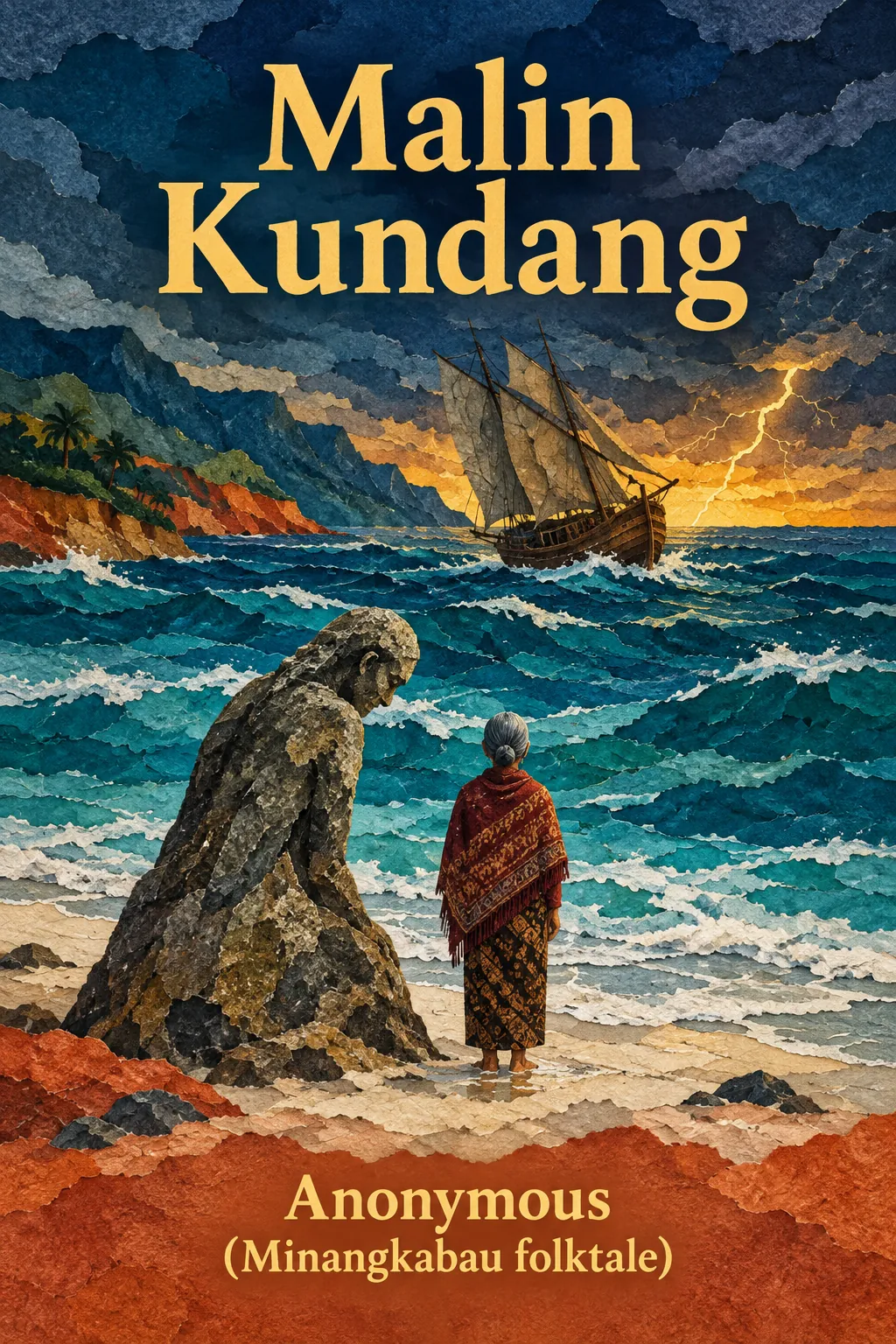
Malin Kundang
Tác giả: Anonymous (Minangkabau folktale)
Malin Kundang is a Minangkabau folktale from the coast of West Sumatra. Malin, a poor boy raised by his widowed mother, sails off on a merchant ship to change his fortune. Years later he returns as a rich trader with a wealthy wife, while his mother has waited on the shore every day. Their meeting tests whether wealth has made him wiser or ashamed of his roots. Schools use the tale to teach theme, moral lesson and characterisation.
Ý Tưởng Chính
"A poor boy who becomes rich is ashamed of his mother and denies her. The folktale warns that success without gratitude and respect for parents is a loss, not a win."
Những Hiểu Biết Cốt Lõi
Success is tested by how you treat those who helped you
Malin succeeds as a merchant but fails as a son. The tale measures achievement not only by wealth but also by loyalty to the people who supported us before we had anything. A rich life that forgets its roots is presented as an empty one.
On the beach he chooses to deny his mother in front of his wife and crew rather than admit where he came from.
Shame about your origins can be stronger than love
Malin does not forget his mother. He recognises her and still rejects her, because he fears being judged for his poor background. The story shows how social pride can silence a person's better feelings, a pressure many students will recognise.
His mother asks for no money and no gifts, only to be recognised, yet even that small request feels too costly to him.
Leaving home is not the fault; forgetting is
In Minangkabau culture, merantau, going away to learn and earn, is respected. The tale does not blame Malin for leaving, but for breaking the unspoken promise to return in heart as well as in body. That distinction matters in essays.
His mother blesses his departure and waits for years, while Malin never sends word home.
Folktales punish with images people remember
The stone shaped like a kneeling figure turns an abstract idea, durhaka, into something a listener can picture and point to. Oral stories need strong images because they are passed on by memory, not by print. The punishment works as teaching, not as a legal verdict.
At Air Manis beach in Padang, visitors are shown a rock that people call Batu Malin Kundang.
Tóm Tắt Chương
Chapter-by-chapter summary
Spoiler warning: this section covers the whole plot, including the ending.
The tale is oral, so it has no printed chapters. We split it into six natural parts, and small details differ between tellings.
Part 1: The widow and her son
On a fishing coast in West Sumatra, a widow and her only son, Malin Kundang, live in deep poverty. In many tellings the mother is called Mande Rubayah.
Malin helps earn the family's living from childhood. He is quick, hardworking and devoted to his mother.
Some versions say his father went to sea and never returned, while others leave the father out.
This opening matters because it builds the debt Malin owes. Without it, his later behaviour would not hurt as much.
It also sets the stage: a shore, a small village and a sea that offers both escape and danger.
Part 2: Malin decides to leave
One day a large merchant ship anchors near the village. Malin sees prosperous sailors and decides to leave and change his family's fate.
His mother is reluctant, since he is all she has. After he insists, she gives her blessing and some simple provisions, and asks him not to forget her.
She walks with him to the shore and watches the ship until it vanishes.
The parting matters because it plants a promise that Malin will break later.
It also shows that his wish to leave began as a good ambition, not as proof of a bad heart. In Minangkabau tradition, going away to seek fortune (merantau) is respected.
Part 3: The years abroad
In some versions the ship is attacked by pirates, and Malin survives by hiding or by drifting ashore on a fertile land. He works hard there and slowly builds a business.
Over the years he becomes a wealthy merchant with ships of his own. He marries a woman from a respected family.
Meanwhile he sends no news home. His mother waits and keeps asking sailors whether anyone has seen her son.
This part shows that Malin's talent is real. It also shows how distance and status can slowly erase a promise.
The story does not explain why he never wrote; it simply lets the silence grow.
Part 4: The grand ship returns
Malin finally sails to his home coast with his wife, and his magnificent ship draws the whole village to the shore. News reaches his mother, who runs to the beach.
She recognises her son, in many tellings by an old scar on his body, and embraces him in tears.
But Malin sees a ragged old woman in front of his wife and his crew. Ashamed, he claims that she is not his mother.
This is the turning point. His inner struggle between pride and gratitude is decided in favour of pride.
The wife and crew stand as witnesses, and what Malin fears is their opinion. His mother asks for no money, only to be acknowledged.
Part 5: Denial and curse
In many versions Malin pushes his mother to the ground and orders the crew to set sail. She is hurt in body and in heart.
Brokenhearted, she calls on God to judge her son if he really is a disloyal child. She speaks out of unbearable pain, not out of hatred from the start.
The curse turns the story from a family drama into a moral tale.
The word for what Malin has done is durhaka, a serious wrong against a parent.
Notice how fast the scene moves, from joy to shame to curse, on the same beach. That speed makes his fall feel sudden.
Part 6: Storm and stone
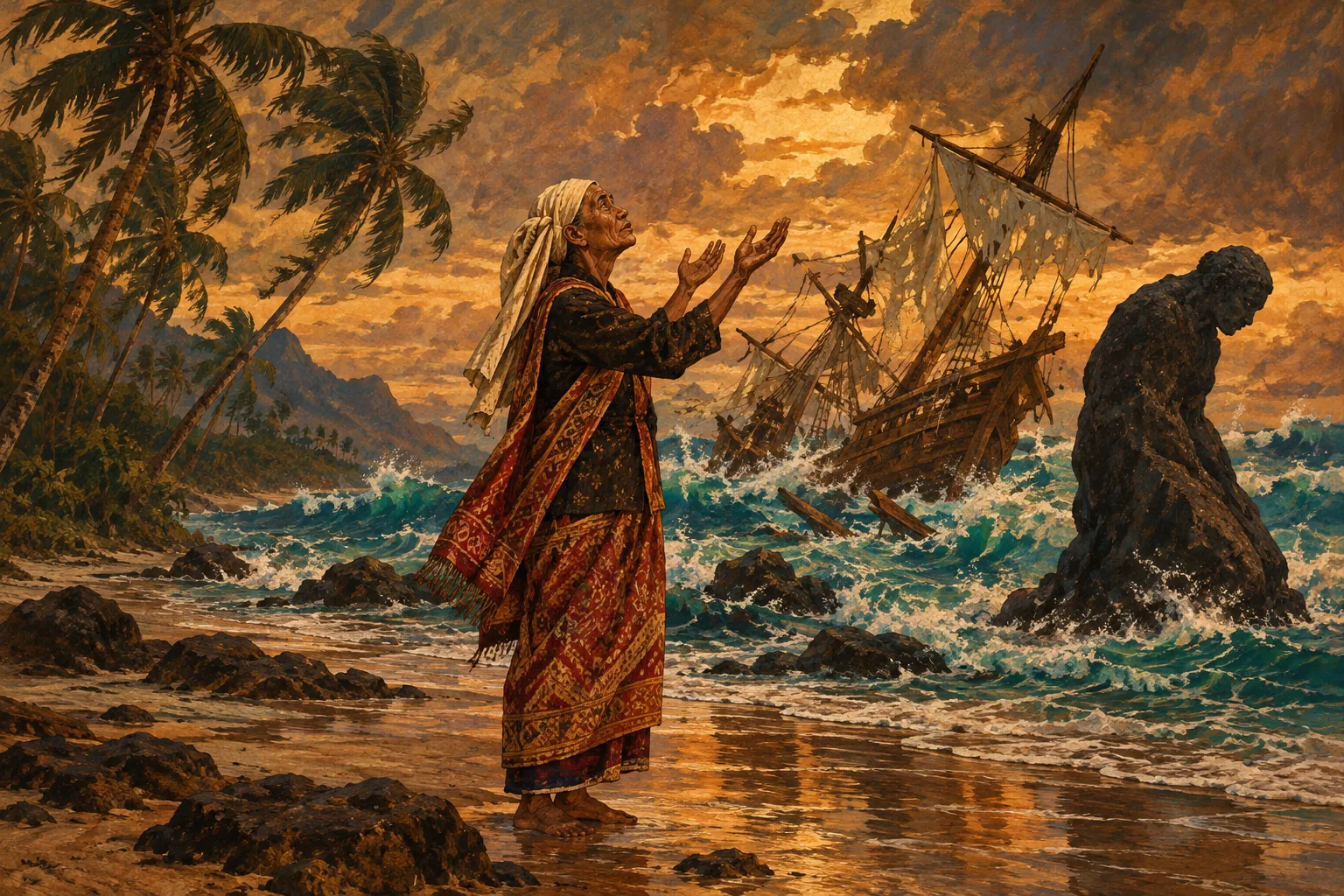
Soon after the ship leaves, the sky darkens and a violent storm strikes. Malin's ship is smashed, and its pieces wash up on the shore.
Malin himself turns to stone. At Air Manis beach in Padang, a rock that looks like a kneeling person is known as Batu Malin Kundang.
In some versions Malin begs for forgiveness, but too late.
The ending shows the folktale's cause-and-effect logic: a wrong done to a parent is paid for in a way everyone can see.
It is also why the story is so easy to remember and retell. Visitors still come to see the rock, and teachers still use the tale to open a class on moral values.
Characters
- Malin Kundang: the protagonist, a poor, hardworking boy who becomes a rich merchant and then denies his mother out of shame. He is a dynamic character, because his personality changes during the story.
- Malin's mother (Mande Rubayah in many tellings): a poor widow who raises Malin alone and waits for years. She is patient and loving, asks only to be recognised, and curses him after being insulted.
- Malin's wife: a woman from a wealthy family who stands beside him on the ship. In some versions she reacts to the old woman with disgust, and she represents the status Malin is afraid to lose.
- The crew: sailors who obey Malin's orders to leave. They are minor characters, but they are the audience whose opinion Malin fears.
- The villagers: neighbours who bring news of the ship to the mother. They show that the village, and its values, are watching.
- The sea and the storm: not a person, but a force that carries Malin away and brings him back. The storm acts as the moral consequence of his deed.
Writing about this story
Teachers usually ask for the intrinsic elements first, then the moral lesson. Here is a quick map you can adapt in your own words:
- Theme: disloyalty to a parent, and the danger of forgetting where you come from.
- Characters: Malin (who changes), his mother (faithful), the wife and crew (minor).
- Setting: a fishing village and shore in West Sumatra, a merchant ship and the sea; the time is not fixed.
- Plot: forward, cause and effect: poverty, leaving, success, return, denial, curse, stone.
- Point of view: third person, mostly watching from outside, with some insight into feelings.
- Moral: respect and thank your parents, whatever you achieve.
For the extrinsic side, mention the Minangkabau culture of respect for mothers and of merantau, and the religious value of honouring parents.
A common mistake is to retell the plot and stop. Marks go to explaining why events show the theme or the character.
Because the tale is oral, short direct quotes are rarely available, so cite events as evidence.
Compare your own answer with the three-level model essays further down this page, and write your own before you read them.
For another telling of the same story, see our separate folklore article on Malin Kundang.
Hành Động Ngay
Các bước thực tế bạn có thể thực hiện ngay hôm nay:
-
Thank the people who helped you early on, and do it in public as well as in private.
-
When you feel ashamed of your background, ask whose opinion you are really afraid of.
-
In an exam answer, link every event to a theme or a character trait instead of only retelling it.
-
Keep in touch with family while you study or work far from home.
Trích Dẫn Đáng Nhớ
"“This old woman is not my mother.” (Part 4, our retelling of Malin's denial)"
— Anonymous (Minangkabau folktale)
"“Do not forget me, my son.” (Part 2, our retelling of the mother's parting request)"
— Anonymous (Minangkabau folktale)
"“If he truly is my son and rejects me, let him answer for it.” (Part 5, our retelling of the curse)"
— Anonymous (Minangkabau folktale)
Ai Nên Đọc Cuốn Này
Students in junior and senior high school who study Bahasa Indonesia or need a quick folktale analysis, plus teachers looking for discussion points. It also suits readers who want a short, memorable story about family, pride and gratitude.
Về Anonymous (Minangkabau folktale)
Malin Kundang has no single author. It is a folktale of the Minangkabau people of West Sumatra, told aloud for generations and later written down in school books and story collections. Details such as the mother's name change between versions, but the core stays the same: a denial, a mother's curse and a rock.
Tóm Tắt Được Viết Bởi

Kỹ sư phần mềm & Nhà văn
Kỹ sư phần mềm với niềm đam mê chuyển đổi ý tưởng phức tạp thành hiểu biết thực tiễn. Viết về tài chính, đầu tư, khởi nghiệp và công nghệ.
Xem tất cả tóm tắt →Đánh Giá
Chưa có đánh giá nào. Hãy là người đầu tiên chia sẻ suy nghĩ của bạn!
Viết Đánh Giá
Đọc tiếp
Khám phá chủ đề: Hướng dẫn học tậpTóm tắt sách

Animal Farm của George Orwell — Tóm Tắt & Phân Tích
George Orwell
Các con vật tại Trang trại Manor nổi dậy chống lại chủ trang trại Jones để xây dựng một xã…

Những Kẻ Ngoài Lề - S.E. Hinton
S.E. Hinton
Câu chuyện xoay quanh Ponyboy Curtis và nhóm bạn Greasers, những thanh niên nghèo bị coi thường bởi nhóm Socs…

Gatsby Vĩ Đại của F. Scott Fitzgerald — Tóm Tắt & Phân Tích
F. Scott Fitzgerald
Thông qua lời kể của Nick Carraway, tác phẩm khắc họa cuộc đời của Jay Gatsby, một triệu phú tự…

Chuột và Người - John Steinbeck
John Steinbeck
Câu chuyện về George và Lennie, hai công nhân lang thang mơ về một mảnh đất riêng. Tuy nhiên, sự…
Bài Viết
Malin Kundang: Cậu bé bị hóa thành đá
Malin Kundang là truyện dân gian của người Minangkabau ở Tây Sumatra, Indonesia. Một cậu bé nghèo ra khơi, làm…

Truyện Ông lão đốn tre (Taketori Monogatari)
Truyện ông lão đốn tre (Taketori Monogatari) kể về công chúa Kaguya, cô bé được tìm thấy trong một thân…
Ragnarok: ngày tận thế của các vị thần Bắc Âu
Ragnarök là ngày tận thế trong thần thoại Bắc Âu: một trận chiến cuối cùng, nơi thần, người khổng lồ…