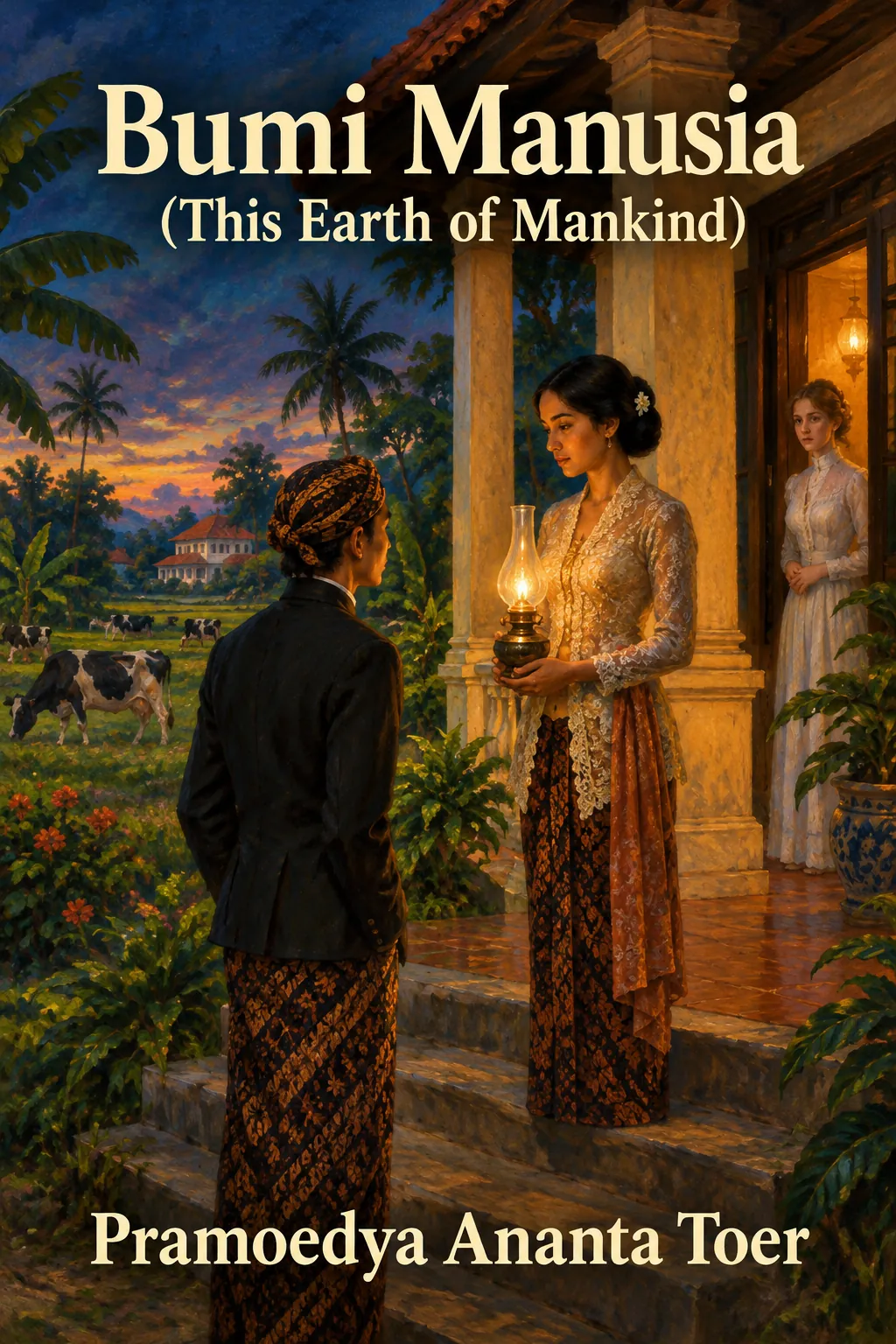
Bumi Manusia (This Earth of Mankind)
Tác giả: Pramoedya Ananta Toer
Bumi Manusia (1980) is the first novel of Pramoedya Ananta Toer's Buru Quartet. It follows Minke, a Javanese student at a Dutch school in Surabaya, who falls in love with Annelies, the daughter of the formidable Nyai Ontosoroh. Through their family he discovers how colonial law ranks people by race, and he starts to find his own voice as a writer. The book asks what justice means when the law itself is unequal.
Ý Tưởng Chính
"At the turn of the twentieth century, a Javanese schoolboy falls in love with the daughter of a remarkable woman and learns that colonial law and European schooling serve power before justice."
Những Hiểu Biết Cốt Lõi
Education is not the same as justice
Minke is proud of his European schooling, yet it cannot protect his family when the law is used against them. The novel suggests that knowledge only becomes valuable when it is joined to fairness. Pramoedya does not reject learning. He asks what a learned person owes to others.
The Dutch court ignores Minke's marriage despite his excellent education.
Law can be a tool of race and rank
The verdict does not ask who loves or raised Annelies. It asks which race and legal status each person holds, and that decides everything. The novel invites readers to look behind a rule and ask whom it protects and whom it leaves out.
Nyai Ontosoroh built the farm and raised her daughter, but the court sees only a native concubine.
Dignity is made by action
Nyai was given a low status, but she created standing for herself through learning, work and courage. Her example shows that dignity is something people defend, not something authority hands out. Even in defeat she keeps her pride and her voice.
She learns Dutch and bookkeeping and then runs the Buitenzorg business.
Writing as resistance
Minke begins as a student who admires Europe and becomes a writer who answers injustice in print. Pramoedya, who wrote the story in prison, makes the pen a form of courage. The novel suggests that clear words can defend people when official routes fail.
Minke answers the attacks on his family with newspaper articles under the pen name Max Tollenaar, with Kommer's help.
Tóm Tắt Chương
Chapter-by-chapter summary
Spoiler warning: this section covers the whole plot, including the ending.
The novel has no numbered chapter titles in this guide, so the story is split into six natural parts.
Part 1: A student at the HBS
Minke is a Javanese pupil at the elite Dutch school in Surabaya and the son of a regent. He writes well in Dutch and is praised by his teacher, Juffrouw Magda Peters, although many European classmates look down on him.
His classmate Robert Suurhof takes him to the house of Nyai Ontosoroh and Herman Mellema in Wonokromo. There Minke meets Annelies, a beautiful, fragile girl, and falls in love at once.
Pramoedya sets the scene in Surabaya, a port city where Dutch officials, Chinese traders, Indo-Europeans and Javanese people live side by side under strict ranks.
Minke's own sense of being modern and educated is the lens through which we first see this world.
This matters because it puts a native schoolboy inside a household that fits no category of the colonial order.
Part 2: Nyai Ontosoroh's story
Minke begins to stay at the Buitenzorg estate. Nyai Ontosoroh tells him how her father handed her to Herman Mellema when she was very young.
She learned Dutch and bookkeeping from Mellema and now runs the dairy business herself, because he has sunk into drink and neglect. Her son Robert Mellema is cold to Minke, while Annelies clings to her mother.
Annelies seems childlike for her age, working in the dairy yet unable to decide much for herself.
The household becomes a second home for Minke, which draws gossip in town.
Her story shows that skill and education can grow outside the official school system.
Part 3: The world of the regent's son
Minke is called home for his father's appointment as regent. In the Javanese court tradition he must crawl before his own father, which is a shock after the equality he enjoys among Europeans.
His father has risen through loyalty to the colonial government, and the son sees that this loyalty has a price.
The ceremony shows that Minke belongs fully to neither world, which explains his restlessness.
This scene sets two hierarchies side by side, feudal and colonial. The novel criticises both.
Part 4: A death and a public humiliation
Herman Mellema is found dead at a brothel run by Ah Tjong. The case goes to court, where Nyai is questioned about her life and treated as a woman with no standing.
The case is also a question of who gets to speak. Nyai refuses to be shamed and answers the judges with calm precision.
Newspapers attack the family. Minke answers with articles published under the pen name Max Tollenaar, helped by his journalist friend Kommer.
The articles bring public attention to Nyai's case, and for the first time he sees readers respond to his words.
Writing becomes his first real weapon.
Part 5: Marriage and a returning claim
Minke and Annelies marry under Islamic rites, with Nyai's blessing. Their happiness is short, because Annelies grows ill and withdrawn.
The marriage gives Minke a sense of adult responsibility. Yet it rests on a ceremony that the colonial court may refuse to recognise.
Then Maurits Mellema, Herman's legitimate son from the Netherlands, appears. He claims the family property and guardianship of Annelies through the Dutch legal system.
Part 6: The ruling
The colonial court recognises only European law. Annelies is a legal minor under her European father's name, Nyai is only a native concubine, and Minke's marriage carries no weight.
Despite help from Jean Marais, Kommer and their allies, the family loses and Annelies is taken away to the Netherlands. Nyai tells Minke that they fought as well and as honourably as they could, a line that turns defeat into dignity.
The trial shows that every character's private virtue counts for nothing against the category written in the law.
The ending is not a victory, yet it leaves Minke with a task: to keep writing and to keep learning from people like Nyai.
That is why the story continues in the next books of the quartet.
Characters
The main figures are Minke, Nyai Ontosoroh, Annelies, Robert Mellema, Jean Marais, Kommer, Herman Mellema and Magda Peters. The character cards on this page describe each one.
Minke is the narrator and a gifted student who admires European learning. His growth from admirer to critic is the main line of the novel.
Nyai Ontosoroh is the moral centre of the book. She turns a position of shame into one of skill and authority, and she refuses to let the court define her.
Annelies is beautiful, gentle and fragile. Her dependence on her mother makes the legal claim on her feel even more cruel.
Robert Mellema rejects his mother's world and feels superior to natives. He shows how the colonial ranking can damage a young person's character.
Jean Marais is a French painter who lost a leg in the Aceh war. He is kind to Minke and treats him as an equal.
Kommer is a journalist of mixed descent who believes in Minke's writing. He helps Minke use the press to answer the attacks on his family.
Herman Mellema is the Dutch planter who bought Nyai and taught her the business. His decline and death set off the legal crisis.
Magda Peters is the HBS teacher who praises Minke's essays. She stands for the part of Europe that values ideas over race.
Historical background
The story takes place around the turn of the twentieth century, when the Dutch East Indies divided people into legal groups, with Europeans at the top and natives at the bottom.
A nyai was a native woman living with a European man without legal marriage, so she had almost no rights over her home or her children.
Pramoedya wrote the novel out of this history. He first told it to fellow prisoners on Buru Island, and it was published in 1980.
Writing about this book
For an essay, start from one clear claim, for example that Nyai Ontosoroh is the moral centre of the novel or that the court scene exposes racial law.
Support the claim with specific events: the sale of Nyai as a girl, Minke's crawl before his father, the verdict on Annelies.
Remember the intrinsic elements: the theme is justice and human dignity under colonialism, the setting is Surabaya at the turn of the twentieth century, and the narrator is Minke in the first person. The message (amanat) is that the educated must be just in thought and deed.
In a review, name the author, year and publisher context, summarise without the ending, and judge strengths and weaknesses fairly. Use the essay samples below to compare, not to copy.
Hành Động Ngay
Các bước thực tế bạn có thể thực hiện ngay hôm nay:
-
Ask who benefits from a rule before you accept it as fair.
-
Use what you learn to protect others, not only to advance yourself.
-
Write down your views clearly, because words can defend a person.
-
Judge people by what they do, not by the status others give them.
Trích Dẫn Đáng Nhớ
"“A person who has been educated must also be just, first in thought and even more so in deed.” (A principle from his teacher Magda Peters that Minke takes to heart; own translation)"
— Pramoedya Ananta Toer
"“We have fought, my child, as well and as honourably as we could.” (Nyai Ontosoroh, final part, own translation)"
— Pramoedya Ananta Toer
Ai Nên Đọc Cuốn Này
Students in Indonesian classes (Kurikulum Merdeka, Fase E-F, roughly ages 16 to 18) and general readers who want a story of colonial Java that is also a love story. It is useful for unsur intrinsik and resensi assignments and for comparing colonial novels across countries.
Về Pramoedya Ananta Toer
Pramoedya Ananta Toer (1925–2006) was an Indonesian novelist born in Blora, Central Java. He was jailed under Dutch rule and again from 1965 to 1979, mostly on Buru Island, where he composed the Buru Quartet that begins with Bumi Manusia. His books were banned in Indonesia for years.
Tóm Tắt Được Viết Bởi

Kỹ sư phần mềm & Nhà văn
Kỹ sư phần mềm với niềm đam mê chuyển đổi ý tưởng phức tạp thành hiểu biết thực tiễn. Viết về tài chính, đầu tư, khởi nghiệp và công nghệ.
Xem tất cả tóm tắt →Đánh Giá
Chưa có đánh giá nào. Hãy là người đầu tiên chia sẻ suy nghĩ của bạn!
Viết Đánh Giá
Đọc tiếp
Khám phá chủ đề: Hướng dẫn học tậpTóm tắt sách
Animal Farm của George Orwell — Tóm Tắt & Phân Tích
George Orwell
Các con vật tại Trang trại Manor nổi dậy chống lại chủ trang trại Jones để xây dựng một xã…

Những Kẻ Ngoài Lề - S.E. Hinton
S.E. Hinton
Câu chuyện xoay quanh Ponyboy Curtis và nhóm bạn Greasers, những thanh niên nghèo bị coi thường bởi nhóm Socs…

Gatsby Vĩ Đại của F. Scott Fitzgerald — Tóm Tắt & Phân Tích
F. Scott Fitzgerald
Thông qua lời kể của Nick Carraway, tác phẩm khắc họa cuộc đời của Jay Gatsby, một triệu phú tự…

Chuột và Người - John Steinbeck
John Steinbeck
Câu chuyện về George và Lennie, hai công nhân lang thang mơ về một mảnh đất riêng. Tuy nhiên, sự…
Bài Viết

Truyện Ông lão đốn tre (Taketori Monogatari)
Truyện ông lão đốn tre (Taketori Monogatari) kể về công chúa Kaguya, cô bé được tìm thấy trong một thân…

Ragnarok: ngày tận thế của các vị thần Bắc Âu
Ragnarök là ngày tận thế trong thần thoại Bắc Âu: một trận chiến cuối cùng, nơi thần, người khổng lồ…
Narcissus và Echo
Narcissus và Echo là thần thoại Hy Lạp về chàng trai đẹp đem lòng yêu chính bóng mình dưới nước,…