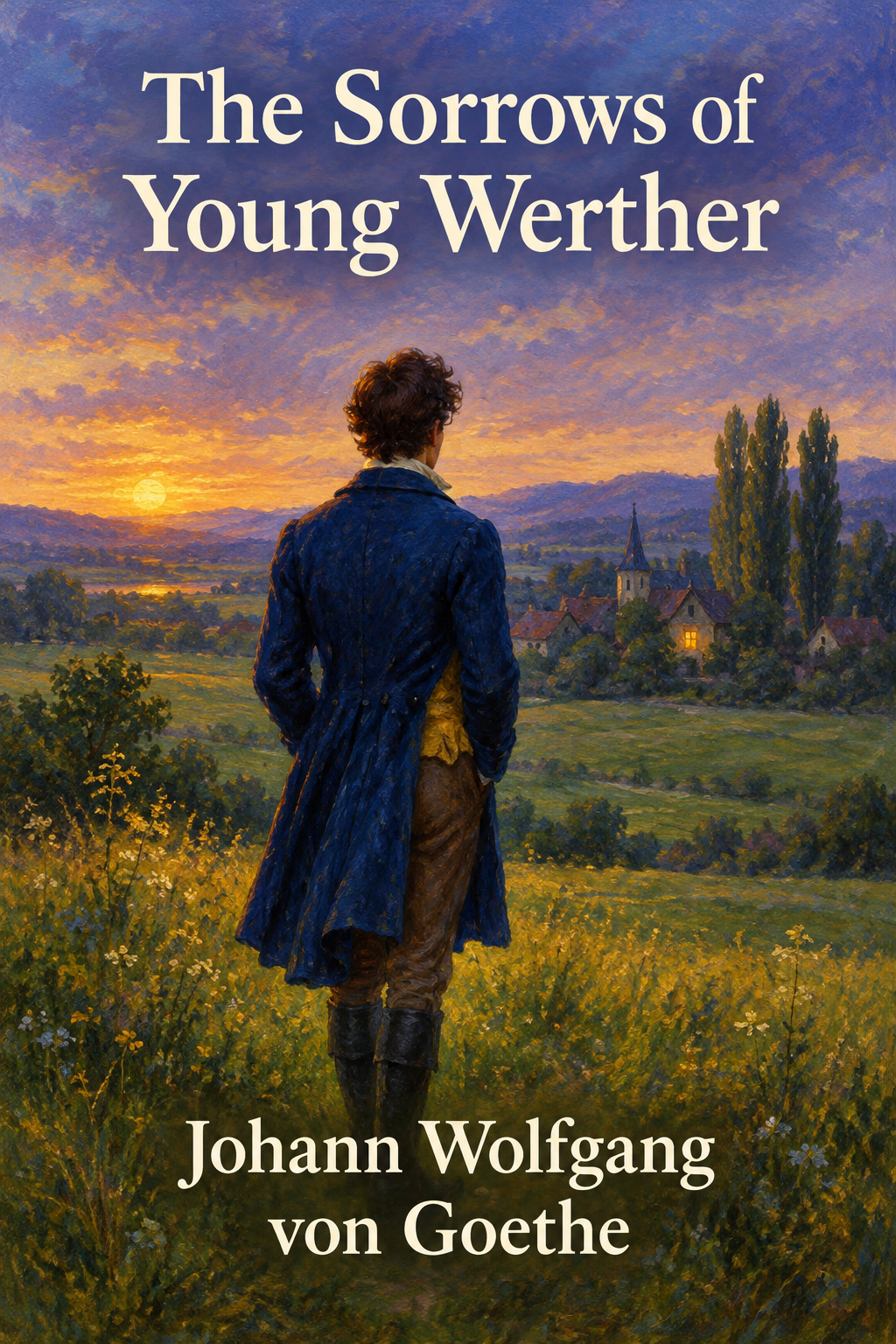
The Sorrows of Young Werther
oleh Johann Wolfgang von Goethe
A young man named Werther moves to a village for the summer and falls for Charlotte, a kind and capable woman who is already engaged to Albert. He pours his feelings out in letters to his friend Wilhelm, and his choices shrink as his longing grows. Between an unhappy love and a diplomatic job with its rigid rules of rank, he runs out of room, and the title hints at where that leads.
Ide Utama
"Goethe's novel asks what happens when deep feeling collides with social rules, and because we see only through Werther's letters, we feel both his passion and the limits of his view."
Wawasan Utama
Feeling against duty
Werther treats his feelings as the highest law, while Charlotte treats her promises as binding. The conflict is not only about who loves whom; it is about what a person owes to others and what a person owes to themselves. This is why the book feels so tense: each side is sure it is right.
Charlotte keeps her promise to her dying mother to look after the household, and she stays with Albert. Werther reads that loyalty as a rejection of him, and his letters grow more absolute.
Rank decides who belongs
In a society built on birth, talent and sincerity are not enough. Werther is intelligent and well liked by ordinary people, yet the nobles treat him as an outsider. The book shows how these rules work quietly in drawing rooms and offices.
At the Count's assembly, Werther is not punished for anything he has done. He is asked to leave because of who he is. That moment pushes him out of his job and closes one more safe place in the story.
Nature as a mirror
Werther does not describe a landscape neutrally. Sunlight, fields and trees become a reflection of his mood, so a beautiful day can lift him and a grey one can pull him down. Reading the scenery is a way of reading his heart.
In the May letters, his joy in the meadows and trees is so strong that it sets the tone for everything that follows. The reader feels the warmth first and the danger only later.
A one-sided story
Everything reaches us through Werther's letters. Wilhelm's replies are never printed, and Charlotte and Albert speak only as Werther reports them. Readers have to decide how much to trust his view, and that is part of the book's power.
When Werther describes a conversation, the reader sees only what he chose to notice. It is worth asking what the other people in it would have said, and how the story would sound from their side. That gap is where most of the discussion happens.
Writing as relief or trap
Werther tries to sort out his feelings by writing to Wilhelm. Yet each letter repeats the same longing, and the words can deepen the feeling as much as they relieve it.
Albert returns at the end of July, and on 3 September Werther decides to leave. Yet the following summer finds him back near Charlotte. The reader must ask whether writing about it eased him or kept him in the same place.
Rincian Bab
Chapter-by-chapter summary
Spoiler warning: this section covers the whole plot, including the ending.
Part 1: Arrival in Walheim (May 1771)
The editor's short preface gives way to Werther's own letters, starting on 4 May. Werther has settled in Walheim, a small village where he is charmed by the meadows, the trees and the plain-spoken people. In his letter of 10 May he admits that he is so content with this quiet life that he is neglecting his talents. Nature in these letters works like a mirror, with sunlight and open fields reflecting his mood, which swings quickly. This matters because the calm happiness at the start makes his later fall feel personal rather than distant.
Part 2: The first meeting (June 1771)
On 16 June, Werther goes to the Bailiff's house to take Charlotte, the Bailiff's daughter, to a dance. Before they leave, he finds her cutting bread for her younger brothers and sisters, and he is struck by her calm and her sense of duty. Since her mother's death, she has run the household, a duty her mother gave her on her deathbed. Charlotte is engaged to Albert, a steady man who is away, but Werther dances with her, and from then on his letters keep returning to her. This matters because the first meeting fixes the central problem: Werther loves someone who is already bound by her promises.
Part 3: Albert returns and Werther resolves to leave (July to September 1771)
In July, Werther writes that he feels as if his soul beats in every nerve of his body. Albert returns to the village at the end of July, and Werther sees clearly that he has no place in Charlotte's life, yet he keeps coming back to her side. On 28 August, which is Werther's birthday, Albert sends him a gift of two volumes of Homer. On 3 September Werther decides to leave the village. On 10 September he writes that he will never see Charlotte again, and he waits for sunrise, when the horses are due to take him away. This matters because his decision turns a hopeless love into a plan of escape, and he takes his feelings with him.
Part 4: The embassy post (Book II, from October)
Book II opens in October, when Werther takes a post with an ambassador whose name is never given. His job is to prepare official papers, and the ambassador sends almost every draft back for revision. Werther finds this maddening and often overrides him, which brings a mild reprimand from the minister in February. Work that depends on other people's approval wears him down, and his letters grow more bitter about the men who decide what counts. This matters because the office is where Werther first meets the fact that effort and talent do not guarantee respect.
Part 5: The Count's assembly and the Prince's court (March to June 1772)
On 15 March, Werther attends the assembly at the house of Count O—. When noble guests arrive, the atmosphere shifts: Werther is not of noble birth, and the company treats him as an outsider. The guests snub him, and the Count quietly asks him to leave. Werther withdraws with courtesy, but the story spreads, and on 24 March he resigns his post. That same month a prince invites him to spend the spring at his country house. The Prince's stay runs from spring until June: in May Werther is with him at a hunting lodge, and in June he writes that he can remain there no longer. Werther had hoped to join the army, but the prince, who is a general, does not approve. Bored by court life, Werther sets out again. This matters because it shows that the rules of rank close doors that talent cannot open.
Part 6: Near Walheim again and the last visits (July to December 1772)
After leaving the Prince in June, Werther wanders through July. By 18 July he admits he wants to be near Charlotte again, and by 29 July he is close enough to watch Albert embrace her, which torments him. On 12 September he kisses Charlotte's hand on her return, and his letters through the autumn describe the strain of being so close to her. On 12 October he writes that Ossian has replaced Homer in his heart. On 8 November Charlotte gently asks him to drink less wine, and he answers that he thinks of her constantly, and she changes the subject. On 4 December, after he is overwhelmed while she plays a favourite tune, Charlotte tells him he is ill and asks him to go and calm himself, so he leaves. On 20 December she asks him not to come before Christmas Eve, yet the next evening he visits her anyway. This matters because Charlotte's wish for distance is the clearest sign that the story has run out of safe options.
Part 7: The final night and the editor's account (21 to 22 December 1772)
On the evening of 21 December, at about half past six, Werther visits Charlotte. She has sent for friends, but none of them come. He reads Ossian aloud, they both weep, and he kisses her. She pushes him away, calls his name several times, and tells him it is the last time. She goes into the next room and locks the door. Through the night Werther writes farewell letters, including a long one to Charlotte and one to Albert asking his forgiveness, and he settles some small debts. Around midnight, he takes his own life. A servant finds him at six in the morning, and he dies at about noon on 22 December. The editor closes the story with a short account of the funeral: the steward, Charlotte's father, and his sons follow the body, Albert cannot attend, and Charlotte's life is despaired of. This matters because the editor's account is brief and does not describe the grief of those left behind, so the reader must weigh the cost of Werther's passion alone.
Characters
- Werther: The narrator and protagonist, a sensitive young man who writes to his friend Wilhelm about his feelings, his work and the landscape around him. He is warm, observant and quick to be moved, but his view of events narrows as the story goes on.
- Charlotte (Lotte): The Bailiff's daughter, who has taken over the household and the younger children after her mother's death. She is kind, capable and honest, and she takes her promises seriously. We see her only as Werther describes her, which is part of what makes her hard to read.
- Albert: Charlotte's fiancé, a steady and sensible man with a government post. He treats Werther with courtesy, even when the situation is painful. Because we see him only through Werther's eyes, it is hard to know what Albert truly feels.
- Wilhelm: Werther's friend and the recipient of nearly every letter. His replies are never printed, so he exists for the reader only through Werther's words. Werther confides in him freely, and the reader hears only one side of that friendship.
- The Bailiff: Charlotte's father, a local official who has been raising a large family since his wife's death. He runs a practical, hospitable household, and the everyday life of the house is the setting for Werther's first encounters with Charlotte.
- Count O—: A nobleman whose dinner party exposes the gap between rank and merit. He is polite to Werther at first, but when noble guests arrive, he quietly asks Werther to leave, and the episode leads Werther to resign.
- The Prince: A noble who invites Werther to spend the spring at his country house. He is a general, and he does not approve of Werther's wish to join the army. Werther soon finds the court life dull and leaves.
- The Ambassador: Werther's superior at the embassy, who is never named in the book. He checks every official paper and sends them back for revision, which is a daily source of Werther's frustration.
Writing about this book
If you are writing a book report, do not retell the plot. Pick one question the book raises and answer it with evidence from the letters. A few questions work well. How much of Charlotte do we actually hear, and what might she say if she had her own letters? Does Werther's love of nature help his judgment or undermine it? How would the story change if the reader could see Albert's side? Choose one, and keep your own view at the centre. Quote briefly and give the date of the letter, which is enough to show you have read closely. Notice also how the letter form works on you: the immediacy of each letter pulls you in, and the lack of a second voice keeps you on his side until you choose otherwise. Your conclusion can say whether you find Werther sympathetic or whether you read him as a warning.
Ambil Tindakan
Langkah praktis yang bisa Anda terapkan hari ini:
-
When one strong feeling starts shaping every decision, write down the facts it leaves out.
-
After reading a one-sided account, imagine how each other person in it would tell the same story.
-
Notice who gets listened to in a room, and whether rank or background is deciding that.
-
Before a big decision, talk it through with someone who will give you a plain, honest answer.
Kutipan Menarik
"“I am so happy, my dear friend, so absorbed in the exquisite sense of mere tranquil existence, that I neglect my talents.” (Book I, 10 May)"
— Johann Wolfgang von Goethe
"“So much simplicity with so much understanding—so mild, and yet so resolute—a mind so placid, and a life so active.” (Book I, 16 June)"
— Johann Wolfgang von Goethe
"“I feel as if my soul beat in every nerve of my body.” (Book I, 16 July)"
— Johann Wolfgang von Goethe
Siapa yang Harus Membaca Ini
Readers aged 15 and up. It suits students of German or world literature, anyone curious about why this novel shook Europe, and readers who enjoy letters, diaries or close inner monologue. The book deals openly with unrequited love, despair and suicide, so readers who find those themes hard should read with care or choose another book first.
Tentang Johann Wolfgang von Goethe
Johann Wolfgang von Goethe (1749–1832) was a German poet, playwright, novelist and scientist, born in Frankfurt and based in Weimar for most of his life. He wrote The Sorrows of Young Werther in 1774, and the novel made him famous far beyond Germany almost overnight. He is also known for Faust.
Ringkasan Ditulis Oleh

Software Engineer & Writer
Software engineer with a passion for distilling complex ideas into actionable insights. Writes about finance, investment, entrepreneurship, and technology.
Lihat semua ringkasan →Ulasan
Belum ada ulasan. Jadilah yang pertama berbagi pemikiran Anda!
Tulis Ulasan
Lanjut membaca
Jelajahi topik: FiksiRingkasan

Out of My Mind
Sharon M. Draper
“Out of My Mind” karya Sharon M. Draper adalah kisah menyentuh tentang kehidupan Melody Brooks, seorang gadis muda penderita cerebral…

Ender’s Game
Orson Scott Card
“Ender’s Game” karya Orson Scott Card adalah novel fiksi ilmiah memikat yang membawa pembaca ke masa depan saat umat manusia…

Pachinko
Min Jin Lee
“Pachinko”, sebuah saga sejarah lintas generasi yang memikat karya Min Jin Lee, mengisahkan perjuangan sebuah keluarga Korea dalam mengarungi gejolak…

The Perks of Being a Wallflower
Stephen Chbosky
The Perks of Being a Wallflower karya Stephen Chbosky adalah novel coming-of-age yang mendalam, dikisahkan melalui surat-surat pribadi Charlie, seorang…
Artikel

Zaman Pencerahan Dijelaskan: Gagasan, Tokoh, dan Warisannya
Zaman Pencerahan adalah gerakan abad ke-18 di Eropa yang menempatkan akal dan bukti di atas tradisi serta otoritas. Para pemikir…

Sejarah Dunia 1700–1918: Revolusi, Industri, Kekaisaran dan Perang
Antara 1700 dan 1918, revolusi, pabrik, kekaisaran, dan perang dunia membentuk ulang masyarakat di Eropa, Amerika, Asia, dan Afrika. Panduan…

Tema A Christmas Carol: kemurahan hati, isolasi dan tanggung jawab
Novela Dickens biasanya dibaca sebagai kisah seorang pria yang mengubah pikirannya. Tema-temanya lebih tajam dari itu: kemurahan hati sebagai praktik,…