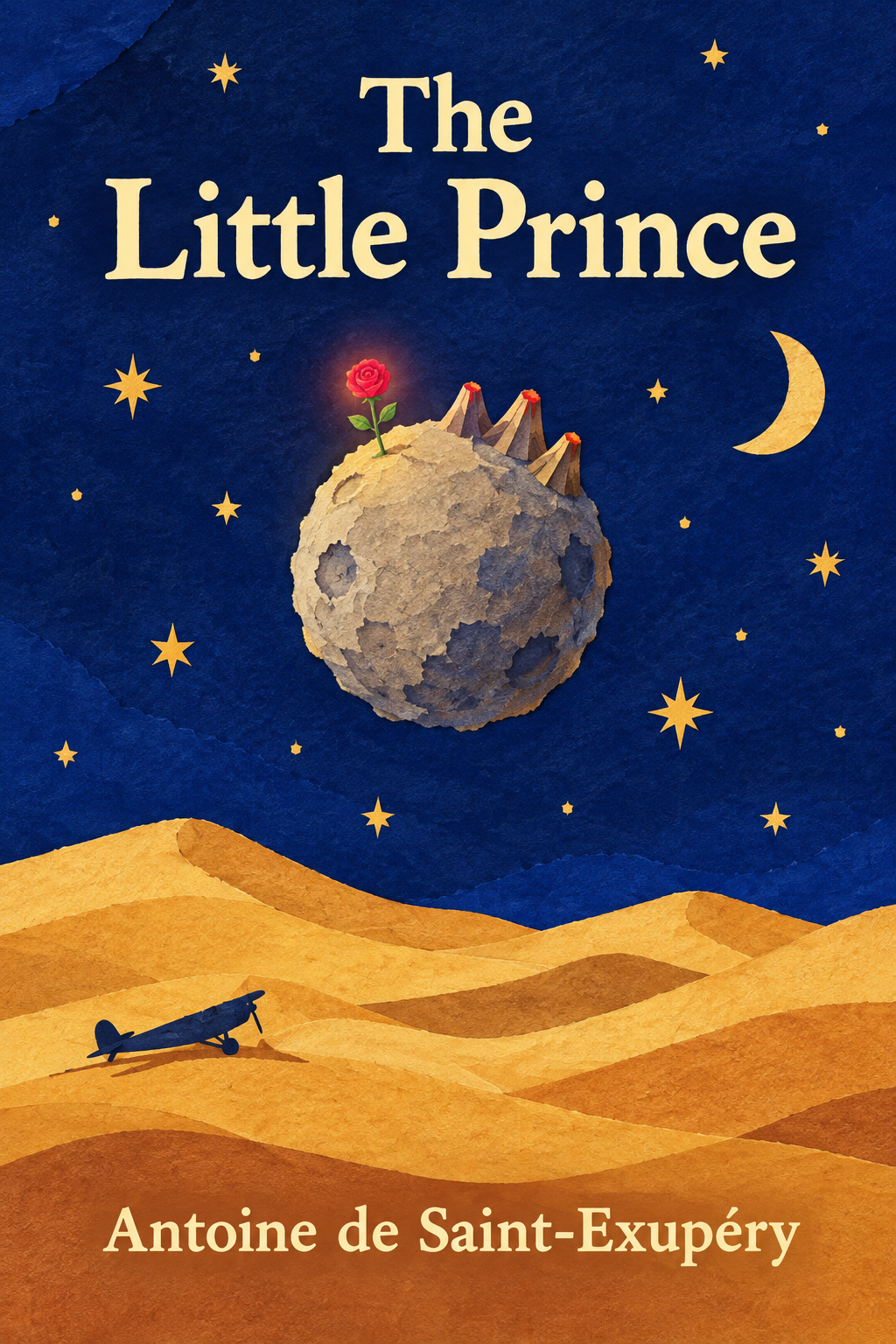
The Little Prince
oleh Antoine de Saint-Exupéry
The Little Prince is a short novella about a pilot whose plane breaks down in the Sahara Desert. There he meets a boy from a tiny planet who asks him to draw a sheep, and the two talk about the planets the boy has visited and the rose he left behind. Through a fox, the boy learns what it means to build a bond, and the book asks what grown-ups forget about love, friendship and responsibility.
Ide Utama
"The Little Prince argues that grown-ups lose sight of what matters because they count and own things, while real love means taming someone patiently and taking responsibility for them."
Wawasan Utama
Seeing with the heart
The book argues that the most important things cannot be counted or owned. Grown-ups rely on numbers, labels and titles, while the boy notices feelings and small details. The lesson is not that adults are bad, but that they can lose sight of what matters, and the fox’s secret is that what matters most cannot be picked out by sight alone.
The businessman counts the stars and writes the total on paper, believing that counting makes them his. He never asks what the stars mean to anyone, or what they might mean to him.
Taming means responsibility
The fox explains that a bond grows through time and patience. Once you have tamed someone, you become responsible for them, and that responsibility is a form of love. The idea applies to friends and family just as well as to a small planet, which is why the boy never forgets his promises.
The boy finds that his rose is special, though a garden holds five thousand roses, because of the time and care he has given her. He later says that he is responsible for her, and he repeats it to himself as a reminder.
Words and actions
The rose speaks sharply, and the boy is hurt again and again. The book suggests that words can hide pride or shyness, while daily actions show the truth more reliably. Judging someone only by their harshest words can cost you the thing you care about most.
After the quarrel, the boy regrets that he did not judge his rose by what she did, such as the scent and light she gave him, rather than by what she said. He leaves, and only later understands what he has lost.
Rincian Bab
Chapter-by-chapter summary
Spoiler warning: this section covers the whole plot, including the ending.
Part 1: The drawing and the desert
Chapter 1. As a six-year-old, the pilot drew a boa constrictor that had swallowed an elephant. Grown-ups saw only a hat, so he gave up drawing and studied geography, history, arithmetic and grammar instead. As a pilot he still shows the drawing, and most people still see a hat. Grown-ups, he says, prefer talk of bridge, golf and ties. The chapter sets up the book’s first lesson: a child and an adult can look at the same picture and see different things.
Chapter 2. The pilot’s plane breaks down in the Sahara, far from anyone, with barely enough water for eight days. The first morning a small voice asks him to draw a sheep, and he is astonished to find a boy in the desert. His first drawing is too sick, the second has horns and is a ram, and the third is too old. Impatient to get back to his engine, he draws a box with air holes and says the sheep is inside. The boy’s face lights up: that is exactly the sheep he wanted. The friendship starts not with good drawing but with imagination, as the boy accepts a sheep nobody can see.
Chapter 3. The boy asks many questions but rarely answers the pilot’s. Little by little, from chance remarks, the pilot learns that the boy comes from somewhere else. Seeing the plane, the boy asks whether the pilot fell from the sky, then asks which planet he comes from. The boy says the box will be the sheep’s house at night. When the pilot offers a rope and a stake to tie it by day, the boy is surprised. Where he lives, he says, everything is so small that going straight ahead gets you nowhere, so the sheep needs no rope. These small clues about his home open the mystery that carries the reader through the rest of the story.
Part 2: Life on the small planet
Chapter 4. The pilot concludes that the boy’s planet is barely bigger than a house, and that it must be asteroid B-612. A Turkish astronomer saw it only once, through a telescope, in 1909. At an international congress nobody believed him because of his costume. He tried again in 1920, dressed in European clothes, and everyone agreed. The pilot tells this to show how grown-ups love numbers. Told about a new friend, they ask his age, his brothers and his father’s income, but never what his voice sounds like or which games he loves.
Chapter 5. On the third day the boy asks whether sheep eat shrubs, and then whether they eat baobabs. The pilot explains that baobabs grow as big as churches and that a herd of elephants could not finish one. The boy replies that baobabs begin small. Left alone, their seeds split a small planet apart. So every morning, after washing, the boy pulls up the young shoots. He calls it a question of discipline: tedious but very easy. He asks the pilot to draw a warning for children on Earth. The boy’s small daily habit shows that protecting something big begins with ordinary, repeated actions.
Chapter 6. On the fourth morning the boy says he loves sunsets and wants to watch one. The pilot says you must wait for the sun to set. The boy laughs and says he always feels at home. On Earth sunsets are far away, but on his tiny planet he only has to move his chair a few steps. Once he watched the sun set forty-three times in a single day. When the pilot asks whether he was very sad that day, the boy does not answer, but says that when someone is very sad, sunsets become dear to them. This is the first hint of sadness in the story, and it shows the loneliness beneath the boy’s calm.
Chapter 7. On the fifth day the boy asks whether a sheep that eats shrubs also eats flowers, even thorny ones. The pilot, busy with a stuck bolt on his engine, brushes him off: thorns are pointless and cruel. The boy says flowers are weak and naive and only pretend to be fierce. The pilot snaps that he is a serious man who does not think about flowers. The boy calls him a grown-up who mixes everything up. Then he speaks of a conceited gentleman who never smells a flower, and he begins to weep. The pilot holds him and promises a muzzle for the sheep and armour for the flower. The pilot’s busy mind misses what the boy feels, and the tears show how much the flower means to him.
Chapter 8. The boy describes the rose he loved. She grew from a seed of unknown origin, and he watched her closely. She took days to dress, choosing colours and arranging each petal, then announced that she had just woken and was still untidy. She is vain and demanding, and her sharp words often hurt him. Only later does he understand that he should have judged her by what she did, not by what she said, and that he should not have run away. Flowers are contradictory, he says, but he was too young to love her well. This regret quietly shapes the rest of his journey.
Chapter 9. The boy leaves with a flock of wild migrating birds. Before he goes, he cleans his three volcanoes, the extinct one included, and pulls up the last baobab shoots. He waters the rose and prepares to cover her with her glass globe, then feels like weeping. When he says goodbye, she first says nothing. Then she admits she was foolish, asks his forgiveness, and tells him to be happy. She says she loves him, that he did not know it through her fault, and that she does not want him to see her cry. This is the first time she says she loves him, and his departure is shaped by a love that was never spoken plainly.
Part 3: Six asteroids
Chapter 10. The first asteroid is home to a king in purple and ermine, seated on a simple but majestic throne. He calls the boy a subject, since to kings all men are subjects. He orders the boy to yawn, then to sit, but the royal robe covers the whole planet, so the boy stays standing. The king claims to rule everything, even the stars. When the boy asks for a sunset, the king says he will allow one at about 7:40 that evening, once conditions are right. The boy gives up on the king and moves on. The king shows a kind of power that depends entirely on giving orders, with no real connection to anyone.
Chapter 11. The second asteroid belongs to a vain man, who calls out that an admirer has come. To vain men, every other man is an admirer. To admire, he explains, is to agree that he is the handsomest, best-dressed, richest and cleverest man on the planet. The boy claps, and the vain man bows again and again, lifting his hat. Puzzled that anyone needs so much praise, the boy leaves. The visit shows how someone living only for applause has nobody to talk to but an audience. Pride, the chapter shows, is a lonely place with no one to speak to.
Chapter 12. The third asteroid is home to a drinker, sitting in silence before a row of empty bottles and a row of full ones. Why do you drink? the boy asks. To forget, the drinker says. To forget what? To forget that I am ashamed. Ashamed of what? Of drinking. The boy cannot follow this logic and leaves, sad. The chapter shows how a habit can become a trap: shame leads to drinking, and drinking brings more shame, a loop the drinker cannot see clearly from inside.
Chapter 13. The fourth asteroid belongs to a businessman so busy with sums that he hardly looks up. He reels off a count of more than five hundred million stars. He says he owns them. Kings rule, the boy says, they do not own. Owning, the businessman replies, means being the first to think of it. He writes the number on a small paper and locks it in a drawer. The boy has a flower he waters every day and three volcanoes he cleans. Owning them is useful to them, he says, but the businessman is of no use to the stars, and the man has no answer. A quiet question follows: what does owning something actually give you?
Chapter 14. The fifth asteroid is the smallest of all, with room for one street lamp and one lamplighter. The lamplighter lights the lamp at night and puts it out in the morning, as his orders say. The planet now spins so fast that he must light and extinguish the lamp every minute. He never rests, yet he keeps his order without complaint. The boy admires him and offers to help him rest, but the lamplighter says the rule is the rule. Of the king, the vain man, the drinker and the businessman he has met, only the lamplighter does not seem absurd to him. The lamplighter’s steady duty sharpens the question of what a duty is worth.
Chapter 15. The sixth asteroid is ten times larger and is home to an old geographer who writes enormous books. A geographer, he explains, knows where seas, rivers, towns, mountains and deserts are. Yet when the boy asks about oceans, mountains and towns, the geographer does not know, because he never travels and only writes down explorers’ reports. The boy mentions his flower, and the geographer replies that flowers are not recorded because they are short-lived. The boy realises that his rose may vanish, and he asks where to go next. The geographer recommends Earth. The geographer writes about the world without visiting it, so he sends the boy toward Earth, where real people can be met.
Part 4: Earth and the desert
Chapter 16. The seventh planet is Earth, which the narrator describes with playful counts: 111 kings, 7,000 geographers, 900,000 businessmen, 7.5 million drunkards and 311 million vain people, about two billion grown-ups in all. He recalls the army of 462,511 lamplighters who once lit the lamps of the six continents. Seen from afar, their turns resembled an opera ballet. Only the lamplighters of the North and South Poles, each with a single lamp, lead lazy lives. The chapter widens the view from a few small planets to the whole human world.
Chapter 17. The narrator admits he has exaggerated, since people take up very little room on Earth. All two billion could stand on a small Pacific island. On landing in the African desert, the boy meets a snake the colour of moonlight, thin as a finger. There is nobody in the deserts, the snake says. The Earth is big. The boy sits on a stone and looks up at his planet, far above. The snake says it can carry him farther than a ship, and that whomever it touches, it returns to the earth they came from. It always speaks in riddles. Here the boy sees how far he still is from the people he seeks, which deepens his loneliness.
Chapter 18. Walking on, the boy finds a flower with three petals, a plain little thing. He asks where the people are. She says a caravan once passed, and that six or seven people may exist, though nobody knows where to find them. The wind carries them wherever it likes, and since they have no roots, life is hard for them. The boy says goodbye, and the flower says goodbye too. The brief scene shows how far from home the boy has come and how little he has learned about the people of Earth.
Chapter 19. The boy climbs a high mountain. The only mountains he knows are his three volcanoes, which reach his knee, and he uses the extinct one as a stool. From this height, he thinks, he will see the whole planet and every person on it. Instead he sees only needle-sharp rock. He calls out hello, and the echo answers hello, hello, hello. He says he is alone, and the echo says alone. He decides that this planet is dry, pointed and salty, and its people lack imagination: they only repeat what they are told. His own flower, he recalls, always spoke first. The echo answers without understanding, and the boy misses the rose who always spoke first.
Chapter 20. After a long walk over sand, rock and snow, the boy finds a road, and roads lead to people. He comes to a garden full of roses. They tell him they are roses, and he is stunned: they look just like his flower. She had told him she was the only one of her kind in the universe, yet here are five thousand identical roses in one garden. He lies down in the grass and weeps. He imagines his flower furious, pretending to die to escape ridicule. He realises he owns only an ordinary rose and three volcanoes that reach his knee. He must now measure what is truly special to him against thousands of identical roses.
Part 5: The fox and the travellers
Chapter 21. The boy asks the fox to play, since he feels very unhappy. The fox says he cannot play, because he is not tamed, and asks the boy to tame him. Taming means creating ties, the fox explains. To the fox, the boy is only one of a hundred thousand little boys, but once tamed they will each be unique to the other. The fox asks him to come back at the same hour each day, since rituals make one day special. Then the fox shares a secret: the things that matter most cannot be picked out by sight alone. Whoever tames something is responsible for it forever. The fox turns the book’s central question into a simple promise about how bonds are made.
Chapter 22. The boy meets a railway switchman, who sorts travellers by the thousand and sends trains left or right. Brightly lit express trains thunder past. The switchman says even the engine driver does not know what the passengers are looking for. Another lit train passes in the opposite direction. Are they coming back already? the boy asks. It is an exchange, the switchman says, and nobody is ever content where they are. The passengers only sleep or yawn. Only children press their noses against the windows, and the boy sees that children alone know what they seek.
Chapter 23. Next the boy meets a merchant who sells pills that quench thirst. One pill a week, and you no longer feel the need to drink. Experts have calculated that the pills save fifty-three minutes a week, the merchant explains. What do people do with those minutes? Whatever they like, he says. The boy thinks that with fifty-three minutes to spare, he would stroll slowly to a fountain. The merchant is pleased with his trade, but the boy sees that what matters is not how much time you save, but what you do with it.
Part 6: The well and the goodbye
Chapter 24. The pilot’s plane has been broken for eight days, and his last drop of water is gone. He says he would be glad to stroll towards a fountain. The boy says they must look for a well. They walk for hours in silence, and when night falls the pilot, feverish with thirst, sees the stars as in a dream. The boy asks if he is thirsty too, and says water can be good for the heart. The desert is beautiful, he adds, because it hides a well somewhere. He falls asleep, and the pilot carries him through the night and finds the well at dawn. The practical pilot, who has been so sensible all week, now trusts the boy’s hope that a hidden well exists.
Chapter 25. At the well, the pilot is surprised: it looks like a village well, though no village is in sight. The boy turns the pulley, which groans like an old weathervane after a long sleep, and says the well is singing. The pilot draws water and holds the bucket to the boy’s lips. The boy says people on Earth grow five thousand roses in one garden and still do not find what they seek, which could be found in one rose or a little water. The eyes cannot find what really matters; the search must go deeper. He reminds the pilot of the promised muzzle, since he is responsible for his flower. Tomorrow is the anniversary of his fall to Earth, near this place. He sends the pilot back to the engine and asks him to return the next evening. The boy’s words now sound like a farewell.
Chapter 26. The next evening the pilot sees the boy sitting on an old stone wall beside the well, speaking with someone else. Yellow as gold, a snake lies at the foot of the wall. The pilot runs toward him, but the snake slides into the sand and vanishes between the stones. He catches the boy in his arms, pale as snow. The boy says he is going home, which is much farther and harder. He promises that when the pilot looks up at the stars, they will seem to laugh. Then he asks him not to come that night. He walks away quietly. Near his ankle there is a flash of yellow, and he falls, gently, like a tree, without a sound. The pilot cannot move. The quiet farewell becomes final at this moment.
Chapter 27. Six years later, the pilot still has not told the story often. His friends were glad to see him alive, and he told them he had only been tired. He is a little comforted, though not fully. He believes the boy went home, because at dawn he did not find the body. He likes to hear the stars at night, which sound to him like five hundred million little bells. But one worry remains: he forgot to add the leather strap to the muzzle, so the boy could never fasten it. Did the sheep eat the flower? He asks readers who ever visit the Sahara to wait under a star, and if a golden-haired child appears, to write and tell him the boy has come back. The book ends with a question left open, so the reader carries the friendship forward.
Characters
- The pilot. An adult pilot whose plane breaks down in the Sahara. As a child he drew a boa swallowing an elephant, and years later he tells the story, still missing his friend. He is a grown-up who still remembers how a child sees.
- The little prince. A boy from a tiny planet who asks for a sheep. He travels through six asteroids and Earth, learns about love from a fox, and cares deeply for his rose even when she hurts him.
- The rose. The boy’s flower at home. She is vain and demanding, and her sharp words hurt him, yet she perfumes and brightens his small planet. Her apology and her confession show that she loves him.
- The fox. A wise animal the boy meets on Earth. He asks to be tamed, and explains that a bond is built through time, patience and care. He is the book’s teacher about friendship.
- The snake. A mysterious snake the boy meets in the desert. It speaks in riddles, says the Earth is big, and returns to the earth whoever it touches. It appears again near the end of the book.
- The businessman. An asteroid dweller who says he owns the stars, counts them and locks the numbers in a drawer. He shows the difference between owning something and caring for it.
Writing about this book
A useful way to write about The Little Prince is to choose one moment that surprised you and ask why the boy reacted as he did. The sheep in the box, the rose’s apology or the lamplighter’s endless duty all offer good starting points.
Consider these questions. Who do you think is the wisest character, and why? Which grown-up in the book reminds you of someone you know? What would you say to the pilot when he gives up drawing?
When you write, connect the book to your own life: a friend you have grown close to over time, a habit you keep for someone else, or a moment when you judged a person by what they did rather than what they said. Quote briefly, and put ideas into your own words wherever you can. Aim for your own argument, not a summary of the plot.
Ambil Tindakan
Langkah praktis yang bisa Anda terapkan hari ini:
-
Look at the time you spend on a relationship, not only at the things you own.
-
When someone’s words hurt, look at what they have done before you judge them.
-
Ask a grown-up what matters to them, not only about numbers and results, and listen to the answer.
-
Before rushing ahead, ask what you are rushing towards and whether it matters to you.
Kutipan Menarik
"When someone is very sad, sunsets become dear to them. (Chapter 6)"
— Antoine de Saint-Exupéry
"I should have judged her by her deeds, not by her words. (Chapter 8)"
— Antoine de Saint-Exupéry
"He alone does not seem absurd to me. (Chapter 14)"
— Antoine de Saint-Exupéry
Siapa yang Harus Membaca Ini
Readers aged about nine and up, and adults who want to reread a classic slowly. It suits students looking for a book report theme, parents reading with children, and anyone who wants a short, gentle book about friendship, responsibility and what grown-ups forget.
Tentang Antoine de Saint-Exupéry
Antoine de Saint-Exupéry (1900–1944) was a French writer and pilot who flew mail routes and wrote about the air and the desert. His novel Night Flight, published in 1931, drew on that work. The Little Prince first appeared in 1943, with the author's own drawings. He disappeared on a reconnaissance flight over the Mediterranean in 1944, during the Second World War.
Ringkasan Ditulis Oleh

Software Engineer & Writer
Software engineer with a passion for distilling complex ideas into actionable insights. Writes about finance, investment, entrepreneurship, and technology.
Lihat semua ringkasan →Ulasan
Belum ada ulasan. Jadilah yang pertama berbagi pemikiran Anda!
Tulis Ulasan
Lanjut membaca
Jelajahi topik: FiksiRingkasan

Out of My Mind
Sharon M. Draper
“Out of My Mind” karya Sharon M. Draper adalah kisah menyentuh tentang kehidupan Melody Brooks, seorang gadis muda penderita cerebral…

Ender’s Game
Orson Scott Card
“Ender’s Game” karya Orson Scott Card adalah novel fiksi ilmiah memikat yang membawa pembaca ke masa depan saat umat manusia…

Pachinko
Min Jin Lee
“Pachinko”, sebuah saga sejarah lintas generasi yang memikat karya Min Jin Lee, mengisahkan perjuangan sebuah keluarga Korea dalam mengarungi gejolak…

The Perks of Being a Wallflower
Stephen Chbosky
The Perks of Being a Wallflower karya Stephen Chbosky adalah novel coming-of-age yang mendalam, dikisahkan melalui surat-surat pribadi Charlie, seorang…
Artikel

Zaman Pencerahan Dijelaskan: Gagasan, Tokoh, dan Warisannya
Zaman Pencerahan adalah gerakan abad ke-18 di Eropa yang menempatkan akal dan bukti di atas tradisi serta otoritas. Para pemikir…

Sejarah Dunia 1700–1918: Revolusi, Industri, Kekaisaran dan Perang
Antara 1700 dan 1918, revolusi, pabrik, kekaisaran, dan perang dunia membentuk ulang masyarakat di Eropa, Amerika, Asia, dan Afrika. Panduan…

Tema A Christmas Carol: kemurahan hati, isolasi dan tanggung jawab
Novela Dickens biasanya dibaca sebagai kisah seorang pria yang mengubah pikirannya. Tema-temanya lebih tajam dari itu: kemurahan hati sebagai praktik,…