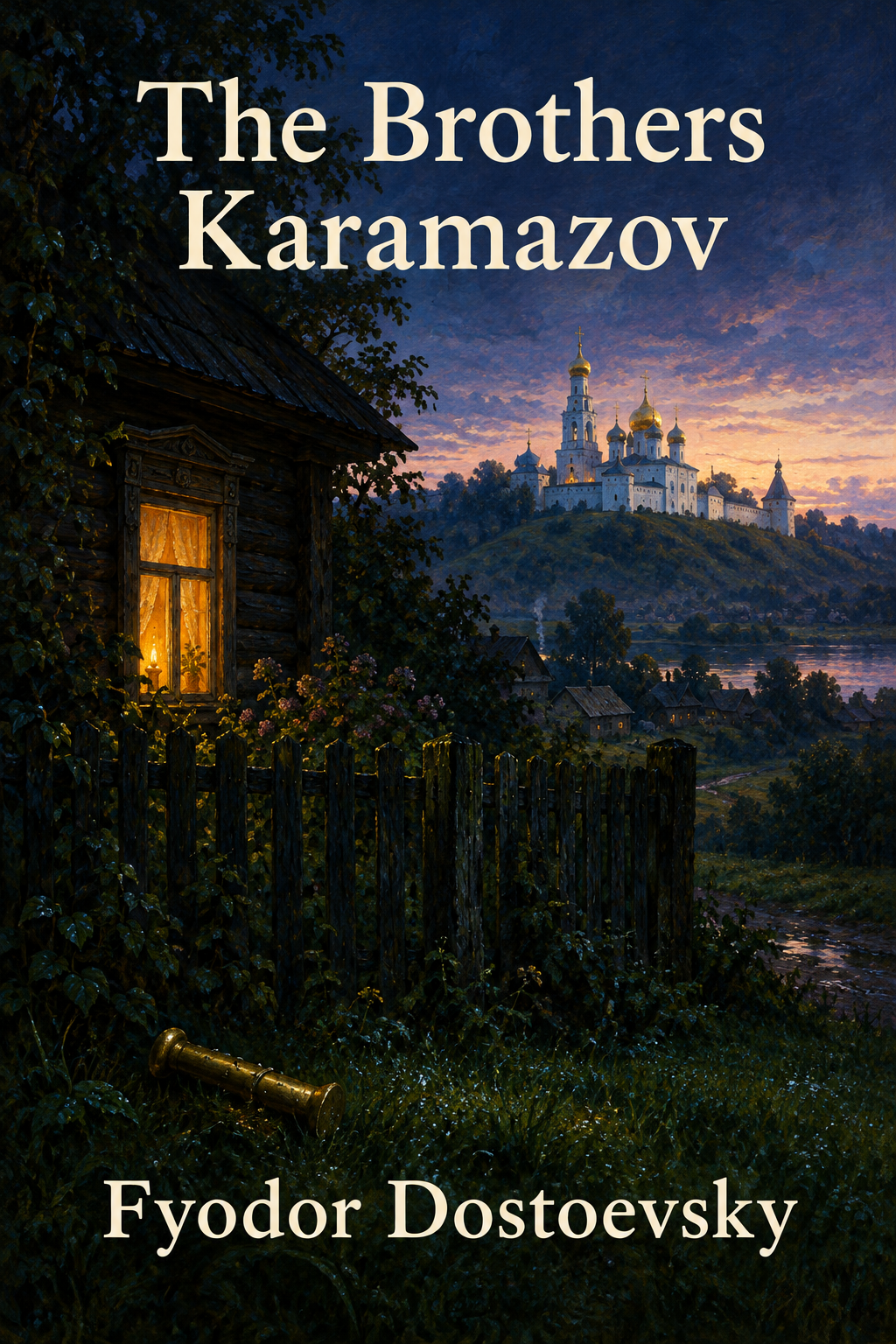
The Brothers Karamazov
oleh Fyodor Dostoevsky
The Brothers Karamazov is a murder story about a selfish, mocking father and his three very different sons. Dmitri is passionate and reckless, Ivan is a brilliant sceptic, and Alyosha is a gentle novice at the local monastery. Dmitri and his father fight over money and over the same woman, Grushenka, until the old man is found dead and Dmitri is charged. Around the crime, Dostoevsky stages big arguments about faith, doubt, suffering and whether people are responsible for one another.
Ide Utama
"Three brothers and their father are pulled into a murder case that tests what people believe about God, freedom and guilt. The book argues that each person is responsible for others, and that love has to be lived, not just imagined."
Wawasan Utama
Faith tested by suffering
The novel never makes belief easy. Ivan's case against God rests on the suffering of innocent children, and Dostoevsky gives it full force instead of handing him a weak argument. The reply does not come as a counter-argument. It comes through Zosima's life and Alyosha's choices, which suggest that faith is something you live, not something you prove.
Ivan's “Rebellion” in Book 5 is not answered in the same conversation. The answer comes later, in Zosima's life story in Book 6 and Alyosha's vision of Cana in Book 7.
Freedom and its burden
In “The Grand Inquisitor”, the cardinal claims that most people cannot bear freedom and would gladly trade it for bread, wonders and someone to obey. The book argues that freedom, painful as it is, is what makes love and goodness real. Many characters try to get out of choosing for themselves, and they escape into drink, pride or someone else's ideas.
Smerdyakov acts on Ivan's ideas instead of his own conscience. What follows is a murder, a suicide and an innocent man convicted.
Everyone is responsible for everyone
Zosima teaches that each person shares the guilt for the wrongs of others. That sounds unfair at first, but the plot puts it to the test. Dmitri did not kill his father, yet he accepts suffering. Ivan did not strike the blow, yet he comes to see his part in it. In this book, guilt is a moral question before it is a legal one.
In Book 9, as the evidence turns against him, Dmitri dreams of a crying baby and wakes wanting to suffer for people like that child.
Love in action, not in dreams
Zosima warns that real love is harder and less pleasant than the love we imagine. Characters who love humanity in theory often fail the person standing in front of them. The novel's hope lives in small, concrete acts: an onion given to a beggar, a visit to a sick child, an apology made in time.
Alyosha's patient work with the schoolboys in Book 10 leads to his speech at the stone in the epilogue, where their kindness to Ilyusha becomes a memory they all share.
Rincian Bab
Chapter-by-chapter summary
Spoiler warning: this section covers the whole plot, including the ending.
The novel has four parts made up of twelve books, followed by an epilogue. Here is what happens in each book.
Book 1: The History of a Family
Fyodor Pavlovich Karamazov is a greedy landowner and a buffoon in a small Russian town. His first wife runs away and leaves him with their son Dmitri. His second wife, a timid young woman, gives him Ivan and Alexei, called Alyosha, and then dies. Fyodor ignores all three boys, so the servant Grigory and various relatives bring them up. Years later the sons come back to town. Dmitri, a former army officer, wants money he believes his father owes him. Ivan has made a name for himself as a writer. Alyosha, aged twenty, has joined the town monastery as a novice under the elder Zosima. Why it matters: the family's broken past sits underneath every later quarrel.
Book 2: An Unfortunate Gathering
To settle the money dispute between Dmitri and Fyodor, the family meets in Zosima's cell at the monastery. Fyodor turns the visit into a show, clowning and insulting everyone. Zosima stays calm and tells him to stop lying to himself. The guests discuss Ivan's article on church courts, and someone reports his view that if people stopped believing in immortality, nothing would count as wrong any more. Dmitri arrives late and the meeting falls apart in shouting. Before it ends, Zosima kneels and bows to the ground in front of Dmitri, which shakes everyone. Why it matters: the elder seems to sense the suffering ahead, and Ivan's idea becomes the moral fuse of the novel.
Book 3: The Sensualists
We meet the servants: old Grigory, his wife Marfa, and Smerdyakov, the sullen cook. Smerdyakov's mother was a homeless, simple-minded woman, and the town believes Fyodor is his father. In a garden, Dmitri pours out his heart to Alyosha. He is engaged to the proud Katerina Ivanovna but has fallen for Grushenka, and he has spent 3,000 roubles that Katerina asked him to send on for her. That evening Dmitri bursts into his father's house, sure Grushenka is there, and beats the old man. At Katerina's home, Grushenka mocks and humiliates her rival. Why it matters: motive, money and jealousy are now all on the table.
Book 4: Lacerations
Zosima is close to death. Sent into town on errands, Alyosha finds schoolboys throwing stones at a thin, sick boy named Ilyusha, who then bites Alyosha's finger. The reason soon comes out: Dmitri once dragged Ilyusha's father, the poor ex-captain Snegiryov, out of a tavern by his beard while the boy begged him to stop. Katerina announces that she will stay loyal to Dmitri whatever happens, even though Ivan loves her. Alyosha takes Snegiryov 200 roubles from Katerina. The captain is tempted, then grinds the notes into the ground out of pride. Why it matters: each scene shows people wounding themselves through pride, which is what the title means.
Book 5: Pro and Contra
Lise, a teenage girl who uses a wheelchair, has sent Alyosha a love letter, and they half-seriously agree to marry. In a tavern, Ivan talks openly with Alyosha for the first time. He says he accepts God but not God's world, because nothing can justify the suffering of innocent children, so he returns his ticket. He then tells his prose poem “The Grand Inquisitor”: Christ comes back to sixteenth-century Seville, and an old cardinal arrests him, arguing that people want bread, miracles and authority, not freedom. Afterwards Smerdyakov hints that Ivan should leave town, and Ivan goes to Moscow. Why it matters: this is the strongest case against faith anywhere in the novel.
Book 6: The Russian Monk
Alyosha writes down Zosima's last talks and the story of his life. As a young man Zosima was an arrogant army officer. His brother Markel, who died young, had taught him that every person is guilty before all others. The lesson came back to him on the morning of a duel: he let his opponent fire first, then refused to shoot and asked forgiveness. Later he became a monk. His teaching is gentle and practical: love all of creation, do not judge, and take responsibility for other people's sins. Zosima dies that evening. Why it matters: this book is Dostoevsky's answer to Ivan, given as a life rather than an argument.
Book 7: Alyosha
Everyone expects a miracle around Zosima's body. Instead it begins to smell of decay unusually soon, and the elder's enemies in the monastery gloat. Alyosha is crushed. In this mood he lets his cynical friend Rakitin take him to Grushenka, who has been planning to seduce him. When she hears that Zosima has died, she treats Alyosha tenderly and tells a folk tale about an onion: one small kindness that might pull a sinner out of hell. Back at the monastery, as the Gospel story of the wedding at Cana is read over the coffin, Alyosha dreams of Zosima, then goes outside and kisses the earth. Why it matters: Alyosha's faith survives by passing through doubt.
Book 8: Mitya
Dmitri is desperate to find 3,000 roubles to repay Katerina and start a new life with Grushenka. He begs the merchant Samsonov, chases a timber dealer to a village only to find him dead drunk, and asks Madame Khokhlakova, who tells him to go and look for gold. Afraid that Grushenka has gone to his father, he creeps into Fyodor's garden at night carrying a brass pestle. As he runs away, Grigory catches hold of him, and Dmitri knocks him down. Later Dmitri turns up covered in blood and holding a wad of money, then races to the village of Mokroye, where Grushenka is meeting her former Polish lover. She turns from the Pole to Dmitri, and then the police arrive. Why it matters: the reader sees everything except the murder itself.
Book 9: The Preliminary Investigation
Officials question Dmitri through the night. He admits hitting Grigory, who has survived, but swears he did not kill his father. At last he confesses where his money came from. He had spent half of Katerina's 3,000 roubles weeks earlier and sewn the other 1,500 into a small bag around his neck, as proof that he was not quite a thief. That night he tore it open. But Grigory says the door from the house to the garden was open, and that makes Dmitri's story look like a lie. Worn out, Dmitri dozes and dreams of a burned-out village, a poor mother and her crying, hungry baby. He wakes wanting to suffer for people like them. Why it matters: his moral rebirth begins at the moment his legal position collapses.
Book 10: The Boys
Later that autumn the story turns to the schoolboys. Kolya Krasotkin, a clever, show-off boy of about thirteen, has stayed away from the dying Ilyusha since a quarrel. Ilyusha is tormented by the belief that he killed a dog called Zhuchka by feeding it bread with a pin inside, a cruel trick Smerdyakov taught him. Alyosha has quietly brought the other boys back to Ilyusha's bedside. When Kolya finally visits, he brings a dog, and it is Zhuchka: alive, renamed and trained to do tricks. Ilyusha is overjoyed, but the doctor makes it clear that he will not recover. Why it matters: on a small scale, the children act out the novel's ideas about guilt, cruelty and forgiveness.
Book 11: Ivan
Ivan has come back from Moscow and is falling ill. Alyosha tells him that he, Ivan, did not kill their father. Ivan visits Smerdyakov three times. At the last visit Smerdyakov confesses that he killed Fyodor himself and took the money, but he insists Ivan is the real murderer: Ivan taught him that without God everything is permitted, then left town guessing what might happen. Smerdyakov hands him the 3,000 roubles. That night a feverish Ivan argues with a shabby, mocking devil who seems to come from inside his own mind. Then Alyosha arrives with the news that Smerdyakov has hanged himself. Why it matters: Ivan's ideas have consequences, and he must face his share of the guilt.
Book 12: A Judicial Error
The trial draws crowds from all over Russia. Ivan, close to collapse, holds up the money and says Smerdyakov killed their father and that he, Ivan, put him up to it. But he starts raving about the devil, and nobody believes him. Frightened for Ivan, Katerina hands the court a drunken letter in which Dmitri wrote that he would kill his father to get the money. The prosecutor builds a careful psychological case. The brilliant defence lawyer, Fetyukovich, argues that no robbery has been proved and that such a man hardly deserves to be called a father. The jury finds Dmitri guilty, and he is sentenced to twenty years of penal labour in Siberia. Why it matters: the court reaches the wrong answer through clever reasoning.
Epilogue
Ivan lies seriously ill. Katerina and Alyosha talk over a plan, worked out by Ivan, for Dmitri to escape to America with Grushenka. Katerina visits Dmitri in the prison hospital, and for a moment they forgive each other, though each admits to loving someone else. After Ilyusha's funeral, Alyosha gathers the boys beside a large stone and asks them to remember this day, and their kindness to Ilyusha, for the rest of their lives, because one good memory can save a person. The boys shout, “Hurrah for Karamazov!” Why it matters: the novel ends not on the verdict but on a small community held together by memory and love.
Characters
- Fyodor Pavlovich Karamazov: the father. He is greedy, sensual and a gifted clown who enjoys humiliating other people and himself. He ignored his sons when they were small. His desire for Grushenka, and the 3,000 roubles he keeps in an envelope for her, set the plot moving.
- Dmitri (Mitya) Karamazov: the eldest son, a former army officer. He is generous, violent and painfully honest about his own disgrace, and he swings between shame and wild joy. He is the obvious suspect, and the novel slowly shows him changing inside.
- Ivan Karamazov: the middle son: cool, intellectual and lonely. He cannot accept a world in which children suffer, and he is the author of “The Grand Inquisitor”. His idea that without immortality everything is permitted reaches further than he means it to.
- Alyosha (Alexei) Karamazov: the youngest son, whom the narrator calls his hero. A novice under Zosima, he listens more than he talks, and almost everyone trusts him. Zosima tells him to leave the monastery and live out in the world.
- Smerdyakov: the family cook, rumoured to be Fyodor's illegitimate son. He has epilepsy, sneers at Russia and admires Ivan's ideas. Quiet and resentful, he is easy to overlook, and the plot depends on exactly that.
- Elder Zosima: a respected elder at the town monastery and Alyosha's teacher. His teaching of active love and shared responsibility is the novel's main answer to Ivan's rebellion. He teaches through stories and memories rather than arguments.
- Grushenka (Agrafena Alexandrovna): the young woman both Fyodor and Dmitri want. Years ago a Polish officer seduced her and then left. She is proud, teasing and sometimes cruel, but she is also capable of sudden, real kindness.
- Katerina Ivanovna: Dmitri's fiancée, the proud daughter of a lieutenant-colonel. Dmitri once saved her father from disgrace with a gift of money, and she cannot bear being in his debt. Her feelings for Dmitri and for Ivan are tangled up with her pride.
- Ilyusha Snegiryov: a poor, sickly schoolboy whose father Dmitri humiliated in public. Fiercely loyal to his father, he fights the other boys and becomes gravely ill. His story is at the centre of the last book and the epilogue.
- Kolya Krasotkin: a clever, proud schoolboy who likes to sound like a radical thinker. Through Alyosha he learns to drop the act and really care about Ilyusha, and he becomes the leader of the boys who gather around Alyosha.
Writing about this book
A good essay on this novel follows one thread instead of trying to cover everything. The book is long, but its big questions are clear, and each one gives you a strong angle.
- Who is guilty? Smerdyakov struck the blow, but Ivan's ideas, Dmitri's threats and Fyodor's cruelty all play a part. Do you agree with Zosima that everyone shares the blame?
- Ivan or Zosima? Compare “Rebellion” and “The Grand Inquisitor” in Book 5 with Zosima's life in Book 6. Which convinces you more, and why does Dostoevsky give the other side such strong lines?
- Three brothers, one person? Some readers see Dmitri as feeling, Ivan as reason and Alyosha as faith. Does the novel back this up, or are the brothers more mixed than that?
- Why end with the boys? Ask why a murder novel closes with schoolboys at a funeral. Connect the speech at the stone to the onion story in Book 7.
- Justice: the court convicts the wrong man through careful reasoning. What does the book suggest about the limits of evidence and psychology?
Use specific scenes as evidence: the elder's bow in Book 2, the decaying body in Book 7, the dream in Book 9. State what you think, then test it against a scene that seems to point the other way.
Ambil Tindakan
Langkah praktis yang bisa Anda terapkan hari ini:
-
Be honest with yourself first. Zosima's advice to Fyodor shows how lying to yourself slowly makes any truth hard to see.
-
Ideas have consequences. Ivan's clever theory, repeated to the wrong listener, helps lead to a real death.
-
Choose small, concrete acts of love over grand feelings about humanity. The novel's hope lives in visits, apologies and kept promises.
-
A clever argument can still be wrong. The trial shows how evidence and psychology can add up to a convincing case against an innocent man.
-
Good memories protect people. Alyosha tells the boys that one kind memory from childhood can keep a person from doing evil later on.
Kutipan Menarik
"“Above all, don't lie to yourself.” (Book 2)"
— Fyodor Dostoevsky
"“Love in action is a harsh and dreadful thing compared with love in dreams.” (Book 2)"
— Fyodor Dostoevsky
"“God and the devil are fighting there and the battlefield is the heart of man.” (Book 3)"
— Fyodor Dostoevsky
"“It's not God that I don't accept, Alyosha, only I most respectfully return Him the ticket.” (Book 5)"
— Fyodor Dostoevsky
Siapa yang Harus Membaca Ini
Readers of about sixteen and up who enjoy big novels full of ideas: senior high school students in literature or philosophy classes, university readers, and anyone who liked Crime and Punishment. If you only have time for part of it, read Book 5, Book 6 and the epilogue.
Tentang Fyodor Dostoevsky
Fyodor Dostoevsky (1821–1881) was a Russian novelist. He was arrested in 1849 for belonging to a radical discussion circle, went through a mock execution and then served four years in a Siberian prison camp. His novels include Crime and Punishment, The Idiot and Demons. The Brothers Karamazov was his last novel, and he finished it only months before he died.
Ringkasan Ditulis Oleh

Software Engineer & Writer
Software engineer with a passion for distilling complex ideas into actionable insights. Writes about finance, investment, entrepreneurship, and technology.
Lihat semua ringkasan →Ulasan
Belum ada ulasan. Jadilah yang pertama berbagi pemikiran Anda!
Tulis Ulasan
Lanjut membaca
Jelajahi topik: FiksiRingkasan

Out of My Mind
Sharon M. Draper
“Out of My Mind” karya Sharon M. Draper adalah kisah menyentuh tentang kehidupan Melody Brooks, seorang gadis muda penderita cerebral…

Ender’s Game
Orson Scott Card
“Ender’s Game” karya Orson Scott Card adalah novel fiksi ilmiah memikat yang membawa pembaca ke masa depan saat umat manusia…

Pachinko
Min Jin Lee
“Pachinko”, sebuah saga sejarah lintas generasi yang memikat karya Min Jin Lee, mengisahkan perjuangan sebuah keluarga Korea dalam mengarungi gejolak…

The Perks of Being a Wallflower
Stephen Chbosky
The Perks of Being a Wallflower karya Stephen Chbosky adalah novel coming-of-age yang mendalam, dikisahkan melalui surat-surat pribadi Charlie, seorang…
Artikel
Zaman Pencerahan Dijelaskan: Gagasan, Tokoh, dan Warisannya
Zaman Pencerahan adalah gerakan abad ke-18 di Eropa yang menempatkan akal dan bukti di atas tradisi serta otoritas. Para pemikir…
Sejarah Dunia 1700–1918: Revolusi, Industri, Kekaisaran dan Perang
Antara 1700 dan 1918, revolusi, pabrik, kekaisaran, dan perang dunia membentuk ulang masyarakat di Eropa, Amerika, Asia, dan Afrika. Panduan…

Tema A Christmas Carol: kemurahan hati, isolasi dan tanggung jawab
Novela Dickens biasanya dibaca sebagai kisah seorang pria yang mengubah pikirannya. Tema-temanya lebih tajam dari itu: kemurahan hati sebagai praktik,…