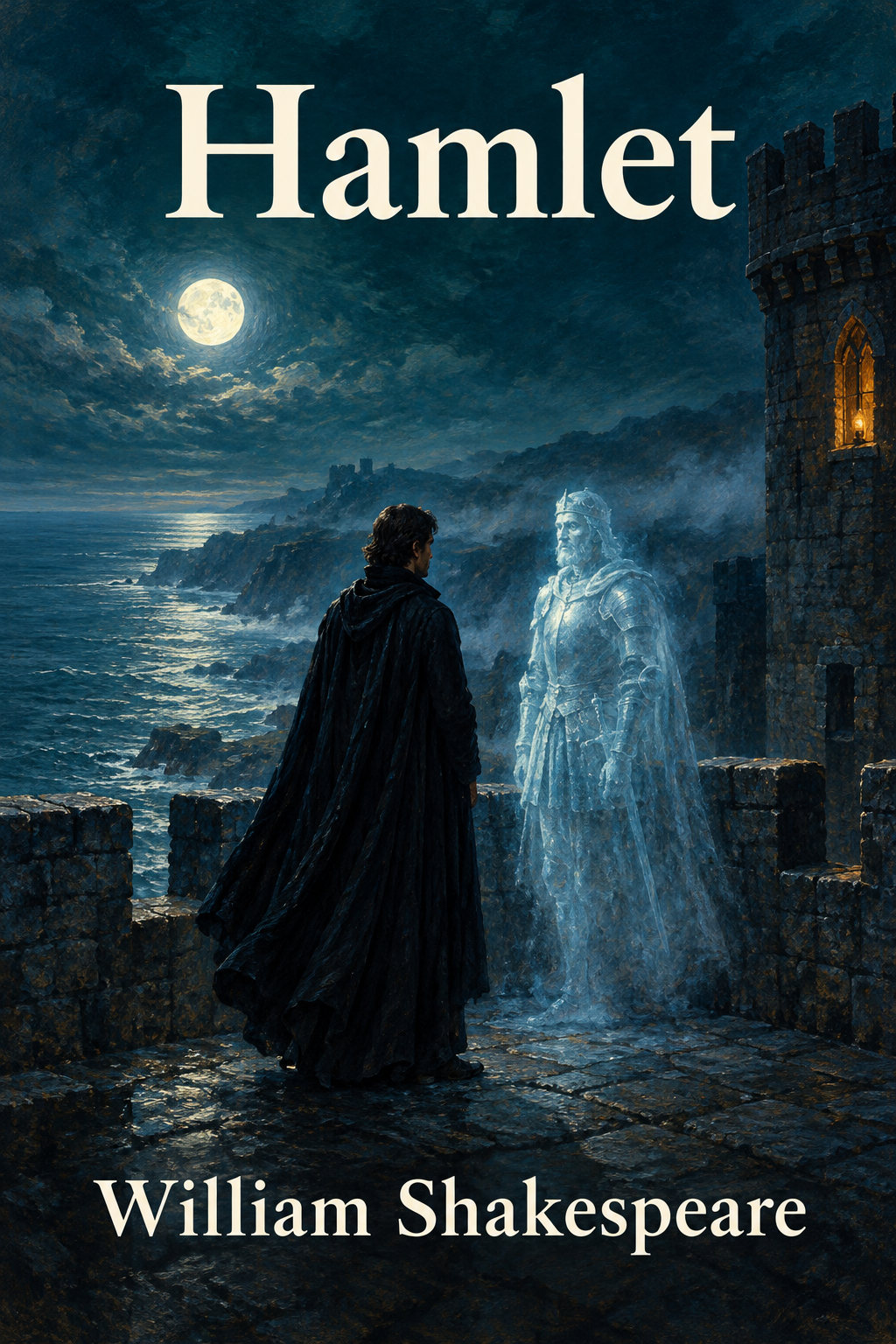
Hamlet
oleh William Shakespeare
Hamlet is a revenge tragedy by William Shakespeare in which a young prince learns from his father's ghost that his uncle, Claudius, murdered the old king and married the queen. Hamlet must decide whether to act on the ghost's word, and he chooses a risky plan: he pretends to be mad while he looks for proof. The play is a study of doubt, grief and how hard it is to act on a truth you cannot fully trust.
Ide Utama
"The play asks what happens when you know something terrible but cannot be sure enough to act. Hamlet's doubts and delays turn a simple revenge plot into a tragedy about the cost of hesitation."
Wawasan Utama
Knowing is not the same as doing
Hamlet commits himself to revenge almost at once, yet he struggles for much of the play to act on it. The play treats this delay as more than a personality quirk. It shows a mind that wants proof before it commits to violence, and that wants to be sure its judgment is right. That tension drives the plot, and it may explain why the play still feels modern.
Think of a promise you know you should keep but keep postponing. Asking what is actually stopping you can make Hamlet's hesitation feel familiar rather than strange.
Appearance versus reality
Almost everyone at Elsinore performs. Claudius presents himself as a grieving brother and a careful ruler, Polonius gives tidy advice to his children while spying on them, and Hamlet puts on an antic disposition to hide his purpose. The play keeps asking how much of what we see can be trusted, and it rarely lets us settle the question.
Watch the scenes where characters speak one way in public and another in private. Noticing the gap is often the quickest way into the play.
Theater as a mirror
Hamlet asks the traveling players to perform a version of his father's murder, and he watches Claudius's face closely. The play-within-a-play turns a stage performance into a test of guilt. Shakespeare uses the device to remind us that drama itself can reveal what people try to hide, and that watching is never neutral.
Readers today can ask the same question about a film, a news story or a social media clip: who is telling this, and what do they want me to feel?
Mortality in the graveyard
In the graveyard scene, the gravediggers joke about who deserves a Christian burial, and Hamlet holds the skull of Yorick, the jester he knew as a child. The scene moves from court rank to plain bone. Whatever a person's status, the play suggests, death gives the same ending, and that reminder sharpens every choice the characters have made.
A useful exercise is to list the characters who die and note whether their choices or chance caused their deaths. The answer shapes how you read the final scene.
Rincian Bab
Chapter-by-chapter summary
Spoiler warning: this section covers the whole plot, including the ending.
Act 1: The Ghost Appears
The play opens on the battlements of Elsinore castle, where guards see the ghost of the late king. Horatio, a scholar and the prince's friend, doubts what they describe until the ghost appears again. At court, Claudius, the dead king's brother, has taken the throne and married the widowed Queen Gertrude. Prince Hamlet, still grieving, is deeply troubled by the speed of it all. Laertes warns his sister Ophelia to keep her distance from the prince, and Polonius repeats the warning. Then the ghost speaks to Hamlet and reveals that Claudius poisoned him in his sleep. Hamlet swears to avenge him and decides to act strangely while he works out what to do. This act sets up the central problem: a truth no one else will believe, and a son who must act on it.
Act 2: Spies and a Plan
Hamlet's behavior alarms the court. Polonius sends a servant to spy on his son Laertes in France, then suggests that Hamlet's strange mood is caused by love for Ophelia. Ophelia reports that Hamlet came to her looking wildly disturbed. The king and queen call in Rosencrantz and Guildenstern, two of Hamlet's old school friends, and ask them to find out what is wrong. Hamlet sees through them. He speaks bitterly about the rot in Denmark and admires humanity in a long, ironic speech. When a company of traveling players arrives, he asks them to perform a play that echoes his father's murder, planning to watch the king's reaction.
Act 3: The Play Within the Play
Claudius now fears Hamlet and watches him with Ophelia, while Polonius hides nearby. In a famous soliloquy Hamlet asks whether it is nobler to suffer or to fight against a sea of troubles, and then he rejects Ophelia coldly. In the hall, the players perform, and the poisoning scene makes Claudius rise and leave. Hamlet is sure now that the ghost spoke the truth. He later finds the king alone at prayer, but holds back, reasoning that a man killed in prayer would go straight to heaven. In his mother's room, Hamlet hears a noise behind the hanging cloth and stabs through it, believing he has struck the king. It is Polonius. The ghost returns to remind Hamlet of his task, and asks him to be gentle with Gertrude.
Act 4: Exile and Poison
Claudius learns that Polonius is dead and decides to send Hamlet to England. Hamlet hides the body and answers the king with a grim joke about where it is. Two courtiers, Rosencrantz and Guildenstern, escort him, carrying a letter that asks the English king to have him executed. Ophelia, grieving her father, loses her mind, sings broken songs and hands out flowers. Laertes returns from France in a rage, and Claudius persuades him that Hamlet is to blame. Fortinbras's army marches across Denmark, and Hamlet is shamed by soldiers who fight over a worthless patch of land. Pirates attack Hamlet's ship, and he finds his way back to Denmark. Gertrude reports that Ophelia drowned, and Claudius and Laertes plan a rigged duel with a poisoned blade and a poisoned cup.
Act 5: The Graveyard and the Duel
The gravediggers are preparing Ophelia's grave and joke about who deserves a Christian burial. Hamlet picks up a skull that proves to be Yorick, the jester of his childhood, and reflects on death. At the graveside, Laertes attacks him in grief. Then the courtier Osric brings a challenge to a duel. Hamlet senses danger but accepts. During the match, Gertrude drinks from the poisoned cup meant for Hamlet and falls. Laertes wounds Hamlet with the poisoned blade, but the swords are exchanged, and Hamlet wounds Laertes in turn. Dying, Laertes reveals Claudius's plot. Hamlet stabs the king with the poisoned sword and makes him drink the poisoned wine. Hamlet, dying, asks Horatio to tell his story.
Characters
- Hamlet: The prince of Denmark and the play's center. A student at Wittenberg, he returns home for his father's funeral and finds his world changed. He is witty, grieving and furious, and he struggles to act on what the ghost has told him.
- Claudius: Hamlet's uncle, who has taken the throne and married Gertrude. He calms the court with smooth words and public piety, but he is a murderer who plots to kill Hamlet in secret. He is the play's main antagonist.
- Gertrude: Hamlet's mother and the widowed queen, who marries Claudius soon after her husband's death. She loves her son but often seems blind to the danger around her. Her choices and her loyalty to Claudius put her at the center of the family's tensions.
- Ophelia: Polonius's daughter and Hamlet's former love. Obedient to her father and her brother, she is caught between them and the prince. Her grief after her father's death shows through songs and flowers, and she remains one of the play's most haunting figures.
- Polonius: The chief counselor to the king, fond of long advice and quick to spy. He sends a servant to watch his son, hides behind a curtain to overhear Hamlet and Ophelia, and believes Hamlet's madness is caused by love.
- Laertes: Polonius's son and Ophelia's brother, who is studying in France. He is quick to anger and takes his father's and sister's troubles personally. Claudius easily turns his grief into a plan against Hamlet, and the two men agree to a duel.
- Horatio: Hamlet's friend from Wittenberg and a level-headed scholar. He doubts the ghost at first, then accepts what he has seen. Hamlet trusts him more than anyone, and Horatio remains loyal until the final scene.
- Rosencrantz and Guildenstern: Two courtiers and former schoolmates of Hamlet. Claudius and Gertrude send them to find out what is troubling the prince, and Hamlet sees their purpose at once. Later they escort him to England with a letter that orders his death, and their part in the plot ends badly.
- Fortinbras: The prince of Norway, whose army crosses Denmark on its way to fight over a small piece of land. He appears in the final scene and takes command of the Danish state. Hamlet's dying words favor him as the next ruler.
- The Ghost of King Hamlet: The late king of Denmark, who appears in armor on the battlements. He demands revenge against Claudius, but he asks Hamlet to leave Gertrude to heaven. His appearances drive the whole plot forward.
Writing about this book
Hamlet suits essays about how people make decisions. Start with a question rather than a summary: why does Hamlet wait so long, and is his delay a flaw, a sign of wisdom, or a realistic response to a ghost's word? Pick one scene that stays with you, such as the play within the play or the graveyard, and explain why it stands out. Then connect it to your own experience. Have you ever known what needed doing and struggled to begin? Compare what you felt with Hamlet's reasons. Keep plot retelling short, because your reader already knows the story; spend your words on your reading. Quote sparingly and always cite the act and scene. Use the evidence in the text, not only your memory, and check each claim against the scene before you write it down. A strong conclusion asks a question the play leaves open, such as whether Hamlet is a hero, a victim or both. Your teacher will likely value one clear argument, backed by two scenes, more than a long summary.
Ambil Tindakan
Langkah praktis yang bisa Anda terapkan hari ini:
-
Notice when doubt is protecting you and when it is simply stopping you from acting on what you know.
-
Before trusting an appearance, ask what evidence would prove it wrong, the way Hamlet tests Claudius with the play.
-
When you read a play, hear the lines spoken aloud, since much of the meaning lives in the voices.
-
Track the side characters, since each one shows a different response to power, loyalty and death.
Kutipan Menarik
"“To be, or not to be: that is the question.” (Act 3, Scene 1)"
— William Shakespeare
"“Something is rotten in the state of Denmark.” (Act 1, Scene 4)"
— William Shakespeare
"“There are more things in heaven and earth, Horatio, than are dreamt of in your philosophy.” (Act 1, Scene 5)"
— William Shakespeare
"“The play's the thing / Wherein I'll catch the conscience of the king.” (Act 2, Scene 2)"
— William Shakespeare
"“Alas, poor Yorick! I knew him, Horatio.” (Act 5, Scene 1)"
— William Shakespeare
Siapa yang Harus Membaca Ini
Readers aged 14 and up will get the most from Hamlet, especially students studying Shakespeare for English class or exams. Plays are read differently from novels, so a modern edition with notes helps first-time readers. It also suits adults who want to think about grief, loyalty and hesitation.
Tentang William Shakespeare
William Shakespeare (1564–1616) was an English playwright and poet from Stratford-upon-Avon. He wrote comedies, histories and tragedies for the London stage, including Macbeth, King Lear and Romeo and Juliet. Hamlet is widely regarded as one of his greatest works, and it is still performed in theaters around the world.
Ringkasan Ditulis Oleh

Software Engineer & Writer
Software engineer with a passion for distilling complex ideas into actionable insights. Writes about finance, investment, entrepreneurship, and technology.
Lihat semua ringkasan →Ulasan
Belum ada ulasan. Jadilah yang pertama berbagi pemikiran Anda!
Tulis Ulasan
Lanjut membaca
Jelajahi topik: FiksiRingkasan

Out of My Mind
Sharon M. Draper
“Out of My Mind” karya Sharon M. Draper adalah kisah menyentuh tentang kehidupan Melody Brooks, seorang gadis muda penderita cerebral…

Ender’s Game
Orson Scott Card
“Ender’s Game” karya Orson Scott Card adalah novel fiksi ilmiah memikat yang membawa pembaca ke masa depan saat umat manusia…

Pachinko
Min Jin Lee
“Pachinko”, sebuah saga sejarah lintas generasi yang memikat karya Min Jin Lee, mengisahkan perjuangan sebuah keluarga Korea dalam mengarungi gejolak…

The Perks of Being a Wallflower
Stephen Chbosky
The Perks of Being a Wallflower karya Stephen Chbosky adalah novel coming-of-age yang mendalam, dikisahkan melalui surat-surat pribadi Charlie, seorang…
Artikel

Zaman Pencerahan Dijelaskan: Gagasan, Tokoh, dan Warisannya
Zaman Pencerahan adalah gerakan abad ke-18 di Eropa yang menempatkan akal dan bukti di atas tradisi serta otoritas. Para pemikir…

Sejarah Dunia 1700–1918: Revolusi, Industri, Kekaisaran dan Perang
Antara 1700 dan 1918, revolusi, pabrik, kekaisaran, dan perang dunia membentuk ulang masyarakat di Eropa, Amerika, Asia, dan Afrika. Panduan…

Tema A Christmas Carol: kemurahan hati, isolasi dan tanggung jawab
Novela Dickens biasanya dibaca sebagai kisah seorang pria yang mengubah pikirannya. Tema-temanya lebih tajam dari itu: kemurahan hati sebagai praktik,…