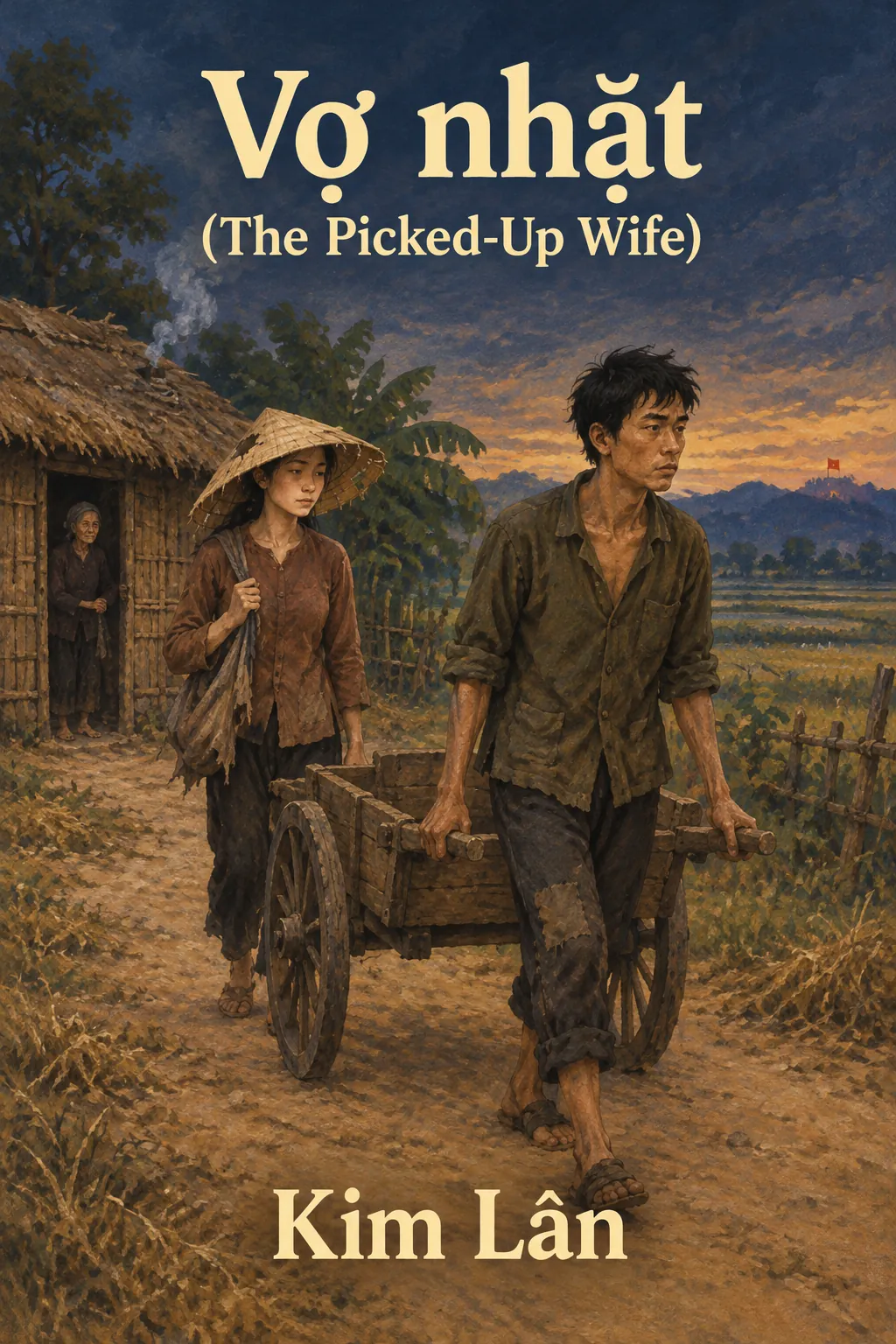
Vợ nhặt (The Picked-Up Wife)
par Kim Lân
Vợ nhặt (The Picked-Up Wife) is a short story by Kim Lân set in the Vietnamese famine of 1945. Tràng, a poor and unattractive cart-puller, treats a hungry stranger to a few bowls of food, and she follows him home as his wife. The neighbours are shocked, and his mother is torn between sorrow and welcome. The story asks how people keep their dignity, and their hope, when hunger has made life cheap.
L'idée principale
"In the 1945 famine a starving woman follows a poor cart-puller home, and their strange wedding shows that people still reach for family and hope when life seems cheapest."
Aperçus clés
Hunger makes a human life cheap
The title says it first: a wife is ‘picked up’ like something left by the road. In a famine, survival comes before ceremony, pride and even choice, and people are treated as if they have no price. Kim Lân does not shout about this; he lets the strange wedding speak.
The woman agrees to follow a man she hardly knows after a few bowls of cheap food, and the neighbours see nothing normal in it, only shock. The wedding has no matchmaker, no gifts and no feast.
Kindness survives in the poorest house
Tràng owns almost nothing, yet he feeds a stranger and takes her home. His mother, who has every reason to refuse, accepts the girl with tears and gentle words. The story suggests that decency is not a luxury of the comfortable.
Mrs Tứ says that a woman who marries her son in such hard times must have a good heart, and she comforts the newlyweds instead of blaming them. Their small acts of care are the real plot of the story.
Hope is built from small things
The morning after, nothing has solved the famine, yet the house feels different. A swept yard, a plan to raise chickens and a joke about a thin gruel make the future seem possible. Hope here is practical and modest, not a speech.
At the end, the wife mentions people raiding rice stores, and Tràng pictures the hungry crowd and a red flag. The ending does not say the famine is over; it says a way out may exist.
A strange situation reveals ordinary people
The central situation, a man who ‘picks up’ a wife, is the engine of the story. It is comic and painful at once, and each character is tested by it: Tràng grows, the woman softens, and Mrs Tứ shows how fear and faith can live in one heart.
Watch how Tràng walks home: nervous, proud, anxious and amused. That is why exam questions so often ask about the situation.
Détail des chapitres
Chapter-by-chapter summary
Spoiler warning: this section covers the whole plot, including the ending.
The story has no numbered chapters, so we follow it in six natural parts.
Part 1: A village of hunger
The story opens in the outcast quarter (xóm ngụ cư) of a village, where famine has been spreading since the end of the previous year.
The dead lie by the roads, crows call from the graveyard and the smell of death hangs in the air.
Tràng, a rough-looking young man who pulls a hired cart, walks home at dusk, laughing to himself while children tease him.
He lives with his old mother, Mrs Tứ, in a ramshackle hut on the edge of the village.
Why it matters: the darkness comes first, so every kindness that follows weighs more.
Part 2: Two meetings with a hungry woman
On one trip Tràng sings a teasing line to passers-by, and a thin young woman laughs and helps push his cart.
Days later he meets her again in the market town, now ragged and hungry, quick with her tongue and shameless about her need.
Tràng treats her to several bowls of cheap rice cake, and half in jest he says she could come home with him.
To his surprise, she quietly follows.
Why it matters: the marriage begins as a joke, which shows how hunger has stripped away every ordinary ceremony.
Part 3: Walking home with a wife
Tràng buys a few small things for her and leads her home, while she hides part of her face under a torn hat.
He is anxious and strangely happy, and the neighbours' stares and whispers only make his heart beat faster.
For the first time he feels that he has someone to look after.
Why it matters: this is where Tràng starts to change from a carefree man into a responsible one.
Part 4: Mrs Tứ meets her daughter-in-law
Mrs Tứ is astonished to find a strange woman in her yard, and when she understands, she falls silent and begins to weep.
Her tears hold sorrow that she cannot give her son a proper wedding, and pity for the girl who has come to such a poor house.
She says that a woman who joins her son in hard times must have a good heart, and she recalls the saying that nobody stays rich or poor for ever.
Why it matters: her grief and her welcome together show the human warmth that drives the story.
Part 5: The first morning
The next morning Tràng finds the yard swept and the house tidier, and the wife who seemed sharp-tongued yesterday now looks gentle and sensible.
Mrs Tứ is lighter in spirit and talks about raising chickens to bring life to the yard.
Tràng feels something new in himself, as though he has become a real man of the house with a duty to look ahead.
Why it matters: small plans become a thread that ties a poor family to the future.
Part 6: Bran gruel and the red flag
The family's breakfast is only a pot of thin bran gruel, and Mrs Tứ jokes about it to ease the shame.
His wife says she heard on the road that the Việt Minh lead hungry people to raid the Japanese rice stores and share the grain.
In the distance a drum beats, calling people to pay tax.
Tràng remembers a crowd of starving people marching behind a red flag, and he sees a light opening ahead of him.
Why it matters: the ending sets hope beside suffering instead of erasing it.
Characters
- Tràng is a poor, rough cart-puller and the heart of the story: generous, awkward and changed by responsibility.
- Thị is the hungry woman, nameless and sharp at first, who grows gentle and capable once she has a home.
- Mrs Tứ is Tràng's old mother, who greets the surprise with tears, kindness and a small joke.
- The famine is the invisible enemy that makes life cheap and drives every choice.
- The neighbours gossip and wonder, showing how strange the marriage looks.
- The hungry crowd and the Việt Minh appear only in report and memory, and stand for a way out.
Background: the 1945 famine
The famine of 1944–1945 in northern Vietnam, under French colonial rule and Japanese occupation, killed an estimated one to two million people.
Kim Lân places the story inside that crisis, just before the August Revolution of 1945.
What the title means
The word nhặt means to pick up, and it is normally used for things found by the road, such as a coin or a fallen fruit.
Joined to the word for wife, it sounds shocking and a little comic, and it tells you at once how cheap people have become.
As the story goes on, the word changes its colour, because Tràng does not pick up an object but takes in a person.
The title therefore carries the whole story: first the pain of famine, then the care that answers it.
Themes at a glance
Three themes carry the story: the cheapness of life in famine, the stubborn warmth of family, and a hope that grows from small plans.
They are not separate, because each scene touches all three.
That is why one moment, such as the gruel breakfast, can support several different arguments in an essay.
How the story is built
Kim Lân builds the story around one unusual situation instead of a long plot.
Almost everything happens within about a day and a half, from Tràng's walk home at dusk to the family's breakfast.
The narrator stays close to Tràng's feelings, so the reader shares his nerves, his pride and his surprise.
Humour and sorrow sit side by side, because the neighbours' gossip is funny and yet it comes from people who may not live to see next month.
Small objects carry meaning: the torn hat, the rice cake, the swept yard, the gruel and the flag.
The ending is open, since nobody eats well and the famine goes on, but a way out has entered the characters' minds.
Questions exams often ask
- Analyse the character of Tràng and how he changes after he takes the woman home.
- Explain the central situation of the story and the meaning of the title.
- Discuss the role of Mrs Tứ in the scenes of welcome and in the final morning.
- Comment on the ending and the image of the red flag as a symbol of hope.
Writing about this book
Begin from the central situation: a marriage that is born in famine.
Every character and detail can then be read as an answer to one question about dignity and hope.
For an essay on Tràng, follow three steps: his circumstances, his act of taking the woman home, and the change that follows.
For Mrs Tứ, stay with her sorrow, her welcome and her fragile cheerfulness.
For a social-issue paragraph, draw lessons about kindness, sharing and hope in hard times, and use the story only as a short example.
Quote briefly and exactly, then explain what the words show.
The model answers on this page are learning examples to compare with your own work, never text to copy.
Passer à l'action
Étapes pratiques à mettre en œuvre dès aujourd'hui :
-
Start any essay on the story with its central situation: a marriage that begins in famine and ends with a plan for tomorrow.
-
Describe Tràng through contrast: a rough, poor outsider with a generous heart and a growing sense of duty.
-
Treat Mrs Tứ as the moral centre of the ending, where grief, welcome and gentle humour sit side by side.
-
Quote briefly and accurately, then explain; never retell the whole plot in an exam answer.
Citations notables
"“người chết như ngả rạ” (opening scene; people dying like cut rice stalks)"
— Kim Lân
"“Ai giàu ba họ, ai khó ba đời” (Mrs Tứ's words; a proverb that neither wealth nor poverty lasts)"
— Kim Lân
"“lá cờ đỏ bay phấp phới” (final scene; a red flag fluttering)"
— Kim Lân
À qui s'adresse ce texte
Students in Vietnamese Grade 12 and anyone preparing for the national high-school exam or literature entrance papers, plus teachers and general readers who want to understand one of Kim Lân's best-known short stories and the 1945 famine behind it. The story is short and suitable from about age 15.
À propos de Kim Lân
Kim Lân (1920–2007), born Nguyễn Văn Tài in Từ Sơn, Bắc Ninh, was a Vietnamese short-story writer best known for plain, warm stories about village life, such as Làng and Vợ nhặt. He also worked as a film actor. He received the Hồ Chí Minh Prize for literature and art in 2001. His writing is rooted in the countryside and in ordinary people.
Résumé écrit par

Software Engineer & Writer
Software engineer with a passion for distilling complex ideas into actionable insights. Writes about finance, investment, entrepreneurship, and technology.
Voir tous les résumés →Avis
Pas encore d'avis. Soyez le premier à partager vos impressions !
Écrire un avis
Continuer la lecture
Explorer le thème: Guides d’étudeRésumés
La Ferme des animaux de George Orwell — Résumé & Analyse
George Orwell
Les animaux de la Ferme du Manoir se révoltent contre M. Jones pour créer une société utopique basée sur l'égalité.…

outsiders (S.E. Hinton)
S.E. Hinton
L'histoire suit Ponyboy Curtis et son gang, les Greasers, dans leur conflit violent avec les Socs, les jeunes riches de…

Gatsby le Magnifique de F. Scott Fitzgerald — Résumé & Analyse
F. Scott Fitzgerald
Narré par Nick Carraway, le roman suit Jay Gatsby, un millionnaire mystérieux qui tente de reconquérir son ancien amour, Daisy…
Des souris et des hommes par John Steinbeck
John Steinbeck
L'histoire suit George et Lennie, deux ouvriers agricoles itinérants pendant la Grande Dépression. Ensemble, ils rêvent de posséder leur propre…
Articles
Le Conte du coupeur de bambou (Taketori Monogatari)
Le Conte du coupeur de bambou (Taketori Monogatari) raconte l'histoire de la princesse Kaguya, une fillette trouvée dans une tige…

Ragnarök : la fin des dieux nordiques
Le Ragnarök est la fin du monde dans la mythologie nordique : une bataille finale où dieux, géants et monstres…

Narcisse et Écho
Narcisse et Écho est un mythe grec : un bel adolescent tombe amoureux de son propre reflet, tandis qu'une nymphe…