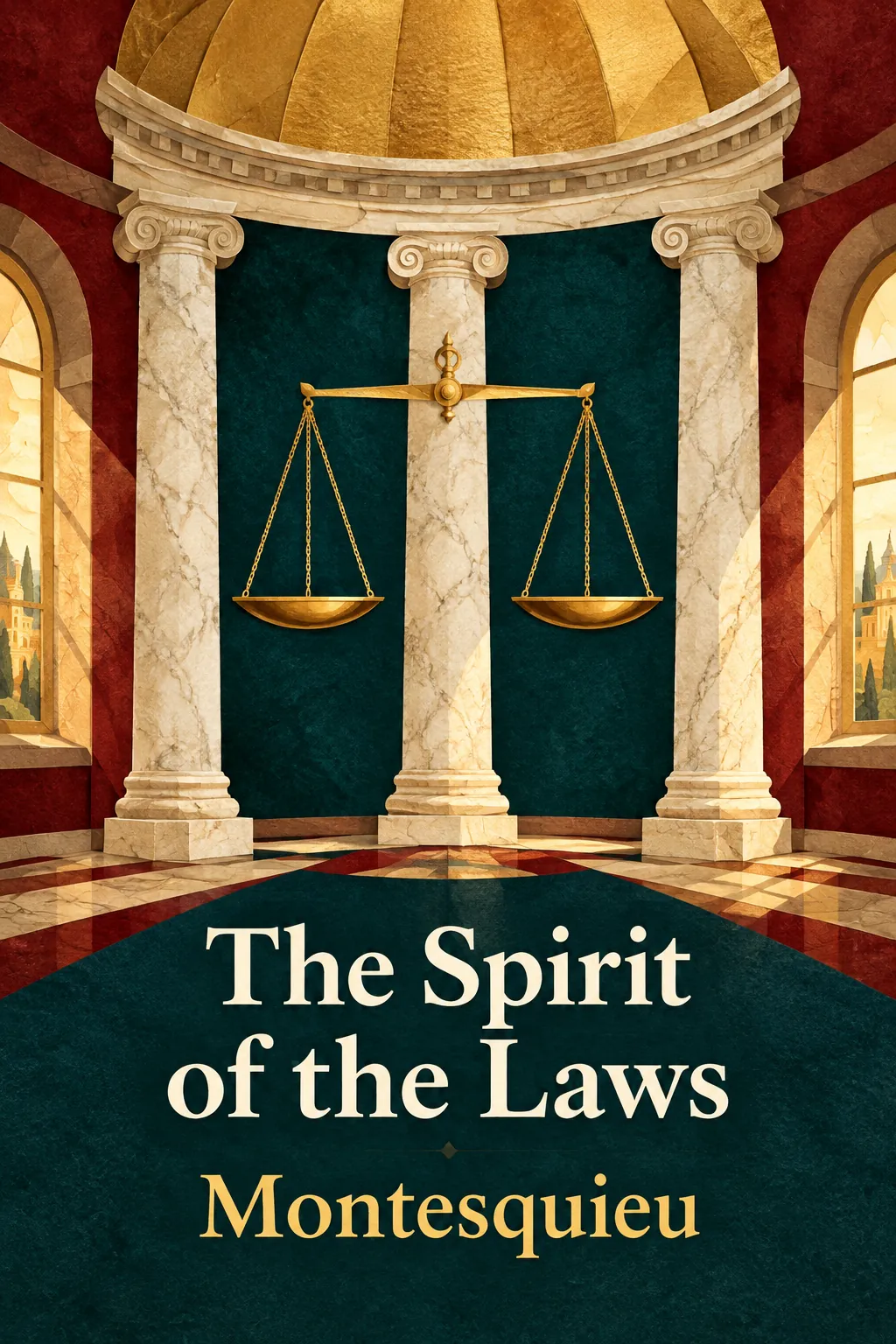
The Spirit of the Laws
par Montesquieu
The Spirit of the Laws (1748) is Montesquieu's study of why laws differ from place to place and what keeps people free. He sorts governments into republics, monarchies and despotisms, each running on its own driving force: virtue, honor or fear. He then links laws to climate, trade, religion and custom. His most famous claim is that liberty needs power divided among separate bodies so that each can check the others.
L'idée principale
"Good laws are not one perfect template. They fit a country's size, climate and habits, and liberty survives only when power is built to check power."
Aperçus clés
Power must be checked by power
Montesquieu believes that anyone who holds power tends to push it as far as it will go, so good intentions are not enough. The structure of government itself has to hold people back.
In the English system he describes, Parliament makes laws, the crown carries them out and independent judges decide cases, so none of them can rule alone. Later, the framers of the US Constitution built three branches of government with this idea in mind.
Laws must fit their setting
There is no single perfect set of laws. Size, climate, religion, trade and custom all shape what works, and a lawmaker who ignores them will fail.
A small city republic can rely on citizens' public spirit, while a large kingdom cannot. Montesquieu would say that copying laws from one to the other is like wearing someone else's coat: it may not fit.
Every government has its own driving force
Republics run on virtue, monarchies on honor and despotisms on fear. A government decays when its driving force fades, so reformers must look at what really motivates people.
A king who stops rewarding honor and starts relying on pure command begins to slide toward despotism. Montesquieu used this pattern to explain how free states lose their freedom without a single dramatic day.
Liberty lives in everyday law
Freedom is protected not only by grand constitutions but by fair criminal rules, sensible taxes and judges who follow clear laws. Vague laws let the powerful punish whom they like.
Montesquieu warns that treason charges with no clear definition frighten people into silence. He argues that a citizen should be able to know in advance which acts are crimes.
Détail des chapitres
Chapter-by-chapter summary
The book has 31 books (we would say chapters), which most editions group into six parts. Because it is non-fiction, there is no plot to spoil, so you can read the parts in any order. Part 2 is the one most people want first.
Part 1 (Books 1–8): Laws and the three governments
Montesquieu opens by saying that laws are not random orders. They are the relations that follow from the nature of things, and they must fit the people they govern. He then names three kinds of government. A republic runs on virtue, meaning love of the laws and of the common good. A monarchy runs on honor, the drive to earn rank and respect. A despotism runs on fear. Book 4 argues that schooling should teach the principle of the government, and Book 8 shows how each kind decays when its principle fades. This part matters because it gives readers a way to compare any state by asking what actually keeps it going.
Part 2 (Books 9–13): Defense, liberty and the constitution
Book 9 asks how states survive war. Small republics are easy prey, and large monarchies are slow to move, so he praises a federation of small republics. The centrepiece is Book 11. Montesquieu defines political liberty as the feeling of safety that comes when citizens do not have to fear one another or the state. Chapter 6 describes the English constitution, where legislative, executive and judicial powers sit in different hands. Books 12 and 13 follow with criminal justice and taxes: vague treason laws and heavy taxes, he says, are quiet ways to destroy freedom. This part matters most for exams and for history, because it is where the separation of powers comes from.
Part 3 (Books 14–19): Climate, land and national character
These books argue that laws must suit the land. Book 14 claims that climate shapes temperament, with cold air making people bold and heat making them slack. Modern readers reject this, but his practical point stays: a good lawmaker works against a country's bad tendencies instead of ignoring them. Book 15 attacks slavery, often through sharp irony. Book 16 looks at the position of women, Book 17 at political servitude, and Book 18 at soil and farming. Book 19 introduces the general spirit of a nation, the mix of customs, religion and habits, and warns rulers not to change manners by force. This part matters because it treats law as one piece of a whole society.
Part 4 (Books 20–23): Commerce, money and population
Books 20 to 23 turn to trade, money and population. Montesquieu argues that commerce softens rough manners and makes nations need one another, which tends to favor peace. He also warns that the spirit of trade can sit uneasily with the plain virtue of an old-style republic. Book 22 explains how money and exchange worked in his day, and Book 23 links the size of a population to its laws, family life and economy. This part matters because it shows him treating economics as one more force that shapes law, long before economics became a separate subject.
Part 5 (Books 24–26): Religion and the kinds of law
Books 24 to 26 deal with religion and with the different kinds of rules that govern human life. Montesquieu says a religion should be judged partly by its effects on society, and he calls for gentleness and tolerance rather than persecution. Book 26 closes this part with a plain warning: divine law, church law, natural law, civil law and political law each cover their own ground, and mixing them up produces bad decisions. This part matters because it argues that a lawmaker must know which kind of question is in front of them before choosing a rule.
Part 6 (Books 27–31): Roman and French legal history
The last five books are the most technical. Book 27 looks at Roman laws of inheritance, Book 28 traces the origins of French civil law, and Book 29 gives advice on drafting laws: use a plain style, avoid needless detail, and remember that useless laws weaken necessary ones. Books 30 and 31 study feudal law and the rise of the Frankish monarchy. Here Montesquieu defends the nobility and the parlements (the high courts) as intermediate powers that hold back royal absolutism. This part matters because it shows what he feared at home in France and why he argued the way he did.
Key people and terms
Montesquieu
Charles-Louis de Secondat, Baron de Montesquieu (1689–1755), a French nobleman and judge from Bordeaux. He became famous with the satirical Persian Letters in 1721 and spent about twenty years on this book, which first appeared anonymously in Geneva.
Republic
A state ruled by the people as a whole (democracy) or by a part of them (aristocracy). Montesquieu says it depends on virtue: each citizen's willingness to put the public good before private gain. He thinks it is hard to keep up in a large country.
Monarchy
Rule by one person under fixed laws. Its driving force is honor, the desire for rank and distinction. Montesquieu thinks a monarchy stays moderate only while nobles, courts and other bodies stand between the king and the people.
Despotism
Rule by one person without fixed laws, by will alone. Its principle is fear. Montesquieu treats it as the worst kind of government, because it has to keep people frightened in order to survive.
Separation of powers
The idea that legislative, executive and judicial power should sit in different hands. The aim is safety, not tidy design: no single person or body can then make, enforce and judge the same law.
Political liberty
Not doing whatever one likes, but the security of living under laws. Montesquieu says it exists only where power is not abused and where nobody needs to fear another person.
Intermediate powers
Bodies such as the nobility, the clergy and the parlements that stand between a monarch and the people. Montesquieu sees them as brakes on royal absolutism and as the reason a monarchy differs from a despotism.
General spirit
His term for the mix of climate, religion, laws, customs and manners that gives each nation its character. Good laws grow out of it instead of fighting it, which is why he warns against copying another country's laws wholesale.
Climate theory
The claim in Book 14 that climate shapes temperament and therefore the laws that suit a people. Few accept it today, but it is a standard exam point because it shows how he tied law to its surroundings.
Gentle commerce
The view in Book 20 that trade softens manners and binds nations together, making peaceful relations more likely. Later readers often sum it up as gentle commerce.
Federal republic
A union of small republics that join for defense but keep self-government. Book 9 praises it as a way to mix the freedom of small states with the strength of large ones. Writers of The Federalist Papers cited it in debates over the US Constitution.
Writing about this book
A strong report on The Spirit of the Laws picks one idea and follows it through the text, instead of trying to cover all 31 books. Here are starting points, not answers.
- Power and its limits. Read Book 11, Chapters 3, 4 and 6. Why does Montesquieu think good people in power still need to be restrained? Can you think of a school, club or company where one person holds all the power? What goes wrong?
- Laws that fit. Why does he say the laws of one country rarely suit another? Pick a rule from your own country and ask what in its history, climate or customs supports it.
- Where he is wrong. His climate theory sounds odd today. What does it show about how thinkers of his time reasoned, and which of his ideas survive without it?
- Then and now. Compare the English system he describes with how your country divides power today. What is similar, and what has changed?
Use short quotes with the book and chapter, say clearly which sentences are your own opinion, and tie each point to a passage you actually read.
Passer à l'action
Étapes pratiques à mettre en œuvre dès aujourd'hui :
-
When you judge a rule, ask what setting it was made for before asking if it is good or bad.
-
Do not rely on good people alone; build checks so that no single person controls a whole decision.
-
Look for what motivates a group, such as honor, duty or fear, to see how it really works.
-
Read Book 11 first: it holds the most famous argument and links the rest of the book together.
Citations notables
"“…every man invested with power is apt to abuse it, and to carry his authority as far as it will go.” (Book 11, Chapter 4)"
— Montesquieu
"“To prevent this abuse, it is necessary from the very nature of things that power should be a check to power.” (Book 11, Chapter 4)"
— Montesquieu
"“Liberty is a right of doing whatever the laws permit.” (Book 11, Chapter 3)"
— Montesquieu
À qui s'adresse ce texte
Students in upper secondary school and university who study civics, politics or world history, and general readers curious about where constitutions and the separation of powers come from. It is long, so start with Books 1 to 3 and Book 11, and use this guide to find your way through.
À propos de Montesquieu
Charles-Louis de Secondat, Baron de Montesquieu (1689–1755), was a French nobleman, judge and political thinker from near Bordeaux. He became famous with the satirical Persian Letters (1721), wrote on Roman history, and travelled through Europe, including England. The Spirit of the Laws, published in 1748, became one of the most influential books of the Enlightenment and shaped modern ideas about constitutions.
Résumé écrit par

Software Engineer & Writer
Software engineer with a passion for distilling complex ideas into actionable insights. Writes about finance, investment, entrepreneurship, and technology.
Voir tous les résumés →Avis
Pas encore d'avis. Soyez le premier à partager vos impressions !
Écrire un avis
Continuer la lecture
Explorer le thème: Sciences et idéesRésumés

Educated par Tara Westover
Tara Westover
Le récit poignant d'une jeune femme née dans une famille survivaliste isolée dans l'Idaho, sans scolarité ni soins médicaux. À…

Atomic Habits résumé : quatre lois pour commencer petit
James Clear
Atomic Habits présente quatre lois pour concevoir une habitude : rendre évident, attractif, facile et satisfaisant. Clear les relie aux…

Réfléchissez et devenez riche
Napoleon Hill
Et si les secrets de la richesse et du succès ne résidaient pas dans des stratégies financières complexes, mais dans…

Melbourne
Alex Ng
Dans cet ouvrage, Sophie Cunningham propose une exploration intime de la capitale culturelle de l'Australie. En mêlant histoire, architecture, météorologie…
Articles
Qu'est-ce que le libéralisme ? Ses origines au XIXe siècle
Le libéralisme est l'idée politique selon laquelle la liberté individuelle, l'égalité des droits devant la loi et un pouvoir limité…
Le XVIIIe siècle : chronologie des événements mondiaux (1701-1800)
Le XVIIIe siècle couvre les années 1701 à 1800. Il s'ouvre sur des guerres de succession royale et se termine…
Montesquieu : De l'esprit des lois et la séparation des pouvoirs
Montesquieu était un juge et écrivain français du XVIIIe siècle qui affirmait que le pouvoir doit être divisé pour qu'aucune…