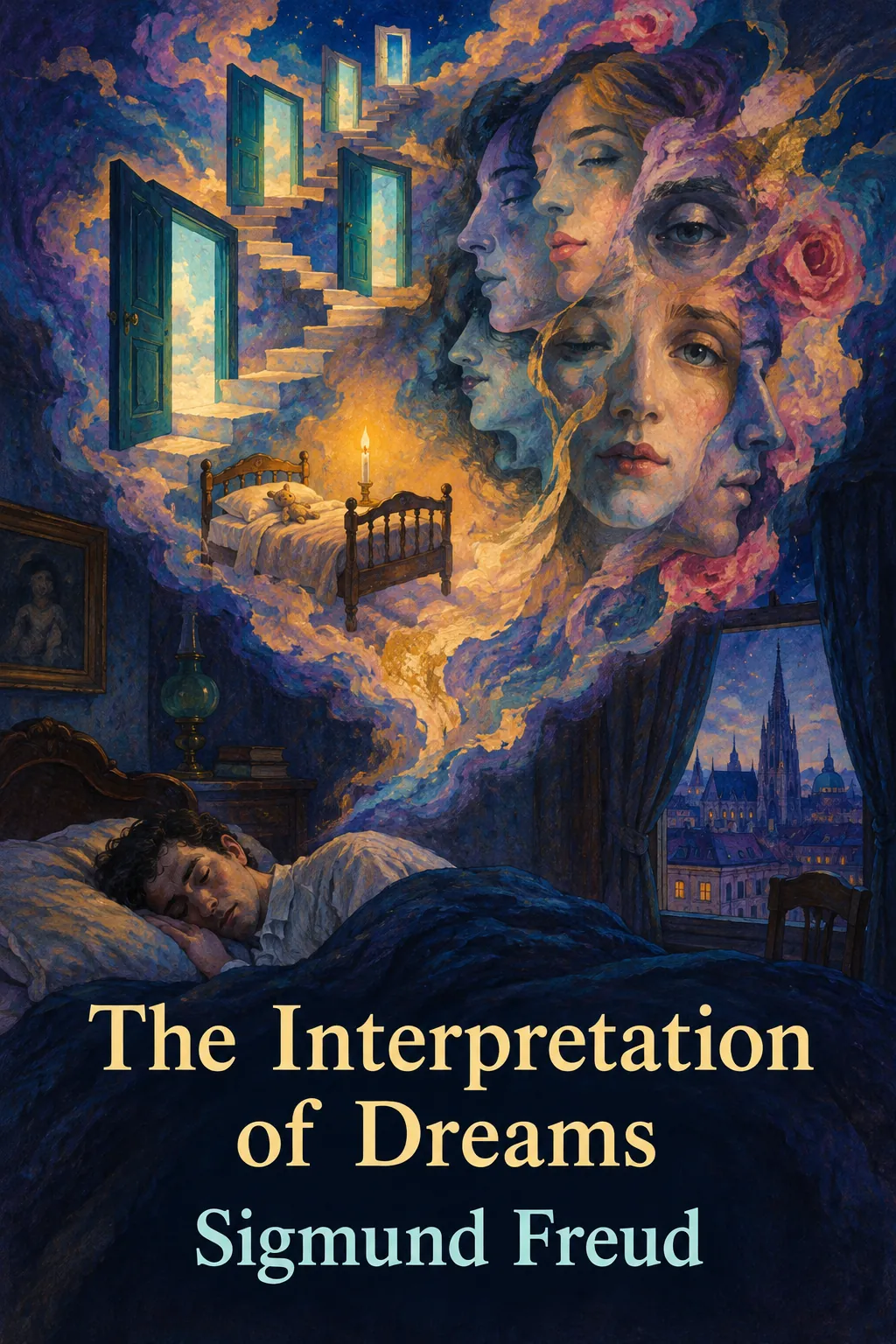
The Interpretation of Dreams
by Sigmund Freud
The Interpretation of Dreams (1899) is Sigmund Freud's book arguing that dreams have meaning. Each dream, he says, is a disguised attempt to fulfil a wish, often one the dreamer would rather not admit. The remembered story, the manifest content, hides the real thoughts behind it, the latent content. Through condensation, displacement and visual imagery, the mind's dream-work scrambles those thoughts. Freud shows how to unpick them using the dreamer's own associations, starting with his own dreams, and builds from this his first model of the unconscious.
The Big Idea
"Freud argues that dreams are not nonsense but disguised wishes, and that decoding them reveals the hidden desires and conflicts that shape our waking lives."
Key Insights
Dreams are meaningful, not noise
Freud's starting point is that a dream is a psychological act that can be understood, just like a slip of the tongue or a symptom. The strangeness of dreams is a puzzle to solve, not a reason to ignore them. This gave later psychology permission to treat inner experience as something to study.
In Chapter 2 the Irma dream looks like a jumble of doctors and a patient's throat, yet its details lead to one clear thought: it was not his fault.
The dream hides what it means
Freud separates what we remember from what the dream is about. The manifest content is a disguise, and the latent content is the actual material. Because of censorship, a wish the dreamer finds unacceptable cannot appear openly, so it appears in altered form.
The smoked salmon dream in Chapter 4 looks like a small domestic frustration but, on Freud's reading, covers jealousy of a friend.
The dream-work follows patterns
Dreams are not random because the mind processes them in recognisable ways. Condensation merges, displacement shifts the emphasis, and thoughts become pictures. Naming these operations lets a reader describe a dream's structure instead of only retelling its plot.
A single dream figure that looks like two different people at once is an example of condensation.
Dreams are a route to the unconscious
Freud treats the dream as evidence for a layer of mind that works by different rules from waking thought. Interpretation is his way in, which is why he calls it the royal road. The idea reaches well beyond dreams, into how we think about motives we do not recognise in ourselves.
In the burning-child dream in Chapter 7, a wish to see the child alive again is built into the very scene that wakes the father.
Chapter Breakdown
Chapter-by-chapter summary
The book has seven chapters. Chapter 1 reviews earlier theories, Chapters 2 to 6 build Freud's own, and Chapter 7 turns the findings into a general picture of the mind.
Chapter 1: The scientific literature on dream problems
Freud opens by surveying what earlier thinkers had said about dreams, from the ancient belief that dreams carry messages from the gods to the physiology of his own day. Many scientists treated dreams as the brain's noise: a rattling window, a hungry stomach or a bright light produces a confused image. Freud accepts that such stimuli can start a dream, but they cannot explain why a dream takes the particular shape it does. Why it matters: the chapter clears the ground, exposes a gap in the existing theories and prepares his claim that dreams carry meaning.
Chapter 2: The method of interpreting dreams
Freud explains his method through one specimen, a dream he had in July 1895 that is now known as the dream of Irma's injection. In it he meets a patient, Irma, who still has pains despite his treatment, and several colleagues who each offer a poor explanation. Freud takes each detail in turn and writes down whatever comes to mind. The trail ends with the conclusion that the dream clears him of blame for her illness. Why it matters: this is the book's method in action. Meaning comes from free association on the dream's parts, not from a fixed dictionary of symbols.
Chapter 3: A dream is the fulfilment of a wish
This short chapter states the thesis. Freud starts where dreams are easiest to read: thirsty sleepers who dream of drinking, and children whose dreams plainly give them what the day denied. His example is his small daughter Anna, kept from food after an upset stomach, who dreamed of strawberries and omelette. Adult dreams, he says, work the same way but less openly. Why it matters: everything later depends on this claim, and starting with transparent cases makes it feel testable.
Chapter 4: Distortion in dreams
If dreams grant wishes, why are so many of them strange, painful or frightening? Freud answers that some wishes are unacceptable to the dreamer, so a kind of censorship disguises them. His examples include a patient's dream of a dinner party she could not give because she had only smoked salmon in the house, which he traced to jealousy of a friend. Anxiety dreams are, in his view, wishes that failed to pass the censor cleanly. Why it matters: the idea of disguise explains why dreams need interpreting at all.
Chapter 5: The material and sources of dreams
Where does a dream get its raw material? Freud points to recent, often trivial, events of the day, to childhood memories, to bodily sensations, and to the typical dreams many people share, such as being naked in public, sitting an exam or losing a loved one. He argues that childhood wishes often power a dream, and he reads the Greek story of Oedipus and Shakespeare's Hamlet as signs that such wishes are widely shared. Why it matters: this is where the book ties dreams to childhood and plants the seed of his later work on the Oedipus complex.
Chapter 6: The dream-work
The longest chapter explains how the mind turns hidden dream-thoughts into the dream we remember. Condensation packs several thoughts and people into one image. Displacement moves the emotional weight onto a minor detail. Abstract thoughts are turned into pictures, and a final step smooths the result into a story that seems coherent. Freud also discusses common symbols, but he warns that every dream still needs the dreamer's own associations. Why it matters: it gives readers a vocabulary for describing how a dream is built, and it is the part most often quoted.
Chapter 7: The psychology of the dream processes
Freud steps back from interpretation to ask what dreams reveal about the mind. He begins with a father who, exhausted after watching over his sick child, who has now died, lies down in the next room and dreams that the child says, “Father, don't you see I'm burning?” A fallen candle really was setting the bed alight. From such cases Freud sketches a mind with a primitive, wish-driven process and a slower, logical one, and argues that dreams are a step back to the more primitive mode. Why it matters: this chapter turns a book about dreams into a first map of the unconscious.
Key people and terms
- Sigmund Freud: the author and the book's main dreamer. A Viennese neurologist, aged 43 when the book appeared, he uses his own dreams as test cases and analyses them in detail, while holding back some private material.
- Irma: a patient in Freud's own dream of July 1895, with her name disguised. Her pains stand for his worry that he had failed as her doctor. The dream is the first one he analyses in full.
- Manifest content: the dream as the dreamer remembers it, with its scenes, people and words. It is the surface that has to be read.
- Latent content: the hidden thoughts and wishes behind the dream. Interpretation aims to move from the manifest content back to these.
- Wish-fulfilment: Freud's central claim that every dream expresses a wish as already satisfied, often in disguise.
- Dream-work: the set of mental operations that turns latent thoughts into the manifest dream: condensation, displacement, picture-making and smoothing into a story.
- Condensation: the merging of several thoughts, people or places into a single dream image, so that one figure may carry many meanings.
- Displacement: shifting emotional weight from an important element to a trivial one, so the dream seems to centre on something that hardly matters.
- Censorship: the force that blocks or disguises wishes the dreamer finds unacceptable. It explains why dreams are strange rather than plain.
Writing about this book
If you are writing an essay or discussion post on The Interpretation of Dreams, start from a question rather than a verdict. These prompts open the book up without telling you what to conclude.
- Freud says dreams are disguised wishes. What evidence does he give in Chapter 3, and does it convince you for adult dreams as well as children's?
- He mostly analyses his own dreams. What does that add, and what risks does it carry for a scientific claim?
- Pick one dream from the book, such as Irma's injection, and describe its manifest content, then the latent thoughts Freud finds. How many steps lie between them?
- Compare Freud's idea of censorship with how you think about things you would rather not admit to yourself.
- Many researchers today explain dreaming through memory and brain activity rather than hidden wishes. Which parts of Freud's argument still seem useful as description, even if the theory is disputed?
A strong essay names a specific dream or chapter, explains Freud's reading in your own words, and then asks what is gained or lost by reading dreams this way.
Take Action
Practical steps you can implement today:
-
Write down a dream as soon as you wake, then list the real events from the day before that appear in it.
-
Treat each odd detail of a dream as a starting point and note what it reminds you of, instead of looking up a symbol.
-
When a dream feels strange, ask what the dream might be avoiding saying directly.
-
Read Freud's claims as a historical theory and a set of useful questions, not as settled science.
Notable Quotes
"“A dream is the fulfilment of a wish.” (Chapter 3)"
— Sigmund Freud
"“The interpretation of dreams is the royal road to a knowledge of the unconscious activities of the mind.” (Chapter 7)"
— Sigmund Freud
"“Father, don't you see I'm burning?” (Chapter 7)"
— Sigmund Freud
Who Should Read This
Readers curious about psychology, the unconscious and the roots of modern therapy. It suits motivated high school students, university students in psychology, literature or philosophy, and general readers who want the source of ideas like the Freudian slip. Start with Chapters 2 to 4 and 6 if the full text feels long.
Frequently Asked Questions
What is The Interpretation of Dreams about?
It is Sigmund Freud's book arguing that dreams have meaning. Freud claims that a dream is a disguised fulfilment of a wish and that its true content can be uncovered by following the dreamer's associations. Along the way he builds his first account of the unconscious mind.
What is the difference between manifest and latent content?
Manifest content is the dream as you remember it: the story, people and images. Latent content is the set of hidden thoughts and wishes behind it. Freud says the dream-work disguises the latent content, and interpretation works backwards from the manifest dream to uncover it.
Does Freud say every dream is a wish?
In this book, yes: he holds that every dream expresses a wish, though often in a disguised form. In 1920 he allowed exceptions for dreams that repeat traumatic experiences, which do not fit the pattern neatly. Many modern researchers do not accept that all dreams are wishes.
Is Freud's theory of dreams still accepted today?
Most researchers reject the claim that all dreams are disguised wishes, and many explain dreaming through memory processing and brain activity. The book remains important historically, and ideas such as the unconscious and free association still influence therapy, literature and everyday language.
Where should a first-time reader start?
Begin with Chapter 2, the Irma dream, to see the method at work, then read Chapter 3 for the thesis, Chapter 4 for disguise and Chapter 6 for the dream-work. Chapter 1 is a literature review and Chapter 7 is the most technical, so both can wait.
Check Your Understanding
Pick an answer for each question to see if you were right.
-
In which year did The Interpretation of Dreams first appear, though the title page was dated 1900?
1899 — It came out in November 1899, with the date 1900 printed on the title page.
-
What does Freud call the dream as the dreamer remembers it?
Manifest content — The remembered story is the manifest content, while the hidden thoughts behind it are the latent content.
-
Which process merges several thoughts or people into one dream image?
Condensation — Condensation packs many thoughts into a single image, so one figure can carry several meanings.
-
What is Freud's central claim about dreams?
They are disguised fulfilments of wishes — His thesis in Chapter 3 is that a dream fulfils a wish, usually in disguised form.
-
Which dream does Freud analyse in full in Chapter 2 to show his method?
The dream of Irma's injection — The Irma dream of July 1895 is his first fully analysed specimen dream.
About Sigmund Freud
Sigmund Freud (1856–1939) was an Austrian neurologist who founded psychoanalysis. He practised in Vienna and developed his ideas about the unconscious through work with patients and through analysing himself. The Interpretation of Dreams was his first major work and shaped psychology, literature and art for the century that followed.
Summary Written By

Software Engineer & Writer
Software engineer with a passion for distilling complex ideas into actionable insights. Writes about finance, investment, entrepreneurship, and technology.
View all summaries →Reviews
No reviews yet. Be the first to share your thoughts!
Write a Review
Keep reading
Explore the topic: Personal DevelopmentSummaries

Educated by Tara Westover
Tara Westover
A memoir about a young woman born to survivalists in Idaho who, despite having no formal schooling, teaches herself to…

Atomic Habits: An Easy & Proven Way to Build Good Habits & Break Bad Ones
James Clear
No matter your goals, Atomic Habits offers a proven framework for improving–every day. James Clear, one of the world’s leading…

The Psychology of Money
Morgan Housel
Morgan Housel’s insightful exploration of how psychology affects our financial decisions and wealth-building journey.

Think and Grow Rich
Napoleon Hill
What if the secrets to wealth and success weren’t hidden in complex financial strategies, but within the power of your…
Articles

Let Them Theory vs task separation: where responsibility starts
Let Them Theory and task separation both ask you to stop managing other people’s choices, but they start from different…

Scout Mindset vs Growth Mindset: Beliefs and Abilities
Scout mindset checks beliefs against evidence; growth mindset concerns developing abilities. A fictional presentation example shows how to use both…

Spaced repetition vs rereading: how to review a book
Compare the timing of spaced review with the task of recalling or rereading. Work through a fictional example, check mistakes,…