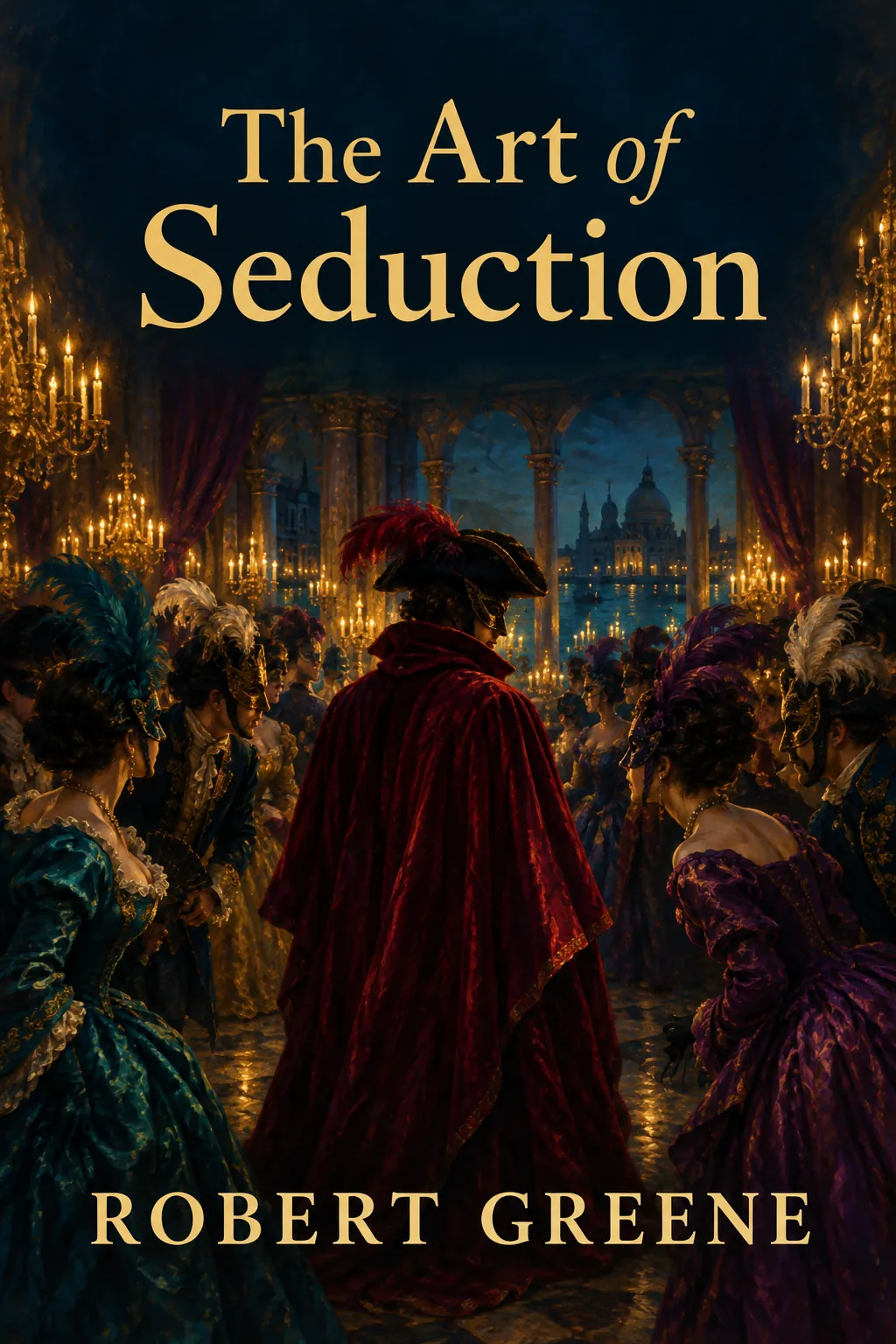
The Art of Seduction
by Robert Greene
The Art of Seduction is Robert Greene's study of how people charm, attract and sway others, built from history, literature and film. Part One describes nine seductive types, such as the Siren, the Rake and the Charismatic, along with the opposite figure who repels. Part Two sets out a four-phase process: separation, leading astray, the precipice and the final move. Greene treats seduction as a form of power, so the book works both as a study of persuasion and as a warning.
The Big Idea
"Greene argues that seduction works by understanding what people secretly want and stirring their fantasies, and he presents it as a game of psychological power that deserves a critical, not naive, reading."
Key Insights
Desire feeds on fantasy, not facts
A thread running through the nine types is that people respond more to an imagined person than to a real one. The Ideal Lover, the Star and the Siren all work by leaving room for the other person's own dreams. Greene's point is that attraction is often made in the imagination, which also explains why it can fade when reality arrives.
The Star keeps some distance and mystery, so admirers fill the gaps with their own hopes.
Tension and mixed signals hold attention
Greene argues that steady, predictable behaviour is easy to ignore, while alternating warmth and distance keeps people curious. The Coquette is the clearest example, and the phases in Part Two repeat the pattern of closeness followed by delay. The idea is a useful lens for noticing how attention is held, in relationships and also in marketing and media.
Someone who answers sometimes eagerly and sometimes slowly can seem more interesting than someone who is always available.
Seduction is a form of power, with ethical limits
The book treats attraction as influence over another person's choices. That makes it a good case study in persuasion, but it also raises problems that Greene's cool tone does not settle. Isolating a person or clouding their judgment can harm them. A careful reader asks where influence ends and manipulation begins, and what consent requires.
Phase Two ends with isolating a person from other influences, a pattern that many readers will recognise as unhealthy in real life.
History and stories are illustrations, not proof
Greene builds his case from Cleopatra, Casanova, film stars and literary figures. These stories make the types vivid, but they are chosen to fit his argument, and many historical details are retold from legend. Treat the examples as memorable pictures of an idea, then check whether the pattern holds in ordinary life.
A famous romance in history shows what a type might look like, but it cannot show how often the approach works or what it costs.
Chapter Breakdown
Chapter-by-chapter summary
The book has two parts: nine seductive character types, then a process in four phases. This guide groups them into short sections. The material deals with sexual and psychological influence and is written for adult readers. This guide describes the ideas neutrally and does not turn them into advice.
Preface: Seduction as Power
Greene opens by arguing that seduction is a quiet form of power. Force makes people resist, while seduction makes them willing, even eager. He says it starts with psychology, not looks: reading what a person lacks, fears and dreams about. The book follows his earlier work on power and uses the same method, short principles backed by stories about Cleopatra, Casanova, film stars and political figures. Why it matters: the framing tells you what you are reading. This is a cool-eyed book about influence, not a book about love as mutual care.
Part One (1): The Siren, the Rake and the Ideal Lover
The first group of types is tied to desire and fantasy. The Siren has an overwhelming erotic presence and seems to promise release from ordinary life, as Cleopatra is often said to have done. The Rake pursues pleasure with real hunger and makes others feel intensely wanted. The Ideal Lover is attentive and romantic, and becomes a screen on which the other person projects longing. Casanova is the figure most often linked with this type. Why it matters: all three work by feeding a dream, which is why Greene keeps stressing imagination over reality.
Part One (2): The Dandy, the Natural and the Coquette
These three types attract by contrast with convention. The Dandy plays with the usual roles of masculine and feminine, treats appearance as a work of art, and appeals to people who feel boxed in by the rules. The Natural is spontaneous, open and childlike, so others relax and lower their guard. The Coquette alternates warmth and distance and seems self-sufficient, so admirers chase her. Why it matters: Greene shows that what looks effortless can be shaped with care, and that mystery and freedom attract strongly.
Part One (3): The Charmer, the Charismatic, the Star and the Anti-Seducer
The Charmer makes each person feel like the centre of attention, using tact and empathy. The Charismatic radiates intensity and confidence, and Greene uses the Russian mystic Rasputin as an example of how personal magnetism can move people. The Star is distant and glamorous, like a screen onto which admirers project their hopes. Part One closes with the Anti-Seducer, the pushy, needy or judgmental personality that repels. Why it matters: the range runs from warm charm to near-worship, so the book is also about the risks of being drawn in.
Part Two, Phase One: Separation
Part Two turns from character to process. In the first phase, the seducer draws a person's attention away from daily routine. Greene describes choosing a suitable target, approaching indirectly, sending mixed signals and showing that others also find the seducer attractive. The aim is to stir interest and a sense that something is missing. Why it matters: the phase rests on a simple observation, that people notice what contrasts with their routine, and Greene's own examples show how easily curiosity can be turned into dependence.
Part Two, Phase Two: Lead Astray
The second phase aims to mix pleasure with confusion. Greene describes small acts of attention, the use of words and gestures that blur fantasy and reality, and strategic shows of weakness that make the seducer seem safe. Surprise and suspense keep the other person engaged, and the phase ends with isolating the target from other influences. Why it matters: this is where the book is most open to criticism, because isolating someone and clouding their judgment can easily slide into manipulation, whatever the intention.
Part Two, Phase Three: The Precipice
In the third phase, the relationship is pushed toward an edge. Greene's maneuvers here include proving yourself through a show of devotion or sacrifice, effecting a regression that stirs the other person's childhood memories and old longings, stirring up transgressive desires that play with taboo, using spiritual lures that tie attraction to something higher, and mixing pleasure with pain so that relief feels stronger. Why it matters: Greene treats feeling and choice as things that can be shaped from outside. Readers can use this as a map for noticing such patterns in others.
Part Two, Phase Four: Moving in for the Kill
The last phase has four maneuvers. Giving the other person space to fall means the seducer holds back a little, so that the next step seems to be the other person's own choice. Physical lures bring in sensual contact once the mind has been prepared. Mastering the bold move rests on the claim that hesitation can break the spell. Finally, Greene warns about the aftereffects: emotions linger, and a careless ending can turn admiration into resentment. Why it matters: even in this cold account, he admits that seduction has consequences, and he treats it as a skill with a cost, not a free trick.
Key people and terms
- The Siren: The Siren is built on overwhelming erotic presence and a hint of danger. She seems free of ordinary rules, so others imagine an escape from routine. Greene's historical model is Cleopatra. The type depends on theatre, bold appearance and a sense of mystery.
- The Rake: The Rake pursues pleasure with real hunger and makes the other person feel intensely wanted. He is persistent, bold and sometimes reckless. His appeal comes from unusually strong, focused attention.
- The Ideal Lover: The Ideal Lover listens, notices and offers romance as a kind of dream. The other person sees in them the fulfilment of what has been missing in life. The appeal comes from the fantasy, not from the real person behind it. Casanova is the best-known historical example.
- The Dandy: The Dandy shapes themselves into a work of art and plays with the lines between masculine and feminine. Ambiguity and style attract people who feel limited by social roles. The type makes difference itself the attraction.
- The Natural: The Natural is spontaneous, open and childlike. Because there seems to be no calculation, others relax and respond in kind. Greene presents this ease as powerful precisely because it appears to be free of effort.
- The Coquette: The Coquette alternates warmth and coolness and seems content alone. Admirers feel they must work for attention, which raises desire. The type shows how withholding can be as strong as giving.
- The Charmer: The Charmer makes each person feel understood and valued. Tact, humour and attention create pleasure in their company. The type seduces through social ease more than through erotic tension.
- The Charismatic: The Charismatic radiates confidence and intensity. People feel drawn to an inner power and want to follow. Greene links the type to leaders and mystics, with Rasputin as a well-known example.
- The Star: The Star is distant, glamorous and a little unreachable. Admirers project their hopes onto a blank, luminous image. The type shows how keeping some mystery can matter more than constant visibility.
Writing about this book
Because the topic is manipulation, the strongest school essays and discussion posts take a position instead of just listing tactics. Here are questions to start from.
- Greene says seduction is power. Do you agree, or is there a version of attraction based on mutual respect?
- Which of the nine types do you recognise in films, books or public life, and what makes the image work?
- The book draws on famous stories. How reliable are history and legend as evidence for how people behave?
- Is there a line between charm and manipulation? What would help someone notice when they cross it?
- How does the idea of fantasy versus reality connect to advertising, politics or social media?
Pick one type or one phase and test it against an example you know well. Describe what Greene says, then give your own view on whether it is fair, and note what the book leaves out, such as consent, honesty and care for the other person.
Take Action
Practical steps you can implement today:
-
Notice how attention, mystery and fantasy shape attraction in films, ads and politics, not only in romance.
-
Treat each seducer type as a pattern to recognise in others, not a script to copy.
-
When someone sends mixed signals or tries to isolate you, name the pattern and take time before deciding.
-
Read the book critically: ask what is missing, such as consent, honesty and care for the other person.
Notable Quotes
"“Seduction is a game of psychology, not beauty, and it is within the grasp of any person to become a master at the game.” (Preface)"
— Robert Greene
"“Charm is seduction without sex.” (The Charmer)"
— Robert Greene
"“…the ultimate form of power and persuasion.” (Preface)"
— Robert Greene
Who Should Read This
Adult readers who are curious about persuasion, psychology, history or the social side of attraction. It suits people who enjoy an analytical, sceptical reading. It is not a dating manual, and its themes of sexual and psychological manipulation make it unsuitable for younger teenagers.
Frequently Asked Questions
What is The Art of Seduction about?
It is Robert Greene's study of how people attract, charm and influence others. Part One describes nine seductive character types and one anti-type, and Part Two sets out a process in four phases. He draws on history, literature and film, and he frames seduction as a form of power.
What are the nine seducer types in the book?
They are the Siren, the Rake, the Ideal Lover, the Dandy, the Natural, the Coquette, the Charmer, the Charismatic and the Star. Each has its own way of attracting people, from erotic presence to mystery, spontaneity or glamour. Greene also describes the Anti-Seducer as the figure who repels.
What are the four phases of the seductive process?
Part Two groups the process into separation, leading astray, the precipice and moving in for the kill. In order, they cover drawing attention away from routine, mixing pleasure and confusion, pushing the relationship toward an edge, and the final decisive move, followed by warnings about the aftermath.
Is The Art of Seduction a follow-up to The 48 Laws of Power?
Yes, in spirit. Greene published The 48 Laws of Power in 1998 and The Art of Seduction in 2001. Both use short principles illustrated with historical examples, and both treat social behaviour as a field of strategy. The later book focuses on attraction and emotional influence.
Is the book a guide to dating?
Not really. Greene writes about seduction in a broad sense that includes politics, business and art, and his tone is analytical and often cold. Many readers use it as a study of psychology and persuasion, and critics point out that it says little about honesty and mutual respect.
Check Your Understanding
Pick an answer for each question to see if you were right.
-
How many seductive character types does Part One describe, not counting the Anti-Seducer?
Nine — Part One presents nine types, from the Siren to the Star, plus the Anti-Seducer as a contrast.
-
Which type alternates warmth and distance to keep others interested?
The Coquette — The Coquette mixes closeness with withdrawal, so admirers feel they must pursue her.
-
How many phases make up the seductive process in Part Two?
Four — Part Two has four phases: separation, leading astray, the precipice and moving in for the kill.
-
Which earlier Robert Greene book is The Art of Seduction often compared with?
The 48 Laws of Power — The 48 Laws of Power (1998) came first, and The Art of Seduction (2001) continues its approach.
-
According to Greene, seduction depends more on what than on physical beauty?
Psychology — Greene argues that understanding a person's desires, fears and fantasies matters more than looks.
About Robert Greene
Robert Greene is an American author born in Los Angeles in 1959. He writes about power, strategy and human behaviour, drawing on history and classical sources. His best-known books are The 48 Laws of Power (1998), The Art of Seduction (2001), The 33 Strategies of War (2006), Mastery (2012) and The Laws of Human Nature (2018).
Summary Written By

Software Engineer & Writer
Software engineer with a passion for distilling complex ideas into actionable insights. Writes about finance, investment, entrepreneurship, and technology.
View all summaries →Reviews
No reviews yet. Be the first to share your thoughts!
Write a Review
Keep reading
Explore the topic: Business StrategySummaries

The Psychology of Money
Morgan Housel
Morgan Housel’s insightful exploration of how psychology affects our financial decisions and wealth-building journey.

Thinking Fast and Slow
Daniel Kahneman
“Thinking, Fast and Slow” by Daniel Kahneman is a groundbreaking exploration of human psychology. It delves into how our two…

Mindset
Carol S. Dweck
Carol Dweck’s groundbreaking research on how beliefs about ability shape motivation, learning, and achievement.
Strategy: A History
Lawrence Freedman
“Strategy: A History” by Lawrence Freedman is a comprehensive exploration of the evolution of strategy in various realms, from military…
Articles

Let Them Theory vs task separation: where responsibility starts
Let Them Theory and task separation both ask you to stop managing other people’s choices, but they start from different…

Scout Mindset vs Growth Mindset: Beliefs and Abilities
Scout mindset checks beliefs against evidence; growth mindset concerns developing abilities. A fictional presentation example shows how to use both…

Spaced repetition vs rereading: how to review a book
Compare the timing of spaced review with the task of recalling or rereading. Work through a fictional example, check mistakes,…