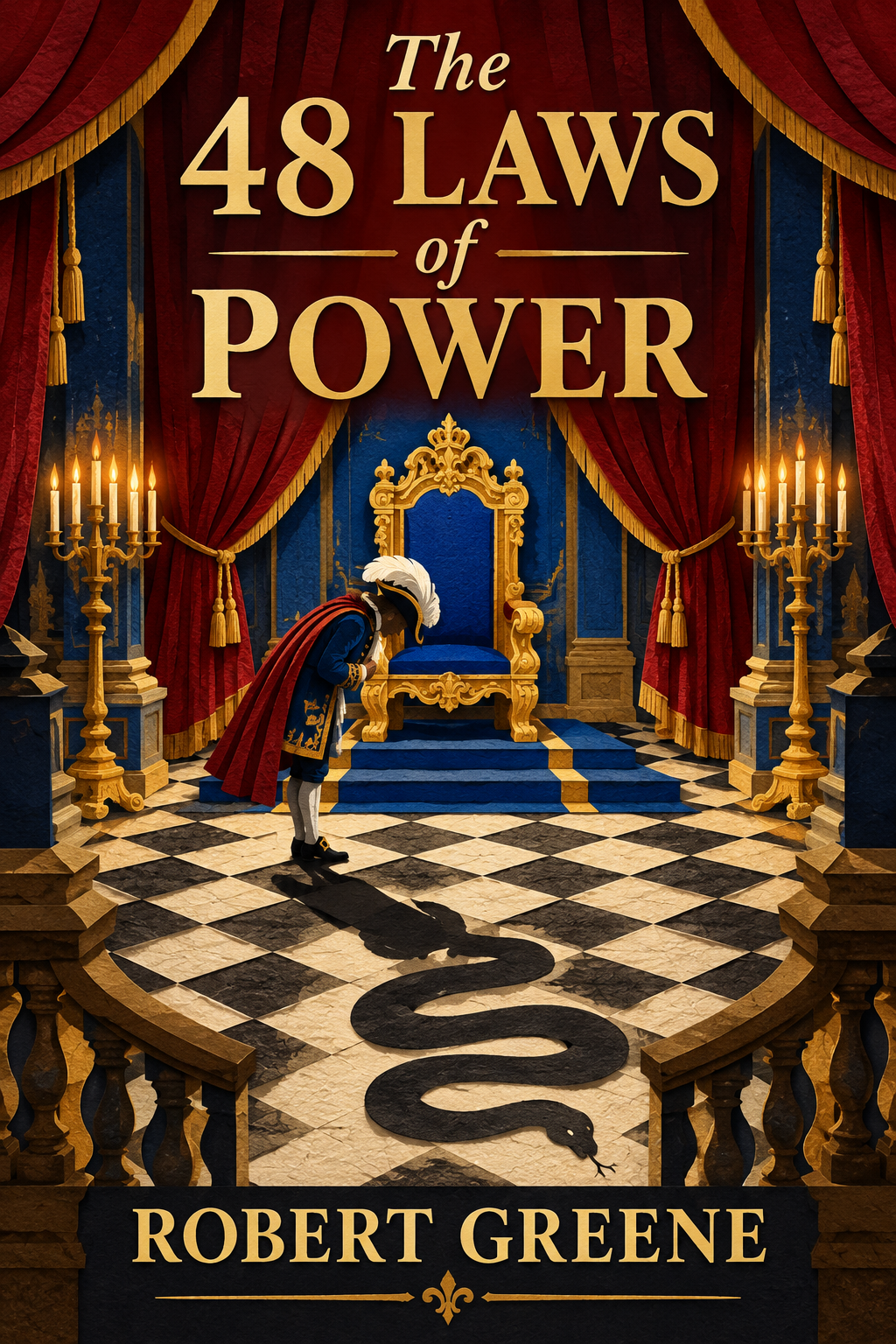
The 48 Laws of Power
by Robert Greene
The 48 Laws of Power is a 1998 handbook of tactics for gaining, keeping and defending power, drawn from court politics, war, business and con artistry. Robert Greene gives each of its 48 laws a short rule, a story of someone who broke it, a story of someone who followed it, and a note on when the opposite works. The book reads as cold realism, and its best use is learning to spot manipulation before it is aimed at you.
The Big Idea
"Greene argues that power is a social game played by everyone, whether they admit it or not, and that studying how rulers, courtiers and con artists won and lost it teaches you to read people and protect yourself."
Key Insights
You cannot opt out of power
Greene's starting point is that every workplace, family and friendship group has a power structure, and pretending otherwise leaves you weak. People who say they dislike politics still compete for attention, trust and resources. The book asks you to look at those dynamics honestly rather than hoping good work speaks for itself. This is its most defensible claim, because it trains observation: who decides, who is envied, who is quietly dependent on whom. You can accept that insight without adopting any of the manipulative tactics the laws describe.
Law 1's story of Fouquet shows a talented minister who ignored the king's feelings and was arrested within weeks of his party.
Image shapes how others treat you
Laws 5, 6, 25 and 37 treat reputation and presentation as assets you can build on purpose. A reputation spreads without effort once it is established, and it colours how people read everything you do afterwards. Greene is right that first impressions and consistent signals matter in hiring, politics and sales. The weakness is that he rarely separates honest image-building, such as being known for reliability, from deceptive image-building, such as faking credentials. Readers should make that distinction themselves, because trust built on fakery collapses under pressure.
Galileo naming Jupiter's moons after the Medici family is Greene's model of presenting a gift in a way that rewards your patron.
People respond to their own interests
Law 13 advises that when you need help, you should explain what the other person gains instead of appealing to pity or past favours. Law 33 extends the idea: find what drives someone, whether security, status or fear, and speak to it. Used well, this is just good negotiation and good teaching, because it forces you to understand the other side. Used badly, it becomes pressure on a person's weak points. The same skill can build a partnership or a trap, and the book leaves that choice to you.
A job candidate who shows how the hire will save a manager time is using Law 13 in its mild form.
Focus and planning beat constant motion
Laws 23 and 29 are the least cynical in the book. Law 23 says to put your energy into one strong point instead of spreading it thin, and Law 29 says to plan past the first victory, because many people win a moment and lose the aftermath. Together they describe a habit anyone can use: choose a few goals, think through the consequences, and then act with confidence. These laws work in studying, project work and career choices without requiring anyone to be deceived, which makes them the easiest to adopt.
A student who picks one subject to master this term, and plans the exams backwards from the date, is using both.
The laws carry costs the book underplays
Greene gives a “reversal” for many laws, but he spends less time on the damage that constant calculation does to trust. Laws such as 14, 15 and 20 reward suspicion, ruthlessness and distance, which can leave a person isolated, as Law 18 itself warns. Critics also note that his examples come from courts, wars and cons, where rulers could punish failure with exile or death, and that modern teams reward cooperation more. Treat the book as a catalogue of tactics to recognise, weigh and mostly resist, not as a plan for living.
Law 18 warns against isolation, yet several other laws push readers toward exactly the distance that causes it.
Chapter Breakdown
Chapter-by-chapter summary
The book has 48 laws, each a short chapter. Here they are grouped into six sets of eight, in the book's own order.
Laws 1–8: Guarding your position and your image
The opening laws are about not threatening anyone above you and not showing your hand. Law 1 uses the story of Nicolas Fouquet, the finance minister whose lavish 1661 party for Louis XIV made the young king look small; Fouquet was arrested within weeks. Greene's lesson is to make your superior shine, as Galileo did when he named Jupiter's moons after the Medici family. Laws 3 and 4 praise secrecy and brevity, since every extra word gives away information. Law 5 treats reputation as the base of all power, and Law 6 adds that being noticed matters as much as being good. Laws 7 and 8 cover letting others do the work while you take credit, and making people come to you. Why it matters: these laws set the book's view that appearance is a tool and attention is currency.
Laws 9–16: Influence, dependence and enemies
This group is about how to move people. Greene says to prove a point by showing it, not arguing it (Law 9), to avoid people whose misery is contagious (Law 10), and to make yourself needed so others cannot easily drop you (Law 11). Law 13 gives practical advice that holds up well: when you ask for help, show what the other person gains instead of begging for sympathy. The darker laws follow. Law 12 recommends small honest or generous acts to lower someone's guard, Law 14 treats friendliness as a way to gather information, and Law 15 says a half-beaten enemy will come back. Law 16 notes that absence can raise your value. These are the laws critics quote most, and the book rarely weighs their human cost.
Laws 17–24: Staying unreadable and choosing your ground
These laws cover how to stay unreadable and choose where to fight. Law 17 suggests that unpredictability keeps others slightly off balance, while Law 18 warns of the opposite danger: isolation leaves you blind to what is happening around you. Law 19 is a sound caution to learn who you are dealing with, because some people never forgive a slight. Law 20 advises staying uncommitted so factions compete for you, and Law 21 advises seeming less clever than the target so they relax. Law 22 turns surrender into a way to gain time. Law 23 says to focus your effort on one strong point, and Law 24 describes the perfect courtier, who is smooth, adaptable and alert to every shift in mood. Why it matters: these laws show Greene's model of power as constant positioning.
Laws 25–32: Identity, belief and persuasion
Here Greene turns to identity and persuasion. Law 25 says to build your own persona instead of accepting the role others give you, much as a stage actor would. Law 26 says to have others carry out the dirty work while you stay clean, and Law 27 explains how leaders gather followers by offering something to believe in. Law 28 argues that half-hearted action invites doubt, so act boldly. Law 29 balances this with the demand to plan all the way to the end, and Law 30 recommends hiding the effort behind your results. Laws 31 and 32 show how to steer choices by shaping the options and by selling people the fantasy they want. The section is the most useful for readers interested in marketing, leadership and public image.
Laws 33–40: Weak points, timing and spectacle
This group is about finding what moves people and when to act. Law 33 tells the reader to discover each person's weak spot, which can be insecurity, desire or fear, and Law 34 says to carry yourself with dignity so others treat you that way. Law 35 treats timing as a skill: know when to wait and when to move. Law 36 suggests ignoring what you cannot have, since showing hurt only gives others power over you. Law 37 praises grand, memorable symbols and public moments, and Law 38 advises blending in with the crowd's customs while keeping your own opinions. Law 39 says anger makes opponents careless, and Law 40 warns that free offers usually come with hidden costs, which is among the book's most widely applicable lessons.
Laws 41–48: Succession, change and knowing when to stop
The final laws deal with taking over, changing things and knowing when to stop. Law 41 warns that following a famous predecessor is hard, so carve out your own identity. Law 42 says that removing one troublemaker can calm the whole group. Law 43 argues that winning people's emotions works better than forcing them, and Law 44 describes copying an opponent's behaviour to unsettle them. Law 45 teaches that reform should arrive slowly, because people resist sudden change. Law 46 cautions that looking flawless breeds envy, and Law 47 warns that overreaching after a win often loses it. The last law, Assume Formlessness, ties the book together: stay flexible, avoid a fixed pattern, and adapt like water, so enemies cannot predict you.
Key people and terms
- Robert Greene: The American author of the book. He collects stories of rulers, courtiers, generals and swindlers and organises them into rules. His tone is calm and cold, as if describing a game he watches from above rather than urging anyone to play it.
- Joost Elffers: The book producer behind the project. He worked with Greene on shaping the book, and the Japanese edition lists him as a co-author alongside Greene, which explains why two names appear on its cover.
- Nicolas Fouquet: Louis XIV's finance minister, who staged a splendid party in 1661 at his château, Vaux-le-Vicomte. The king saw it as a challenge, and Fouquet was arrested weeks later. He is Greene's cautionary story for Law 1.
- Louis XIV: The French king known as the Sun King, who ruled from 1643 and held his court at Versailles. His court is Greene's model of a place where favour, image and rivalry decide careers.
- Galileo Galilei: The Italian astronomer who, after discovering Jupiter's moons in 1610, named them for the Medici family. Greene uses the gesture as an example of making a patron shine, and it helped Galileo win the family's support.
- Courtier: Someone who gains influence by pleasing a ruler. Greene uses the courtier as his model for how anyone in an organisation can rise: by reading moods, controlling their image and avoiding offence.
- Judgment, transgression, observance, reversal: The pattern most laws follow: a short rule, a story of someone who broke it, a story of someone who followed it, and a note on when doing the opposite works. Reading in that order makes each law easier to remember.
- The mark: A con artist's word for the target. In the book it covers anyone being manipulated, and Law 21 shows how a trickster seems less clever than the mark to lower their guard.
- Sun Tzu: The ancient Chinese strategist traditionally credited with The Art of War. Greene borrows the idea that appearances can deceive and that the best victory is won without open conflict, then applies it to office and court life.
- Machiavellian: Describes cunning, self-interested political tactics, after Niccolò Machiavelli, the Italian author of The Prince (written in 1513). Greene admires his realism and his habit of describing how power works rather than how it should.
Applying it in real life
The safest way to use the book is as a field guide to what other people might be doing, not as a script for what you should do. Start with observation. In your next meeting, notice who is credited for the work, who gets attention, and who seems to need nobody's approval. Then ask which law, if any, explains it.
Next, borrow the parts that are honest. Law 9 says to show your point through results. Law 13 says to explain what the other side gains. Law 29 says to think through the full consequences before you start. These work without deceiving anyone.
Finally, test each law against its cost. If you read the book for a class, an essay or a discussion, these questions give you a place to start:
- Which laws describe how people behave, and which tell you how to behave?
- Would Greene's examples still work in a team where people expect to work together for years?
- When does Law 4's advice to say little look like wisdom, and when does it look like hiding?
- What does Law 18 suggest about the limits of the book's own advice?
Take Action
Practical steps you can implement today:
-
Watch the power dynamics around you before deciding how to act; naming them clearly is the first step to handling them well.
-
Make your superiors look good and share credit generously; Law 1's stories show that outshining the wrong person can cost more than it gains.
-
When you ask for help, say what the other person gains rather than relying on pity or past favours.
-
Think through the whole plan to the end, including what happens after you win, before you commit.
-
Treat every law as a description of tactics to recognise, and weigh its cost to trust before you use it.
Notable Quotes
"“Never outshine the master.” (Law 1)"
— Robert Greene
"“Always say less than necessary.” (Law 4)"
— Robert Greene
"“Crush your enemy totally.” (Law 15)"
— Robert Greene
"“Plan all the way to the end.” (Law 29)"
— Robert Greene
"“Assume formlessness.” (Law 48)"
— Robert Greene
Who Should Read This
Readers from about age 16 who want a blunt look at office politics, leadership and persuasion, including students of history, business or political science. It suits anyone who has been surprised by a colleague's tactics. Parents and teachers should know that it describes manipulation openly and works best when read critically, with discussion.
Frequently Asked Questions
What is The 48 Laws of Power about?
It is a 1998 book by Robert Greene that sets out 48 rules for gaining and keeping power, each backed by short historical stories from courts, wars and business. The laws cover reputation, secrecy, persuasion, timing and defence against rivals. Greene presents the rules as observations of how power has worked, not as moral advice.
Is The 48 Laws of Power about manipulation?
Many of its laws describe manipulation, such as feigning friendship, spreading confusion or using other people's weak points. Greene argues that people already do these things, so understanding them protects you. Critics reply that the book normalises cynical behaviour. A fair reading takes both views seriously and treats the laws as tactics to study, not a code to adopt.
Do I need to read all 48 laws?
No. Each law stands alone, so you can read them in any order. A good approach is to read the short rule first, then the historical story, then the note on the reversal. You can also pick five or six laws that match a problem you face now and return to the rest later.
Where did Greene get his stories?
Greene draws on history and strategy writing, and thinkers such as Machiavelli, Sun Tzu and Baltasar Gracián stand behind the book. The stories feature kings, courtiers, generals and con artists. They are retold to illustrate each law, so they are better read as illustrations than as full history.
How is it different from Machiavelli's The Prince?
The Prince, written in 1513, is a short advice book for a ruler, while Greene's book speaks to ordinary readers and spreads its advice over 48 laws with many stories from different eras. Greene shares Machiavelli's cool, realistic tone, but he applies it to workplaces and social life instead of only to government.
Is the book still worth reading today?
Its tactics will feel familiar in modern workplaces, politics and social media, where attention and reputation matter. But its examples come from hierarchical courts and fit cooperative teams less well. Read it for its pattern-spotting and the arguments it provokes, then weigh each law against your own values and the long-term cost of lost trust.
Check Your Understanding
Pick an answer for each question to see if you were right.
-
In what year was The 48 Laws of Power first published?
1998 — The book first appeared in 1998.
-
Which minister was arrested weeks after throwing a party that outshone Louis XIV?
Nicolas Fouquet — Fouquet's 1661 party at Vaux-le-Vicomte is Greene's warning story for Law 1.
-
When asking for help, what does Law 13 say you should appeal to?
The other person's self-interest — Law 13 says to show what the other person gains, not to rely on mercy or gratitude.
-
Which law closes the book?
Assume formlessness — Law 48, Assume Formlessness, tells readers to stay flexible and unpredictable.
-
What is a common criticism of the book?
It underplays the cost of constant calculation to trust — Critics say Greene rarely weighs how scheming damages relationships and trust.
About Robert Greene
Robert Greene is an American author born in 1959 in Los Angeles. He worked in magazines and film before writing The 48 Laws of Power, his first book, in 1998. His later books include The Art of Seduction, The 33 Strategies of War and Mastery, all built on historical case studies. Joost Elffers, a book producer, helped develop this one.
Summary Written By

Software Engineer & Writer
Software engineer with a passion for distilling complex ideas into actionable insights. Writes about finance, investment, entrepreneurship, and technology.
View all summaries →Reviews
No reviews yet. Be the first to share your thoughts!
Write a Review
Keep reading
Explore the topic: Business StrategySummaries

The Psychology of Money
Morgan Housel
Morgan Housel’s insightful exploration of how psychology affects our financial decisions and wealth-building journey.

Thinking Fast and Slow
Daniel Kahneman
“Thinking, Fast and Slow” by Daniel Kahneman is a groundbreaking exploration of human psychology. It delves into how our two…

Mindset
Carol S. Dweck
Carol Dweck’s groundbreaking research on how beliefs about ability shape motivation, learning, and achievement.

Strategy: A History
Lawrence Freedman
“Strategy: A History” by Lawrence Freedman is a comprehensive exploration of the evolution of strategy in various realms, from military…
Articles

Let Them Theory vs task separation: where responsibility starts
Let Them Theory and task separation both ask you to stop managing other people’s choices, but they start from different…

Scout Mindset vs Growth Mindset: Beliefs and Abilities
Scout mindset checks beliefs against evidence; growth mindset concerns developing abilities. A fictional presentation example shows how to use both…

Spaced repetition vs rereading: how to review a book
Compare the timing of spaced review with the task of recalling or rereading. Work through a fictional example, check mistakes,…