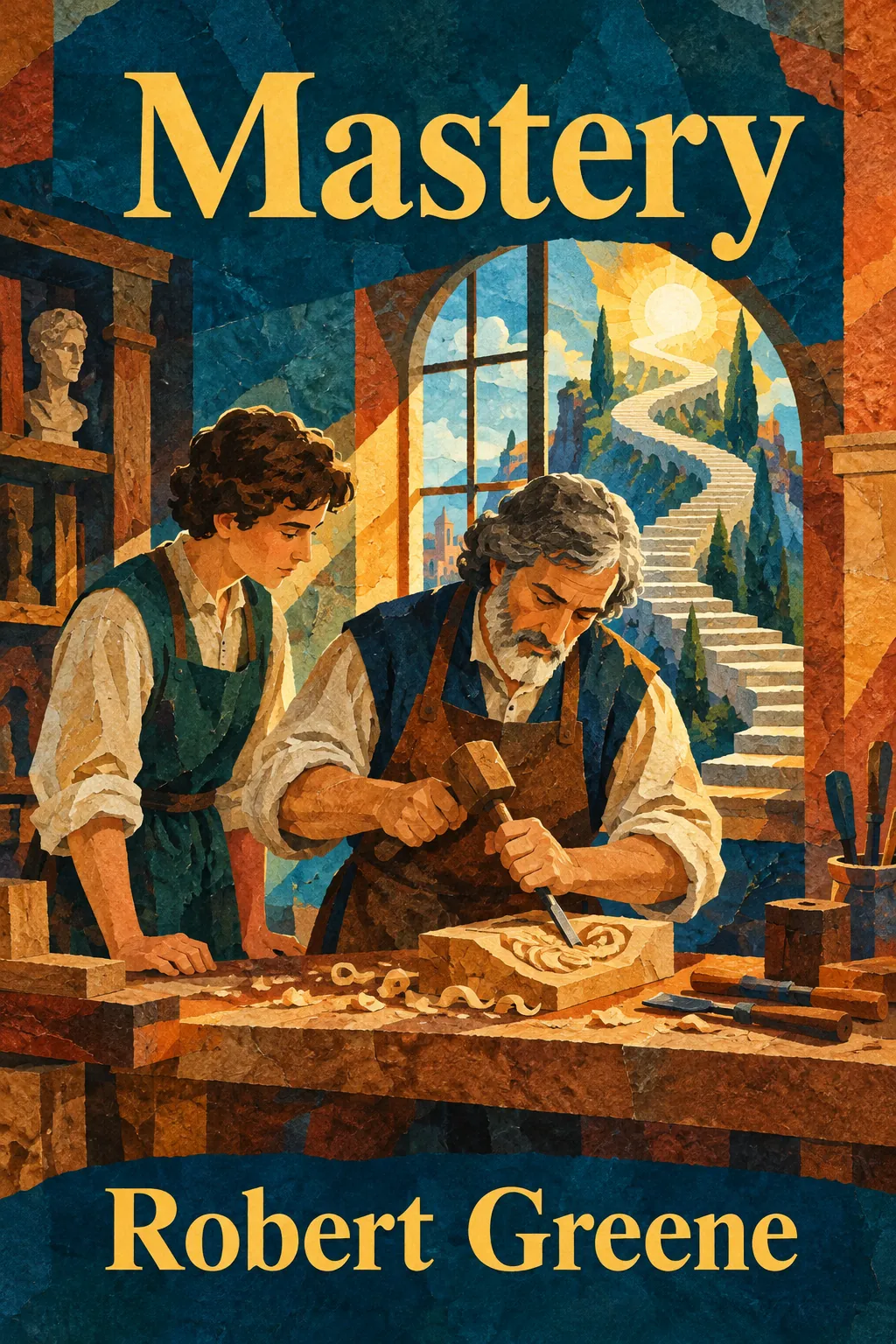
Mastery
by Robert Greene
Mastery by Robert Greene argues that deep skill is built, not born. Greene studies Darwin, Mozart, Faraday and modern experts such as Temple Grandin, and finds one pattern: people find a calling they care about, serve a long apprenticeship, learn from mentors, read people well and then break through creatively. The book lays out each stage as a set of strategies you can try, whatever your field.
The Big Idea
"Mastery comes from time, deliberate practice and the right mentors, not from rare genius. Greene argues that anyone can approach it by finding a Life's Task and following a long apprenticeship."
Key Insights
Start with what pulls you, not what pays
Greene holds that the road to mastery begins with a deep personal interest. When you care about a subject, dull practice feels less painful and long effort becomes sustainable. Choosing a field only for money or approval makes it hard to keep going when progress slows.
When choosing a subject or career, write down what you did for hours as a child. The pattern often points to work you can stick with.
The slow years are the shortest road
The first years of a field rarely show results, and comparing yourself to others makes them feel wasted. Greene argues that this is when you build the basics and the habits that later look like talent. Learning environments matter more than pay or titles.
In a new job or club, watch the best member for a month before copying their methods. That is Deep Observation in practice.
A mentor is a mirror, then a stepping stone
A good teacher shows you faults you cannot see and passes on tacit knowledge that books miss. But a mentor is not a permanent home. Greene says you absorb their way of thinking, then develop your own style and move on.
Choose someone whose current skills match your needs, ask for honest feedback on real work, and plan how you will go beyond their approach.
Skill without people skill stalls
Greene counts social intelligence as part of mastery. Misreading colleagues, rivals or customers can end a promising career. Seeing people as they are, not as you wish them to be, lets you protect your work and get it supported.
Before a difficult meeting, write what each person actually wants, based on what they have done rather than what they have said.
Deep roots make creativity free
Original work, in Greene's view, grows out of knowledge, not out of ignoring it. Once you know a field thoroughly, you can see which rules are fixed and which can be bent, and combine ideas in ways beginners cannot.
After mastering the basics of a craft, set yourself one creative task, such as a project that mixes two skills, and treat the first drafts as experiments.
Chapter Breakdown
Chapter-by-chapter summary
Mastery is non-fiction, so there is no plot to spoil. Each section below follows one chapter of the book: what it says, then why it matters.
Chapter 1: Discover Your Calling: The Life's Task Approach
Greene begins with the idea that each person has a deep, early-formed pull toward certain activities, which he calls the Life's Task. Most people lose touch with it because of family pressure, money worries or fashion. The chapter advises returning to the interests that gripped you in childhood, looking for a niche where those interests become useful work, avoiding false paths chosen for safety or status, and letting go of careers that no longer fit. Why it matters: every later stage asks for years of effort, and that effort only lasts if you truly care about the work.
Chapter 2: Submit to Reality: The Ideal Apprenticeship
Greene splits the apprenticeship into three steps. Deep Observation comes first: you watch a field closely and absorb its rules and its people. Skills Acquisition follows, where steady practice makes the basics automatic. Experimentation comes last, when you test your own ideas and learn from the results. Strategies in the chapter include valuing learning over money, trusting the process, moving toward resistance and pain, and treating failure as training. Why it matters: Greene sees the slow years as the shortest road, because the experience gathered there later looks like talent.
Chapter 3: Absorb the Master's Power: The Mentor Dynamic
A good mentor shortens the road. Greene advises choosing a mentor who fits your present needs rather than the most famous name, studying that person closely and taking in their knowledge and way of thinking. A mentor also works like a mirror, pointing out weaknesses you cannot see yourself. In the end you must take what you learned and build your own style, leaving the teacher behind. Why it matters: the chapter shows how to learn faster than self-study allows, and it treats choosing a mentor as a skill of its own.
Chapter 4: See People as They Are: Social Intelligence
Technical skill is not enough if you misread the people around you. Greene calls the missing ability social intelligence and asks you to see others as they are, with real motives and temperaments, rather than as your hopes or fears paint them. Practical ideas include letting your work speak for you, shaping a persona that suits the setting, and adjusting how you deal with different personality types. Why it matters: the chapter treats relationships at work as part of the craft, because a good reader of people protects both the work and the chance to share it.
Chapter 5: Awaken the Dimensional Mind: The Creative-Active
After the apprenticeship comes the creative-active phase. Because you now know a field deeply, Greene says, you can treat its rules as flexible and try new combinations. He recommends giving yourself a creative task to chase, tolerating the discomfort of not yet having an answer, and moving between playful exploration and focused work. Darwin and Einstein are among his examples. Why it matters: originality here is not a flash of luck but the reward for deep preparation, which is why the book places it after the apprenticeship.
Chapter 6: Fuse the Intuitive with the Rational: Mastery
The final chapter describes the goal itself. A master, Greene argues, sees the whole field as one living system and can take in details and the big picture at once. Years of practice make intuition accurate, and it then works hand in hand with reasoned judgement. Mozart is used to show that even famous prodigies were shaped by early, intense training. Why it matters: the chapter presents mastery as a state anyone can approach step by step, not a mysterious gift, and it ties the book's whole argument together.
Key people and terms
- Robert Greene. American author of The 48 Laws of Power and The Art of Seduction. For Mastery, published in 2012, he studied historical figures and interviewed present-day practitioners to find shared patterns in how skill develops over many years.
- Life's Task. Greene's name for the deep, individual calling each person carries from early life. Finding it, and shaping a career around it, is the first step toward mastery and the source of motivation for everything that follows.
- Ideal Apprenticeship. The long learning period made of three steps: Deep Observation, Skills Acquisition and Experimentation. During it you build the base of knowledge and habits that later makes creative work possible.
- Mentor. An experienced guide who shares knowledge and shows you your blind spots. Greene says to pick one for the skills you need now, and to move beyond them once you have absorbed what they can teach.
- Social intelligence. The ability to read other people's motives and moods without letting your own wishes distort the picture. Greene treats it as part of mastery, since good work still has to be shared with, and supported by, other people.
- Creative-Active. The phase after apprenticeship, when deep knowledge lets you question the rules of a field, set yourself a creative task and produce original work instead of repeating what others have done.
- Dimensional Mind. Greene's term for a mind with deep, wide knowledge that can look at a subject from many angles and link ideas freely, so that new solutions become visible to it.
- Intuition and reason. The end state of mastery: a feel for the whole field, built over years, that works together with careful logical thinking. Greene presents this fusion as the mark of a true master.
- Charles Darwin. English naturalist whose years of patient observation came before his bold theory of evolution. Greene uses him as an example of a long apprenticeship that leads to a creative breakthrough.
- Temple Grandin. American animal scientist who is autistic. She is one of the present-day masters discussed in the book, and her path shows how someone can turn a particular way of thinking into a strength.
Writing about this book
Mastery is a book of ideas rather than a story, so the best essays and reading notes link its claims to real experience. Start by stating Greene's main argument in one sentence, then test it against something you know well, such as a sport, an instrument, a school subject or a first job.
Questions to think about:
- What might your own Life's Task be? How do your childhood interests connect to what you care about now?
- Which apprenticeship step are you in: observing, practising or experimenting? Which one are you skipping?
- Who could be a mentor for you, and what would you want to learn from them?
- Are you chasing shortcuts when you should be building basics?
- Do you agree that anyone can reach mastery? What might the book underestimate, such as money, luck or health?
A good essay picks one example from the book, such as Darwin's years of observation, and goes deep. Putting it beside your own experience usually gives you a clearer voice than listing every strategy. Include a point where you disagree: it makes your writing stronger.
Take Action
Practical steps you can implement today:
-
Write down the interests that pulled you as a child and look for the thread that still runs through your life today.
-
Treat the first years in any field as paid learning: observe closely, practise the basics, and postpone judging your results.
-
Choose a mentor for what you need now, ask for blunt feedback, and plan to move beyond them.
-
Study the people around you as they actually behave, not as you hope they will behave.
-
After you have solid basics, set yourself a creative task and run small experiments.
Notable Quotes
"Submit to reality. (Chapter 2)"
— Robert Greene
"Value learning over money. (Chapter 2)"
— Robert Greene
"Move toward resistance and pain. (Chapter 2)"
— Robert Greene
Who Should Read This
Anyone who wants to get really good at something and feels unsure where to begin. It suits upper-secondary and university students choosing a path, early-career professionals, artists, athletes and makers. The language is plain, and the ideas apply to study as well as work.
Frequently Asked Questions
What is Mastery by Robert Greene about?
Mastery is a 2012 non-fiction book about how people reach the highest level of skill. Greene studies historical figures and modern experts and finds a common path: discover a Life's Task, serve a long apprenticeship, learn from mentors, develop social intelligence, work creatively and finally combine intuition with reason.
What is the Life's Task in Mastery?
It is Greene's name for the deep, individual calling each person has from early in life. He says it often appears in childhood interests and is easy to lose under pressure from family, money or fashion. Reconnecting with it gives you the motivation to endure years of practice.
What are the three steps of the apprenticeship?
The first is Deep Observation, in which you absorb the rules and culture of a field. The second is Skills Acquisition, where repeated practice makes the basics automatic. The third is Experimentation, where you try your own ideas and learn from the results before moving on to creative work.
How long does it take to reach mastery, according to Greene?
Greene describes it as many years of steady, focused practice, not a short course or a trick. The apprenticeship alone often lasts years, and the creative phase comes afterwards. His point is that time spent learning well is what builds the skills that later look like talent.
Is Mastery useful if I do not work in a creative field?
Yes. The core ideas of finding your direction, practising patiently, learning from a mentor and reading people apply to sport, science, business, trades and study. The creative-active phase matters most to people who want to produce original work, but the earlier chapters help in any career.
Check Your Understanding
Pick an answer for each question to see if you were right.
-
What does Greene call a person's deep, individual calling?
The Life's Task — The Life's Task is the early-formed calling that Chapter 1 asks you to rediscover.
-
Which is the first step of the ideal apprenticeship?
Deep Observation — Apprenticeship begins with Deep Observation, followed by Skills Acquisition and then Experimentation.
-
According to Greene, how should you choose a mentor?
By how well they fit your present needs — He advises choosing a mentor who matches what you need to learn now.
-
What does social intelligence mean in the book?
Seeing people as they are, not as you wish — Chapter 4 asks you to read real motives and temperaments, free of your own wishes.
-
Which phase comes after the apprenticeship?
The Creative-Active phase — Deep knowledge from the apprenticeship makes original work possible in the creative-active phase.
About Robert Greene
Robert Greene is an American author known for The 48 Laws of Power and The Art of Seduction. He reads history and biography for patterns of behaviour and turns them into practical guides. Mastery (2012) is his study of how skill and creativity develop over a lifetime.
Summary Written By

Software Engineer & Writer
Software engineer with a passion for distilling complex ideas into actionable insights. Writes about finance, investment, entrepreneurship, and technology.
View all summaries →Reviews
No reviews yet. Be the first to share your thoughts!
Write a Review
Keep reading
Explore the topic: Business StrategySummaries

The Psychology of Money
Morgan Housel
Morgan Housel’s insightful exploration of how psychology affects our financial decisions and wealth-building journey.
Thinking Fast and Slow
Daniel Kahneman
“Thinking, Fast and Slow” by Daniel Kahneman is a groundbreaking exploration of human psychology. It delves into how our two…
Mindset
Carol S. Dweck
Carol Dweck’s groundbreaking research on how beliefs about ability shape motivation, learning, and achievement.
Strategy: A History
Lawrence Freedman
“Strategy: A History” by Lawrence Freedman is a comprehensive exploration of the evolution of strategy in various realms, from military…
Articles

Let Them Theory vs task separation: where responsibility starts
Let Them Theory and task separation both ask you to stop managing other people’s choices, but they start from different…

Scout Mindset vs Growth Mindset: Beliefs and Abilities
Scout mindset checks beliefs against evidence; growth mindset concerns developing abilities. A fictional presentation example shows how to use both…

Spaced repetition vs rereading: how to review a book
Compare the timing of spaced review with the task of recalling or rereading. Work through a fictional example, check mistakes,…