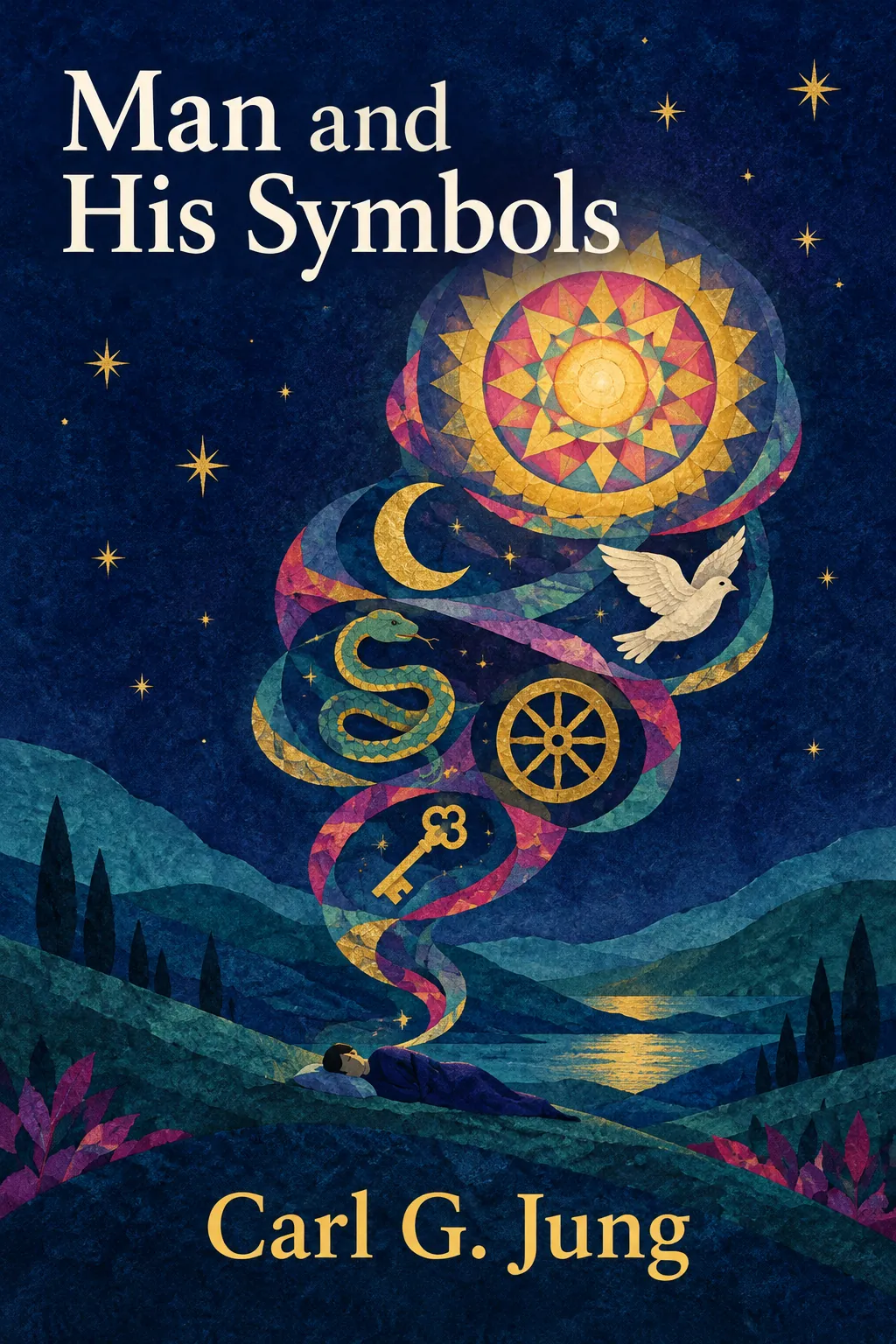
Man and His Symbols
by Carl G. Jung
Man and His Symbols is Carl Jung's introduction to his ideas for ordinary readers. Jung argues that the mind has a hidden side that speaks in images, mostly in dreams, and that these images are symbols with meanings no dictionary can fix. Four of his closest colleagues then follow the same thread through myth, the long path he called individuation, modern art and one real case. Written near the end of his life, it was published in 1964.
The Big Idea
"Symbols are the language of the unconscious, and dreams are where it speaks most plainly. Learning to read them, patiently and with help from myth and art, is how a person grows whole."
Key Insights
A symbol points past itself
Jung separates signs from symbols. A sign stands for something known: a skull on a bottle means poison. A symbol stands for something that cannot be fully put into words, so it keeps more meaning than any single explanation can hold. That is why Jung distrusts dream dictionaries. A snake in a dream might mean fear to one person and healing to another. The meaning comes from the dreamer's own life, from the culture around them, and from what the image stirs up when they think about it.
A wheel can be a road sign in one setting and a sun symbol in another.
Dreams are messages from the unconscious
In Jung's view the mind is larger than what we notice. Feelings, memories and perceptions that never reach awareness do not vanish; they go on working. Dreams are where this hidden side speaks most directly, often by balancing what the waking mind ignores. Jung asks us to treat a dream as meaningful rather than random, and to ask what it adds to our conscious view. The aim is not to predict anything but to notice what has been left out of the picture.
Someone who always acts confident might dream of being small and lost, pointing to a doubt they avoid.
Archetypes are patterns shared by everyone
Jung noticed that certain images turn up again and again in the myths, religions and dreams of people who never met each other: the hero, the wise old figure, the great mother, the journey underground. He called the patterns behind them archetypes. An archetype is not a fixed picture but an inherited tendency to form such pictures, which each person fills with personal detail. This idea is the bridge between Jung's clinic and the book's chapters on myth and art.
Henderson's hero stories and Jaffé's art are both read as archetypes at work.
Individuation is the work of a lifetime
Individuation is Jung's word for becoming a whole, distinct person over the course of a lifetime. It does not mean becoming selfish or perfect. It means meeting the parts of yourself you have pushed aside, such as the Shadow, along with the inner figures that shape how you relate to others, and slowly letting them join your conscious life. In the book, von Franz presents dreams as a guide through this process, which is never finished.
Someone who admits their own envy, instead of blaming it on others, has taken a small step on this path.
Chapter Breakdown
Chapter-by-chapter summary
The book has six parts by five authors: Jung wrote the first, and four colleagues wrote the rest.
Part 1: Approaching the Unconscious (Carl Jung)
Jung begins with a distinction. A sign points to something known, like a road sign or a company logo. A symbol points past itself to something we cannot fully put into words, such as a wheel or a cross, which can mean more than its plain shape. He then argues that the mind has an unconscious side, and that dreams are where it speaks most clearly to the waking mind. To read a dream, he says, ask what each image means to this person, not what a dictionary says. He also introduces archetypes, patterns of imagery found in people everywhere. Why it matters: every later part builds on these ideas.
Part 2: Ancient Myths and Modern Man (Joseph L. Henderson)
Henderson reads myths, rituals and folk tales as something like a dream shared by a whole community. His main subject is the hero myth, which begins with a crude, childlike figure such as the trickster and moves toward a hero who faces a monster and grows up. He reads this as a picture of the ego becoming strong enough to stand alone. He also covers initiation rites, which mark the passage from one stage of life to the next, and shows the same patterns in modern people's dreams. Why it matters: it shows that archetypes are not Jung's private invention but appear in stories across cultures.
Part 3: The Process of Individuation (Marie-Louise von Franz)
Von Franz explains individuation, the lifelong effort to become a whole and distinct person. Dreams, she says, guide the process by presenting figures we have to meet. First comes the Shadow, the side of ourselves we reject. Next come the anima and animus, the inner figures Jung described as the feminine side of a man and the masculine side of a woman. Last is the Self, the centre of the whole personality, which often appears in dreams as a circle or mandala. She stresses that this is not a staircase but a winding road. Why it matters: this is the practical heart of the book.
Part 4: Symbolism in the Visual Arts (Aniela Jaffé)
Jaffé follows symbols through art. She starts with the sacred use of stones and animals in early religion, moves through Romantic landscape painting, and ends with the abstract and fragmented works of the twentieth century. Her argument is that artists often draw on images from the unconscious without planning to, and that strange modern forms can be read as a reaction to the shared mind of the age. Viewers are drawn to such works, she suggests, because symbols inside them respond. Why it matters: it shows symbols at work outside the consulting room.
Part 5: Symbols in an Individual Analysis (Jolande Jacobi)
Jacobi follows one patient, called Henry, through the dreams and pictures produced during his analysis. Instead of explaining theory, she shows a single case. Certain symbols recur in Henry's dreams and slowly change form. The analyst does not announce what they mean but listens to the patient's own associations and moves a step at a time. Why it matters: the chapter shows that interpreting symbols is a long conversation, not a dictionary lookup, and it tests the ideas of the earlier parts against real material.
Conclusion: Science and the Unconscious (Marie-Louise von Franz)
In the closing part von Franz ties the book together and looks outward. She asks how Jung's psychology relates to science, noting that intuitive images can play a part in scientific thinking too, and she introduces Jung's idea that mind and matter may be linked at a deep level. She ends with a warning: modern people have lost touch with their symbols, and with them a source of meaning. Why it matters: it frames the study of symbols as a question for society, not only for individuals.
Key people and terms
- Carl Gustav Jung (1875–1961): Swiss psychiatrist who founded analytical psychology. He first worked alongside Sigmund Freud, then went his own way. He wrote the first part of this book, which sets out the ideas the other authors develop.
- Marie-Louise von Franz (1915–1998): Jung's close colleague for many years. She wrote the long chapter on individuation and the conclusion. She is known for reading fairy tales and alchemical texts through the lens of Jungian psychology.
- Joseph L. Henderson: American psychiatrist and Jungian analyst. He wrote the part on myths, rituals and initiation, tracing how old stories about heroes and rites of passage still shape the dreams of modern people.
- Aniela Jaffé: Jung's secretary and collaborator, who also edited his autobiographical book Memories, Dreams, Reflections. In this volume she wrote about symbols in the visual arts. She was part of Jung's circle in Zurich for many years.
- Jolande Jacobi: Hungarian-born Jungian analyst who worked in Vienna and later in Zurich. She wrote the case chapter, following a patient called Henry through his dreams and pictures to show how analysis works in practice.
- Symbol: an image or word that carries more meaning than its plain surface, and whose full meaning cannot be pinned down. Unlike a sign, which stands for something already known, a symbol points toward something still unfolding.
- Archetype: a recurring pattern of imagery, such as the hero, the wise old figure or the great mother, found in myths and dreams around the world. It is an inherited tendency to form such images, not a fixed picture.
- Shadow: the part of ourselves that we dislike, deny or have never noticed. In dreams it often appears as a person of the same sex who is threatening or unpleasant. Meeting it is the first task of individuation.
- Anima and animus: Jung's names for the inner figures he linked to the feminine side of a man (anima) and the masculine side of a woman (animus). They appear in dreams as people and shape how we relate to others.
- The Self and individuation: the Self is the centre of the whole personality, conscious and unconscious together, often pictured as a circle or mandala. Individuation is the lifelong path toward it, through meeting the Shadow and other inner figures.
Writing about this book
This book works well for an essay or a class discussion if you build your argument from a few clear ideas. Write "Jung argues…" rather than stating his claims as proven facts, because many of his ideas are still debated. Here are questions to start from.
- What is the difference between a sign and a symbol? Find one example of each from daily life and compare them.
- Think of a dream, or a story, that stayed with you. What do you associate with its main image, and does it change what the image seems to mean?
- Why might hero stories still attract people today? Compare Henderson's explanation with your own view.
- How does the idea of the Shadow change the way you think about people who irritate you?
- Von Franz warns that modern people have lost touch with symbols. Do you agree? Give reasons.
Do not try to settle on one answer. Concrete examples from your own experience, clearly separated from Jung's claims, make the strongest writing.
Take Action
Practical steps you can implement today:
-
Treat a dream as a message to explore, not a code to look up. Start with what each image means to you.
-
When something fascinates or annoys you strongly, ask what it touches inside you before blaming the outside.
-
Write dreams down on waking and note what you associate with each image. Patterns appear over weeks, not nights.
-
Be wary of fixed symbol lists. Meaning depends on the person and the moment.
-
Read myths and art as a way of seeing what people share, which can make your own inner life feel less strange.
Notable Quotes
"“Thus a word or an image is symbolic when it implies something more than its obvious and immediate meaning.” (Part 1, Approaching the Unconscious)"
— Carl G. Jung
"“Man also produces symbols unconsciously and spontaneously, in the form of dreams.” (Part 1, Approaching the Unconscious)"
— Carl G. Jung
"“Whoever denies the existence of the unconscious is in fact assuming that our present knowledge of the psyche is total.” (Part 1, Approaching the Unconscious)"
— Carl G. Jung
Who Should Read This
Good for students of psychology, literature, art or religion, and for anyone curious about dreams. It reads easily from upper secondary school age, though the later parts ask for patience. It is an introduction, not a clinical manual, and Jung's ideas are still debated, so treat it as a starting point rather than proof.
Frequently Asked Questions
What is Man and His Symbols about?
It is Jung's introduction to his ideas for non-specialists: that the mind has an unconscious side, that dreams speak in symbols, that shared patterns called archetypes appear across cultures, and that people grow through a process he called individuation. Four colleagues add chapters on myth, art and a real case.
Did Jung write the whole book?
No. Jung wrote only the first part, Approaching the Unconscious. Joseph L. Henderson, Marie-Louise von Franz, Aniela Jaffé and Jolande Jacobi wrote the rest. Jung died in 1961 and the book was published in 1964.
What is the difference between a sign and a symbol?
A sign stands for something known and fixed, such as a traffic sign or a logo. A symbol implies more than its obvious meaning and points to something that cannot be fully defined. Its meaning depends on the person and context.
What is an archetype?
An archetype is a recurring pattern of imagery, such as the hero or the wise old figure, found in myths, religions and dreams around the world. Jung saw it as an inherited tendency to form such images, which each person fills with personal detail.
Is it a good first book on Jung?
Yes, it is often recommended as one, because it was written for general readers and uses many examples. Reading the first part alone gives the core ideas. The later parts are more specialised, so you can pick them by interest.
Check Your Understanding
Pick an answer for each question to see if you were right.
-
Who wrote the first part of the book?
Carl Jung — Jung wrote Approaching the Unconscious; four colleagues wrote the other parts.
-
According to Jung, what makes a symbol different from a sign?
It suggests something more than its obvious meaning — A symbol implies more than its plain meaning and cannot be fully defined.
-
What is the lifelong process of becoming a whole person called?
Individuation — Von Franz describes individuation as the central process of psychological growth.
-
Which figure holds the parts of ourselves that we dislike or deny?
The Shadow — The Shadow is the rejected side of the personality and the first figure we meet.
-
What does Jolande Jacobi's chapter follow?
The dreams and pictures of a patient called Henry — Her chapter presents a single case through the patient's dreams and pictures.
About Carl G. Jung
Carl Gustav Jung (1875–1961) was a Swiss psychiatrist who founded analytical psychology. He worked with Sigmund Freud for several years, then developed his own ideas about the unconscious, archetypes and the stages of a person's inner growth. Man and His Symbols, written near the end of his life, was meant to explain these ideas to general readers.
Summary Written By

Software Engineer & Writer
Software engineer with a passion for distilling complex ideas into actionable insights. Writes about finance, investment, entrepreneurship, and technology.
View all summaries →Reviews
No reviews yet. Be the first to share your thoughts!
Write a Review
Keep reading
Explore the topic: Personal DevelopmentSummaries

Educated by Tara Westover
Tara Westover
A memoir about a young woman born to survivalists in Idaho who, despite having no formal schooling, teaches herself to…

Atomic Habits: An Easy & Proven Way to Build Good Habits & Break Bad Ones
James Clear
No matter your goals, Atomic Habits offers a proven framework for improving–every day. James Clear, one of the world’s leading…

The Psychology of Money
Morgan Housel
Morgan Housel’s insightful exploration of how psychology affects our financial decisions and wealth-building journey.
Think and Grow Rich
Napoleon Hill
What if the secrets to wealth and success weren’t hidden in complex financial strategies, but within the power of your…
Articles

Let Them Theory vs task separation: where responsibility starts
Let Them Theory and task separation both ask you to stop managing other people’s choices, but they start from different…

Scout Mindset vs Growth Mindset: Beliefs and Abilities
Scout mindset checks beliefs against evidence; growth mindset concerns developing abilities. A fictional presentation example shows how to use both…

Spaced repetition vs rereading: how to review a book
Compare the timing of spaced review with the task of recalling or rereading. Work through a fictional example, check mistakes,…