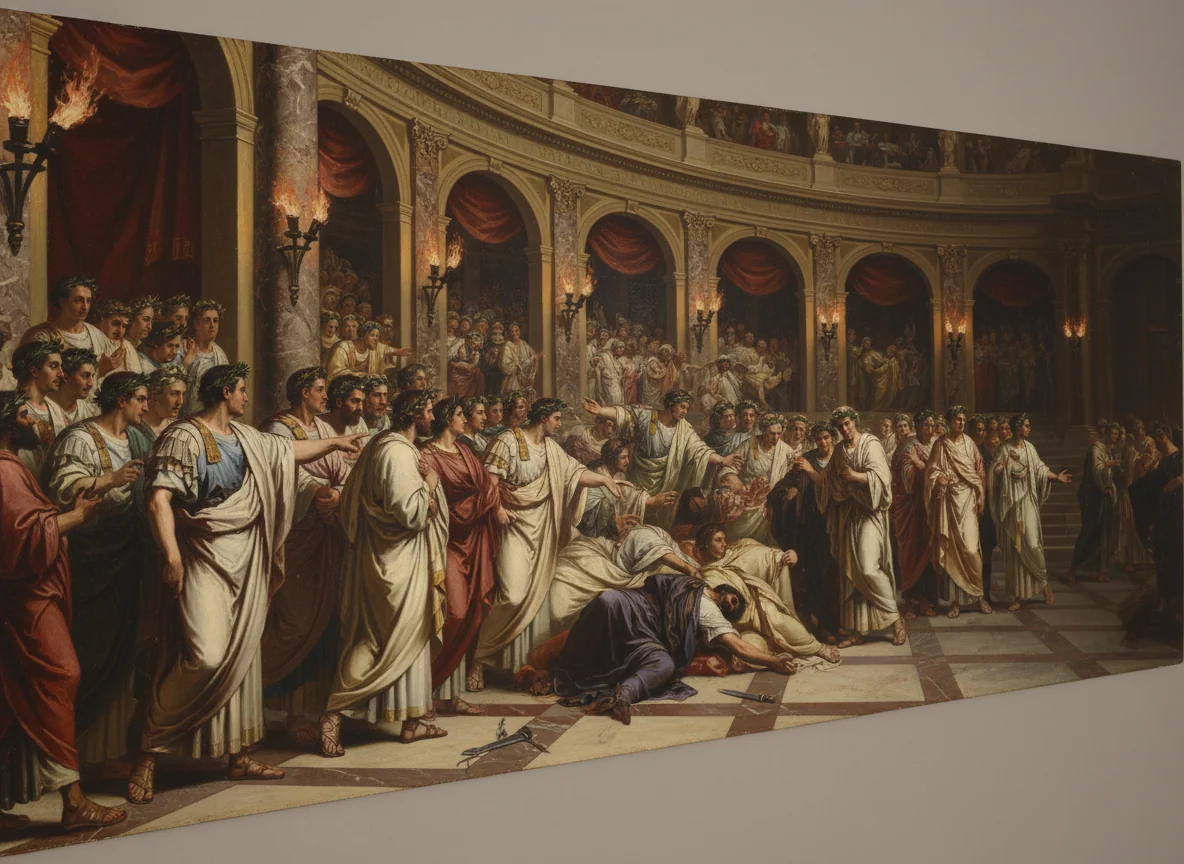
The Most Famous Murder in History
Imagine a man who had everything. He had conquered the wild forests of Gaul, crossed the Rubicon in a gamble that redefined destiny, defeated his greatest rival, Pompey the Great, and effectively ruled the known world. At 55 years old, Julius Caesar was not just a leader; he was a living legend. But as he walked into a meeting room on a sunny morning in 44 BC, he wasn't walking into a celebration of his power—he was walking into a trap.
The paradox of the julius caesar assassination is that the man who had survived countless battles, escaped pirates, and outmaneuvered the finest generals of his age was brought down not by an army, but by a circle of men he considered his peers, his colleagues, and in some cases, his friends. It is the ultimate political thriller, a story of betrayal, paranoia, and a fatal miscalculation that changed the course of human history forever.
Why They Killed Him: The Fear of a King
To understand why was julius caesar killed, we have to look at the Roman psyche. The Romans had a visceral, ancestral hatred for the word "King" (Rex). For centuries, the Republic had been built on the idea that no single man should hold absolute power. Caesar, however, was systematically dismantling that tradition.
By 44 BC, Caesar had been named dictator perpetuo—dictator in perpetuity. In plain English, he had just declared himself the leader for life. While Caesar claimed he was merely streamlining the government, the Roman Senate saw a tyrant in the making. They watched as he wore the purple robes of ancient kings and had his image placed on coins—honors usually reserved for gods or deceased heroes.
This sparked a desperate paranoia among the nobility. Leading the charge were Gaius Cassius Longinus, a man driven by a mixture of political ideology and personal grudge, and Marcus Junius Brutus. Brutus was the most tragic figure in the plot; he was a close friend of Caesar, and perhaps even a protégé. However, Brutus believed his ancestral duty to the Republic outweighed his personal loyalty to the man. For the conspirators, killing Caesar wasn't just a crime—they framed it as a patriotic necessity to "save" Rome from a monarchy.
The Ides of March: How the Plot Unfolded
The conspiracy was far larger than just a few disgruntled senators. In reality, over 60 senators were involved in the plot, creating a clandestine network of betrayal right under Caesar's nose. As the date of March 15—the ides of march—approached, the tension in Rome was suffocating.
The universe seemed to be screaming at Caesar to stay home. First, there was the famous soothsayer who had warned him months prior to "beware the Ides of March." Then there was his wife, Calpurnia. Haunted by nightmares of her husband being murdered in her arms, she begged him not to attend the Senate session. For a moment, it worked; Caesar considered staying home.
However, the conspirators were masters of manipulation. Decimus Brutus, another trusted associate, visited Caesar and mocked his superstitions, telling him that the Senate was waiting to bestow a great honor upon him. As Caesar walked toward the meeting, a man reportedly handed him a written warning detailing the plot. In a moment of fatal arrogance or haste, Caesar never read the letter. He walked straight into the jaws of death.
The Killing: 23 Stab Wounds
Because the official Senate house (the Curia Julia) was under repair, the meeting was held at the Theatre of Pompey. The irony was thick: Caesar was murdered in a building named after the very rival he had defeated to gain power.
The attack was a choreographed chaos. To get close enough to strike, the conspirators surrounded Caesar under the guise of presenting a petition. Tillius Cimber grabbed Caesar’s toga, pulling it down from his shoulders—the signal to attack. Suddenly, the senators drew hidden daggers. The first blow was struck by Casca, who stabbed Caesar in the neck.
Caesar fought back at first, reportedly catching a dagger with his hand. But as more senators joined in, he was overwhelmed. In total, julius caesar death was the result of 23 stab wounds. According to later medical examinations by a physician, only one of those wounds—a strike to the chest—was actually fatal. The rest were the result of a frenzied, collective rage.
"Et tu, Brute?" (And you, Brutus?)
While historians debate if Caesar actually spoke these words, the sentiment captures the horror of the moment. Seeing Brutus—his friend and confidant—among the killers, Caesar allegedly stopped fighting. He pulled his toga over his head, choosing to die in dignity rather than plead for his life from those he had loved.
The Conspiracy That Failed
The conspirators made one fatal mistake: they had a plan for the murder, but no plan for the aftermath. They believed that once the "tyrant" was dead, the people of Rome would cheer and the Republic would spontaneously restore itself. They were wrong.
The vacuum of power was immediately filled by Mark Antony, Caesar's loyal lieutenant. During Caesar's public funeral, Antony delivered a masterclass in psychological warfare. By highlighting Caesar's generosity to the poor and reading his will—which left a sum of money to every single Roman citizen—Antony turned the public's grief into a violent rage against the assassins.
The result was not a return to the Republic, but 13 years of brutal civil war. Brutus and Cassius were eventually hunted down and defeated at the Battle of Philippi, where both committed suicide. The chaos only ended when Caesar's adopted heir, Octavian (later known as Augustus), emerged victorious.
The ultimate irony of the roman senate assassination is that by killing Caesar to prevent a monarchy, the conspirators ensured its arrival. Augustus became the first official Emperor of Rome, wielding more power than Julius Caesar had ever dreamed of. The Republic didn't just die on the Ides of March; it was buried by the very men who claimed to be its saviors.