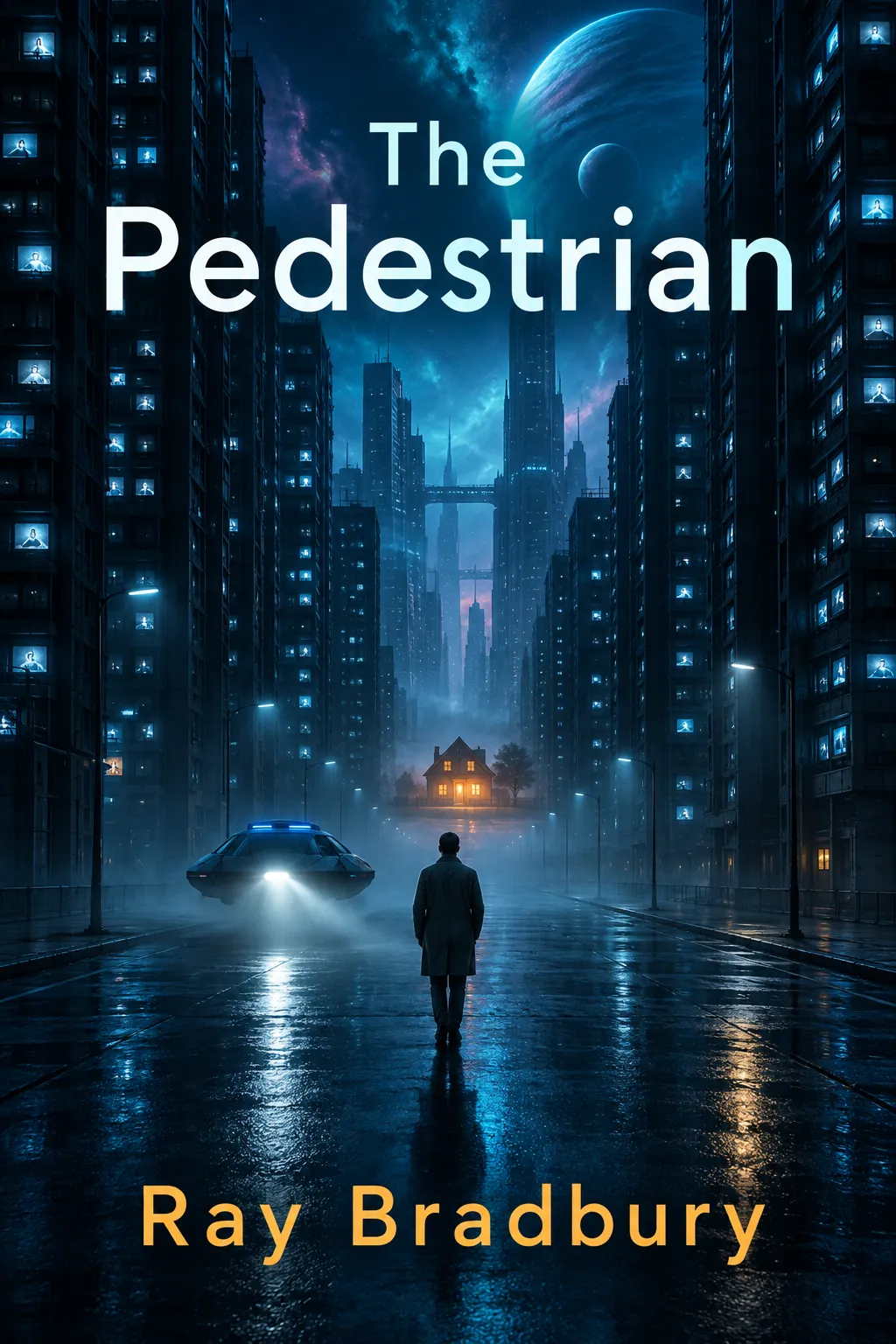
The Pedestrian
Tác giả: Ray Bradbury
Ray Bradbury's 'The Pedestrian' (1951) is a short story about Leonard Mead, a writer who takes a walk every evening through the silent streets of a future city. Everyone else sits indoors watching television, so his habit looks strange, even suspicious, to the only authority left, an automated police car. The story is about what happens when a quiet, harmless choice goes against the way a whole society has agreed to live.
Dùng thử Audible · Là thành viên Amazon Associates, chúng tôi nhận hoa hồng từ các giao dịch mua đủ điều kiện. Chi tiết
Ý Tưởng Chính
"In a 2053 city where everyone stays home with their screens, a man who simply walks at night is treated as a threat. Bradbury asks what a society loses when it stops using its own streets."
Những Hiểu Biết Cốt Lõi
Normal can become a weapon
The police car never accuses Mead of harming anyone. It only observes that he is doing something nobody else does. Bradbury shows that when a society treats its own habits as the definition of normal, a harmless difference starts to look like a disorder, and the people in charge feel justified in correcting it.
The car sends Mead to a center for 'regressive tendencies' only because he walks and owns no television.
Technology as a quiet jailer
There is no brutal guard in the story, only a machine that follows rules. The danger comes from a system that cannot listen, bend or ask why. Bradbury suggests that handing judgment to automatic processes can feel safe and fair while removing every chance for a human answer.
The car repeats its questions and records 'no profession' without ever asking what a writer is.
Walking as a form of attention
For Mead, walking is not exercise. It is a way to notice the air, the houses and the empty city that others no longer see. The story treats attention as a freedom, and implies that people who stop going outside also stop looking at their world and at one another.
Mead listens at dark windows and finds that the whole street is humming with the same grey light.
A writer without readers
When Mead says he is a writer, the car decides he has no profession. Bradbury links the disappearance of the street to the disappearance of books and magazines. A culture that no longer reads or talks has little use for the people who make stories, and that makes Mead lonely as well as odd.
His house is the only lit one, a small sign of a mind still at work in a dark neighbourhood.
Tóm Tắt Chương
Chapter-by-chapter summary
Spoiler warning: this section covers the whole plot, including the ending.
The Pedestrian has no numbered chapters, so this guide splits the story into six natural parts.
Part 1: A November evening in a silent city
On a misty November evening in 2053, Leonard Mead steps out of his front door to begin his nightly walk. The streets are wide, empty and quiet, and he moves along them like a traveller crossing a desert.
Behind every window the same grey-blue light flickers, the glow of television screens. Mead imagines the houses as tombs, with the people inside sitting like the dead.
This opening matters because it sets up the whole conflict. Mead is the only living thing moving through a city that has gone to sleep with its eyes open.
Part 2: Walking as a private joy
Mead does not walk because he has to. He walks because he loves the cool air, the smell of the night and the chance to see his city properly.
Over the years he has covered a huge distance on foot, and in all that time he has almost never met another walker. He listens for sounds behind the dark windows and hears only the faint murmur of the screens.
This part shows how much the habit means to him. It makes his treatment later in the story feel unfair rather than merely strange.
Part 3: The police car appears
As Mead crosses an intersection, a bright light snaps on and pins him in place. A police car, the only one the city still needs, has rolled up silently behind him.
A flat, metallic voice orders him to stand still. Mead realises that nobody is sitting inside, and that a machine is speaking to him through a speaker.
The mood turns from dreamy to tense here. The car is not cruel, it is simply a system, and that is exactly what makes it frightening.
Part 4: Questions a machine cannot understand
The car demands his name, his business and his reason for being outside. Mead answers politely that he is only out walking, and the machine treats this answer as one that does not compute.
When it asks about his work, Mead says he is a writer, and the car records him as having no profession. In this world nobody reads what a writer makes, so the word means nothing.
The car also notes that he has no television in his house and no wife. Each answer makes him look less like a person and more like a fault to be repaired.
The dialogue shows how a society can define normal so narrowly that ordinary human habits start to count as symptoms.
Part 5: Taken away
The car announces that Mead will be taken to the Psychiatric Center for Research on Regressive Tendencies. The back door opens onto a small, cold compartment, more like a cell than a seat.
Mead objects only mildly, and the car answers with the same flat politeness. There is nobody to appeal to, and he gets in.
The injustice here is quiet. Nothing is done with violence, and the machine simply follows its rules, which is enough to take away his freedom.
Part 6: The lit house
The car drives off through the empty streets with Mead inside. It passes the dark houses, where the screens go on flickering as if nothing had happened.
The story ends on a different image. Mead's own house stands on the street with every window lit in warm yellow, the only bright house in the neighbourhood.
That final contrast, one warm home against rows of grey flicker, leaves the reader to decide what has really been lost.
Characters
- Leonard Mead: the protagonist, a solitary writer who walks every night for pleasure. He is gentle, curious and honest, and his only 'crime' is that he enjoys something nobody else does any more.
- The police car: an automated vehicle with no driver, the city's only police unit. Its voice is polite and flat, and it can only compare people with its rules, never understand them.
- The residents: the unseen people behind the windows, lit by their screens. They never speak, and their silence shows how easily a whole population can settle into the same habit.
- The city: wide, clean, quiet and almost empty. It works like a character because its stillness is the pressure that Mead walks against.
- The Psychiatric Center: the institution that waits at the end of the ride. It is never shown, but it stands for a society that treats difference as an illness.
Background: 1951 and the road to Fahrenheit 451
Bradbury's story first appeared in 1951 in a magazine and was collected in 1953 in the book The Golden Apples of the Sun. It belongs to the same period as the stories that grew into his famous novel.
If you like the mood, read Fahrenheit 451 by Ray Bradbury, which develops the same fear of screens, quiet streets and a society that distrusts people who think and read for themselves.
Writing about this book
Start with one clear question that the story raises, such as why a harmless walk is treated as a danger. A strong answer picks a single idea and follows it through the story.
Use specific moments as evidence. The flickering windows, the car's cold questions, the 'no profession' answer and the lit house at the end all work well.
Notice how Bradbury lets the machine, not a villain, carry the threat. Explain how that choice makes the story feel closer to real life.
Compare the opening and the ending. The street starts silent and grey, and ends with one warm house, so you can discuss how contrast shapes the message.
Keep your own voice. Say what you would have done in Mead's place, and say whether you think the story is a warning, a joke or both.
Quote only a few words at a time and explain each one, because the story is short and a long quotation will take over your essay.
Hành Động Ngay
Các bước thực tế bạn có thể thực hiện ngay hôm nay:
-
Notice how much of your day is spent inside screens, and choose one short walk without your phone to compare.
-
When a rule says something is normal, ask who decided it and whether anyone is actually harmed.
-
Read short stories like this one slowly, and look for the image that stays with you at the end.
-
Use the contrast between the dark houses and the one lit house as a starting point for any essay or discussion.
Trích Dẫn Đáng Nhớ
"“To enter out into that silence that was the city at eight o'clock of a misty evening in November” (Part 1)"
— Ray Bradbury
"“Walking for air. Walking to see.” (Part 4)"
— Ray Bradbury
"“Psychiatric Center for Research on Regressive Tendencies” (Part 5)"
— Ray Bradbury
Ai Nên Đọc Cuốn Này
The Pedestrian is a good first Bradbury story for readers aged about 12 and up. It takes about fifteen minutes to read and works well for middle school, high school and early college classes on science fiction, technology and conformity. It is also a helpful bridge to Fahrenheit 451 for readers who want to see where those ideas started.
Muốn đọc trọn cuốn sách?
Đọc hoặc nghe trọn vẹn The Pedestrian.
Dùng thử Audible · Là thành viên Amazon Associates, chúng tôi nhận hoa hồng từ các giao dịch mua đủ điều kiện. Chi tiết
Về Ray Bradbury
Ray Bradbury (1920–2012) was an American writer born in Waukegan, Illinois. He is best known for Fahrenheit 451, The Martian Chronicles and The Illustrated Man. He wrote hundreds of short stories that mixed science fiction, fantasy and horror, and he spoke up for libraries and reading throughout his life.
Tóm Tắt Được Viết Bởi

Kỹ sư phần mềm & Nhà văn
Kỹ sư phần mềm với niềm đam mê chuyển đổi ý tưởng phức tạp thành hiểu biết thực tiễn. Viết về tài chính, đầu tư, khởi nghiệp và công nghệ.
Xem tất cả tóm tắt →Đánh Giá
Chưa có đánh giá nào. Hãy là người đầu tiên chia sẻ suy nghĩ của bạn!
Viết Đánh Giá
Đọc tiếp
Khám phá chủ đề: Khoa học viễn tưởngTóm tắt sách

Tóm Tắt Sách Vượt Qua Giới Hạn (Out of My Mind)
Sharon M. Draper
“Out of My Mind” by Sharon M. Draper is a poignant narrative that explores the life of Melody Brooks, a…

Tóm Tắt Sách Ender’s Game
Orson Scott Card
“Ender’s Game” by Orson Scott Card is a riveting science fiction novel that transports readers into a future where humanity…

Tóm Tắt Sách Pachinko (Pachinko)
Min Jin Lee
“Pachinko”, a spellbinding multigenerational historical saga by Min Jin Lee, explores the lives of a Korean family trying to make…

Tóm Tắt Sách Những Ưu Ái Của Kẻ Vô Hình (The Perks of Being a Wallflower)
Stephen Chbosky
The Perks of Being a Wallflower by Stephen Chbosky is a profound coming-of-age novel, told through the intimate letters of…
Bài Viết

Chủ đề A Christmas Carol: lòng hào phóng, sự cô lập và trách nhiệm
Truyện ngắn của Dickens thường được đọc như câu chuyện về một người đàn ông thay đổi suy nghĩ. Nhưng…

Proxima Centauri
Proxima Centauri là ngôi sao gần Mặt Trời nhất, cách khoảng 4,25 năm ánh sáng. Đây là một sao lùn…

Giãn nở thời gian
Giãn nở thời gian là hiệu ứng được thuyết tương đối của Einstein dự đoán và đã được đo đạc:…