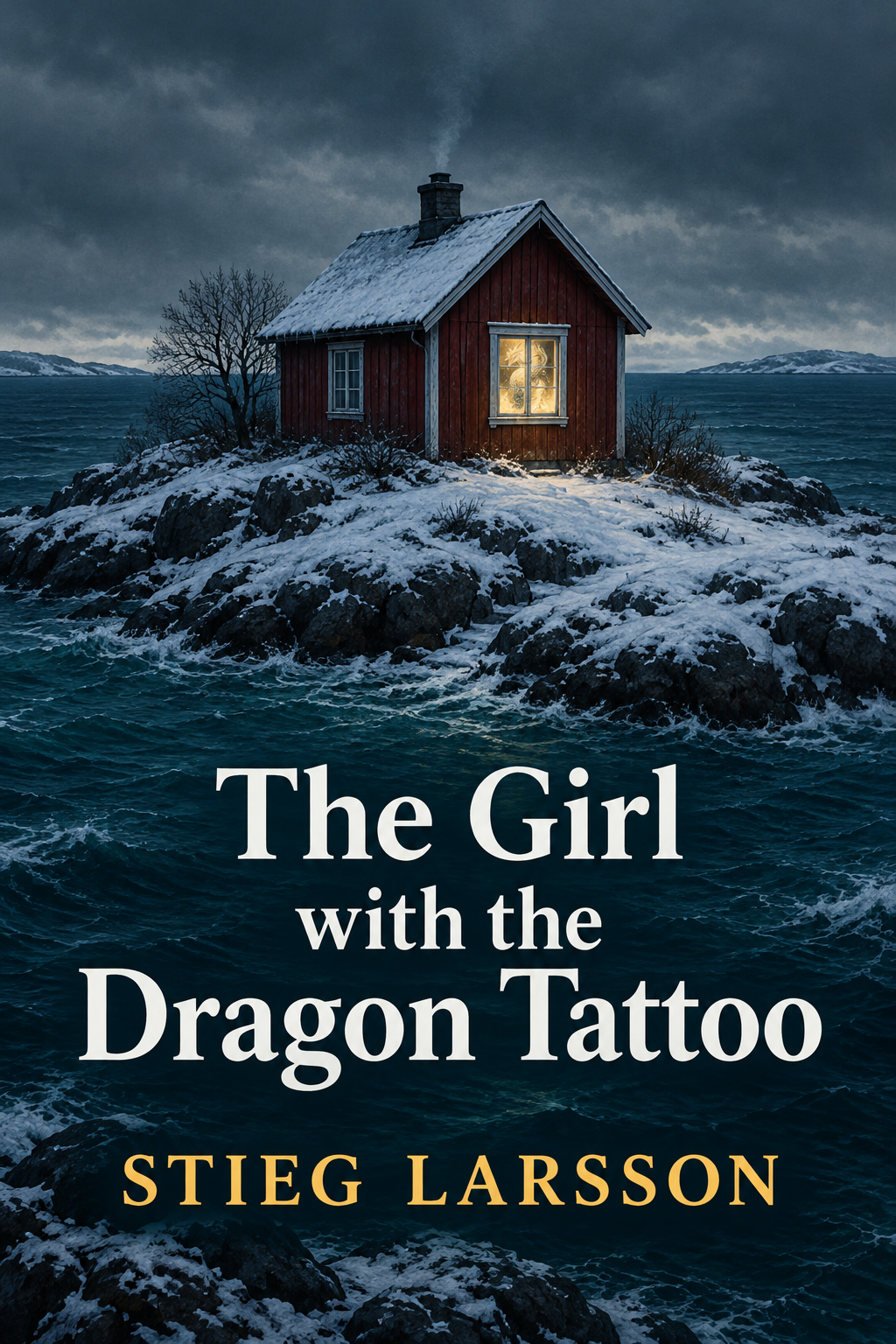
The Girl with the Dragon Tattoo
Tác giả: Stieg Larsson
The Girl with the Dragon Tattoo is a Swedish crime thriller. Mikael Blomkvist, a magazine journalist who has lost a libel case, takes on a job: former industrialist Henrik Vanger wants him to look into the 1966 disappearance of his grand-niece, Harriet, whom he believes was murdered by someone in the family. Lisbeth Salander, a gifted and guarded hacker, joins the search. The book is a slow-burning puzzle about family secrets and the violence hidden behind respectable walls.
Ý Tưởng Chính
"A journalist and a hacker follow a 1966 disappearance into a wealthy family's past, and the book argues that the worst violence often hides behind respectability."
Những Hiểu Biết Cốt Lõi
Violence behind respectability
The book's central warning is that serious violence often hides behind a respectable name, a family business or a legal role. Martin Vanger is trusted as a company leader, and Nils Bjurman is a lawyer who was meant to protect Salander. The Swedish title, Men Who Hate Women, names this problem directly, while the English and Japanese titles focus on Salander's tattoo instead.
Salander's own guardian uses the authority he was given to hurt her, so the person meant to protect her becomes the source of the danger.
Silence has a cost
Families and institutions protect themselves by staying quiet, but silence has a long cost. The people left behind carry the damage for decades, and a lie that keeps a secret safe can shape many lives at once.
Harriet fled the island and stayed away for decades, so the family's story about her was wrong for almost as long as the silence lasted.
Journalism under pressure
A journalist can be discredited by powerful people, and the book shows that a source can have motives of their own. Blomkvist loses his case and is weakened, but he keeps checking facts and working with people who find what is hidden, and that work finally brings the truth out.
The documents behind his libel defeat were planted by an informant, but Salander's copy of Wennerstrom's files gives him a way to fight back.
Who gets believed
The people the system is meant to protect are often the least heard. Salander is judged, categorised and controlled by people who hold power over her, while her skill with information makes her one of the few people who can find the truth.
When the system fails her, Salander has to protect herself, and her research is what breaks the case open.
Tóm Tắt Chương
Chapter-by-chapter summary
Spoiler warning: this section covers the whole plot, including the ending.
Prologue to Chapter 4: The offer
The prologue shows Henrik Vanger, an old industrialist, receiving a pressed flower on his birthday, as he has every year since his grand-niece Harriet vanished in 1966. In the first chapters, Mikael Blomkvist, part-owner of the magazine Millennium, loses a libel case over his reporting on the financier Hans-Erik Wennerstrom and is sentenced to three months in prison. Lisbeth Salander, a researcher at a security firm, writes a thorough report on him for a client she does not know. That client is Henrik. In Chapter 4 he makes his offer. Blomkvist will write the Vanger family history, and Henrik promises material against Wennerstrom in return. The real task is to find out who in the family killed Harriet. Why it matters: the offer turns a disgraced journalist's cover job into the book's central investigation.
Chapters 5 to 18: Two investigations
Blomkvist moves into a cottage on the Vanger estate and starts on the police files, the family tree and the photographs of the 1966 Children's Day parade, the day Harriet disappeared. Salander's story runs beside his. Her court-appointed guardian, Nils Bjurman, abuses the power he has over her. The book shows her backstory and then her answer: she records him and takes control, forcing him to leave her alone. By the end of this stretch Blomkvist is working with Salander as his researcher. Why it matters: two separate cases, one about a vanished girl and one about a guarded young woman, begin to show the same pattern of abuse hidden behind a respectable role.
Chapters 19 to 23: The pattern and the trap
Henrik is in hospital, and several Vangers, including Cecilia, want the investigation stopped. Martin Vanger, Harriet's brother and the company's chief executive, stays friendly. In Chapter 19, Salander links names in Harriet's date book, together with the Bible verses written beside them, to a series of murdered women, one of them killed in 1960. In Chapter 21, an enhanced parade photograph shows a man in a dark jacket with a red patch on the shoulder, and the pair find a burned, mutilated cat on the porch. In Chapter 22, someone shoots at Blomkvist while he is jogging. The first bullet hits a concrete wall, and a chip of concrete cuts his temple. In Chapter 23, Blomkvist finds old photographs that explain why Cecilia seems to appear in so many of them: the woman in Harriet's room that day was her sister, Anita. Another photograph shows the man in the dark jacket, and he is Martin. Blomkvist goes to Martin's house, and Martin pulls him into a basement built for torture and chains him to the floor. Why it matters: the investigator walks straight into the killer's home just as the pattern comes together.
Chapters 24 to 27: Rescue and answers
In Chapter 24, Salander works out that Martin is the killer and reaches his house in time. In the basement, Martin explains that his father, Gottfried, murdered the first seven women on Blomkvist's list, and that he himself killed the eighth and kept going. Salander beats him with a golf club and cuts Blomkvist down from a noose. Martin flees by car, and Salander follows on her motorcycle. Martin drives straight into a truck and dies. In Chapter 25, Salander removes the evidence from his house, and she and Blomkvist realise that photographs found there show the teenage Harriet. In London they trace a call from Anita Vanger to a woman in Australia. In Chapter 26, Blomkvist finds Harriet on a sheep farm. She tells him that Gottfried raped her for a year, and that one night she held him under the water of the lake and killed him. Martin then abused and threatened her. Anita helped her leave the island and gave her a passport. In Chapter 27, Harriet returns to Henrik. She had sent the flowers so that he would know she was alive. Henrik asks Blomkvist not to publish Martin's crimes, and Blomkvist reluctantly agrees. Salander tells him that she has a copy of everything on Wennerstrom's computer. Why it matters: the family's story about Harriet was wrong, and the truth was worse than a single murder.
Chapter 28 and the Epilogue: Wennerstrom falls
Blomkvist learns how Salander broke into Wennerstrom's computer: she attached a device to his broadband connection and can watch everything he does. The documents behind Blomkvist's libel defeat were planted by an informant, and a Millennium employee, Janne Dahlman, has been passing information to Wennerstrom. Blomkvist plans a special issue of the magazine, and Harriet, now head of the Vanger company, joins its board. Salander also moves money out of Wennerstrom's accounts. The epilogue shows the special issue going out. It shakes the Swedish stock market and reveals the empire's links to criminal networks, and news reports soon announce Wennerstrom's demise. Why it matters: the corporate case closes, while Salander's own story is left open for the sequels.
Characters
- Mikael Blomkvist: A journalist and part-owner of Millennium, known for his reporting and for the libel case that damaged his name. He is patient and stubborn, and once he has a question he will not let it go, even when the people around him want it closed.
- Lisbeth Salander: A gifted hacker and researcher who grew up under state guardianship. She is private, sharp and hard to read, and she is better than almost anyone at finding what others have hidden, including the secrets in her own past.
- Henrik Vanger: A former head of the Vanger industrial group and the family's senior figure. For almost four decades he has held onto the question of what happened to his grand-niece, and he hires Blomkvist to finally answer it.
- Harriet Vanger: Henrik's grand-niece (he usually calls her his niece), who vanished in 1966 and was long presumed murdered. She is the book's central mystery. She fled the island after the abuse she suffered, and her reappearance changes how the whole story should be read.
- Martin Vanger: Harriet's brother and the company's chief executive. He is a respected figure in the family and the business, and he is also the killer whose crimes continue into the present day.
- Hans-Erik Wennerstrom: A wealthy financier at the centre of Blomkvist's libel case. He is powerful and secretive, and he planted an informant to feed Blomkvist false documents. Salander's hacking shows how much more he has been hiding.
- Nils Bjurman: Salander's court-appointed guardian and lawyer. He abuses the legal power he holds over her. His role shows how a position meant to protect someone can be used to harm them.
- Erika Berger: Millennium's editor-in-chief and co-owner. She works closely with Blomkvist, and the magazine she runs is where the book's journalism plays out. Her decisions shape what the public learns.
Writing about this book
If you are writing a book report on this novel, start with a question rather than a summary. Blomkvist and Salander both work from the margins, and both are doubted by people with more power. Compare how each of them earns trust, and what that costs them.
Ask why the family kept its silence for so long. Was it loyalty, fear or self-protection? Your answer will change how you read the family's respectable public face, which the book treats with suspicion.
The book also asks you to think about violence that hides behind a good name. Think of a case from your own world where a respected role made a problem harder to see, and compare it with the novel.
Keep the report in your own words, and name the chapter whenever you refer to a scene. Strong reports show what you noticed, not just what happens.
Hành Động Ngay
Các bước thực tế bạn có thể thực hiện ngay hôm nay:
-
Track who controls the information in each scene, because that often shows where the danger is.
-
When a family or company works hard to protect its reputation, ask who benefits from the silence.
-
Notice how the book uses an old crime to show that violence can continue in the present.
-
If you enjoy the puzzle, read The Girl Who Played with Fire next, which explores Salander's past further.
Trích Dẫn Đáng Nhớ
"I want you to find out who in the family murdered Harriet (Chapter 4)"
— Stieg Larsson
"I assume that something happened to Harriet here on the island (Chapter 5)"
— Stieg Larsson
"So in effect I've spent half my life collecting information about a single day. (Chapter 6)"
— Stieg Larsson
"Everyone has secrets. It's just a matter of finding out what they are. (Chapter 2)"
— Stieg Larsson
Ai Nên Đọc Cuốn Này
Readers who enjoy slow-burning crime thrillers, family mysteries and stories about investigative journalism. The book contains scenes of sexual and violent crime, so it is written for adult readers rather than school-age readers. Expect a long, patient read, and it rewards close attention to who knows what, and when.
Về Stieg Larsson
Stieg Larsson (1954 to 2004) was a Swedish journalist and author. For years he investigated far-right groups and other abuses of power, and he wrote fiction from that experience. He died in 2004, before the first Millennium novel appeared in Swedish in 2005. The series went on to become a worldwide bestseller.
Tóm Tắt Được Viết Bởi

Kỹ sư phần mềm & Nhà văn
Kỹ sư phần mềm với niềm đam mê chuyển đổi ý tưởng phức tạp thành hiểu biết thực tiễn. Viết về tài chính, đầu tư, khởi nghiệp và công nghệ.
Xem tất cả tóm tắt →Đánh Giá
Chưa có đánh giá nào. Hãy là người đầu tiên chia sẻ suy nghĩ của bạn!
Viết Đánh Giá
Đọc tiếp
Khám phá chủ đề: Truyện hư cấuTóm tắt sách

Tóm Tắt Sách Vượt Qua Giới Hạn (Out of My Mind)
Sharon M. Draper
“Out of My Mind” by Sharon M. Draper is a poignant narrative that explores the life of Melody Brooks, a…

Tóm Tắt Sách Ender’s Game
Orson Scott Card
“Ender’s Game” by Orson Scott Card is a riveting science fiction novel that transports readers into a future where humanity…

Tóm Tắt Sách Pachinko (Pachinko)
Min Jin Lee
“Pachinko”, a spellbinding multigenerational historical saga by Min Jin Lee, explores the lives of a Korean family trying to make…

Tóm Tắt Sách Những Ưu Ái Của Kẻ Vô Hình (The Perks of Being a Wallflower)
Stephen Chbosky
The Perks of Being a Wallflower by Stephen Chbosky is a profound coming-of-age novel, told through the intimate letters of…
Bài Viết

Thời Khai sáng là gì? Ý tưởng, nhà tư tưởng và di sản
Khai sáng là phong trào tư tưởng châu Âu thế kỷ 18, đề cao lý tính và bằng chứng hơn…

Lịch sử thế giới 1700–1918: Cách mạng, công nghiệp, đế quốc và chiến tranh
Từ 1700 đến 1918, cách mạng, nhà máy, đế chế và một cuộc chiến tranh thế giới đã định hình…

Chủ đề A Christmas Carol: lòng hào phóng, sự cô lập và trách nhiệm
Truyện ngắn của Dickens thường được đọc như câu chuyện về một người đàn ông thay đổi suy nghĩ. Nhưng…