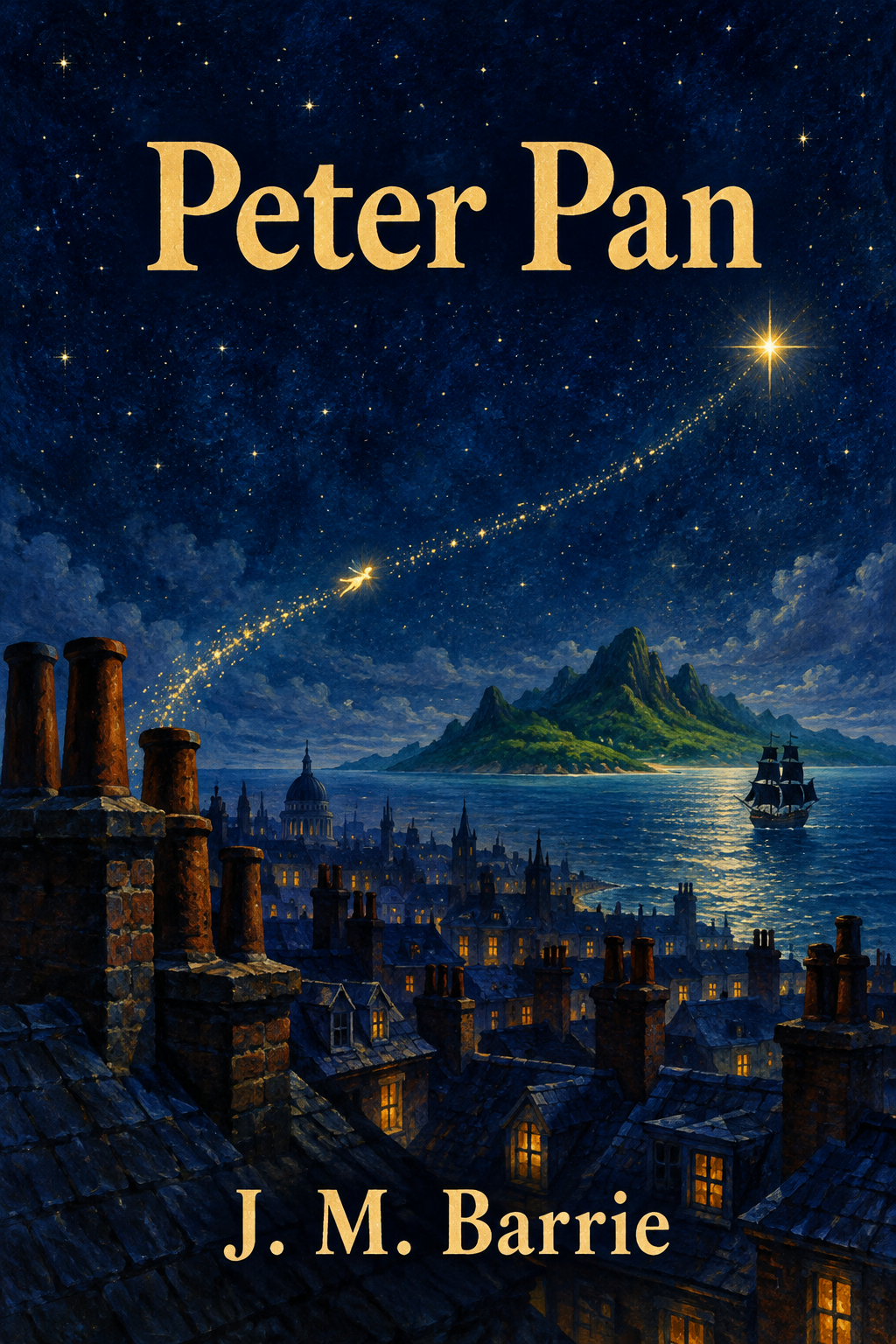
Peter Pan
Tác giả: J. M. Barrie
Peter Pan is J. M. Barrie's story of the Darling children, who fly out of their London nursery with a boy named Peter. He takes them to Neverland, an island of pirates, fairies and lost boys, where Captain Hook is the enemy. The book is about imagination and adventure, and about the pull of home and childhood. It is also darker than its reputation, with real fear and a sharp look at what it means to stay a child forever.
Ý Tưởng Chính
"Peter Pan asks what it costs to refuse growing up, and why a home, with its stories and its people waiting, is so hard to leave behind."
Những Hiểu Biết Cốt Lõi
Refusing to grow up
Peter’s wish to stay a boy is both freedom and loss. Barrie shows that the freedom of never growing up comes with a cost: Peter can play forever, but the people around him pay for it.
In chapter 11, Peter says he wants to stay a little boy and keep having fun. The appeal of that wish is easy to feel, and the book makes sure readers also notice who is left behind by it.
Home as the centre
The nursery, the family and the bedtime routine form the book’s safe centre. However exciting the island is, the story keeps pulling back to the warmth of home, which it treats as both comfort and limit.
In chapter 7, Wendy keeps house for the boys in their underground home, building a family life out of very little. In chapter 11, she decides to take them back to their parents. She is both a child and a mother figure, and that double role gives her choice its weight.
Imagination that lifts and endangers
In this book imagination is more than play: it can lift a person into the air. Peter teaches that happy thoughts make flying possible, but the same power leads to real danger on the island.
In chapter 3 the children learn that a thought can carry them away from home, and they choose to go. By chapter 5 the island’s dangers are plainly real, not a game. The make-believe world slowly overlaps with the real one.
Fear, death and dated portrayals
The book is darker than its cheerful reputation. Hook’s dread of the crocodile, the poisoned medicine and the fights on the pirate ship show that the stakes are real. Peter’s casual view of death, and the stereotyped picture of the island’s native people, both deserve a critical look.
In chapter 8, alone on the sinking rock, Peter feels a brief shudder of fear, and then the thought that to die will be an awfully big adventure beats inside him like a drum. The line sounds carefree and frightening at once, which is why many readers stop on it.
Tóm Tắt Chương
Chapter-by-chapter summary
Spoiler warning: this section covers the whole plot, including the ending.
Chapter 1: Peter Breaks Through
We meet the Darlings in their London house: Mr and Mrs Darling, their children Wendy, John and Michael, and Nana, the Newfoundland dog who looks after the nursery. Mrs Darling finds the name “Peter” written in the children’s minds, and Wendy says he visits the nursery at night. Then a boy drops through the window with a glowing fairy, and he bares his teeth at Mrs Darling. Mr Darling dismisses the story as nonsense that Nana has put into the children’s heads. Why it matters: the wonder enters the most ordinary room in the house, which makes the fantasy feel close to home.
Chapter 2: The Shadow
Mrs Darling screams, and Nana rushes in and lunges at the boy as he escapes through the window. Nana catches his shadow as the window closes, and Mrs Darling rolls it up and puts it away in a drawer. After a muddle over Michael’s medicine, Mr Darling chains Nana up in the back yard, and the parents leave for a party next door. Wendy senses danger, but the house still looks ordinary. Why it matters: a shadow that can come loose from its owner is a sharp image of the book’s central question: what part of us stays behind when we grow up?
Chapter 3: Come Away, Come Away!
Peter comes back for his shadow, and Wendy sews it on for him. In return he teaches the children to fly: they only need to think lovely thoughts and they rise into the air. He persuades Wendy and her brothers to fly away with him, and when their parents rush home, the children have already gone. Peter gives them the way to Neverland: “Second to the right, and then straight on till morning.” Why it matters: this is the moment the children choose adventure over the safe home, and Barrie makes that choice feel light and thrilling.
Chapter 4: The Flight
The children fly through the night over London and out over the sea. The pirates fire Long Tom, a great gun, and in the dark the children are scattered. Tinker Bell, jealous of Wendy, flies ahead signalling “Follow me” and leads Wendy away from her brothers. Why it matters: jealousy and a gun fired in the dark split the children up before they even reach the island.
Chapter 5: The Island Come True
The children reach Neverland, which looks just as they had imagined it, with pirates, the island’s people and wild beasts. Hook plans a rich cake with green sugar and leaves it on the shore of the Mermaids’ Lagoon, where the Lost Boys swim, hoping they will eat it and die. Tinker Bell tells the Lost Boys that Peter wants them to shoot Wendy. Tootles fires, and the arrow strikes the kiss Peter gave her, which hangs on her chain, and it saves her life. Why it matters: the danger on the island is real, not a game, and the chapter brings the rivalry between Peter and Hook into the open.
Chapter 6: The Little House
Tootles is horrified to learn that he has shot a lady. The Lost Boys build a little house around the injured Wendy, and she becomes their mother figure in their rough, loyal world. Their concern is real, even if their manners are rough. Why it matters: the chapter shows the boys’ clumsy but genuine care for one another, and it sets up Wendy’s role as the book’s homemaker.
Chapter 7: The Home Under the Ground
The boys’ home lies under the ground, and Wendy keeps house for them. Peter starts a game of pretending not to have adventures. The boys copy the dull, ordinary things John and Michael do, such as sitting on stools and going for walks. The narrator then chooses the next adventure to tell, and the Mermaids’ Lagoon comes next. Why it matters: a new family life forms on the island, and the book shows it with warmth and a little comedy.
Chapter 8: The Mermaids’ Lagoon
Wendy is stranded on Marooners’ Rock as the tide rises, and Smee and Starkey have left Tiger Lily tied up on the rock. Peter copies Hook’s voice and orders the pirates to cut her ropes, and she escapes into the water. The real Hook arrives, and when Peter helps him up onto the rock, Hook bites him. Michael’s kite carries Wendy away, and Peter is left alone on the rock as it begins to sink. A brief shudder of fear passes through him, and the thought that to die will be an awfully big adventure beats inside him like a drum. Why it matters: the danger is at its most physical here, and Peter’s bravery and recklessness come into direct conflict.
Chapter 9: The Never Bird
Peter is left on the sinking rock until a Never bird gives him her nest. He drifts ashore in it. The chapter is lighter than the one before it, which lets the danger of the previous chapter settle. Why it matters: it reminds readers that the island’s adventures and the ordinary world of home run side by side in the same story.
Chapter 10: The Happy Home
At meals the Lost Boys constantly accuse one another of misdeeds, and they interrupt and grab food. Peter says he is not really their father. Wendy replies that they are her children too, and Peter admits that he feels only like a devoted son to her. Wendy sulks and sits apart. After supper the children dance in their nightclothes and have a pillow fight, then settle down for Wendy’s bedtime story. Why it matters: the chapter shows the household at its warmest, and also the first clear crack between Peter and Wendy. The book’s portrayal of the island’s people is dated, and modern readers should read it with care.
Chapter 11: Wendy’s Story
At bedtime Wendy tells a story about the parents at home and the children who flew away. Peter says Wendy is wrong about mothers, and claims that his own mother forgot him. The narrator doubts this is true. Peter says: “I just want always to be a little boy and to have fun.” Wendy decides the children must go home at once, and she asks Peter to arrange it. Why it matters: Wendy’s decision becomes a real choice, and Peter’s fear is shown as a wound, not just a joke.
Chapter 12: The Children Are Carried Off
Before dawn Hook attacks the island’s people by surprise. He orders Smee to beat the tom-tom, so that the Lost Boys believe the islanders have won. Believing it, the boys climb down from the trees and are captured. Why it matters: the game of adventure turns into real violence and fear, and Hook is shown to rely on cunning rather than courage.
Chapter 13: Do You Believe in Fairies?
The pirates tie up Wendy, John, Michael and the Lost Boys and carry them away. Hook poisons Peter’s medicine, and Tinker Bell drinks it to save Peter’s life and grows weak. Peter calls out to everyone who believes in fairies to clap, and Tinker Bell revives. Peter sets out to rescue Wendy and the boys. Why it matters: belief becomes the working mechanism of the plot, and the fairy’s fragility is what makes the rescue urgent.
Chapter 14: The Pirate Ship
Hook is aboard the Jolly Roger, and good form matters more to him than anything else. He offers the captive boys a place in his crew if they will swear against the King. Tootles answers first, saying his mother would not want him to be a pirate, and the other boys follow his lead. John and Michael refuse. Hook orders the plank readied and has Wendy brought up to watch. When she tells the boys to die like English gentlemen, Smee ties her to the mast. Then a ticking sound comes from the sea. Hook collapses in fear, crawls away and begs his men to hide him. The ticking is Peter, copying the crocodile to frighten the pirates. Why it matters: Hook is more than a simple villain here, and the book shows his fear and his strict code before the final confrontation.
Chapter 15: Hook or Me This Time
Still making the ticking sound, Peter climbs aboard and fights the crew. Starkey refuses to go into the cabin and, when Hook threatens him, he jumps into the sea. Cecco and Jukes go into the cabin and are killed there. Hook has a shell meant to set off the powder magazine, but Peter throws it overboard. Peter wounds Hook with his sword, and when Hook drops his sword, Peter hands it back. Hook climbs onto the side of the ship and invites Peter to kick him. Peter kicks him instead of stabbing him, and Hook jeers at Peter’s bad manners and goes into the sea toward the crocodile, content. Wendy is still tied to the mast, and Peter frees the boys before cutting Wendy’s bonds. Many pirates die. Starkey is later captured by Native American people, and Smee wanders the world. Why it matters: this is the book’s climax, and the victory is quick, bloody and far from clean.
Chapter 16: The Return Home
The children fly home. The narrator turns to the Darling house, where Mr Darling now sleeps in the kennel, vowing to stay there until they return. Peter tells Tinker Bell to bar the nursery window, so that Wendy is shut out and has to go back to the island with him. But when he sees Mrs Darling weeping, her sorrow moves him, and he unbars the window and flies off, saying he does not want silly mothers. Why it matters: home is the book’s destination, and Peter’s brief show of feeling suggests that his affection for Wendy is real even as he resists growing up.
Chapter 17: When Wendy Grew Up
The Darlings take in the Lost Boys, who go to school and gradually lose the ability to fly. In the end Mr Darling finds them amusing and accepts them. Peter comes for Wendy each spring-cleaning to take her back to Neverland. One year he misses a visit without realising it, and Wendy’s last visit with him comes after that. Wendy grows up, marries and has a daughter, Jane. Peter later comes for Jane, and then for Jane’s daughter, Margaret. Why it matters: Barrie lets the pattern repeat with each new girl, which is why the book is more than a fairy tale.
Peter Pan characters
- Peter Pan: a boy who refuses to grow up and lives in Neverland with the Lost Boys. He is brave, playful and quick to act, but he is careless about other people’s feelings and often forgets those who depend on him.
- Wendy Darling: the eldest Darling child, a natural storyteller who becomes the boys’ housekeeper and a mother figure. She is torn between the island and home, and in the end she chooses to go back.
- John and Michael Darling: Wendy’s brothers. John is the older, Michael the younger, and both go with her to Neverland. Michael’s kite carries Wendy away from danger at a crucial moment.
- Mr and Mrs Darling: the parents, who go out for the evening and return too late to stop their children flying away. Their waiting and grief give the family story its emotional weight.
- Nana: the Newfoundland dog who looks after the nursery. Her capture of Peter’s shadow sets the story in motion.
- Captain Hook: the pirate captain, obsessed with manners and good form. He is proud and terrified of the crocodile, and his rivalry with Peter drives the plot.
- Tinker Bell: a fairy who stays close to Peter. She is loyal to him but jealous of Wendy, and she drinks the poisoned medicine meant for Peter.
- The Lost Boys: Tootles, Nibs, Slightly, Curly and the Twins, boys who fell out of their prams and were never claimed. They live on the island with Peter and rely on Wendy for care.
- Tiger Lily: a girl from the island’s people, captured by the pirates. The book’s portrayal of her and her people is dated and should be read critically.
- Smee and Starkey: pirates who serve Hook. Smee is Hook’s loyal, slightly foolish sidekick. He beats the tom-tom that tricks the boys, ties Wendy to the mast, and survives the fight on the ship to wander the world afterwards. Starkey helps leave Tiger Lily tied up on the rock. He refuses to enter the cabin and jumps into the sea, and is later captured by Native American people.
Writing about this book
A strong book report on Peter Pan starts with a question, not a plot summary. Good questions include: is Peter’s refusal to grow up freedom or loss? Why does Wendy want to go home even when the island is exciting? What do the crocodile’s ticking, and Peter’s copy of it, tell us about Hook? Pick one question and build your argument from two or three short scenes, such as the flight in chapter 3, the bedtime story in chapter 11 and the fight on the ship in chapter 15.
Keep quotations short and name the chapter. Explain in your own words why a line matters, rather than repeating the book’s wording at length.
Also consider how the book portrays the island’s native people. Its language and its picture of them are dated by today’s standards. A good essay can say so plainly, then ask why Barrie wrote them that way and what that tells a reader about the time the book was written.
Hành Động Ngay
Các bước thực tế bạn có thể thực hiện ngay hôm nay:
-
Think of a childhood game you still enjoy, and write down what it gives you that your daily routines do not.
-
While you read, note which character wants to stay where they are, and ask what that wish protects.
-
For one week, jot down one line each time your imagination runs ahead of what is around you, and notice the pattern.
-
Compare the book with one film or stage version you know, list three changes, and ask what each one does to the mood.
Trích Dẫn Đáng Nhớ
"“Second to the right, and then straight on till morning.” (Chapter 3)"
— J. M. Barrie
"“I just want always to be a little boy and to have fun.” (Chapter 11)"
— J. M. Barrie
"“To die will be an awfully big adventure.” (Chapter 8)"
— J. M. Barrie
Ai Nên Đọc Cuốn Này
Readers aged about 10 and up who enjoy adventure, fantasy or stories about childhood. It suits students writing a book report, and adults who want a darker, more reflective classic than the films suggest. The English is old-fashioned in places, so a classroom or annotated edition helps younger readers.
Về J. M. Barrie
J. M. Barrie (1860–1937) was a Scottish playwright and novelist. He became close to the Llewelyn Davies boys in London, and their games helped inspire Peter Pan. He first put the character into print in the adult novel The Little White Bird in 1902, wrote the stage play in 1904, and published the novel Peter and Wendy in 1911.
Tóm Tắt Được Viết Bởi

Kỹ sư phần mềm & Nhà văn
Kỹ sư phần mềm với niềm đam mê chuyển đổi ý tưởng phức tạp thành hiểu biết thực tiễn. Viết về tài chính, đầu tư, khởi nghiệp và công nghệ.
Xem tất cả tóm tắt →Đánh Giá
Chưa có đánh giá nào. Hãy là người đầu tiên chia sẻ suy nghĩ của bạn!
Viết Đánh Giá
Đọc tiếp
Khám phá chủ đề: Truyện hư cấuTóm tắt sách

Tóm Tắt Sách Vượt Qua Giới Hạn (Out of My Mind)
Sharon M. Draper
“Out of My Mind” by Sharon M. Draper is a poignant narrative that explores the life of Melody Brooks, a…

Tóm Tắt Sách Ender’s Game
Orson Scott Card
“Ender’s Game” by Orson Scott Card is a riveting science fiction novel that transports readers into a future where humanity…

Tóm Tắt Sách Pachinko (Pachinko)
Min Jin Lee
“Pachinko”, a spellbinding multigenerational historical saga by Min Jin Lee, explores the lives of a Korean family trying to make…

Tóm Tắt Sách Những Ưu Ái Của Kẻ Vô Hình (The Perks of Being a Wallflower)
Stephen Chbosky
The Perks of Being a Wallflower by Stephen Chbosky is a profound coming-of-age novel, told through the intimate letters of…
Bài Viết
Thời Khai sáng là gì? Ý tưởng, nhà tư tưởng và di sản
Khai sáng là phong trào tư tưởng châu Âu thế kỷ 18, đề cao lý tính và bằng chứng hơn…
Lịch sử thế giới 1700–1918: Cách mạng, công nghiệp, đế quốc và chiến tranh
Từ 1700 đến 1918, cách mạng, nhà máy, đế chế và một cuộc chiến tranh thế giới đã định hình…

Chủ đề A Christmas Carol: lòng hào phóng, sự cô lập và trách nhiệm
Truyện ngắn của Dickens thường được đọc như câu chuyện về một người đàn ông thay đổi suy nghĩ. Nhưng…