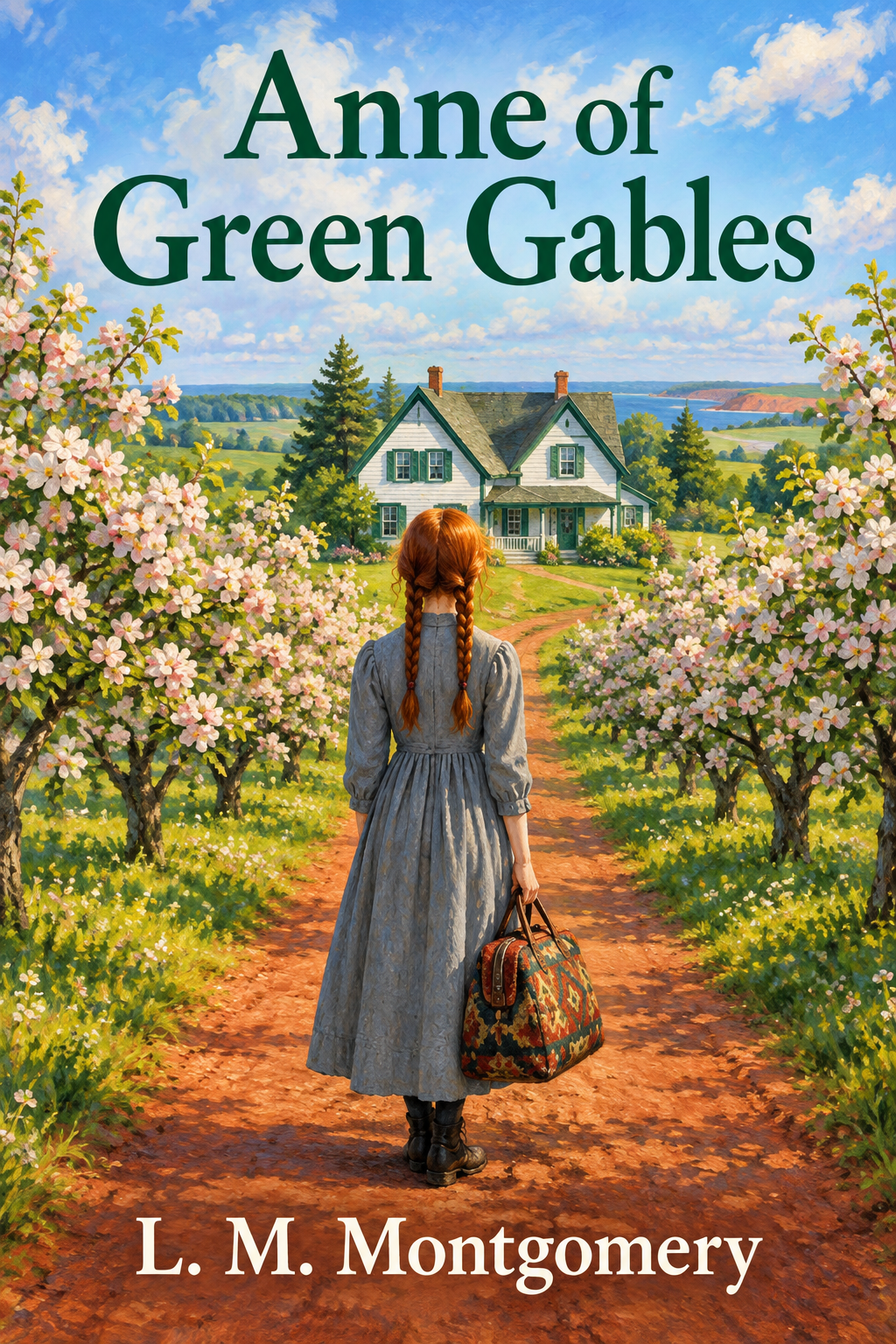
Anne of Green Gables
Tác giả: L. M. Montgomery
Anne of Green Gables is a novel about Anne Shirley, an eleven-year-old orphan with red hair and a very large imagination. The Cuthberts, a brother and sister on a farm in Prince Edward Island, meant to adopt a boy to help with the work. Instead, Anne arrives, and her chatter, temper and dreams soon change the house. The story follows her first years at Green Gables: school, friendship, rivalry, and the question of where she really belongs.
Ý Tưởng Chính
"Anne of Green Gables follows an imaginative orphan who was not the child anyone expected. The book argues that belonging comes from being loved for who you are, not from being useful."
Những Hiểu Biết Cốt Lõi
Imagination Is a Gift and a Risk
Anne sees beauty everywhere and gives names to the places around her, and the book takes that gift seriously. It also shows that a rich inner life can lead to trouble. Her fear of the Haunted Wood and her liniment mix-up are funny, but they cost her something. Growing up, for Anne, means learning when to let her imagination roam and when to pay attention to the people and facts in front of her.
When Marilla sends her through the Haunted Wood after dark, Anne runs through it in terror, and the reader sees a child who has built a ghost story out of trees and believes it.
Belonging Is Not Earned by Usefulness
The Cuthberts first want a boy who can work the farm, so Anne looks like a mistake. As the story goes on, Matthew and Marilla come to value her warmth and wit, not just her labor. Anne, in turn, has to learn that she is wanted. The book suggests that home is built from care and daily attention, and that it can be chosen as much as it is given.
Marilla's decision to keep Anne, made after a talk with Matthew, is the moment the idea of home at Green Gables begins.
Friendship Is Forged in Friction
Anne's friendships are passionate and sometimes messy. Diana is her first true friend, sealed with a vow in the Barry garden at Orchard Slope. Gilbert Blythe starts as a tormentor and becomes her fiercest rival. The book shows that friends and rivals can teach the same lessons: honesty, patience and the courage to keep trying. Anne learns to take people seriously, even the ones who annoy her most.
Anne and Gilbert finish tied at the top of the Entrance exam list, and the rivalry pushes both of them to keep improving.
Owning a Mistake Takes Courage
Anne gets things wrong constantly, and the book is often funniest when she does. What matters is what she does next. Her over-the-top apology to Mrs. Lynde is comic, but it shows that she wants to put things right. Her plain, honest confession to Josephine Barry, Diana's great-aunt, softens a stern heart. The novel suggests that growing up is less about avoiding errors and more about facing them, even when a small lie would be easier.
Anne's false confession about Marilla's brooch collapses when the brooch turns up in Marilla's shawl, a lesson about honesty that arrives in the least dignified way.
Tóm Tắt Chương
Chapter-by-chapter summary
Spoiler warning: this section covers the whole plot, including the ending.
Part 1: Chapters 1–4, A Boy Was Expected
Mrs. Rachel Lynde hears that the Cuthberts plan to adopt a boy, and she is not happy about it. At Bright River, Matthew Cuthbert finds an eleven-year-old girl who will not stop talking, and he drives her home anyway. Marilla is dismayed and plans to send her back. Anne, sure she is about to be sent away, cries herself to sleep. The next morning, the spring view from Green Gables lifts her spirits, though her fear is not gone. Matthew, who has said little, quietly hopes she can stay. It matters because the book's central question, whether Anne can belong without being the boy they wanted, starts here.
Part 2: Chapters 5–9, Anne's Story and Marilla's Decision
On the drive to White Sands, Anne tells Marilla about the hard years she spent in other homes and at the asylum, and Marilla begins to soften. Mrs. Blewett then offers to take Anne straight home, but Marilla decides to keep her after talking with Matthew. Anne's bedtime prayer, improvised and full of wishes, asks to be good-looking when she grows up, and it shows how vivid her imagination is. Marilla starts teaching her manners and lessons. Then Mrs. Rachel criticizes Anne's looks, and Anne flies into a rage and insults her. Marilla's change of heart is what makes Green Gables a home for Anne, yet her temper shows how much she still has to learn.
Part 3: Chapters 10–14, Apologies, a Pledge and a Brooch
Anne's apology to Mrs. Rachel is so elaborate that Marilla is dismayed, though the older woman forgives her. At her first Sunday school, Anne feels out of place among girls in fashionable dresses. Marilla scolds her about the flower-wreathed hat, and Anne then visits the Barrys' house at Orchard Slope, where she meets Diana in the garden and they vow to be friends for life. Then Marilla's amethyst brooch goes missing, and Anne is blamed. Anxious to go on the Sunday-school picnic, she makes a false confession. The brooch later turns up caught in Marilla's shawl, which shows the confession was false. It matters because the false confession, made out of longing for the picnic, shows how badly Anne wants to belong.
Part 4: Chapters 15–19, Slates, Currant Wine and a Rescue
Anne's rivalry with Gilbert Blythe starts in the schoolroom, when he teases her about her red hair, and Anne breaks her slate over his head. Later, a tea party with Diana goes badly when Anne serves currant wine by mistake, and Diana becomes ill and is sent home. Mrs. Barry forbids the girls from playing together. Then, while the adults are away, Anne nurses Diana's little sister, Minnie May, through a severe attack of croup and saves her life, which wins back Mrs. Barry's trust. After a concert, a night-time mishap in the spare-room bed is followed by Anne's honest confession, which wins over Josephine Barry, Diana's great-aunt, known as Miss Barry. It matters because this is where Anne begins to earn trust through her actions, not just her imagination.
Part 5: Chapters 20–24, Imagination Gets Out of Hand
Anne's imagination leads her into trouble again. She and Diana have decided the Haunted Wood is haunted, yet Marilla sends Anne through it after dark on an errand to the Barrys, and Anne runs through the spruce grove in terror. In the kitchen she flavors Mrs. Allan's layer cake with anodyne liniment instead of vanilla, and Mrs. Allan comforts her kindly. Then the new teacher, Miss Muriel Stacy, arrives. Josie Pye dares Anne to walk the ridgepole of Mr. Barry's kitchen roof, and she falls and breaks her ankle. Miss Stacy then plans a Christmas concert, and Anne eagerly prepares recitations for it. It matters because Miss Stacy begins to channel Anne's restless energy into something constructive, which points toward her later ambitions.
Part 6: Chapters 25–29, Puffed Sleeves and a Lily Maid
Matthew secretly buys Anne a brown dress with puffed sleeves for Christmas, and she shines at the concert. Later, the girls stage a scene in which Anne plays Elaine, the Lily Maid, on Mr. Barry's leaking flat boat. The boat sinks under a bridge, and Anne clings to a bridge pile until Gilbert Blythe rows over in a dory and rescues her. She refuses to forgive him. It matters because Anne owes him her life, yet her pride keeps the rivalry alive. Anne and Diana then visit Miss Barry in Charlottetown, and Anne comes home glad to be back at Green Gables.
Part 7: Chapters 30–34, The Entrance Exams
Marilla agrees to let Anne join Miss Stacy's Queen's class, so that Anne can study for the Entrance exams. Anne sits the exams in town, and when the pass list comes out, she has placed at the top, tied with Gilbert Blythe. The tie keeps their friendly rivalry alive. At a charity concert at the White Sands Hotel, Anne overcomes severe stage fright and is encored, a moment that shows how much she has grown since her first days at Green Gables. Afterwards she moves to the Queen's Academy in town, where she struggles with homesickness.
Part 8: Chapters 35–38, Scholarship, Loss and a Choice
At Queen's, Anne works hard through the winter and keeps a friendly rivalry with Gilbert. She wins the Avery scholarship, which could pay for college. Then Matthew reads a newspaper report that the Abbey Bank has failed, and he dies suddenly. Marilla faces the possibility of losing her sight, and she plans to sell Green Gables. Anne gives up the scholarship to stay at home and help Marilla, and she takes the teaching post at Avonlea school. Gilbert withdraws his own application for the post, and the two talk at the gate for half an hour. The novel closes with Anne at her window, looking ahead to the bend in the road. It matters because Anne's choice shows that she has learned what home is worth, and her ambition now serves the people who gave her one.
Characters
- Anne Shirley: An eleven-year-old orphan with red hair, a sharp tongue and an enormous imagination. She turns ordinary days into adventures, and she has to learn that being wanted is different from being useful.
- Marilla Cuthbert: She is strict and practical, and she plans to send Anne back at first. Over time she becomes the mother Anne needs, and her change of heart drives much of the book.
- Matthew Cuthbert: Marilla's gentle, shy brother. He hopes Anne can stay from the start, and he quietly takes her side. His death late in the story is the book's great sorrow, and readers often remember him most.
- Rachel Lynde: A neighbor who says exactly what she thinks, including about Anne's appearance. She is quick to judge, yet she forgives Anne's apology and proves to be a kind friend in the end.
- Diana Barry: Anne's neighbor and first true friend. Diana is cheerful and loyal, and the two of them share some of the book's warmest scenes, along with its most awkward ones. Their vow, sworn in the Barry garden at Orchard Slope, starts it all.
- Gilbert Blythe: A classmate who teases Anne about her red hair and becomes her closest rival at school. Their rivalry turns into respect, and later into a quieter friendship that shapes the end of the book.
- Miss Muriel Stacy: The new teacher at the Avonlea school. She takes her work seriously, runs a Christmas concert, and inspires Anne to aim higher through the Queen's class. Anne admires her from the first day.
- Josie Pye: A sharp-tongued classmate who dares Anne into a risky stunt. Josie is unkind, and she often tests Anne's patience. Her dare leads to Anne's broken ankle.
Writing about this book
If you are writing a book report, start with a question rather than a summary. Here are a few angles to try. First, look at how Anne's imagination shapes her world. Pick one example, such as the names she gives to places or the Haunted Wood, and ask what it reveals about her.
Second, track Marilla. Her first plan is to send Anne back, and her view changes over the early chapters. Find the scene where you think the change begins, and explain why it matters.
Third, think about Anne's friendships. How does she handle Diana, Gilbert and Mrs. Lynde differently? Which relationship teaches her the most?
Finally, consider what the book says about home. Is it a place, a family, or a choice? Write your answer in your own words and support it with one or two scenes from the book.
Hành Động Ngay
Các bước thực tế bạn có thể thực hiện ngay hôm nay:
-
Notice how Anne describes ordinary things, then try the same trick on a walk and write three sentences about what you see.
-
When you make a mistake, give a plain, honest apology first, the way Anne learns to do after her first overblown one.
-
Think of one person who makes you feel wanted for who you are, and tell them why this week.
-
Compare your own first year in a new place with Anne's, and write down one thing you would tell your younger self.
Trích Dẫn Đáng Nhớ
"“Kindred spirits are not so scarce as I used to think.” (Chapter 19)"
— L. M. Montgomery
"“I'm so glad I live in a world where there are Octobers.” (Chapter 16)"
— L. M. Montgomery
"“Dear old world, you are very lovely, and I am glad to be alive in you.” (Chapter 38)"
— L. M. Montgomery
Ai Nên Đọc Cuốn Này
Readers aged 10 and up, especially those in middle school or early high school, will enjoy this classic. It suits anyone who likes warm, funny stories about growing up, and it is a good choice for a class reading list or a book club. Adults who loved it as children may find that it reads differently now.
Về L. M. Montgomery
L. M. Montgomery (Lucy Maud Montgomery, 1874–1942) was a Canadian writer from Prince Edward Island. She worked as a teacher before she became a writer. Anne of Green Gables, published in 1908, was her first novel and drew on the island landscape she knew as a child. It became one of the most loved books in children's literature and started a long series.
Tóm Tắt Được Viết Bởi

Kỹ sư phần mềm & Nhà văn
Kỹ sư phần mềm với niềm đam mê chuyển đổi ý tưởng phức tạp thành hiểu biết thực tiễn. Viết về tài chính, đầu tư, khởi nghiệp và công nghệ.
Xem tất cả tóm tắt →Đánh Giá
Chưa có đánh giá nào. Hãy là người đầu tiên chia sẻ suy nghĩ của bạn!
Viết Đánh Giá
Đọc tiếp
Khám phá chủ đề: Truyện hư cấuTóm tắt sách

Tóm Tắt Sách Vượt Qua Giới Hạn (Out of My Mind)
Sharon M. Draper
“Out of My Mind” by Sharon M. Draper is a poignant narrative that explores the life of Melody Brooks, a…

Tóm Tắt Sách Ender’s Game
Orson Scott Card
“Ender’s Game” by Orson Scott Card is a riveting science fiction novel that transports readers into a future where humanity…

Tóm Tắt Sách Pachinko (Pachinko)
Min Jin Lee
“Pachinko”, a spellbinding multigenerational historical saga by Min Jin Lee, explores the lives of a Korean family trying to make…

Tóm Tắt Sách Những Ưu Ái Của Kẻ Vô Hình (The Perks of Being a Wallflower)
Stephen Chbosky
The Perks of Being a Wallflower by Stephen Chbosky is a profound coming-of-age novel, told through the intimate letters of…
Bài Viết

Thời Khai sáng là gì? Ý tưởng, nhà tư tưởng và di sản
Khai sáng là phong trào tư tưởng châu Âu thế kỷ 18, đề cao lý tính và bằng chứng hơn…
Lịch sử thế giới 1700–1918: Cách mạng, công nghiệp, đế quốc và chiến tranh
Từ 1700 đến 1918, cách mạng, nhà máy, đế chế và một cuộc chiến tranh thế giới đã định hình…

Chủ đề A Christmas Carol: lòng hào phóng, sự cô lập và trách nhiệm
Truyện ngắn của Dickens thường được đọc như câu chuyện về một người đàn ông thay đổi suy nghĩ. Nhưng…