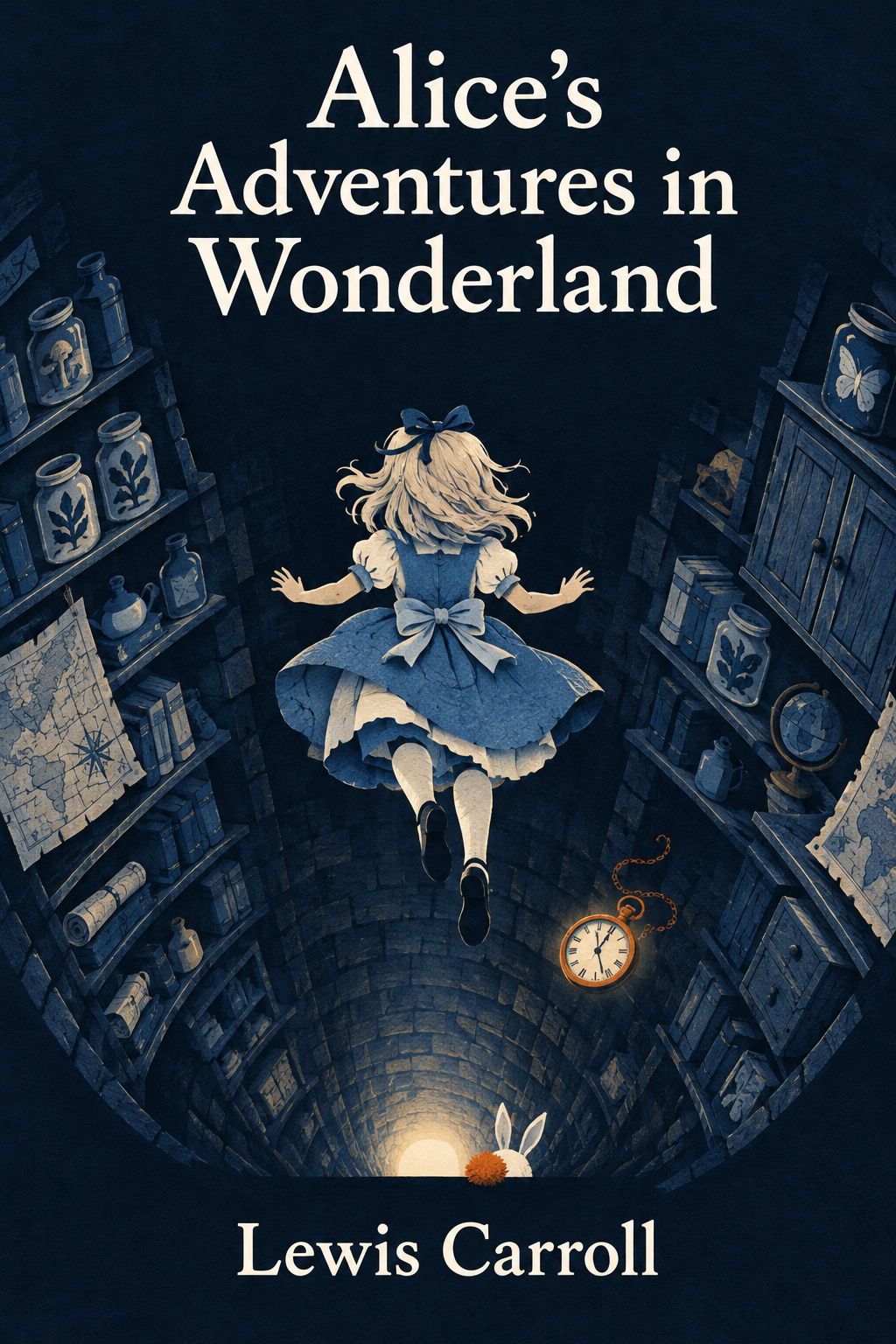
Alice's Adventures in Wonderland
bởi Lewis Carroll
Alice's Adventures in Wonderland is Lewis Carroll's 1865 children's classic about a curious girl who chases a White Rabbit down a hole into a world where nothing behaves as it should. She drinks from a bottle that shrinks her and eats a cake that makes her grow, then meets odd creatures who all seem to play by their own rules. Each encounter tests her manners and her sense of logic.
Ý Tưởng Chính
"Alice's Adventures in Wonderland uses dream logic to poke fun at rules, manners and adult good sense. Alice keeps trying to behave sensibly, and the world keeps refusing to cooperate."
Những Hiểu Biết Cốt Lõi
Logic against nonsense
Alice keeps trying to reason her way through the world and tidy it into sense. The characters answer with riddles and rules that follow their own logic, not hers. The book argues that good sense is a habit that fails when the rules themselves make no sense, and readers are left to enjoy the trying rather than the answer.
At the tea party the Hatter asks why a raven is like a writing desk, and the story never gives an answer, which is part of the joke.
A self that keeps changing
Alice changes size so often that she stops being sure who she is. The book treats identity as something that shifts with experience rather than a fixed label. Her questions about herself grow sharper as the story goes on, and many children will recognise the uncertain feeling of growing up.
When the Caterpillar asks who she is, Alice answers that her size has changed so often she cannot say, and later she insists she is a different person from yesterday.
Rules, power and fairness
In the Queen's garden and at the trial, rank and temper decide what happens, and reason comes second. The court moves toward a sentence before any clear evidence has been heard. Carroll satirises the way power can ignore fairness, so readers laugh even as they notice the injustice. The reader is left to picture what a fair court would look like.
The Queen shouts 'Off with their heads!' at almost everyone in her garden, and at the trial the Queen insists on the sentence first and the verdict afterwards.
Manners against muddle
Alice starts out polite and expects answers that make sense. At the tea party and in the Duchess's house, her manners get her nowhere and conversations stall. Even when she speaks carefully, others change the subject or give answers that make no sense. Readers feel her frustration, and much of the comedy comes from her trying to behave well in a world that does not play along. The book suggests that good manners only work when everyone shares the same rules.
When Alice points out that there is no wine, the March Hare simply replies, 'There isn't any.'
Tóm Tắt Chương
Chapter-by-chapter summary
Spoiler warning: this section covers the whole plot, including the ending.
Chapter 1: Down the Rabbit-Hole
Alice is bored, sitting on a riverbank beside her sister, whose book has no pictures or conversations. A White Rabbit in a waistcoat runs past, checks his pocket watch and says he is late. Alice follows him down a rabbit hole and falls for a long time, past cupboards, shelves and maps. At the bottom she drinks from a bottle that shrinks her, then eats a cake that makes her grow. This chapter matters because it sets the rule of the whole book: an ordinary afternoon can tip into nonsense in a single step.
Chapter 2: The Pool of Tears
After the cake, Alice grows so tall that her head bumps the ceiling, then shrinks until she nearly drowns in a pool of her own tears. She swims out and meets a Mouse, but her attempts to chat about her cat Dinah upset him and he swims away. Alone again, she wonders aloud who she really is: “Who in the world am I? Ah, that's the great puzzle!” This chapter matters because Alice's sense of self begins to wobble, and the book keeps testing it.
Chapter 3: A Caucus-Race and a Long Tale
Alice and a crowd of soaked birds and animals gather on the shore to dry off. The Dodo organises a Caucus-race, a run with no set starting line or finish, and everyone wins a prize, which Alice hands out from her pocket. The Mouse then tells a long, sad tale, but Alice mistakes the word 'tale' for 'tail'. This chapter matters because it is an early example of the book's joke about words, where a small mix-up of meaning turns into a whole scene of confusion.
Chapter 4: The Rabbit Sends in a Little Bill
The White Rabbit mistakes Alice for his maid, Mary Ann, and sends her into his house to fetch gloves and a fan. Inside, she grows so large that she fills the room, and when the Rabbit sends a lizard named Bill down the chimney, she kicks him back up. Outside, the small animals throw pebbles that turn into cakes; Alice eats one and shrinks again. This chapter matters because Alice is judged by her role and her size, and she has to decide how to respond to people who treat her like someone else.
Chapter 5: Advice from a Caterpillar
A blue Caterpillar sits on a mushroom, smoking a hookah, and asks Alice who she is. She answers that she has changed sizes so often that day that she is not sure, and adds, “I can't go back to yesterday, because I was a different person then.” He tells her that one side of the mushroom makes her taller and the other shorter, and she tries it, her neck stretching so far that a pigeon mistakes her for a serpent. This chapter matters because the Caterpillar's questions set up the book's theme of identity and change.
Chapter 6: Pig and Pepper
Alice reaches a house and meets the Duchess, who holds a baby that turns into a pig. Alice takes the creature outside and lets it run off into the wood. In the kitchen, the Cook throws pepper about, and everyone, including the baby, sneezes. The Cheshire Cat grins from a tree, offers directions and says, “We're all mad here.” This chapter matters because the cat's line makes the book's chaos feel normal, and it invites the reader to wonder what normal means.
Chapter 7: A Mad Tea-Party
Alice finds a long table where the Mad Hatter, the March Hare and the Dormouse are having tea. There are plenty of empty seats, but the three keep moving around the table. The Hatter asks why a raven is like a writing desk, a riddle the story never answers, and says it has been six o'clock ever since he quarrelled with Time. This chapter matters because manners and logic both fall apart at once, and the scene is one of the book's best-known set pieces.
Chapter 8: The Queen's Croquet-Ground
Alice finds the Queen of Hearts' garden, where croquet is played with live flamingos as mallets and hedgehogs as balls. Card soldiers bend double to form the arches, and gardeners painting white roses red are caught in the act. The Queen shouts 'Off with their heads!' at almost everyone. The game itself has no fair rules, and everyone plays at the Queen's whim. This chapter matters because it shows the book's satire of power: the Queen's temper decides who gets punished, and fairness does not come into it.
Chapter 9: The Mock Turtle's Story
Alice is led by the Gryphon to the Mock Turtle, a sorrowful creature who is not a real turtle. He tells her about the school he attended under an old Turtle, where he learned subjects with names like Reeling and Writhing, and branches of arithmetic called Ambition, Distraction, Uglification and Derision. Readers can enjoy the sheer silliness of the list while noticing how seriously he takes it. This chapter matters because the book pokes fun at school lessons, and the Mock Turtle's gloom makes those lessons sound even stranger.
Chapter 10: The Lobster Quadrille
The Gryphon proposes the Lobster Quadrille, a dance, and the Mock Turtle sings 'Beautiful Soup' with his usual gloom. The dance is a silly, orderly routine, and the song is a parody of a well-known song of the day, so both feel orderly yet strange. This chapter matters because the book turns the stiff rules of school and song into play. Readers remember it for its mood more than its plot, and the scene shows how the book can be funny and sad at once.
Chapter 11: Who Stole the Tarts?
The King of Hearts presides over a trial in which the Knave of Hearts is accused of stealing the Queen's tarts, and the Queen sits beside him on the throne. The jury is made of animals. The White Rabbit reads out the charge, a short rhyme about the Queen of Hearts and her tarts. The Hatter is the first witness, and his evidence is muddled. The King tells the jury to consider their verdict, though very little clear evidence has been given. This chapter matters because the trial mocks courts that ignore facts, and it sets up Alice's protest in the next chapter.
Chapter 12: Alice's Evidence
Alice, who has grown huge again, is called as a witness, and the King asks what she knows about the case. The King has told the jury to consider their verdict, and the Queen cuts in: “Sentence first, verdict afterwards!” Alice calls the idea nonsense, and the Queen orders her head off. Alice answers back that the whole court is nothing but a pack of cards. The cards rise up and rush at her, and she wakes on the riverbank with her sister brushing leaves from her face. This chapter matters because Alice finally stands up to unfair rules, and the book ends with the dream, which reframes everything before it.
Characters
Alice: A curious, polite girl who tries to reason her way through the nonsense. As her size keeps changing, she starts to doubt who she really is, and she keeps asking questions. She is the steady centre of the story, even when everything around her refuses to make sense.
The White Rabbit: A nervous, fussy rabbit in a waistcoat who is always late and checks his pocket watch. He is the first to draw Alice into the story, and he keeps sending her on errands that make things worse.
The Caterpillar: A blue caterpillar who sits on a mushroom and smokes a hookah. He asks blunt questions about who Alice is and gives her short, puzzling advice about growing and shrinking. He is calm, rude and hard to pin down.
The Duchess: A short-tempered woman in a grand house who holds a baby that turns into a pig. Her kitchen is full of pepper and sneezing, and her manners are as sharp as her temper. She shows how rank can make people unpleasant.
The Cheshire Cat: A grinning cat who appears and vanishes in the trees. He gives Alice directions and offers the book's most quoted claim: that everyone here is a little mad. He is playful, odd and oddly honest.
The Mad Hatter: The host of the tea party, whose clock is stuck at six o'clock after a quarrel with Time. He asks riddles, speaks with odd logic and treats Alice rudely, though she has done nothing wrong.
The March Hare: The Hatter's fellow host at the tea party, as odd as he is. He shares the table with the Dormouse and offers Alice wine that does not exist, which sums up the party's logic.
The Queen of Hearts: A short-fused ruler who runs a croquet game in her garden, using flamingos as mallets and hedgehogs as balls. She shouts 'Off with their heads!' at almost everyone, and she stands for the book's satire of power.
The Mock Turtle: A gloomy creature who is not a real turtle. He tells Alice about his old school, where lessons had names like Reeling and Writhing, and he sings 'Beautiful Soup' with great feeling. His seriousness makes the nonsense around him seem even stranger.
Writing about this book
If you are writing a book report on Alice's Adventures in Wonderland, start with a question you want to answer, not a list of what happens. Good questions include: how Alice tries to make sense of rules that keep changing, why the Caterpillar's questions unsettle her, and what the trial and the croquet game say about power. Write down two or three of these notes before you start drafting, so your opinion has clear evidence behind it.
As you read, note the scenes that make you laugh and the ones that make you uneasy. Ask whether the nonsense has a purpose, and whether the book would be as funny if its puzzles had clear answers. Keep a short list of the moments when Alice is polite and the world refuses to answer, because those moments often hold the strongest material for an essay.
Pick one scene and one short line from the book, then explain what it shows about Alice in your own words. Describe how you felt about her, and say why. Your teacher will want to see your own thinking, not a retelling of the story.
Hành Động Ngay
Các bước thực tế bạn có thể thực hiện ngay hôm nay:
-
Before you follow a rule, ask what it is for, and whether it still makes sense.
-
Notice how your sense of self shifts with experience, and do not treat it as fixed.
-
Check whether the evidence supports a verdict before you accept it, even when authority says so.
-
Stay polite when others are rude, but do not give up your own sense of fairness.
Trích Dẫn Đáng Nhớ
"Curiouser and curiouser! (Chapter 2)"
— Lewis Carroll
"Who in the world am I? Ah, that's the great puzzle! (Chapter 2)"
— Lewis Carroll
"I can't go back to yesterday, because I was a different person then. (Chapter 5)"
— Lewis Carroll
"We're all mad here. (Chapter 6)"
— Lewis Carroll
Ai Nên Đọc Cuốn Này
Suitable for readers aged about 9 and up, and for anyone who enjoys wordplay, puzzles and gentle satire of grown-up rules. Students of English literature will find it a useful text, and adults can reread it as a childhood favourite. It also works as a gentle first classic for readers learning English.
Về Lewis Carroll
Lewis Carroll was the pen name of Charles Lutwidge Dodgson (1832–1898), an English mathematician who taught at Christ Church, Oxford. He told the story to Alice Liddell and her sisters during a boat trip on 4 July 1862, and it was published in 1865 with illustrations by John Tenniel. He also wrote Through the Looking-Glass (1871).
Tóm Tắt Được Viết Bởi

Kỹ sư phần mềm & Nhà văn
Kỹ sư phần mềm với niềm đam mê chuyển đổi ý tưởng phức tạp thành hiểu biết thực tiễn. Viết về tài chính, đầu tư, khởi nghiệp và công nghệ.
Xem tất cả tóm tắt →Đánh Giá
Chưa có đánh giá nào. Hãy là người đầu tiên chia sẻ suy nghĩ của bạn!
Viết Đánh Giá
Đọc tiếp
Tóm tắt sách

Tóm Tắt Sách Vượt Qua Giới Hạn (Out of My Mind)
Sharon M. Draper
“Out of My Mind” by Sharon M. Draper is a poignant narrative that explores the life of Melody Brooks, a…

Tóm Tắt Sách Ender’s Game
Orson Scott Card
“Ender’s Game” by Orson Scott Card is a riveting science fiction novel that transports readers into a future where humanity…

Tóm Tắt Sách Pachinko (Pachinko)
Min Jin Lee
“Pachinko”, a spellbinding multigenerational historical saga by Min Jin Lee, explores the lives of a Korean family trying to make…

Tóm Tắt Sách Những Ưu Ái Của Kẻ Vô Hình (The Perks of Being a Wallflower)
Stephen Chbosky
The Perks of Being a Wallflower by Stephen Chbosky is a profound coming-of-age novel, told through the intimate letters of…
Bài Viết
Thời Khai sáng là gì? Ý tưởng, nhà tư tưởng và di sản
Khai sáng là phong trào tư tưởng châu Âu thế kỷ 18, đề cao lý tính và bằng chứng hơn…
Lịch sử thế giới 1700–1918: Cách mạng, công nghiệp, đế quốc và chiến tranh
Từ 1700 đến 1918, cách mạng, nhà máy, đế chế và một cuộc chiến tranh thế giới đã định hình…

Chủ đề A Christmas Carol: lòng hào phóng, sự cô lập và trách nhiệm
Truyện ngắn của Dickens thường được đọc như câu chuyện về một người đàn ông thay đổi suy nghĩ. Nhưng…