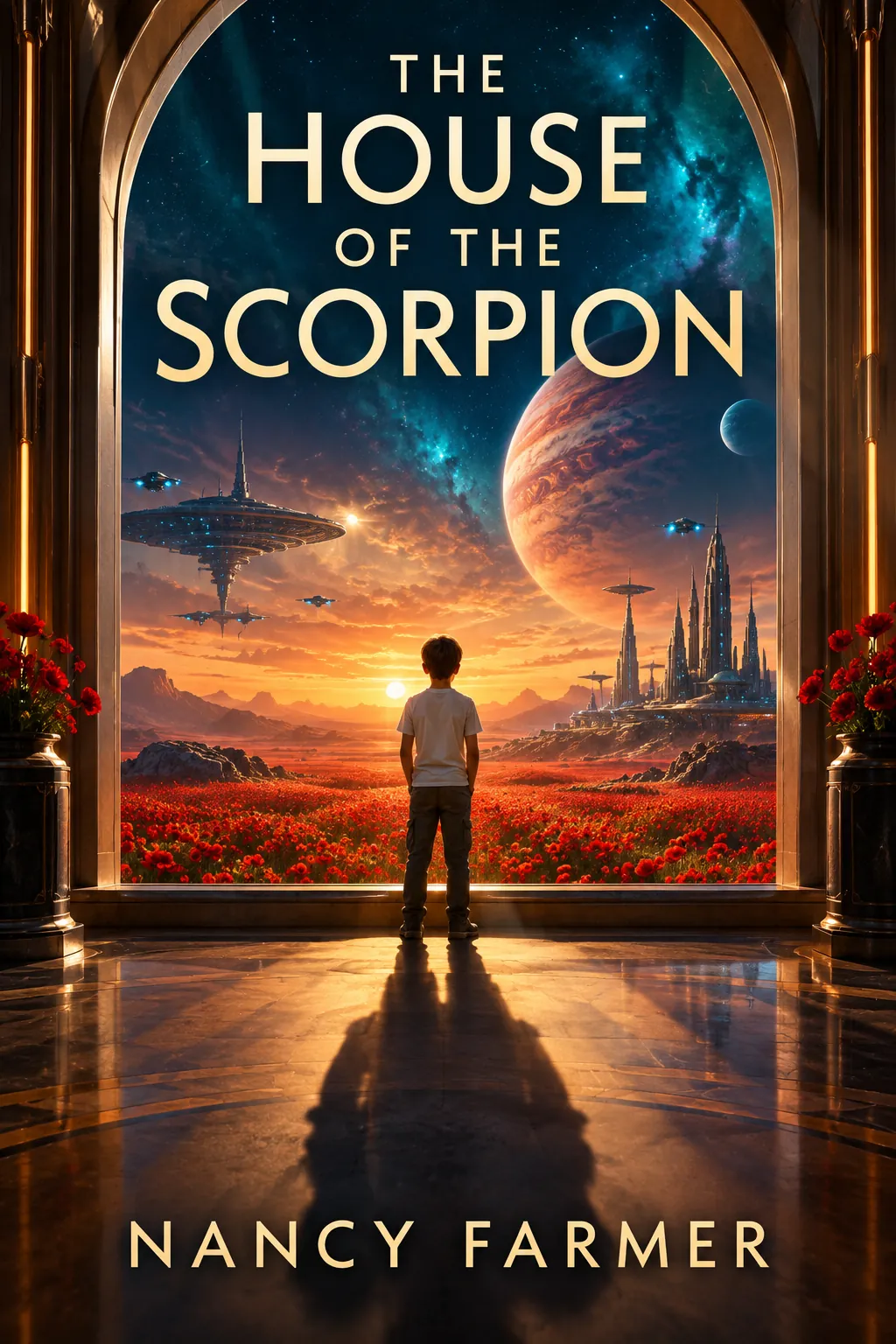
The House of the Scorpion
oleh Nancy Farmer
The House of the Scorpion is a 2002 young adult novel set in Opium, a drug lord's country between the United States and Mexico. Matt grows up thinking he is an ordinary boy, until he learns that he is a clone, grown from the cells of the 140-year-old man who rules the land. The book follows his struggle to own his life, and asks what makes someone a person.
Coba Audible · Sebagai Amazon Associate, kami mendapat komisi dari pembelian yang memenuhi syarat. Detail
Ide Utama
"Nancy Farmer argues that a person is defined by what they feel, choose and love, not by how they were made or by what others want to use them for."
Wawasan Utama
A person is more than their origin
Matt is made from another man's cells, yet his fears, his humour and his loyalties belong to him alone. The book keeps asking whether the way you were made decides who you are, and it answers no. Farmer builds that answer slowly, letting the reader hear Matt think, hesitate and care about others long before any character admits he is a person. Where he came from explains his body, but it never explains what he chooses to do.
When Matt refuses to accept that he exists only as a donor, he is already acting as a person, long before anyone else admits it.
Power feeds on other people
El Patrón lives for well over a century because others pay with their bodies and their freedom. Farmer shows that unlimited power does not make a ruler better, only more able to use people. Every comfort in the big house rests on someone's lost choice, from the eejits in the fields to the clones kept for parts. The more the old man gets, the less he is able to see anyone as a human being, and the book treats that blindness as the real cost of his long life.
The eejits work his fields without a will of their own, and Matt himself is a stored supply of organs.
Small acts of care shape a life
Celia and Tam Lin hold little power in Opium, yet they decide Matt's future. Celia's love gives him a self worth defending, and Tam Lin's guidance and risks give him a chance to leave. Neither is a hero in the loud sense; they teach, feed, warn and protect. Farmer suggests that in a cruel place, ordinary tenderness is a form of resistance, and that being loved is what lets Matt believe he deserves a life of his own.
Celia's secret arsenic doses, meant to make his heart useless for a transplant, and Tam Lin's choice to pretend to obey his orders both show care turned into action.
Words can make cruelty easy
Calling someone a clone, a thing or property makes it easier to hurt them without guilt. The novel shows how a label prepares the ground for mistreatment, because once a person is only a word, nobody has to look at the face behind it. The family uses that word to explain why Matt's feelings do not count. The book invites readers to notice the names used for groups in their own world and to ask who gains when someone is described as less than human.
The moment Mr. Alacrán recognizes Matt as a clone, the boy is locked up, as if the word alone changed what he is.
Freedom comes with a choice about power
Escaping Opium is not the end of Matt's story. Among the Lost Boys he learns that he can lead and act for others, not only for himself. When he returns, he is left facing what he has inherited. The book does not say he will succeed, only that the choice is his. Farmer ends on a question rather than a victory, which fits her argument that being free means being responsible for what you do with whatever power you have.
His leadership among the Lost Boys prepares him for the choice he faces on his return.
Rincian Bab
Chapter-by-chapter summary of The House of the Scorpion
Spoiler warning: this section covers the whole plot, including the ending.
Below, the story is grouped by stage, following the order of the book. The book's own part and chapter divisions are not reproduced here.
A hidden childhood
The book opens in a laboratory, where scientists examine embryos grown from the cells of the ruler El Patrón. One of them will become Matt.
Matt spends his first years in a small house at the edge of the poppy fields in Opium, a strip of land between the United States and Aztlán (the book's name for Mexico). Celia, the cook, is his only company and the one person who loves him.
One day three children, Emilia, Steven and María, find him, and Matt breaks a window to reach them, cutting his bare feet. This matters because his safe little world turns out to have been a hiding place, and stepping outside ends it.
The big house
Matt is taken to the main house, where Mr. Alacrán, El Patrón's great-grandson, recognizes him as a clone and has him locked up. The family treats him as something less than a person.
Then El Patrón himself steps in. He gives Matt clothes and a room of his own, and he assigns a bodyguard named Tam Lin.
This turn shows the book's double edge. Matt is protected not because he matters as himself, but because he belongs to the most powerful man in the country.
What clones are for
Matt grows up in the big house, and his friendship with María slowly turns into love. Tam Lin teaches him, and in time tells Matt that clones are harvested, not born.
Matt learns that clones are treated at birth so that their minds are dulled and they will not resist being used for organs. He tries to deny it, telling himself that El Patrón would not pay for his tutors if he meant to harm him.
He also sees the eejits, workers whose minds are controlled so they labour in the fields without a will of their own. This part turns the book's central question into something concrete: if you can think, feel and love, can you still be property?
The wedding and the betrayal
At the wedding of Steven and Emilia, the same two children who once found Matt at the window, El Patrón suffers a near-fatal heart attack. Matt and María try to run away, but the newlyweds betray them.
María is sent back to her convent school. Matt is taken to the hospital, where El Patrón confirms that Matt was made to be an organ donor.
Then Celia confesses what she has done. She had been dosing Matt with arsenic so that his heart would be useless for a transplant, a desperate way of protecting the boy she raised.
This matters because her love is the one act in the household that treats Matt's life as his own. It also sets El Patrón's rage in motion, since the plan Celia ruined was the plan to keep him alive.
Escape and the Keepers
El Patrón is enraged by Celia's betrayal, and that fury brings on his second heart attack, which kills him. Mr. Alacrán then orders Tam Lin to dispose of Matt, but Tam Lin only pretends to obey, gives Matt supplies and sends him toward Aztlán.
There Matt meets the Lost Boys, orphans in a home run by the Keepers, who make the boys work on plankton farms. At first the boys see Matt as a spoiled aristocrat, but he wins their respect by leading a rebellion.
As punishment he is locked in a closet and then left in the Boneyard, a dry lake bed full of whale bones. Ton-Ton and Fidelito rescue him, and he is reunited with María and her mother, Esperanza Mendoza.
Return to Opium
In the end Matt goes back to Opium. Tam Lin and others of the household have died along with El Patrón, and the old world around Matt is gone.
The book closes with Matt facing what he has inherited and what he will do with it. The ending matters because the boy who was meant to supply a tyrant's body is left to decide what kind of person he will be.
Characters
- Matt (Matteo Alacrán): The hero, a clone of El Patrón. He grows from a sheltered child into a young person who insists he is more than a spare-parts supply, and who learns to act for others as well as himself.
- El Patrón: The 140-year-old ruler of Opium, who has stayed alive by taking organs from his clones. He can be warm toward Matt, which makes his cruelty harder to read.
- Celia: The cook who raises Matt. Her love gives him a sense of self, and she secretly gives him arsenic to make his heart unusable for a transplant, protecting him at great risk.
- Tam Lin: Matt's bodyguard and teacher, a Scot with a troubled past. He gives Matt a model of honour and a way out, and he dies when El Patrón's household falls.
- María: One of the children who find Matt, and the daughter of Esperanza Mendoza. She treats Matt as a person and becomes his closest friend and love.
- Steven and Emilia: Two of the children who first find Matt, and the same pair who later marry. As the newlyweds they betray Matt and María after the wedding.
- Mr. Alacrán: El Patrón's great-grandson, who recognizes Matt as a clone and has him locked up. He later orders Tam Lin to get rid of Matt.
- Esperanza Mendoza: María's mother, a politically powerful figure who helps bring down the Keepers.
- Chacho, Ton-Ton and Fidelito: Boys from the Keepers' orphanage who stand with Matt. Ton-Ton and Fidelito rescue him from the Boneyard.
Writing about this book
A good essay on The House of the Scorpion starts with a question, not a plot retelling. Ask what the book says about who counts as a person, and let your scenes serve that answer.
Three angles work well:
- How Celia and Tam Lin shape Matt, compared with how El Patrón uses him.
- How language dehumanizes people, from the word clone to the way the eejits are treated.
- What the ending says about power: is Matt breaking free of the system, or inheriting it?
Pick one scene as your main evidence and explain it closely in your own words. Keep any quote short and give its context.
Finish by saying what the book wants the reader to feel about a world where some lives are treated as supplies. Your own view, backed by the text, is what makes the essay yours.
Read next
For the real science behind the idea, read our explainer on human cloning, which separates what is possible from what is fiction.
For another quiet and unsettling story about people raised for their organs, try Never Let Me Go by Kazuo Ishiguro.
Ambil Tindakan
Langkah praktis yang bisa Anda terapkan hari ini:
-
Notice the labels people use about others, and ask who benefits from them.
-
Choose a scene, not the whole plot, when you write about the book.
-
Trace how each helper in Matt's life, from Celia to Tam Lin, acts differently from El Patrón.
-
Compare the ending with the real debate on cloning before you decide what the author is warning against.
Kutipan Menarik
"“He's livestock.” (Steven on Matt, early in the big house)"
— Nancy Farmer
"“Because it's part of us.” (a quiet exchange about death)"
— Nancy Farmer
"“Will you thank me for it later?” (the doctor Eduardo, looking at the newborn Matt)"
— Nancy Farmer
Siapa yang Harus Membaca Ini
Readers aged 12 and up who like science fiction with a moral question, plus middle and high school students who have been assigned the novel. It also suits anyone who enjoyed dystopian stories about identity, power and the cost of using people.
Ingin buku lengkapnya?
Baca atau dengarkan The House of the Scorpion secara lengkap.
Coba Audible · Sebagai Amazon Associate, kami mendapat komisi dari pembelian yang memenuhi syarat. Detail
Tentang Nancy Farmer
Nancy Farmer is an American author of novels for young readers, born in Phoenix, Arizona, in 1941. She grew up near the Mexican border and spent years working in southern Africa. Her books have won several Newbery Honors, and The House of the Scorpion also won the National Book Award for Young People's Literature.
Ringkasan Ditulis Oleh

Software Engineer & Writer
Software engineer with a passion for distilling complex ideas into actionable insights. Writes about finance, investment, entrepreneurship, and technology.
Lihat semua ringkasan →Ulasan
Belum ada ulasan. Jadilah yang pertama berbagi pemikiran Anda!
Tulis Ulasan
Lanjut membaca
Jelajahi topik: Fiksi ilmiahRingkasan

Out of My Mind
Sharon M. Draper
“Out of My Mind” karya Sharon M. Draper adalah kisah menyentuh tentang kehidupan Melody Brooks, seorang gadis muda penderita cerebral…

Ender’s Game
Orson Scott Card
“Ender’s Game” karya Orson Scott Card adalah novel fiksi ilmiah memikat yang membawa pembaca ke masa depan saat umat manusia…

Pachinko
Min Jin Lee
“Pachinko”, sebuah saga sejarah lintas generasi yang memikat karya Min Jin Lee, mengisahkan perjuangan sebuah keluarga Korea dalam mengarungi gejolak…

The Perks of Being a Wallflower
Stephen Chbosky
The Perks of Being a Wallflower karya Stephen Chbosky adalah novel coming-of-age yang mendalam, dikisahkan melalui surat-surat pribadi Charlie, seorang…
Artikel

Tema A Christmas Carol: kemurahan hati, isolasi dan tanggung jawab
Novela Dickens biasanya dibaca sebagai kisah seorang pria yang mengubah pikirannya. Tema-temanya lebih tajam dari itu: kemurahan hati sebagai praktik,…

Proxima Centauri
Proxima Centauri adalah bintang terdekat dari Matahari, sekitar 4,25 tahun cahaya jauhnya. Bintang ini katai merah kecil yang terlalu redup…

Dilatasi waktu
Dilatasi waktu adalah efek yang diramalkan oleh relativitas Einstein dan sudah terukur: jam berdetak dengan laju berbeda tergantung kecepatan dan…