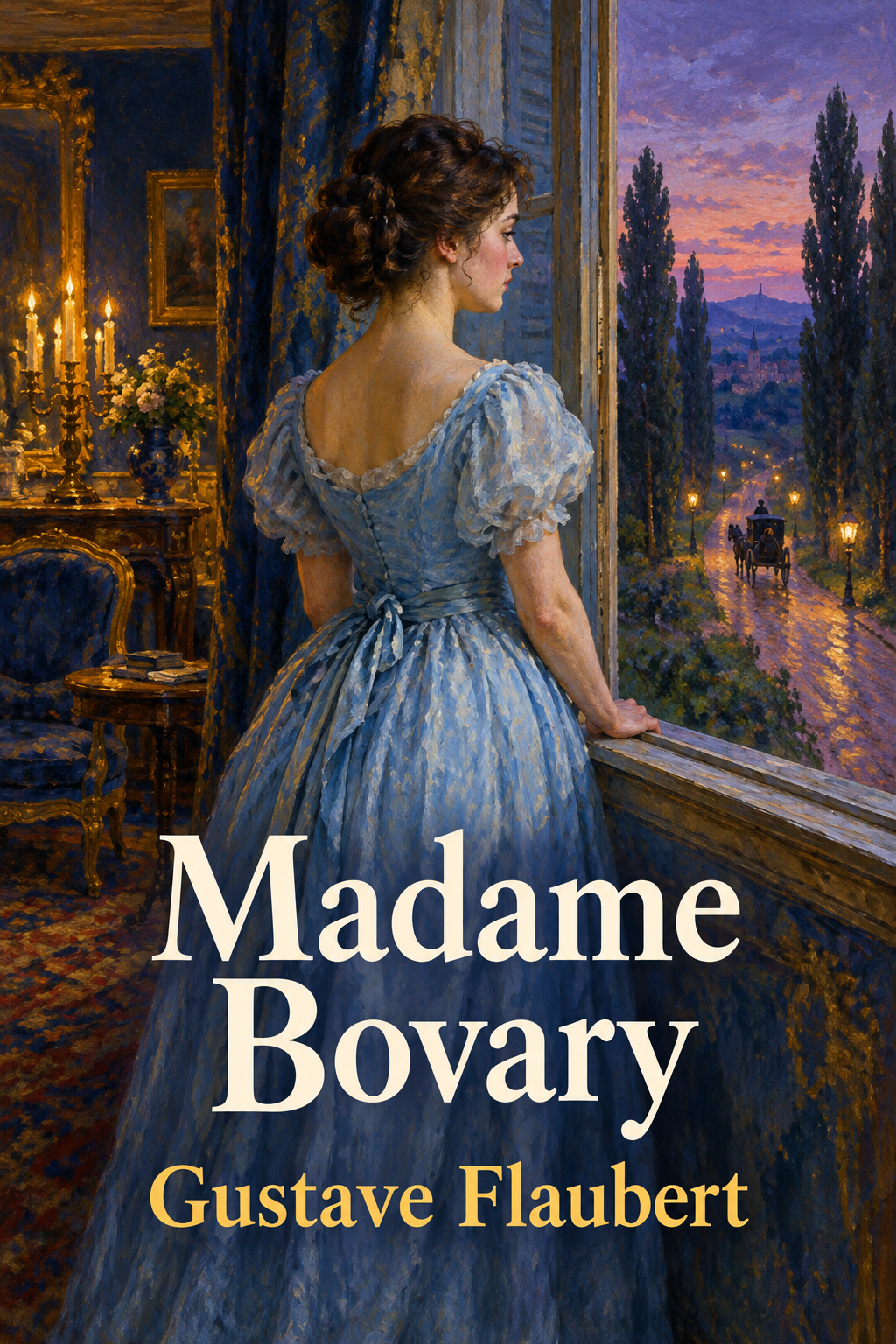
Madame Bovary
oleh Gustave Flaubert
Madame Bovary is a novel about Emma Bovary, the wife of a provincial country doctor in Normandy. Bored by a quiet marriage and fed by romance novels, Emma looks for excitement in fine clothes, society parties and love affairs, while her husband Charles never quite notices what she wants. Her choices run up debts that the family cannot pay. Flaubert follows her in close, unsparing detail, so the reader sees both her hunger and the small town that traps her.
Ide Utama
"Flaubert asks what happens when imagination, fed by romance novels, runs ahead of a small-town life. Emma's story is a close study of boredom, debt and the distance between dreams and daily life."
Wawasan Utama
Romance versus real life
Emma measures her marriage against the novels she loved as a schoolgirl, and nearly every ordinary day falls short of them. Flaubert shows how stories can shape desire, so that a longing for a perfect life turns quiet happiness into a sense of failure. The reader sees the gap between what Emma expects and what she is given, again and again.
After the Vaubyessard ball, the glitter she saw becomes a yardstick, and Tostes looks dull by comparison. Anyone who has held a holiday photo up against an ordinary weekend will recognise the pattern.
Boredom as pressure
Tostes and Yonville are never painted as villains. Their routines, gossip and small rooms wear people down slowly. Flaubert's careful inventories of streets, shops and houses make that monotony something the reader can feel, not just read about. Boredom here is a force that pushes characters toward risky choices.
The long description of Yonville's square and inn shows a place with nowhere to escape to, which helps explain why Emma looks for escape in an affair.
Money as a quiet trap
Debt does not arrive in one moment. It grows through small purchases, signed papers and polite reminders that are easy to ignore. The novel shows how money trouble can break a household long before anyone calls it a crisis, and how the people who lend are rarely the ones who suffer most.
Lheureux hints at loans while Emma is still only unhappy. Later his credit becomes the force closing in on the Bovary home, until a court order demands 8,000 francs.
Goodness that does not see
Charles is faithful, patient and kind, yet he cannot see what is happening in his own home. The book asks whether goodness is enough when it is not joined to understanding. Flaubert treats him with a sympathy that stops short of praise, which makes him harder to dismiss.
Charles does his best for his wife, but his efforts never reach the unhappiness growing beside him, and that gap is what makes the scenes with him painful to read.
Rincian Bab
Chapter-by-chapter summary
Spoiler warning: this section covers the whole plot, including the ending.
Part One, Chapter 1: The new boy at school
Charles Bovary arrives as a shy new pupil at a school in Rouen, and his classmates mock his clumsy cap. The chapter then sketches his youth: a spoiling mother, a careless father, a failed medical exam, a second try that succeeds, and a first marriage to an older widow, Héloïse, arranged by his mother. It matters because it shows a man who is led through life by other people.
Part One, Chapter 2: A broken leg at Bertaux
Called out before dawn, Charles sets the broken leg of the farmer Monsieur Rouault and meets his daughter Emma. He keeps visiting the farm, and the jealous Héloïse makes him promise to stop. Then he learns that her money was largely a lie, and a week later she dies. It matters because Charles is free to marry just as Emma enters his life.
Part One, Chapter 3: The proposal
After a decent wait, Charles returns to Bertaux and spends more and more time with Emma. He asks Rouault for her hand, and Emma, consulted, agrees; the answer is signalled by a shutter opened at the farm. She would like a midnight wedding by torchlight, but the plans stay traditional. It matters because her wish for a romantic gesture is already there before the marriage.
Part One, Chapter 4: The wedding feast
The wedding takes place at Bertaux, with a long procession, a huge meal and dancing late into the night. The next morning Charles is delighted while Emma is calm and composed. The couple then leave for Tostes. It matters because the contrast between his joy and her composure is the first sign that they want different things.
Part One, Chapter 5: A new home at Tostes
Emma inspects the house at Tostes, plans improvements and has Héloïse's dried bridal bouquet taken away. Charles is deeply content with his new wife, while Emma feels something is missing, since marriage has not brought the passion she expected. It matters because her disappointment begins in the very first weeks.
Part One, Chapter 6: The convent and the novels
A flashback takes us to Emma's years at a convent school, where she read romantic novels and treated religion with the same intensity. After her mother's death she played the grieving daughter, soon grew tired of it, and left the convent for her father's farm, where she was bored. It matters because her idea of love comes from books, not from the life around her.
Part One, Chapter 7: Boredom and an invitation
Emma tries to love Charles but can only act the happy wife, and clashes with his mother. In late September the Marquis d'Andervilliers, one of Charles's patients, invites the couple to a ball at his château of Vaubyessard. It matters because the invitation offers a glimpse of a world she has long wanted.
Part One, Chapter 8: The ball at Vaubyessard
Emma is dazzled by the wealth and manners of the guests and ashamed of Charles's awkwardness. She dances with a viscount and sees peasants peering in at a window, which reminds her of her origins. On the road home a cigar case lies in the way, and Emma keeps it. It matters because the ball becomes the yardstick against which every ordinary day is measured.
Part One, Chapter 9: Restlessness at Tostes
Back at Tostes, Emma reads fashion magazines, dreams of Paris and holds on to the cigar case. She treats Charles with growing contempt, and her unhappiness makes her ill. Learning that she is pregnant, she is displeased, and while packing she throws her old bridal bouquet into the fire. Charles decides to move to Yonville for her sake. It matters because her longing has no outlet, so it turns inward and carries the couple to the next stage of the story.
Part Two, Chapter 1: Arriving in Yonville
Flaubert describes Yonville in careful detail, with its Lion d'Or inn, Homais's pharmacy and the churchyard where the gravedigger grows potatoes. The villagers have heard the new doctor is coming and wait for him. The Bovarys arrive late and Emma is in a poor mood, because her pet greyhound has run off on the way and is never found. It matters because Yonville is the setting for most of the middle of the story.
Part Two, Chapter 2: Supper at the Lion d'Or
On the night of arrival the Bovarys eat at the Lion d'Or. The pharmacist Homais, who has already written to Charles, joins them, and so does the young law clerk Léon Dupuis, who lodges with him. Charles and Homais talk medicine, while Emma and Léon find that they share a taste for novels, music and the sea. It matters because this is where the first spark between Emma and Léon is struck.
Part Two, Chapter 3: A daughter and a walk
Charles's practice starts slowly. Emma gives birth to a daughter, Berthe, and is disappointed that she is not a son. After the christening the baby is sent to a wet nurse, and a lonely Emma asks Léon to walk with her to the cottage. Afterwards they stroll by the river, each aware of the other. It matters because the child ties Emma to the household while her thoughts drift elsewhere.
Part Two, Chapter 4: Sunday evenings
As winter arrives, the Bovarys dine with the Homais family on Sunday evenings, and Léon is there too. Emma and Léon are strongly drawn to each other but say nothing. Charles notices nothing, though the villagers already suspect more. It matters because restraint, not action, drives this stage of their story.
Part Two, Chapter 5: Comparisons
Emma compares Charles unfavourably with other men and realises that Léon loves her. She sees herself as a martyr to a hidden love and starves herself. Berthe comes home from the nurse, but Emma's longing leaves little room for her, and she blames Charles. The shopkeeper Lheureux hints that he can arrange loans. It matters because debt now enters quietly, just as her discontent grows.
Part Two, Chapter 6: Léon leaves for Paris
Seeking comfort, Emma visits the priest Bournisien, who is busy with unruly catechism pupils and misses her distress. At home she pushes Berthe away, and the child falls and cuts her cheek. Léon decides that a love for a married woman is impossible and leaves for Paris to study law; the farewell is awkward. It matters because the one person who made her feel understood is gone, and neither the church nor the home can fill the gap.
Part Two, Chapter 7: Rodolphe enters
Emma sinks into gloom and daydreams of Léon. Then Rodolphe Boulanger, a wealthy landowner from a nearby estate, arrives with a servant for Charles to bleed. Justin, Homais's apprentice, faints at the sight of blood, and Emma revives him. Rodolphe notices her beauty and decides to seduce her. It matters because he is the first man to see her restlessness and plan to use it.
Part Two, Chapter 8: The agricultural show
The agricultural show fills Yonville, and Catherine Leroux is honoured for fifty-four years of service on a single farm. Rodolphe takes Emma into the empty town hall, where they watch the ceremony from a window. While an official speaks about public morals, Rodolphe declares his love, and Emma lets her hand rest in his. It matters because a public ceremony hides a private game, and the reader sees both at once.
Part Two, Chapter 9: The affair begins
Rodolphe stays away for six weeks to let Emma's longing build. When he returns she is cold at first, but he persists. Charles, encouraged by Rodolphe, urges her to accept an invitation to ride. In a woodland glen Emma gives in, and the affair begins. Afterwards she cries that she has a lover. It matters because she finally feels the passion she read about, and her life becomes far more dangerous.
Part Two, Chapter 10: Meetings in the arbour
The lovers meet in the arbour of Emma's garden, not at Rodolphe's house, to avoid suspicion. Rodolphe tires of her romantic demands, while she insists that he say he loves her. A letter from her father stirs memories and guilt, and Emma tries to love Charles again. It matters because the cooling has already begun on his side, even as she clings harder.
Part Two, Chapter 11: Hippolyte's operation
After reading a newspaper article on a new treatment for club foot, Homais and the village push Charles to operate on Hippolyte, a servant at the inn. Emma, hoping to see Charles famous, encourages it. The operation seems to work, but gangrene sets in, and another doctor amputates the leg. It matters because Charles is publicly humiliated, and Emma, ashamed of him, returns to Rodolphe with renewed passion.
Part Two, Chapter 12: A plan to run away
Emma loses hope in her marriage and fantasises about escaping with Rodolphe, who gives little encouragement. Lheureux feeds her spending, and she buys costly gifts for her lover. Charles's mother grows suspicious and quarrels with Emma. In the end Emma makes plans to flee with Rodolphe, taking Berthe. It matters because her one way out depends on a man who is already pulling away.
Part Two, Chapter 13: The letter in the apricot basket
On the day of the planned flight, Rodolphe writes a letter ending the affair and hides it in a basket of apricots. Emma finds it, reads it in the attic and nearly throws herself from the window before Charles calls her away. She faints when she sees Rodolphe's carriage leave and falls into a brain fever that lasts weeks. It matters because this collapse opens a long illness and a changed Emma.
Part Two, Chapter 14: Illness, religion and debts
Charles worries over Emma's health and his money; the doctors are costly and he borrows from Lheureux at a high rate. As she recovers, Emma throws herself into devout religion, but it does not give her the ecstasy she had with Rodolphe. To lift her spirits, Homais proposes an evening at the opera in Rouen, and Charles agrees despite the expense. It matters because piety replaces one fever with another, and the debts keep growing.
Part Two, Chapter 15: The opera in Rouen
At the opera in Rouen, Emma enjoys the city's glamour though she is embarrassed by Charles's provincial manners. In the interval she learns that Léon is in the audience, and he soon finds the couple. They leave for a café, and it is arranged that Emma will stay overnight to see the second half the next day. It matters because a chance meeting becomes the start of a secret arrangement.
Part Three, Chapter 1: The cathedral and the cab
Léon, who had half forgotten Emma, feels his old love return. He visits her hotel room and declares his feelings; she refuses him but agrees to meet at the cathedral, writing a letter to say they must not be lovers. At the cathedral a guide offers a tour, until Léon pulls her into a cab and tells the driver to roam the city all day with the blinds drawn. It matters because the affair with Léon begins in this closed carriage.
Part Three, Chapter 2: A death and a power of attorney
Emma misses the coach home to Yonville and returns by private cab. At Homais's pharmacy, he tells her that Charles's father has died. Lheureux then comes with new bills and, hearing of the death, suggests that Emma take power of attorney over the family's money. She persuades Charles that this is sensible, and he sends her to Rouen for three days so that Léon can draw up the papers. It matters because Emma now has control of the family's finances.
Part Three, Chapter 3: Days in Rouen
Emma and Léon spend three days in a Rouen hotel, take a boat trip on the river and enjoy the moonlight. The boatman mentions a party from the night before and describes a man whom Emma recognises as Rodolphe. She hides her shock from Léon and makes him promise to write. It matters because her past is never far away, even in this new place.
Part Three, Chapter 4: Pretexts
Back in Yonville, Léon neglects his work in Rouen and finds reasons to visit. Emma spends more freely and her debts grow. To have a reason for trips to Rouen, she sits at the piano in the evenings, pretending to struggle, then asks to take lessons, and Charles agrees. It matters because the lessons are a cover story, and the money problems grow beside the secret life.
Part Three, Chapter 5: Thursdays in Rouen
Every Thursday Emma goes to Rouen for her supposed piano lessons. At home she is distant, but in Rouen she is intense and theatrical. When Charles learns that the teacher has never met her, she shows him receipts she has forged, and he accepts the story. Meanwhile her debts grow, and Charles's mother burns the power-of-attorney papers after looking at the accounts. It matters because each lie needs another lie to support it.
Part Three, Chapter 6: Bills and a court order
Emma's affair with Léon strains as she grows demanding and he grows resentful. A debt collector arrives, a legal notice is served, and she sells household goods and borrows more from Lheureux. After a masked ball in Rouen she returns to Yonville to find a court order demanding 8,000 francs. She asks Lheureux for help, and he refuses. It matters because the credit that once felt like a convenience has become a debt she cannot escape.
Part Three, Chapter 7: Looking for money
Bailiffs arrive to list the house contents for seizure, and one is left on guard; Emma hides him in the attic. She seeks 8,000 francs from Rouen bankers, who refuse. Léon will not steal from his employer but promises to ask friends. Back in Yonville she finds the auction notice. The notary Guillaumin offers money in exchange for sexual favours, and she leaves in disgust. She begs the tax collector Binet for more time and tries to seduce him, but he draws back. Last, she resolves to go to Rodolphe. It matters because every door closes in turn, and only the man she once loved is left.
Part Three, Chapter 8: The refusal, the arsenic and the death
Rodolphe, still attracted to her, says he has no money, and Emma leaves in anger. At the pharmacy she persuades Justin to let her into the cabinet holding the arsenic and swallows a handful. She gives Charles a letter to read the next day. The poison takes hold, and she suffers terribly; Charles learns the truth and calls for help. Doctors from Rouen cannot save her, a priest gives the last rites, and Emma dies as the blind beggar sings outside. It matters because with her last hope refused, the chapter carries the novel to its tragic end.
Part Three, Chapter 9: The vigil
Charles insists on an expensive funeral, though he is in debt. Emma is to be buried in her wedding dress, in three coffins. During the night watch beside her body, Homais and the priest Bournisien argue about prayer while Charles rages against God. When the maid dresses the body, black fluid leaks from her mouth, and Charles asks for a lock of her hair. It matters because the quarrel of the two men beside the body shows how little they understand the grief in front of them.
Part Three, Chapter 10: The funeral
Old Rouault arrives to find his daughter already dead and is devastated. The whole town attends the funeral, including Hippolyte. Justin cannot watch the burial and visits the grave that night to say goodbye. It matters because the cost of Emma's choices falls on those who loved her most.
Part Three, Chapter 11: Charles's end and the final honour
Creditors press Charles, and he begins to sell household goods. He finds Emma's love letters from Rodolphe and Léon, reads them, and sinks into depression. He meets Rodolphe in Rouen, says he knows of the affair, and blames fate. Soon afterwards Charles dies in his garden. His creditors take everything, Berthe goes to her grandmother, then to a poor aunt, and ends up working in a cotton mill. The book closes with Homais receiving the Legion of Honour. It matters because the innocent pay for Emma's choices while the vain pharmacist is rewarded.
Characters
Emma Bovary. The novel's centre: a farmer's daughter educated in a convent, who measures her life against the romance novels she loved as a girl. Intelligent and restless, she wants passion, beauty and status, and her choices bring ruin to her household.
Charles Bovary. A country doctor who is kind, dutiful and slow to notice change. He loves his wife in his plain way and never understands her hunger for something more. His goodness makes him easy to overlook, and the story asks what that costs.
Rodolphe Boulanger. A wealthy landowner near Yonville. Experienced with women and confident in his charm, he sees Emma as an interesting conquest and treats their affair as a game, which makes his later coldness hard to forgive.
Léon Dupuis. A young law clerk who loves books and music. Shy and dreamy, he is drawn to Emma but hesitates, and when they meet again in Rouen it brings a new affair that is as dangerous as it is hidden.
Monsieur Homais. The village pharmacist: proud of his learning, fond of the newspapers and certain of his own importance. He is a comic figure, and his confident advice to Charles carries a heavy price.
Lheureux. A shopkeeper and moneylender who sells Emma things on credit and then closes in with bills and demands. He is the story's practical pressure, quietly turning other people's trust into his own gain.
Monsieur Rouault. Emma's father, a farmer at Bertaux who is proud of his daughter and glad to see her marry a doctor. He represents the rural world that Emma comes to see as far too small for her.
Berthe. Emma and Charles's daughter, born in Yonville. A child caught in her parents' choices, she is a quiet reminder of what the adults' decisions cost the next generation, and she ends the story as a mill worker.
Writing about this book
If you are writing a book report, avoid retelling the plot. Choose one scene that stayed with you, then ask what Flaubert chose to show and what he left out. Three questions can help you start.
First, how does the author's attention to ordinary detail change the way you feel about Emma? Second, is Charles a sympathetic character, a failure, or both, and what would change if the story were told mainly through his eyes? Third, why does a novel about one woman's dreams spend so much time on rooms, shops and conversations?
Support each point with a short quotation from the chapter you discuss, and name the part and chapter. Compare your reading with another realist novel you have read, such as one about a family under pressure. That comparison often gives your essay a sharper argument than a summary ever could.
Ambil Tindakan
Langkah praktis yang bisa Anda terapkan hari ini:
-
Notice how small choices, such as a purchase on credit, can grow into a serious problem over time.
-
Ask how the stories you love shape what you want, and whether those wants match your real life.
-
Practise noticing ordinary places in close detail, as Flaubert does with the streets and rooms of Yonville.
-
Think about the difference between being kind to someone and actually understanding them.
Kutipan Menarik
"“We were in class when the head-master came in, followed by a ‘new fellow’…” (Part One, Chapter 1)"
— Gustave Flaubert
"“…and now she could not think that the calm in which she lived was the happiness she had dreamed.” (Part One, Chapter 6)"
— Gustave Flaubert
"“Ennui, the silent spider, was weaving its web in the darkness in every corner of her heart.” (Part One, Chapter 7)"
— Gustave Flaubert
"“I have a lover! a lover!” (Part Two, Chapter 9)"
— Gustave Flaubert
Siapa yang Harus Membaca Ini
Best for readers aged 16 and up, especially students of French literature, world literature or realist fiction. The style is slow and dense, and the story deals with adultery and money trouble, so younger readers may want a teacher's guidance. Patient readers will find that the slow pace is part of the point.
Tentang Gustave Flaubert
Gustave Flaubert (1821–1880) was a French novelist born in Rouen, the Normandy city where much of his early life unfolded. He worked on Madame Bovary for several years, polishing every sentence, and its precise, unsentimental style shaped later realist fiction. When parts of the novel were published in 1856, prosecutors charged it with offending public morals; Flaubert was acquitted in 1857.
Ringkasan Ditulis Oleh

Software Engineer & Writer
Software engineer with a passion for distilling complex ideas into actionable insights. Writes about finance, investment, entrepreneurship, and technology.
Lihat semua ringkasan →Ulasan
Belum ada ulasan. Jadilah yang pertama berbagi pemikiran Anda!
Tulis Ulasan
Lanjut membaca
Jelajahi topik: FiksiRingkasan

Out of My Mind
Sharon M. Draper
“Out of My Mind” karya Sharon M. Draper adalah kisah menyentuh tentang kehidupan Melody Brooks, seorang gadis muda penderita cerebral…

Ender’s Game
Orson Scott Card
“Ender’s Game” karya Orson Scott Card adalah novel fiksi ilmiah memikat yang membawa pembaca ke masa depan saat umat manusia…

Pachinko
Min Jin Lee
“Pachinko”, sebuah saga sejarah lintas generasi yang memikat karya Min Jin Lee, mengisahkan perjuangan sebuah keluarga Korea dalam mengarungi gejolak…

The Perks of Being a Wallflower
Stephen Chbosky
The Perks of Being a Wallflower karya Stephen Chbosky adalah novel coming-of-age yang mendalam, dikisahkan melalui surat-surat pribadi Charlie, seorang…
Artikel

Zaman Pencerahan Dijelaskan: Gagasan, Tokoh, dan Warisannya
Zaman Pencerahan adalah gerakan abad ke-18 di Eropa yang menempatkan akal dan bukti di atas tradisi serta otoritas. Para pemikir…
Sejarah Dunia 1700–1918: Revolusi, Industri, Kekaisaran dan Perang
Antara 1700 dan 1918, revolusi, pabrik, kekaisaran, dan perang dunia membentuk ulang masyarakat di Eropa, Amerika, Asia, dan Afrika. Panduan…

Tema A Christmas Carol: kemurahan hati, isolasi dan tanggung jawab
Novela Dickens biasanya dibaca sebagai kisah seorang pria yang mengubah pikirannya. Tema-temanya lebih tajam dari itu: kemurahan hati sebagai praktik,…