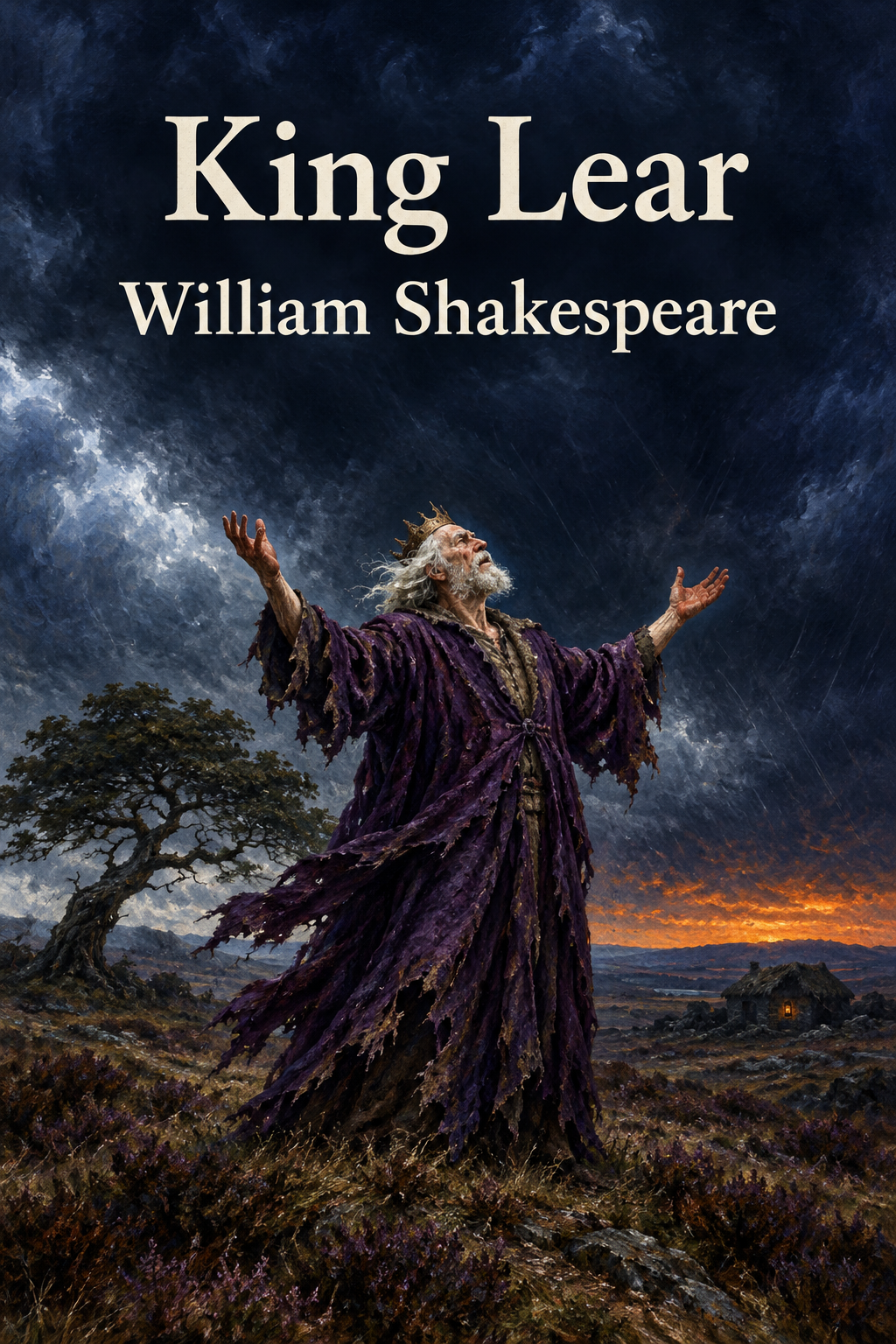
King Lear
oleh William Shakespeare
King Lear is a tragedy about an aging king who splits his kingdom among his daughters after a public test of their love. This King Lear summary follows two linked plots: Lear and his daughters, and the Earl of Gloucester and his sons. Two daughters answer with flattery and the youngest with honest restraint, and that choice starts a chain of betrayal, madness and exile.
Ide Utama
"King Lear asks what love is worth when it is measured in words rather than actions, and what a person is when power and status are stripped away."
Wawasan Utama
Love measured in words
Lear rewards speeches rather than devotion, and the play shows how easily flattery can pass for love. To Lear, plain speech sounds like disloyalty, so the most honest daughter is the first one he punishes. Every later disaster grows out of that one misjudgement.
Goneril and Regan win large shares with praise, while Cordelia's honest answer gets her disowned. Modern readers can use the same test on their own lives: who tells you the truth, and who only tells you what you want to hear?
Power and identity
Lear's authority rests on his title and his train of knights. Once his daughters strip those away, he struggles to say who he is at all, and his growing madness is the play's way of showing that collapse. Early on he asks, 'Who is it that can tell me who I am?'
In the middle of the play, Lear is still a king in name but has no castle, no household and no respect. The Fool's sharp jokes about his lost status show how much that hurts.
Sight and blindness
Both fathers misread the children they should trust. Gloucester's literal blindness makes his earlier failure of judgement impossible to miss, and the play uses his injury to ask what it means to really see.
Once his eyes are gone, Gloucester admits, 'I stumbled when I saw,' meaning that his sight led him astray. Lear makes the same mistake: he trusts what he sees and hears on the surface, and learns the truth only when it is almost too late.
Nature against convention
The storm on the heath can be read as nature's answer to human cruelty. Lear speaks to the wind as if it could hear him, and the weather seems to take on his anger, so the outside world reflects the inside. Lear's rage and the weather's rage run together, and the reader is left to decide where nature ends and human choice begins.
Edmund openly celebrates a 'nature' that frees him from the rules of birth and law, and the play tests that claim. The play then asks whether his claim holds up once the consequences arrive.
Rincian Bab
Chapter-by-chapter summary
Spoiler warning: this section covers the whole plot, including the ending.
Act 1: Dividing the kingdom
Lear, the old king of Britain, decides to divide his kingdom among his three daughters while he is still alive, so that no fights follow his death. He asks each to declare her love in public. Goneril and Regan answer with lavish praise. Cordelia, the youngest and the one he loves most, says she loves him as a daughter should, no more and no less. Lear, furious, disowns her and splits her share between the other two. Kent, a loyal lord, protests and is banished. Meanwhile Edmund, Gloucester's illegitimate son, forges a letter that turns his father against his legitimate brother, Edgar. Why it matters: one public test of love sets off every disaster that follows.
Act 2: Betrayal and the stocks
Edmund wounds his own arm and blames Edgar, so Gloucester believes his legitimate son is plotting murder and declares him an outlaw. Edgar escapes by disguising himself as Poor Tom, a half-naked beggar who acts mad. Meanwhile Goneril and Regan cut down the number of Lear's knights. When he arrives at Gloucester's castle expecting shelter, Regan and Cornwall refuse to see him. Lear finds Kent, who fought with Goneril's steward Oswald, locked in the stocks. As a storm breaks, Lear walks out onto the heath with only his Fool for company. Why it matters: Lear's own daughters now decide where he may sleep.
Act 3: The storm on the heath
A violent storm rages across the heath. Lear curses the wind and rain, and his mind begins to slip. Lear, the Fool and Kent shelter in a hovel, where Edgar, disguised as Poor Tom, is already hiding. Lear holds a mock trial of his daughters in his imagination, arraigning them for cruelty. Gloucester, who has been secretly helping the king, is exposed by Edmund and seized by Cornwall and Regan. Cornwall has Gloucester blinded. A servant tries to stop him and wounds Cornwall, who later dies, and Gloucester is thrown out, blind, into the countryside. Why it matters: both fathers have failed to see the children they should have trusted, and now both are broken.
Act 4: A blind father and a returning daughter
Blinded Gloucester is led by an old man toward Dover, but he has decided to die. His son Edgar, still in disguise and unrecognised, leads him to what he says is the edge of a cliff. The ground is flat, but Edgar makes his father believe he has fallen from a great height and survived. Goneril and Regan both now want Edmund, and Edgar kills Goneril's steward Oswald. Cordelia returns with a French army to rescue her father, and Lear is found in a field, wearing weeds for a crown. In their reunion he wakes calm and humble, and he admits he is a foolish old man. Why it matters: the reunion is the play's one moment of peace, and it makes what follows harder to bear.
Act 5: The final reckoning
The French and British armies meet in battle, and Edmund leads the British side to victory. Lear and Cordelia are taken prisoner. Edmund secretly orders their deaths, then has a change of heart and sends a reprieve, but it arrives too late. Edgar, in unknown armour, fights Edmund in a duel and wins; he then reveals who he is, and Edmund dies. Goneril poisons her sister Regan, then takes her own life. Edgar also reports that Gloucester died, his heart broken by joy and grief. Lear enters carrying Cordelia's body and dies, still searching for signs that she lives. Kent, Edgar and Albany are left to face what remains. Why it matters: the survivors must make sense of what the test of love has cost.
Characters
The play follows two families side by side: Lear and his daughters, and Gloucester and his sons. The two plots mirror each other, so the same themes appear in both households.
- Lear: The aging king of Britain. Proud and quick to anger, he gives away his power before he has thought through what that means. As the play goes on, he loses his followers, his home and his reason, and he finally sees people without the armour of rank.
- Cordelia: Lear's youngest daughter, and the one he loves most. She refuses to flatter him in public, and that honesty costs her a share of the kingdom. Later she returns from France with an army to rescue her father, and her scenes with him are the play's gentlest.
- Goneril: Lear's eldest daughter, married to the Duke of Albany. Smooth in public and ruthless in private, she competes with Regan for Edmund's favour. Her cruelty toward her father grows as the play goes on.
- Regan: Lear's middle daughter, married to the Duke of Cornwall. As hard-hearted as her sister, she joins in cutting down Lear's followers, refuses him shelter, and takes part in the brutal treatment of Gloucester.
- Gloucester: The Earl of Gloucester, a loyal but credulous nobleman. He believes Edmund's forged letter and turns on Edgar, and later he pays a terrible price for helping Lear. His blindness echoes the king's failure to see clearly.
- Edgar: Gloucester's legitimate son, falsely accused and forced into hiding as Poor Tom. He guides his blinded father across the countryside and reveals his identity late in the play. He is the play's most patient character.
- Edmund: Gloucester's illegitimate son, bitter that his birth places him below his brother. He schemes to take Edgar's place, plays both sisters against each other, and in the end sends a secret order for the deaths of Lear and Cordelia.
- Kent: A loyal nobleman who speaks his mind to Lear and is banished for it. He returns in disguise as Caius, serves the king, and stays with him to the end.
- The Fool: Lear's jester, who tells the bitter truth in jokes and songs that no one else dares to say. He is Lear's last steady companion on the heath and disappears from the story before the final act.
- Albany: The Duke of Albany, Goneril's husband. At first he goes along with her, but he slowly sees her cruelty and becomes the play's voice of conscience. At the end he is left with the task of ruling.
Writing about this book
A good book report starts with a question you can argue, not a retelling. Pick one of these, reread the scene that matters most, and note what you notice.
- Was Lear's test of his daughters a fair way to decide who loves him? Compare what Cordelia says in the first scene with what her sisters say.
- Compare the two fathers. What does each one realise too late, and what does that say about how they judge others?
- Why is the storm on the heath so important? Think about what it shows about Lear's mind and about the world around him.
- Which character do you find most frightening, and why? Support your answer with evidence from at least two scenes.
Choose one clear claim before you start writing, and keep quotations short. A strong essay compares two scenes side by side and explains what the difference shows. Put every point in your own words.
Ambil Tindakan
Langkah praktis yang bisa Anda terapkan hari ini:
-
When judging a character, compare what they say with what they do, as Lear should have done.
-
Notice who flatters and who speaks plainly, because the power balance in a scene often shows there.
-
Read Gloucester's story beside Lear's; the parallels show how one family's failures can echo another's.
-
Read one scene aloud, because Shakespeare wrote these lines to be spoken and their rhythm carries the emotion.
Kutipan Menarik
"Nothing will come of nothing: speak again. (Act 1, scene 1)"
— William Shakespeare
"Who is it that can tell me who I am? (Act 1, scene 4)"
— William Shakespeare
"Blow, winds, and crack your cheeks! Rage! blow! (Act 3, scene 2)"
— William Shakespeare
"I am a very foolish fond old man, fourscore and upward, not an hour more nor less. (Act 4, scene 7)"
— William Shakespeare
"Ripeness is all. (Act 5, scene 2)"
— William Shakespeare
Siapa yang Harus Membaca Ini
Good for readers aged 16 and up, including high school and university students of English literature and drama. The language is Early Modern English, so a clear modern translation or an annotated edition helps. Also useful for anyone thinking about family, power and aging.
Tentang William Shakespeare
William Shakespeare (1564–1616) was an English playwright and poet from Stratford-upon-Avon who worked in London's theatres. He wrote comedies, histories and tragedies, and King Lear is one of his best-known tragedies. His plays are still performed around the world in many languages.
Ringkasan Ditulis Oleh

Software Engineer & Writer
Software engineer with a passion for distilling complex ideas into actionable insights. Writes about finance, investment, entrepreneurship, and technology.
Lihat semua ringkasan →Ulasan
Belum ada ulasan. Jadilah yang pertama berbagi pemikiran Anda!
Tulis Ulasan
Lanjut membaca
Jelajahi topik: FiksiRingkasan

Out of My Mind
Sharon M. Draper
“Out of My Mind” karya Sharon M. Draper adalah kisah menyentuh tentang kehidupan Melody Brooks, seorang gadis muda penderita cerebral…

Ender’s Game
Orson Scott Card
“Ender’s Game” karya Orson Scott Card adalah novel fiksi ilmiah memikat yang membawa pembaca ke masa depan saat umat manusia…

Pachinko
Min Jin Lee
“Pachinko”, sebuah saga sejarah lintas generasi yang memikat karya Min Jin Lee, mengisahkan perjuangan sebuah keluarga Korea dalam mengarungi gejolak…

The Perks of Being a Wallflower
Stephen Chbosky
The Perks of Being a Wallflower karya Stephen Chbosky adalah novel coming-of-age yang mendalam, dikisahkan melalui surat-surat pribadi Charlie, seorang…
Artikel

Zaman Pencerahan Dijelaskan: Gagasan, Tokoh, dan Warisannya
Zaman Pencerahan adalah gerakan abad ke-18 di Eropa yang menempatkan akal dan bukti di atas tradisi serta otoritas. Para pemikir…

Sejarah Dunia 1700–1918: Revolusi, Industri, Kekaisaran dan Perang
Antara 1700 dan 1918, revolusi, pabrik, kekaisaran, dan perang dunia membentuk ulang masyarakat di Eropa, Amerika, Asia, dan Afrika. Panduan…

Tema A Christmas Carol: kemurahan hati, isolasi dan tanggung jawab
Novela Dickens biasanya dibaca sebagai kisah seorang pria yang mengubah pikirannya. Tema-temanya lebih tajam dari itu: kemurahan hati sebagai praktik,…