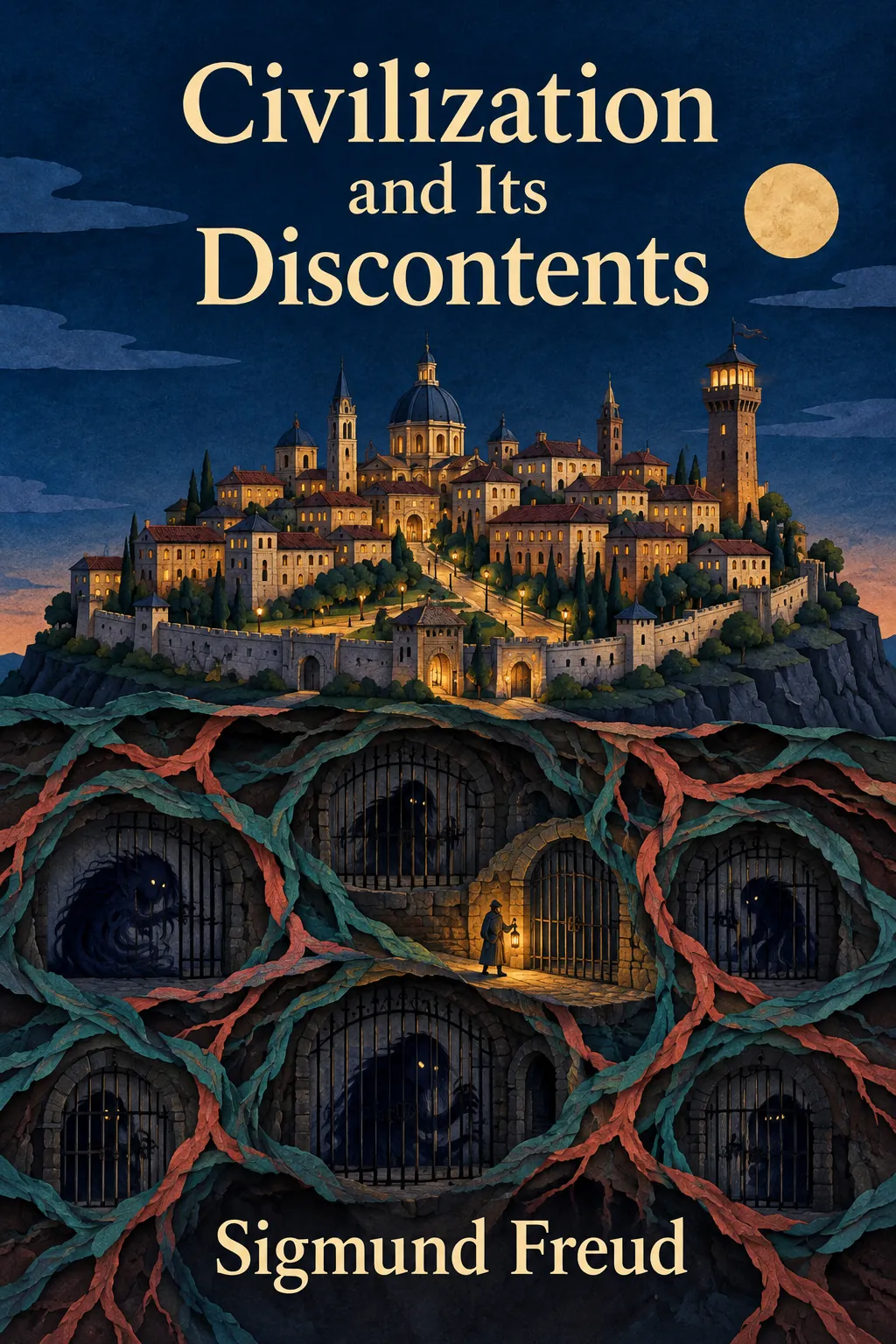
Civilization and Its Discontents
oleh Sigmund Freud
Civilization and Its Discontents is Sigmund Freud's 1930 essay on why people in modern societies so often feel unhappy even as life becomes safer and more comfortable. Freud's answer is that living together demands that we hold back our sexual and aggressive urges. Society enforces this by building a conscience inside each of us, and the conscience punishes us with guilt. The book asks how much restraint is the right price for security.
Ide Utama
"Freud argues that civilization makes shared life possible by restricting our drives, especially sex and aggression, and that this restriction turns into guilt. Progress and unhappiness grow together."
Wawasan Utama
Happiness is not part of the plan
Freud argues that the wish to be happy is built into us, but life does not cooperate. Pain comes from our bodies, from nature, and most of all from other people. Because full happiness is out of reach, people settle for easing pain: through work, art, love, beauty, intoxication or religion. None of these works for everyone, and none works forever. Freud's point is not despair but realism: expecting a permanent state of happiness sets us up for disappointment, while small satisfactions are within reach.
A good friend, a hobby you lose yourself in or a walk in a beautiful place gives real relief, even if it does not last.
Civilization trades freedom for security
Civilization protects us from nature and from each other, mainly through law. Law replaces the force of the strongest person with the force of the community, so everyone is safer. The price is that everyone also gives up some freedom and some instinctive satisfaction. Freud does not say the trade is a mistake. He says it explains why civilized people often feel restless: they have gained protection and lost some happiness, and the bill arrives as a quiet, constant dissatisfaction. Whether the trade is fair is left to each reader.
Traffic rules limit where you may drive, yet most of us prefer them to a road where the strongest simply push through.
Aggression is the real obstacle
Freud rejects the hopeful idea that people are naturally gentle. He sees a strong urge to hurt, dominate and use others, and argues that this urge is the main threat to civilization. Societies cannot remove it, so they redirect it: they bind people through shared ideals and loyalty. That works, but it has a dark side, because loyalty to an in-group often needs an out-group to hate. History, Freud suggests, shows the pattern again and again. He treats it as a fact to plan around, not as a reason to give up on society.
Fierce rivalry between neighbouring football clubs or neighbouring countries often grows out of tiny differences.
Guilt is the price of progress
Civilization stops aggression by turning it inward. A conscience, which Freud calls the superego, takes over the role of parents and society and punishes the self with guilt. The harder we hold back our urges, the stronger this inner judge becomes. So the progress of civilization is paid for in a growing sense of guilt, which Freud calls the most important problem in its development. Guilt can even grow in people who have done nothing wrong, simply from wanting what they must not have. The book leaves open how much guilt a society can bear.
A student who only thinks about cheating, then feels ashamed all week, is hearing the superego at work.
Rincian Bab
Chapter-by-chapter summary
Chapter 1: The oceanic feeling and the city of Rome
Freud opens with a letter from his friend, the writer Romain Rolland. Rolland says the root of religion is an “oceanic” feeling, a sense of being one with the whole world. Freud replies that he cannot find this feeling in himself. He suggests it is a leftover from infancy, when a baby does not yet separate itself from its mother and surroundings. To show how old mental states can survive, he compares the mind to the city of Rome, where every earlier layer would still stand beside the newest buildings. Why it matters: Freud sets up his method here, looking for the roots of adult feelings in childhood.
Chapter 2: Why happiness is so hard
Freud asks what people want from life and answers: happiness, which mostly means avoiding pain and enjoying pleasure. Life makes this hard. Suffering comes from three directions: our own bodies, the harsh outer world, and our relationships with other people. The last, he says, often hurts most. He then reviews the ways people cope, including isolation, intoxication, strict control of the drives, work and art, love, the enjoyment of beauty, and religion. Each helps a little and none works for everyone. Why it matters: Freud presents unhappiness as part of the human situation, not as a personal failure.
Chapter 3: What civilization is and what it costs
Why do the rules of civilization feel so heavy? Freud defines civilization as everything that protects us from nature and regulates relations among people: tools, order, cleanliness, beauty, science and above all law. Law replaces the strength of one person with the strength of the community. In return, each person gives up some freedom. Freud notes that civilized people have exchanged a portion of their possibilities of happiness for a portion of security, and that individual freedom was greater before civilization, though it had little protection. Why it matters: this trade between freedom and safety is the problem the whole book keeps returning to.
Chapter 4: Love versus civilization
Freud traces civilization to two roots: working together and loving. Love between two people, and the family that grows from it, was the first bond. But love also competes with society. Lovers want to be enough for each other, while civilization needs their energy to hold larger groups together. So it redirects sexual energy into friendship and shared goals, and limits sexual life in many ways. Freud also claims that women, tied to family, resist civilization's demands; that is a view of his time, and modern readers treat it with distance. Why it matters: civilization both uses love and restricts it.
Chapter 5: Love thy neighbour and human aggression
The command to “love your neighbour as yourself” strikes Freud as unrealistic. People are not gentle creatures who only want to be loved; they carry a strong urge to attack, summed up in the old saying that man is a wolf to man. Wars and cruelty, he says, are the evidence. Civilization restrains this aggression by tying people together with emotional bonds, but that lets a group love its members while hating outsiders, which he calls the narcissism of minor differences. He also doubts that abolishing private property, as communists argued, would end aggression, since it existed long before property. Why it matters: aggression becomes the central obstacle to civilization.
Chapter 6: Eros and the death drive
Here Freud revises his theory of drives. He used to set the sexual drive against the drive for self-preservation. Now he proposes two basic forces: Eros, which binds people and things into larger units, and a death drive, which pulls toward destruction and a lifeless state. Aggression, he argues, is the death drive turned outward. The history of civilization is the struggle between the two, played out on the scale of humanity. The death drive is his most disputed idea, and many analysts have rejected it. Why it matters: it explains why Freud thinks aggression can never simply be removed.
Chapter 7: Conscience and guilt
How does civilization stop aggression? By turning it inward. A child first avoids bad behaviour out of fear of losing the parents' love. Later this authority is taken into the mind as the superego, or conscience, which watches the ego and punishes it. The tension between them is the sense of guilt. Freud describes a vicious circle: the more we hold back aggression, the harsher conscience becomes, and the more guilt we feel. Civilization, he says, places a watch over our dangerous urges, like a garrison in a conquered city. Why it matters: the source of discontent is an inner judge, not only outside pressure.
Chapter 8: The price of progress and the closing question
Freud now states that the sense of guilt is the most important problem in the development of civilization: progress is paid for with lost happiness through heightened guilt. He suggests that communities also have a cultural superego, with ideals that demand more than people can give, and he raises the possibility that whole societies become neurotic, while staying cautious about such a diagnosis. He ends by saying the fate of humankind depends on whether culture can master the drive to aggression and self-destruction, now far more dangerous because of technology. Which force will win, Eros or death, is left open. Why it matters: the closing question turns the book's argument into a challenge for every reader.
Key people and terms
- Sigmund Freud: Austrian founder of psychoanalysis (1856–1939). He wrote this book in his seventies, after decades of treating patients, and uses what he learned about individual minds to explain whole societies and their unhappiness.
- Romain Rolland: French writer and a friend of Freud. His letter about an “oceanic” feeling of oneness with the world opens the book. Freud answers that he cannot find it in himself and traces it back to infancy.
- Pleasure principle: Freud's name for the basic drive to seek pleasure and avoid pain. Chapter 2 argues that it sets the goal of happiness for everyone, but that the body, nature and other people keep blocking it.
- Sublimation: Redirecting a drive's energy into socially valued activity such as art, research or work. Freud counts it among the best ways to cope with suffering, though he notes it is open to few people and gives only mild satisfaction.
- Eros: The drive to bind and unite: lovers into couples, families into communities, people into larger groups. Freud says civilization is built on it and shows history as its struggle against the death drive.
- Death drive: A proposed drive toward destruction and a return to a lifeless state. Turned outward it appears as aggression. Many psychoanalysts rejected this idea, and Freud himself admitted he arrived at it slowly.
- Superego: The part of the mind that takes in the authority of parents and society and watches over the ego. When it condemns the ego, the result is guilt. Chapters 7 and 8 present it as civilization's inner guard.
- Narcissism of minor differences: Freud's phrase for the way close neighbours quarrel over small differences. His point is that a group can bind its own members with love precisely because it has outsiders to attack.
Applying it to everyday life
Freud wrote about whole societies, but his ideas show up in ordinary situations. These questions can help you apply them, or write about the book for a class.
- Think of a rule you follow without being told. Where did your sense of “should” come from, and how does it feel when you break it?
- When did you last feel guilty about something nobody else knew? Freud would say the inner guard was doing its work. Is it always fair?
- Look at a group you belong to, such as a team, a school or a fan community. Does it define itself partly by who it is not?
- Freud says safety costs some happiness. Which trade-offs in your own life, such as convenience or security, would you reconsider?
- Which of his claims seem dated, for example on women, or on the death drive? What would a critic say?
For a school essay, pick one idea (guilt, aggression, or the trade between freedom and security), give an example from your own reading or the news, and say whether you agree with Freud and why.
Ambil Tindakan
Langkah praktis yang bisa Anda terapkan hari ini:
-
Expect relief, not permanent happiness: small satisfactions such as friendship, work you care about and beauty are more reliable than a perfect life.
-
Notice the rules you carry inside you. Ask whether each one protects people or only makes you feel guilty.
-
Be wary of group loyalty that depends on an enemy. Prefer bonds built on shared goals to bonds built on shared hatred.
-
Treat aggression as a fact to manage honestly, through law, work and love, rather than something to deny.
Kutipan Menarik
"“One feels inclined to say that the intention that man should be ‘happy’ is not included in the plan of ‘Creation’.” (Chapter 2)"
— Sigmund Freud
"“Civilized man has exchanged a portion of his possibilities of happiness for a portion of security.” (Chapter 3)"
— Sigmund Freud
"“Homo homini lupus” (man is a wolf to man). (Chapter 5)"
— Sigmund Freud
"“The narcissism of minor differences.” (Chapter 5)"
— Sigmund Freud
"“Like a garrison in a conquered city.” (Chapter 7)"
— Sigmund Freud
Siapa yang Harus Membaca Ini
Readers from about 16 up who enjoy ideas, including high-school psychology, philosophy and humanities students and first-year university students. It also suits anyone curious about why modern life feels stressful despite its comforts. The ideas are dense, so this guide works well as a first step before opening the book itself, or as revision for a seminar.
Tentang Sigmund Freud
Sigmund Freud (1856–1939) was an Austrian neurologist who founded psychoanalysis. Born in Moravia and long based in Vienna, he developed ideas about the unconscious, dreams and childhood that shaped twentieth-century thought. He left Vienna for London in 1938 after the Nazi takeover and died there. Civilization and Its Discontents is one of his most influential works on society and culture.
Ringkasan Ditulis Oleh

Software Engineer & Writer
Software engineer with a passion for distilling complex ideas into actionable insights. Writes about finance, investment, entrepreneurship, and technology.
Lihat semua ringkasan →Ulasan
Belum ada ulasan. Jadilah yang pertama berbagi pemikiran Anda!
Tulis Ulasan
Lanjut membaca
Jelajahi topik: Pengembangan DiriRingkasan

Educated: Sebuah Memoar tentang Keluarga dan Pengetahuan oleh Tara Westover
Tara Westover
Memoar tentang seorang wanita yang lahir di keluarga survivalist ekstrem tanpa akses sekolah atau medis, namun berhasil menempuh pendidikan hingga…

Ringkasan Atomic Habits: Membangun Kebiasaan Baik dengan Langkah Kecil
James Clear
Atomic Habits menjelaskan empat hukum untuk merancang kebiasaan: jelas, menarik, mudah, dan memuaskan. Clear menghubungkannya dengan sistem serta identitas; contoh…

The Psychology of Money
Morgan Housel
Kupas tuntas pemikiran Morgan Housel tentang bagaimana aspek psikologis memengaruhi keputusan keuangan dan perjalanan kita dalam membangun kekayaan.
Think and Grow Rich
Napoleon Hill
Bagaimana jika rahasia kekayaan dan kesuksesan bukan terletak pada strategi finansial yang rumit, melainkan pada kekuatan pikiran Anda sendiri? Buku…
Artikel

Let Them Theory vs pemisahan tugas: di mana tanggung jawab dimulai
Let Them Theory dan pemisahan tugas sama-sama mengajak Anda berhenti mengatur pilihan orang lain, tetapi keduanya berangkat dari titik yang…

Scout Mindset vs Growth Mindset: Memahami Perbedaan dan Irisannya
Pelajari perbedaan antara scout mindset (menyelidiki kebenaran keyakinan) dan growth mindset (mengembangkan kemampuan) lewat studi kasus praktis di tempat kerja.

Spaced Repetition vs Membaca Ulang: Cara Efektif Mengulas Buku
Bandingkan efektivitas spaced repetition vs membaca ulang untuk buku nonfiksi. Pelajari cara mengulas buku secara cerdas dengan active recall dan…