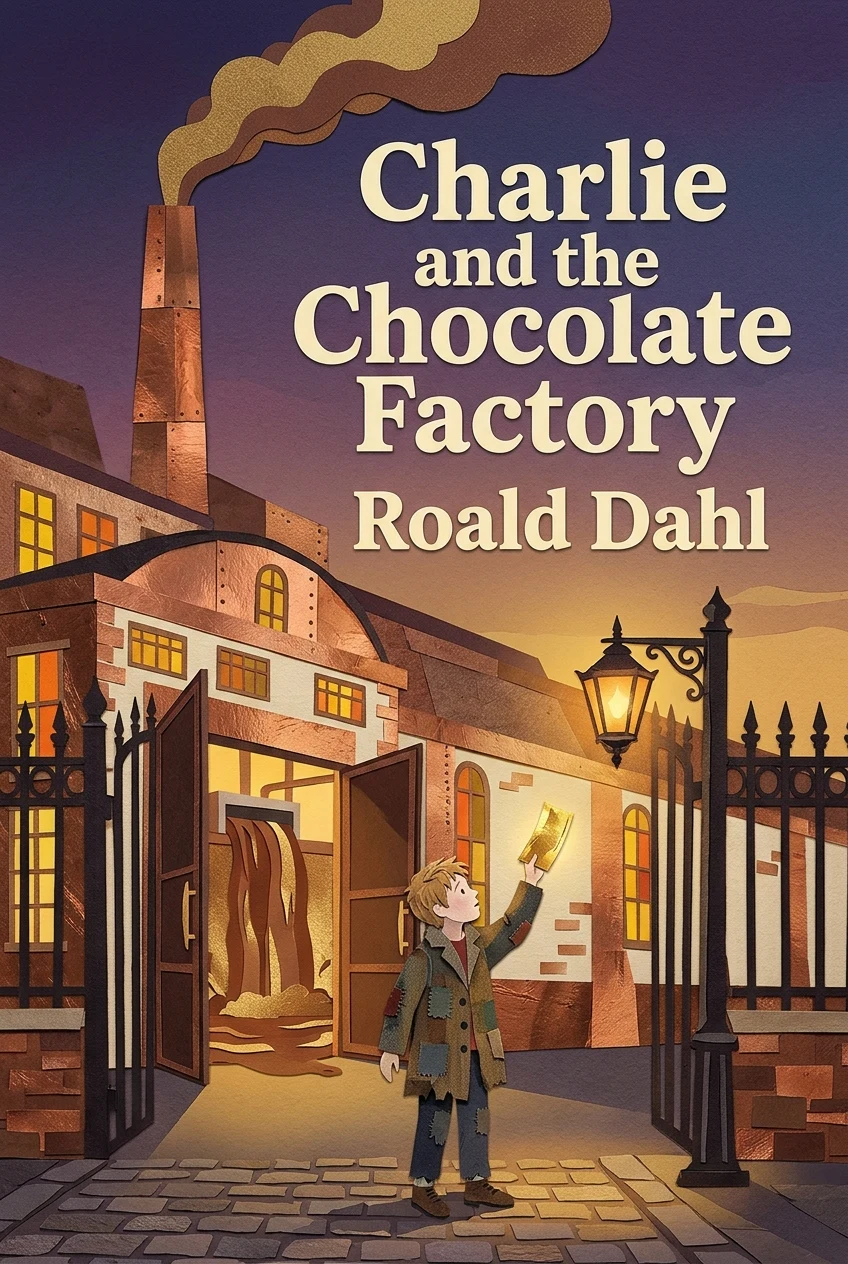
Charlie and the Chocolate Factory
oleh Roald Dahl
Charlie and the Chocolate Factory follows Charlie Bucket, a boy so poor that his four grandparents share one bed and his family lives mostly on cabbage soup. When the eccentric chocolate maker Willy Wonka hides five golden tickets in his bars, the winners get a tour of his secret factory and a lifetime supply of chocolate. Four of the children are tested by their own greed, boasting, spoiling or screen habits, and the tour becomes a test of character.
Ide Utama
"Roald Dahl uses a tour of a secret chocolate factory to show how greed, boasting and spoiling lead to trouble, set against the kindness of a poor boy."
Wawasan Utama
Faults lead to consequences
Each of the four visiting children is drawn into trouble through a conspicuous habit or desire. Augustus's appetite, Violet's pride in chewing gum, Veruca's demands and Mike's devotion to television lead to mishaps closely connected to those traits. Dahl presents the consequences with exaggeration and humour, while the Oompa-Loompas' songs make the criticism explicit. The quick sequence lets readers trace cause and effect, but it also invites them to question whether the punishments fit the behaviour.
Augustus falls into the chocolate river, while Violet takes unfinished gum and swells into a giant blueberry.
Poverty gives the ticket its weight
The Bucket family's hunger is more than background. Charlie receives one chocolate bar a year, his grandparents share a bed, and his father's lost job leaves the household with even less to eat. The ticket hunt is open to children everywhere, but families cannot buy equal numbers of bars. When Charlie finds the last ticket, the contrast between his need and the abundance inside the factory makes the visit more than a pleasant outing.
Grandpa George points out that children who can afford more chocolate have more chances to find a ticket.
Family care is a steady force
Under the comedy, the story gives considerable space to care within the Bucket family. Charlie's parents try to feed him when food is scarce, and Grandpa Joe shares stories and excitement with him. Other adults show affection differently, including by giving in to a child's every demand. Comparing these households gives readers a way to consider the difference between caring for someone and satisfying every wish.
At the end, Charlie's new opportunity includes his parents and grandparents because he does not want to leave them behind.
An unpredictable adult at the centre
Wonka is imaginative and generous, but he can also be abrupt and unsettling. He makes the rules of the visit and responds to each mishap in his own unexpected way. His inventive sweets invite delight, while his manner toward the children and their parents can make readers uncomfortable. The book does not require a single verdict on him; his actions provide material for a discussion about authority and fairness.
After Augustus falls into the river, Wonka directs the response while also worrying about what the boy may do to the chocolate.
Rincian Bab
Chapter-by-chapter summary
Spoiler warning: this section covers the whole plot, including the ending.
Part 1: Charlie's family and the golden tickets (Chapters 1–12)
Chapter 1: Charlie Bucket lives with his parents and four grandparents in a small, crowded house. The grandparents share one bed, while Charlie and his parents sleep on mattresses on the floor. Charlie receives chocolate only on his birthday and makes it last as long as he can. His family's hunger gives the treasure inside a chocolate bar a very different meaning from the one it has for wealthier children.
Chapter 2: Charlie asks his grandparents about the great chocolate factory in town. Grandpa Joe describes its owner, Willy Wonka, and his astonishing inventions, including ice cream that does not melt and sweets that change colour. Charlie's parents listen too. The family's evening conversation turns the mysterious factory into a place of possibility long before its doors open to Charlie.
Chapter 3: Grandpa Joe tells Charlie about Prince Pondicherry, who asked Wonka to build a palace out of chocolate. Wonka warned the prince that it would not last and advised him to eat it. The prince preferred to live in it, until a hot day melted the palace. The complete story gives Charlie a taste of both Wonka's ingenuity and the absurd surprises in store.
Chapter 4: On the following evening, Grandpa Joe explains why Wonka shut his factory: rival makers sent spies to steal his recipes. Later, smoke and the smell of chocolate returned, but the gates stayed shut and no workers were seen entering or leaving. Small shadows moved behind the windows. Charlie's father arrives with a newspaper announcing that the factory will open to a lucky few, deepening the mystery just as a chance to enter appears.
Chapter 5: Mr Bucket reads Wonka's announcement: five golden tickets are hidden in chocolate bars, and their finders will visit the factory and receive a lifetime supply of chocolate. Grandpa George points out that children who can buy more bars have a better chance. Charlie receives only one bar a year. The contest is open to everyone in theory, but the family sees how money changes the odds.
Chapter 6: Augustus Gloop finds the first ticket. Veruca Salt gets the second after her wealthy father has workers unwrap vast quantities of bars for her. The news of the winners spreads while the search grows frantic around the world. Veruca's story makes Grandpa George's concern concrete: her family can buy far more chances than Charlie's.
Chapter 7: On Charlie's birthday, the whole family watches him open his only present, a Wonka bar. There is no ticket. Charlie offers to share the chocolate, but his relatives urge him to enjoy it himself. Their disappointment is real, yet the care they show one another matters more in this scene than the failed search.
Chapter 8: Mr Bucket reads that Violet Beauregarde and Mike Teavee have found the third and fourth tickets. Violet proudly talks about chewing the same piece of gum for months; Mike is absorbed in television. The reports introduce two strong personalities before the factory visit and leave only one ticket for Charlie to dream about.
Chapter 9: Grandpa Joe secretly gives Charlie a coin saved under his pillow and sends him to buy another bar. They open it together, but there is no ticket. After their disappointment, they laugh at their unlikely hopes. Joe has risked a little money on a very small chance, giving Charlie a moment of companionship as well as another attempt.
Chapter 10: Winter brings deep snow and bitter cold. Mr Bucket loses his job and earns a little money clearing snow, but the family has even less food. Charlie grows weaker and tries to conserve his strength. The prospect of chocolate is no longer merely a birthday pleasure: the lack of food threatens the whole household.
Chapter 11: Walking home, Charlie finds money in the snow and buys a chocolate bar. Hungry, he eats it and then buys a second with some of the change. Inside is the fifth golden ticket. The shop fills with excited people, and the shopkeeper helps Charlie get away with his prize. An accidental discovery suddenly gives the boy with the fewest chances a place on the tour.
Chapter 12: Charlie brings the ticket home. Grandpa Joe leaps from bed in excitement, and Mr Bucket reads the instructions aloud: the visit is on 1 February, and Charlie may bring one or two adults. Joe will accompany him. Reporters gather outside as the family prepares for an adventure that, only hours earlier, seemed impossible.
Part 2: Augustus Gloop and the chocolate river (Chapters 13–18)
Chapter 13: The five winners gather at the factory gates on the morning of the visit. The other four children arrive with their parents; Charlie comes with Grandpa Joe. A crowd waits outside until the gates begin to open. Charlie's modest party stands among families whose children have already become famous through the ticket hunt.
Chapter 14: Willy Wonka appears in a top hat and tailcoat, with bright eyes and an energetic manner. He greets the children and leads the visitors into the factory, talking rapidly as they follow him through corridors. Their first destination is the Chocolate Room. After so much anticipation, the host proves as surprising as the stories about him.
Chapter 15: The Chocolate Room contains a valley, a chocolate river and a waterfall that mixes the chocolate. Much of the landscape is edible. As the visitors explore and taste it, Veruca notices small people across the river. Wonka identifies them as Oompa-Loompas. The secret workers Grandpa Joe described are no longer shadows behind a window.
Chapter 16: Wonka says the Oompa-Loompas came from Loompaland, where dangerous creatures drove them to live in trees. They mostly ate unpleasant green caterpillars and longed for scarce cacao beans. He offered them as many cacao beans as they wanted in exchange for coming to work at his factory. Veruca demands an Oompa-Loompa of her own; then Mrs Gloop notices Augustus drinking from the river.
Chapter 17: Augustus ignores Wonka's warning, falls into the chocolate river and is sucked into a pipe. He becomes stuck for a moment before travelling up it. His parents are alarmed, while Wonka directs them to follow an Oompa-Loompa. The workers sing about Augustus's appetite, establishing the pattern of song and sharp comedy that follows each mishap.
Chapter 18: The remaining visitors board a boat rowed by Oompa-Loompas and travel down the chocolate river. Wonka has hot chocolate served to everyone, including Charlie and Grandpa Joe. The boat enters a dark tunnel, and the noisy journey unsettles some of the adults. For Charlie, a child who has known hunger, the rich drink and strange voyage are part of an almost unbelievable day.
Part 3: Violet Beauregarde and the Inventing Room (Chapters 19–21)
Chapter 19: Wonka brings the party to the Inventing Room and warns them to be careful. He shows them Everlasting Gobstoppers, designed to last a long time, and Hair Toffee, which makes hair grow. The room is full of experiments rather than finished treats. That distinction becomes crucial when one visitor wants to try a new invention immediately.
Chapter 20: A huge machine mixes ingredients and produces a small strip of chewing gum. Its plain appearance conceals an ambitious idea, and Wonka is delighted with it. Violet, who prides herself on chewing gum, pays close attention. The machine builds anticipation for a product that seems made to tempt her.
Chapter 21: Wonka explains that the gum tastes like a complete meal, but warns that it is not ready. Violet takes it anyway and tastes the courses in turn, ending with blueberry pie. She turns blue and swells into a huge round shape. Oompa-Loompas roll her away for juicing and sing about gum chewing. Her eagerness to try the invention has consequences far beyond an ordinary spoiled meal.
Part 4: Veruca Salt and the Nut Room (Chapters 22–25)
Chapter 22: Charlie anxiously asks what will happen to Violet. Wonka says she will be juiced, though her colour may remain. The party moves along a corridor past doors bearing the names of more unusual inventions. Charlie's concern for Violet stands out amid the excitement, while the doors suggest how much of the factory remains unseen.
Chapter 23: The visitors inspect rows of square sweets with little faces. Veruca and Mike dispute Wonka's claim that the sweets 'look round': they think he means the sweets are round in shape. When the door opens, the faces turn to look around. Wonka's joke depends on two meanings of the same words, making an argument over an invention into a piece of wordplay.
Chapter 24: In the Nut Room, trained squirrels sort nuts and discard bad ones. Veruca wants a squirrel and enters despite Wonka's warning. The squirrels test her, decide she is a bad nut and send her down the rubbish chute; her parents follow. The workers' song turns from Veruca's demands to the adults who have indulged them.
Chapter 25: Wonka leads the remaining party into a glass lift with buttons for many rooms. It can travel in different directions, and Wonka invites the children to choose a destination. Mike asks about television and presses the button Wonka indicates. The lift shoots sideways, startling its passengers and carrying them toward the next room.
Part 5: Mike Teavee and Television Chocolate (Chapters 26–27)
Chapter 26: The visitors enter a brilliantly white room and put on dark glasses. Wonka demonstrates Television Chocolate: a huge bar is transmitted to a television set, where it appears much smaller. At Wonka's instruction, Charlie reaches into the screen and takes out the real chocolate. Mike sees a machine that can send more than pictures and immediately imagines another use for it.
Chapter 27: Mike sends himself through the television apparatus and appears on the screen only about an inch tall. His parents panic. Wonka proposes using a machine made to stretch chewing gum to make him taller again, and Oompa-Loompas take Mike and his parents away. Their song attacks excessive television watching, while the device has turned Mike's favourite pastime into a physical predicament.
Part 6: Charlie's reward (Chapters 28–30)
Chapter 28: Wonka asks how many children are left; Grandpa Joe tells him that only Charlie remains. Wonka congratulates Charlie on winning, though he has not yet explained the full prize. He ushers Charlie and Joe into the glass lift and presses the UP AND OUT button. The lift rises through the factory and out into the air, beginning the journey on which Wonka will reveal his plan.
Chapter 29: From above, Wonka spots the other children and lowers the lift near the factory gates. Augustus has become thin, Violet remains purple, Veruca is covered in rubbish, and Mike emerges stretched extremely tall and thin. The children and their parents are leaving with their promised supply of sweets. Seeing all four again answers the question of what happened after they disappeared from the tour.
Chapter 30: High above town, Wonka asks whether Charlie loves the factory. He explains that he wants a child to inherit it and offers it to Charlie when he is old enough to run it. The lift goes to the Bucket home, and Wonka invites the entire family to live at the factory. The three grandparents still in bed travel with the bed itself. Charlie's good fortune becomes a new home for the family he refuses to leave behind.
Characters
Charlie Bucket: A poor, kind boy who lives with his parents and four grandparents. Chocolate is a rare birthday treat for him. His concern for his family and his quiet wonder distinguish him from the other winners during the visit.
Willy Wonka: The eccentric inventor and owner of the factory. He guides the visitors, reveals extraordinary sweets and reacts unpredictably to trouble. His humour and his treatment of the children leave readers room to debate how fair a host he is.
Grandpa Joe: Charlie's grandfather and companion on the tour. His stories first bring Wonka's factory alive for Charlie; his excitement at the ticket shows how fully he shares his grandson's hopes.
Augustus Gloop: A boy with an enormous appetite and the first ticket winner. His attempt to drink from the chocolate river leads to the first mishap of the visit.
Veruca Salt: A child accustomed to getting whatever she demands. Her father has workers search bars for her ticket, and in the factory she wants both an Oompa-Loompa and a trained squirrel.
Violet Beauregarde: A proud, competitive gum-chewer. When Wonka demonstrates an unfinished gum with the flavours of a meal, she takes it despite his warning and pays a remarkable price.
Mike Teavee: A boy fascinated by television. In the Television Chocolate Room, he sees a way to put himself on screen and acts before considering the consequences.
Mr and Mrs Bucket: Charlie's parents struggle to feed the family, especially after Mr Bucket loses his job. Their care for Charlie and the grandparents gives the story a warm centre.
The Oompa-Loompas: Wonka's factory workers came from Loompaland, where they mostly ate green caterpillars and longed for rare cacao beans. Wonka offered cacao as payment. Their songs comment on each child's misadventure and often extend the criticism to the child's parents.
Writing about this book
A useful report can begin with one visitor. Choose Augustus, Violet, Veruca or Mike and trace the connection between what that child wants and what happens in the factory. Which details prepare you for the incident before the visit begins? Then compare that child with Charlie. Consider what Charlie's response to hunger and his concern for his family add to the contrast.
You could also ask whether the consequences are fair. Pick a particular scene and look at both the comic language and the danger the child faces. Does the humour make the scene less severe, or does it make the severity more noticeable? Wonka's role offers another question: is he a generous host, an unpredictable judge, or both? Support your view with events from the book, rather than relying on a film adaptation. Finish with your own response to the scene and explain which detail led you to it.
Ambil Tindakan
Langkah praktis yang bisa Anda terapkan hari ini:
-
Trace one visitor's desire from the newspaper reports to the factory incident, noting how Dahl connects the two scenes.
-
Compare the adults' responses to their children and consider what the book suggests about care and indulgence.
-
Notice how the family's hunger changes the meaning of the factory's abundance and Charlie's eventual opportunity.
Kutipan Menarik
"“What an extraordinary little man” (Chapter 14; narration)"
— Roald Dahl
"“I’m afraid that simply isn’t true” (Chapter 5; Grandpa George)"
— Roald Dahl
"“Three good little children left” (Chapter 22; Willy Wonka)"
— Roald Dahl
Siapa yang Harus Membaca Ini
Children from about eight to twelve who enjoy funny, surprising stories may enjoy this book, and it also works as a read-aloud. Lower secondary students can use it to discuss character, fairness and comic exaggeration. Adults revisiting the story may notice how sharply its humour sits beside the family's poverty.
Tentang Roald Dahl
Roald Dahl (1916–1990) was a British writer born in Wales to Norwegian parents. He flew as a fighter pilot for the Royal Air Force during the Second World War, and later wrote for adults as well as children. He is best known for children's books such as Matilda, James and the Giant Peach and Fantastic Mr Fox.
Ringkasan Ditulis Oleh

Software Engineer & Writer
Software engineer with a passion for distilling complex ideas into actionable insights. Writes about finance, investment, entrepreneurship, and technology.
Lihat semua ringkasan →Ulasan
Belum ada ulasan. Jadilah yang pertama berbagi pemikiran Anda!
Tulis Ulasan
Lanjut membaca
Jelajahi topik: FiksiRingkasan

Out of My Mind
Sharon M. Draper
“Out of My Mind” karya Sharon M. Draper adalah kisah menyentuh tentang kehidupan Melody Brooks, seorang gadis muda penderita cerebral…

Ender’s Game
Orson Scott Card
“Ender’s Game” karya Orson Scott Card adalah novel fiksi ilmiah memikat yang membawa pembaca ke masa depan saat umat manusia…

Pachinko
Min Jin Lee
“Pachinko”, sebuah saga sejarah lintas generasi yang memikat karya Min Jin Lee, mengisahkan perjuangan sebuah keluarga Korea dalam mengarungi gejolak…

The Perks of Being a Wallflower
Stephen Chbosky
The Perks of Being a Wallflower karya Stephen Chbosky adalah novel coming-of-age yang mendalam, dikisahkan melalui surat-surat pribadi Charlie, seorang…
Artikel
Zaman Pencerahan Dijelaskan: Gagasan, Tokoh, dan Warisannya
Zaman Pencerahan adalah gerakan abad ke-18 di Eropa yang menempatkan akal dan bukti di atas tradisi serta otoritas. Para pemikir…

Sejarah Dunia 1700–1918: Revolusi, Industri, Kekaisaran dan Perang
Antara 1700 dan 1918, revolusi, pabrik, kekaisaran, dan perang dunia membentuk ulang masyarakat di Eropa, Amerika, Asia, dan Afrika. Panduan…

Tema A Christmas Carol: kemurahan hati, isolasi dan tanggung jawab
Novela Dickens biasanya dibaca sebagai kisah seorang pria yang mengubah pikirannya. Tema-temanya lebih tajam dari itu: kemurahan hati sebagai praktik,…