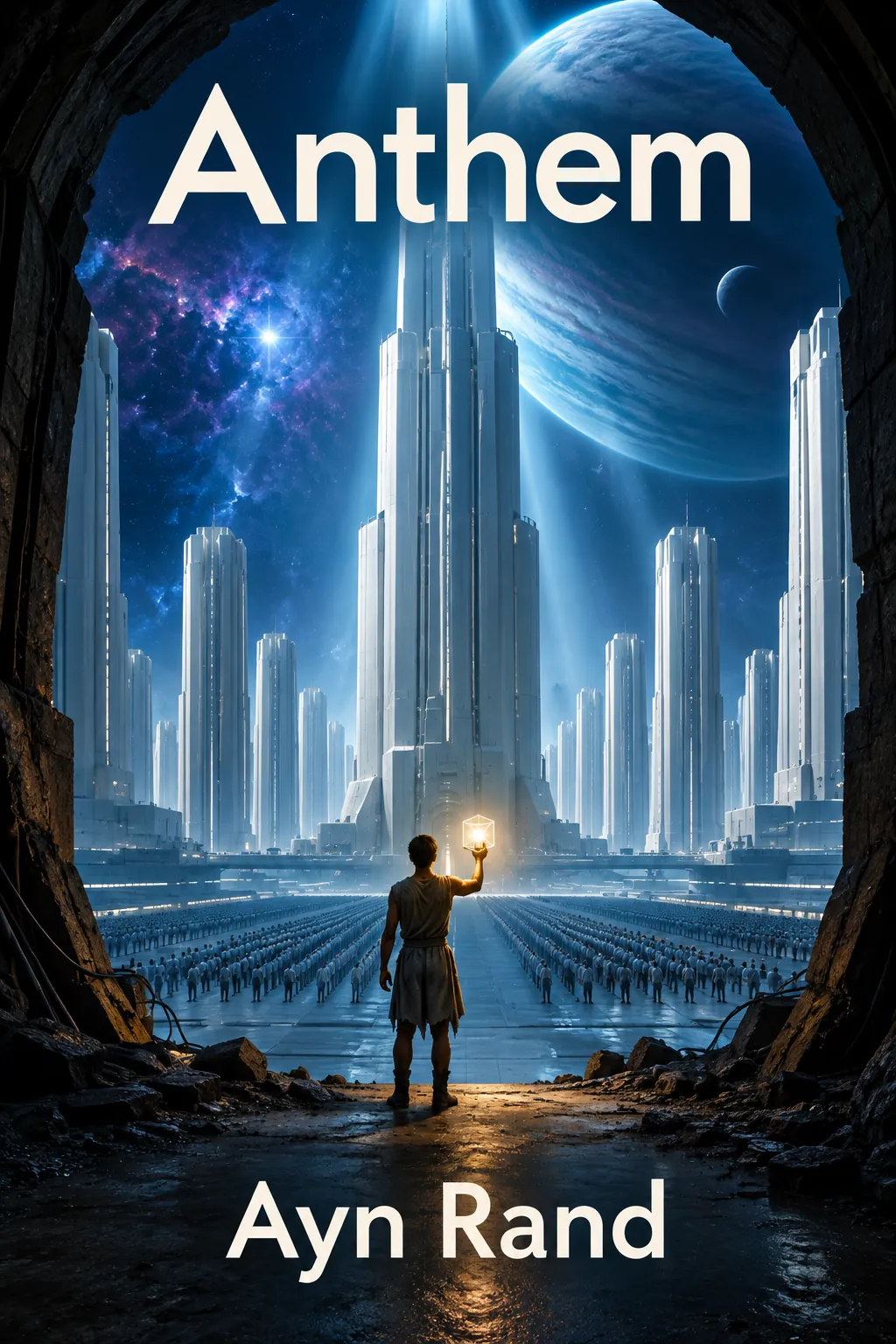
Anthem
oleh Ayn Rand
Anthem is a short dystopian novel by Ayn Rand, first published in 1938. It is set in a future where individuality has been erased and nobody may say “I”. Equality 7-2521, a street sweeper, is too curious to fit in, and he secretly rebuilds something the world has forgotten. His discovery sets him against the councils that rule every life, and the book asks what a person is worth when the group always comes first.
Coba Audible · Sebagai Amazon Associate, kami mendapat komisi dari pembelian yang memenuhi syarat. Detail
Ide Utama
"Anthem argues that the individual mind, not the group, is the source of progress and meaning, and that a society forbidding the word “I” cannot move forward."
Wawasan Utama
The individual versus the collective
Anthem presents a world where the group is everything and the person is nothing, and then shows what that costs. The hero is not rebelling for fun. He is simply unable to stop thinking, and that makes him a danger to a system built on sameness.
The Council of Vocations decides his job without asking, and the Council of Scholars rejects his invention because it came from one man.
Language shapes thought
The people of this future cannot say “I”, so they find it hard even to imagine themselves as separate from the group. Taking away a word removes an idea. When the hero finds it again, he finds himself.
The narrator speaks as “we” for most of the book, and the change at the end is the key moment.
Progress needs freedom
The book argues that discoveries come from curious individuals working freely, and that a society that punishes this will stand still. The hero’s light could help everyone, yet the people in charge protect their habits first.
The scholars worry about the candle-makers and decide the box must be destroyed.
Love as a free choice
The hero’s bond with the Golden One is the opposite of the assigned relationships of the city. They choose each other, and that choice becomes a model of what the book values: consent, honesty and self-ownership.
She follows him into the forest although she has been taught to fear it.
Rincian Bab
Chapter-by-chapter summary
Spoiler warning: this section covers the whole plot, including the ending.
Anthem has twelve short chapters. They are grouped here into nine parts.
Part 1: A secret diary in a tunnel
The story opens as a diary kept in secret. Equality 7-2521 hides in an abandoned underground tunnel and admits that merely writing is a crime.
He lives in a future where nobody says “I”. Children grow up in state Homes, receive a number and a virtue word as a name, and learn that being different is a sin.
Even the way he writes is odd, because he has no word for himself and must say “we” when he means one person. The reader has to work out who is speaking, and that effort is part of the point.
This opening matters because the whole book follows one voice learning to speak for itself. We see the cost of “we” before anyone argues against it.
Part 2: The Home of the Students and the Council of Vocations
Equality 7-2521 is tall, quick and full of questions, and the teachers punish him for it. He enjoys learning, but wanting to know more than others counts as a fault.
At fifteen, the Council of Vocations assigns every person a job once and for all. He hopes to become a Scholar and is made a Street Sweeper instead.
Nobody asks what he wants, and that shows how the system works. He accepts the job, but his curiosity does not go away.
The scene also shows that the rulers rarely use open cruelty. They rely on routine, shame and the fear of standing out.
Part 3: A friend and the Golden One
He has a close friend, International 4-8818, with whom he can speak a little more honestly than with others. Such friendships are tolerated only as long as nobody is preferred over anyone else.
Out in the fields he notices a young woman, whom he names the Golden One in his mind. Her official name is Liberty 5-3000.
Being drawn to one person breaks a rule that treats everyone as interchangeable. It is the first sign that his feelings are his own.
He cannot explain the feeling in the words he has, so he simply carries it as a secret. That silence shows how little language the system leaves for private life.
Part 4: The tunnel is found
While sweeping, he finds a hidden opening in the ground. Below is an old tunnel with iron rails, left by people from a time the world calls unmentionable.
He tells no one and slips away at night to be there. For the first time he has hours that belong only to him.
He knows that leaving the hall at night and keeping a secret are serious offences. He goes anyway, because the wish to understand is stronger than his fear.
This is the turning point. His action is no longer something a council allowed.
He chose it.
Part 5: The light
In the tunnel he finds old tools, wires and glass. By testing and combining them he works out how to make light without a candle.
The joy he feels is new to him, because the result is his own work and nobody else’s. Claiming that credit is a large step away from “we”.
He works slowly, repeating small experiments until the glass finally glows. The book treats this patient trial and error as the real source of progress.
He is sure the discovery will make everyone’s life easier. He decides to give it to the Scholars.
Part 6: The Council of Scholars says no
He carries his glowing box to the Council of Scholars. They do not marvel at it.
They worry that it breaks the rules and could put the candle-makers out of work.
They also reject the idea that one man could find what the group could not. They say the device must be destroyed, and he runs away with it.
The Scholars are not shown as stupid. They are shown as people who have learned to protect the system before they protect the truth.
The scene shows a society that values stability over progress. A useful idea is crushed because it is new.
Part 7: The Uncharted Forest
He flees into the Uncharted Forest, which everyone is taught to fear. There he hunts, makes fire and lives by his own effort.
The Golden One follows him there. The two choose each other freely, with no council to approve it.
Their bond is a chosen relationship, not an assignment. The forest becomes a place of fear, but also of delight.
For the first time he looks at his own body and mind with pride instead of shame. The wilderness gives him what the city never allowed, which is room to be himself.
Part 8: The house in the mountains
The couple walks on and finds a house in the mountains, built long ago and still standing. It has glass windows, shelves and many books.
He reads for days, and slowly he understands that the world once had a word it lost. It is the word for the self.
The old house also shows how much the earlier world knew, from comfortable furniture to the ideas written in its books. It makes clear that the loss was not natural but chosen by later rulers.
Reading gives him the language he was denied. Knowledge here is the tool that frees him.
Part 9: The word “I”
Once he knows the word, he can say who he is. He names himself Prometheus and the Golden One Gaea.
He decides to make the house his home and later return to the city with the light and the new word. The aim is to free others, not to hide.
From this point the narration switches from “we” to “I”, and the change gives the ending its power. It is the moment the reader has been waiting for since the first page.
The book ends with his vow to carve the word “EGO” over the door of the house. It closes on pride in the individual who decides his own life.
Characters
Equality 7-2521 (Prometheus)
The narrator and hero. He is curious, intelligent and brave, and he rediscovers electric light and the word “I”.
His growth from a frightened sweeper to a man who names himself is the spine of the book.
The Golden One (Liberty 5-3000, Gaea)
A young woman who works in the fields and later joins him in the forest. She chooses him and, like him, learns to name herself.
International 4-8818
The narrator’s friend. He represents the small, quiet closeness that survives even in a world that discourages it.
The Council of Vocations
The body that assigns every person a job at fifteen. It shows how the system removes personal choice and calls the result fairness.
The Council of Scholars
The group that rejects the narrator’s invention. They stand for a society that fears change more than it values knowledge.
The word “I”
Although it is not a person, this lost word is the book’s central symbol. Recovering it is the hero’s real discovery.
Writing about this book
Start with a clear claim about what Rand wants you to believe, such as that individual thought drives progress. Then test it against scenes, not just the summary.
The scene with the Council of Scholars is a good piece of evidence. The scholars do not reject the light because it fails.
They reject it because one man made it.
The language is another strong angle. Notice how “we” appears on almost every page at first and how the final chapters change that.
You can also write about structure. The diary form, the short chapters and the move from darkness to light all push the reader toward the final turn.
A strong answer also looks at the other side. Critics say the book makes collective life a caricature, with no real kindness in it, and that Rand’s answer is one-sided.
If you compare it with other dystopias, such as 1984, ask how each handles language and control. In Anthem the threat is forgetfulness, not constant surveillance.
Use only short quotes and always explain them in your own words. A good paragraph makes a claim, gives one scene as evidence, and then explains what that scene shows about the book’s argument.
Ambil Tindakan
Langkah praktis yang bisa Anda terapkan hari ini:
-
Check which of your habits are choices and which are only “what everyone does”.
-
When you meet a new idea, ask whether it works before asking who is allowed to propose it.
-
Pay attention to the words your group uses, because the words you can say limit what you can think.
-
Read a story’s argument carefully, then test it against the other side.
Kutipan Menarik
"“It is a sin to write this.” (Chapter 1)"
— Ayn Rand
"“There are no men but only the great WE, one, indivisible and forever.” (Chapter 1)"
— Ayn Rand
"“I am. I think. I will.” (Chapter 11)"
— Ayn Rand
Siapa yang Harus Membaca Ini
Anthem suits high-school and early college readers, roughly ages 14 and up, who are studying dystopian fiction. It is also a quick read for anyone interested in ideas about individuality, language and politics, and it works well alongside 1984.
Ingin buku lengkapnya?
Baca atau dengarkan Anthem secara lengkap.
Coba Audible · Sebagai Amazon Associate, kami mendapat komisi dari pembelian yang memenuhi syarat. Detail
Tentang Ayn Rand
Ayn Rand (1905–1982) was born Alisa Rosenbaum in St. Petersburg, Russia, and moved to the United States in 1926. She wrote the novels The Fountainhead and Atlas Shrugged and developed the philosophy she called Objectivism. Anthem, written in 1937, is her short dystopian story about individuality and collective rule.
Ringkasan Ditulis Oleh

Software Engineer & Writer
Software engineer with a passion for distilling complex ideas into actionable insights. Writes about finance, investment, entrepreneurship, and technology.
Lihat semua ringkasan →Ulasan
Belum ada ulasan. Jadilah yang pertama berbagi pemikiran Anda!
Tulis Ulasan
Lanjut membaca
Jelajahi topik: Fiksi ilmiahRingkasan

Out of My Mind
Sharon M. Draper
“Out of My Mind” karya Sharon M. Draper adalah kisah menyentuh tentang kehidupan Melody Brooks, seorang gadis muda penderita cerebral…

Ender’s Game
Orson Scott Card
“Ender’s Game” karya Orson Scott Card adalah novel fiksi ilmiah memikat yang membawa pembaca ke masa depan saat umat manusia…

Pachinko
Min Jin Lee
“Pachinko”, sebuah saga sejarah lintas generasi yang memikat karya Min Jin Lee, mengisahkan perjuangan sebuah keluarga Korea dalam mengarungi gejolak…

The Perks of Being a Wallflower
Stephen Chbosky
The Perks of Being a Wallflower karya Stephen Chbosky adalah novel coming-of-age yang mendalam, dikisahkan melalui surat-surat pribadi Charlie, seorang…
Artikel

Tema A Christmas Carol: kemurahan hati, isolasi dan tanggung jawab
Novela Dickens biasanya dibaca sebagai kisah seorang pria yang mengubah pikirannya. Tema-temanya lebih tajam dari itu: kemurahan hati sebagai praktik,…

Sejarah alternatif
Sejarah alternatif adalah fiksi yang mengubah satu peristiwa nyata, misalnya pertempuran atau pemilu, lalu menelusuri akibatnya sejak titik divergensi itu.…

Biopunk
Biopunk adalah genre fiksi ilmiah tentang rekayasa genetika dan bioteknologi yang dilihat dari sudut pandang jalanan. Genre ini bertanya siapa…