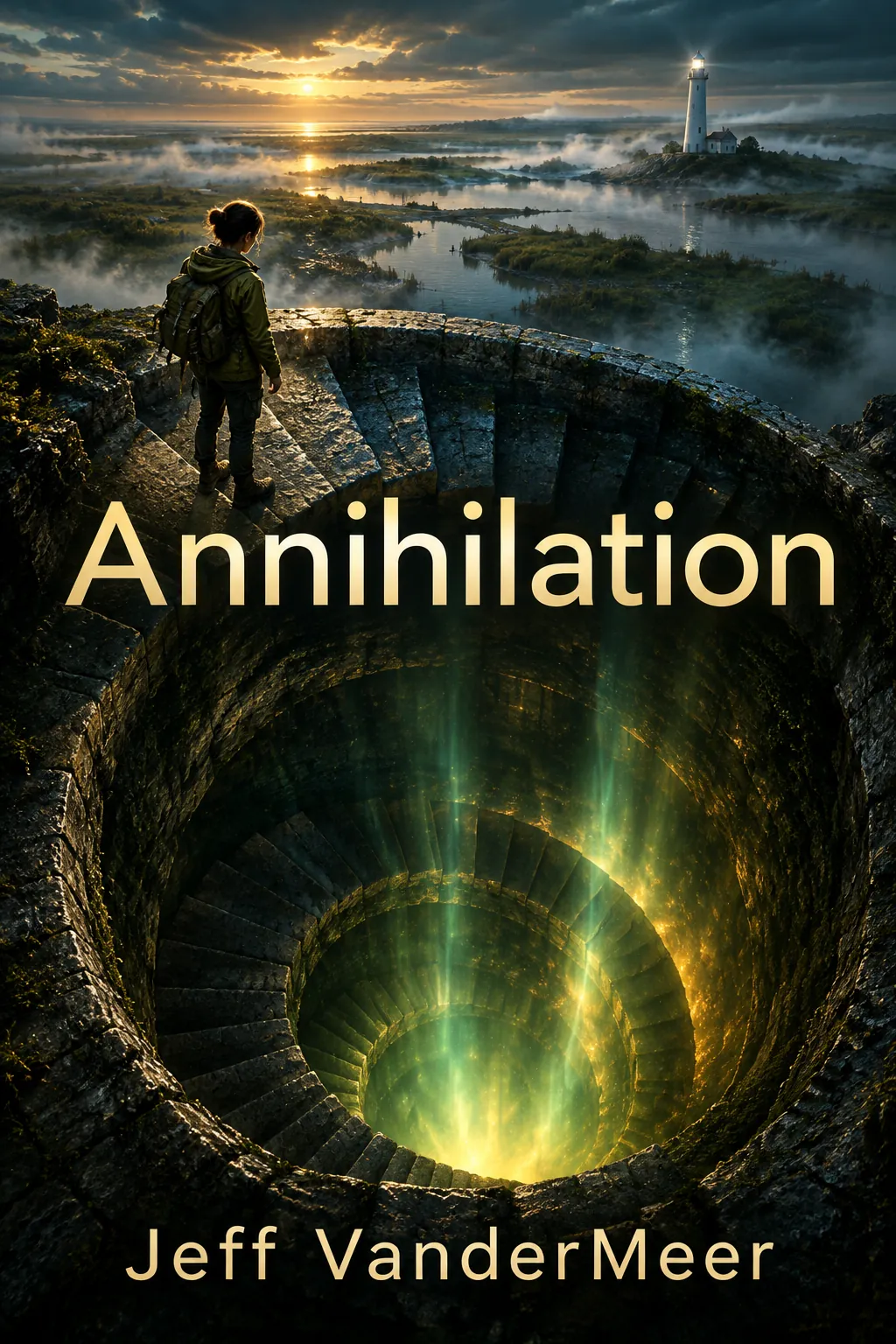
Annihilation
oleh Jeff VanderMeer
Annihilation is a short, eerie novel told by an unnamed biologist who joins the twelfth expedition into Area X, a coastal region sealed off from the world after an unexplained event. Her team of four women finds a strange tunnel, a lighthouse and a landscape that seems to be quietly rewriting them. The book asks what it means to understand a place, or a person, that will not explain itself. It is the first novel of the Southern Reach trilogy, published in 2014.
Coba Audible · Sebagai Amazon Associate, kami mendapat komisi dari pembelian yang memenuhi syarat. Detail
Ide Utama
"When people meet something they cannot explain, they carry their old habits of mind into it. Annihilation shows a scientist watching those habits fail while she herself changes with the wild place around her."
Wawasan Utama
Naming is a way of holding on to control
The biologist and the psychologist cannot even agree whether the structure is a tunnel or a tower. Both words are guesses that let a person feel she understands something she does not. The book suggests that labels often say more about the person using them than about the thing described.
The argument in Part 2 over "tunnel" and "tower" shows each woman clinging to her own picture of the world.
Science works until the subject looks back
The biologist trusts careful observation, samples and notes. Area X slowly shows that an observer can be changed by what she studies, and that detachment has limits. The novel is not against science, but it shows how thin its comfort becomes in a place with no rules to discover.
She finds human cells in plant and animal samples, yet she can no longer be sure that her own body is a neutral instrument.
Institutions hide what they do not understand
The expedition is sent in with hypnosis, partial maps and a missing history of earlier trips. Authority here is not evil in a cartoon way, it is simply frightened and secretive. The result is that the people at the bottom of the chain pay the price.
The lighthouse journals reveal many more expeditions than the public record admits, and the psychologist lies about the anthropologist's fate.
Loneliness can open a person to change
The biologist is at ease alone, and that makes her an unusual witness. Her solitude, grief for her husband and curiosity make her willing to accept the strangeness of Area X in a way her teammates are not. The ending asks whether that is courage, surrender or both.
She leaves the tower, having recognised the Crawler as the lighthouse keeper, and chooses to walk on into Area X instead of going home.
Beauty and danger can live in the same place
Area X is full of tidal pools, birds and quiet light, yet it quietly harms and changes the people who enter it. The book does not treat nature as kind or cruel, only as indifferent to human plans. That indifference is what makes the beauty feel unsettling instead of comforting.
The biologist's delight in the tidal pools sits right beside the growing signs that her body is changing.
Rincian Bab
Chapter-by-chapter summary
Spoiler warning: this section covers the whole plot, including the ending.
The novel has twelve numbered chapters. To keep this guide easy to scan, we group them into seven parts that follow the story in order.
Part 1: Crossing into Area X
The narrator is a biologist, and the book is her written report of the twelfth expedition into Area X. Four women make up the team: a biologist, a psychologist who leads, an anthropologist and a surveyor.
They are hypnotised before they cross the border, so they will follow orders and not panic. This matters because the very first step shows that the people sending them in do not trust them with the truth.
Part 2: The tunnel that is also a tower
At base camp the team finds a structure that is missing from their maps, a stairway spiralling down into the earth. The psychologist calls it a tunnel, but the biologist insists it is a tower, and the argument about the word shows how each woman sees the place differently.
It matters because the book keeps returning to this idea: naming a thing is a way of controlling it, and Area X refuses to be controlled.
Part 3: The words on the wall
On the inside wall of the staircase the biologist finds lines of writing made of a living, fungus-like growth. When she leans close, a cloud of spores drifts into her face, and she hides this from the others.
The spores seem to break the hypnotic commands for her, so she pretends to obey while she watches the psychologist more closely. The secret turns the expedition into a quiet contest of who knows what.
Part 4: The anthropologist vanishes
One dawn the team wakes to find the anthropologist gone, and the psychologist says she abandoned the mission. The biologist, who now knows the hypnosis no longer works on her, does not believe it.
Later the surveyor and the biologist find the anthropologist's mutilated body in the tower, killed by the creature the biologist calls the Crawler. A sample taken from the body shows that the psychologist had lied about her.
It matters because the person in charge has now been caught hiding the truth, and trust inside the team collapses. The psychologist soon disappears.
Part 5: The lighthouse and the journals
The biologist goes on to the lighthouse and finds the psychologist dying at its foot. Her body is heavily infected with fungus, and she seems to believe that the two of them fought at the top and that the biologist jumped.
Before she dies, the psychologist tells the biologist that the border of Area X is slowly expanding.
Inside the lighthouse the biologist finds bloodstains and a hidden pile of journals left by earlier expeditions, far more of them than the authorities ever admitted. She takes an old photograph of the lighthouse keeper and her husband's journal.
The journal tells how he and a teammate saw doubles of their own team walking to the tower, and how he decided to go deeper. The mystery now has a scale: this has happened many times before.
Part 6: The surveyor and the glow
The surveyor has stayed at the campsite. When the biologist returns from the lighthouse, she fears the strange glow she sees in her and shoots her twice.
The biologist fires back and kills her, and her own wounds begin to heal. She is now alone in Area X, and the change in her body can no longer be denied.
Part 7: Into the tower, and out along the coast
Under the microscope the biologist finds that the fungus matches what infected the psychologist, and that some plant and animal samples contain human cells. She concludes that people who enter Area X are changed, and that something there may be turning into human.
She goes down the tower stairs and meets the Crawler. It paralyses her in blinding light and noise, seems to understand her completely, and throws her down the stairs, but when she climbs back it lets her pass.
As she leaves, she glimpses a human face and recognises the Crawler as the lighthouse keeper from the old photograph. She decides to stay in Area X and follow the coastline to its end, as her husband once tried to do.
Characters
Nobody in the book is named by choice: the team members are known only by their jobs, and the story is stronger for it.
- The biologist (narrator): A solitary scientist who is more at ease with tidal pools than with people. Her husband was on the eleventh expedition and came back a changed man.
- The psychologist: The official leader of the team, calm and commanding. She uses hypnosis to keep the others in line, and her lies drive much of the tension.
- The anthropologist: A younger, more eager member of the team. She vanishes at dawn and is later found dead in the tower.
- The surveyor: A practical former soldier who trusts maps, weapons and routine. She stays at the campsite and shoots at the biologist when she fears her glow.
- The biologist's husband: Seen only through memory and his journal. He stands for what Area X takes from the people who go in.
- The Crawler (the lighthouse keeper): The creature in the tower that produces the writing. The biologist can only describe it in pieces, until she recognises the face of the keeper from the old photograph.
Setting and style
The book is short, about 200 pages, and it reads like a field report written by someone who is trying to stay calm. The sentences are plain and exact, which makes the strange details feel more real.
Area X is a mix of marsh, pine forest, dunes and shoreline. It looks like a protected nature reserve, and that is part of the unease: the place seems peaceful while everything about the mission says it is not.
The narrator describes plants, animals and light with a scientist's care. These passages slow the story down and invite you to look closely, just as she does.
The mood comes from what is left unsaid. The book rarely explains the border, the earlier expeditions or the Crawler, and those gaps are part of how it works.
It is natural to finish the book with questions. Instead of hunting for a single answer, ask what the book chooses not to tell you, and why.
Key terms to know
- Area X: The sealed coastal region that the expeditions enter. Its edge is the border the team crosses at the start.
- Southern Reach: The government agency that organises and hides the expeditions. It gives the trilogy its name.
- Weird fiction: A style that mixes science fiction, horror and nature writing to create a feeling of the uncanny rather than a clear explanation.
- Unreliable narrator: A storyteller whose account may be partial, biased or incomplete. The biologist admits she keeps things back.
- The Crawler: The name the biologist gives to the creature in the tower. At the end she recognises it as the lighthouse keeper.
Where it sits in the trilogy
Annihilation is the first of three novels that VanderMeer published in 2014, followed by Authority and Acceptance. The first book won major awards, including the Nebula Award for Best Novel and the Shirley Jackson Award.
Each sequel changes the angle: Authority looks at the agency from the inside, and Acceptance goes back to the origins of Area X. You can read Annihilation alone and still have a complete story.
Alex Garland's 2018 film borrows the idea of a team entering a strange zone, but it is a different story with different events. If you are studying the book, rely on the novel's own scenes and language.
Writing about this book
Annihilation works well for an essay because it gives you one narrator and one clear question: can a trained observer ever see a place without bringing her own mind into it. Start with a claim about the narrator, then test it with two or three scenes.
Good scenes to use include the argument over "tunnel" and "tower", the moment she keeps the spores secret and the lighthouse journals. Each of them shows her choosing what to share and what to hide.
Remember that this is a first-person report, so everything you know is filtered through her. A strong essay asks how far you can trust her, and what she leaves out about herself.
You can also write about setting. Area X is described as beautiful and indifferent at the same time, and you can argue that the landscape works as a character.
If your task is a comparison, pair the book with another story about exploration, such as Heart of Darkness. Keep your paragraphs focused: one idea, one piece of evidence, one comment on why it matters.
A sample thesis might be: the biologist is a reliable observer of nature but an unreliable witness of herself. Then prove it with one scene about what she sees and one about what she hides.
The 2018 film shares only the basic setup. The novel is quieter and more internal, so do not use film scenes as evidence for a point about the book.
Ambil Tindakan
Langkah praktis yang bisa Anda terapkan hari ini:
-
Notice the words you use for unfamiliar things, because a label can hide how little you actually know.
-
Ask who is telling the story, what they might leave out, and why they might choose to leave it out.
-
When an institution gives you only part of the picture, look for the missing records before you decide.
-
Treat curiosity and caution as partners: the biologist's best moments come when she uses both.
Kutipan Menarik
"“The tower, which is not a tower but a tunnel, plunges into the earth.” (Part 1)"
— Jeff VanderMeer
Siapa yang Harus Membaca Ini
Readers who like short, atmospheric science fiction and who enjoy being left with questions will get the most from it. It suits older teens and adults, roughly upper high school and above, and it is a strong choice for a school project on nature, science or unreliable narrators.
Ingin buku lengkapnya?
Baca atau dengarkan Annihilation secara lengkap.
Coba Audible · Sebagai Amazon Associate, kami mendapat komisi dari pembelian yang memenuhi syarat. Detail
Tentang Jeff VanderMeer
Jeff VanderMeer is an American writer born in 1968 who works across fantasy, horror and science fiction. He is best known for the Southern Reach trilogy, which began with Annihilation in 2014, and for the Ambergris stories. His fiction often places nature, fungi and unknowable landscapes at the centre of the plot.
Ringkasan Ditulis Oleh

Software Engineer & Writer
Software engineer with a passion for distilling complex ideas into actionable insights. Writes about finance, investment, entrepreneurship, and technology.
Lihat semua ringkasan →Ulasan
Belum ada ulasan. Jadilah yang pertama berbagi pemikiran Anda!
Tulis Ulasan
Lanjut membaca
Jelajahi topik: Fiksi ilmiahRingkasan

Out of My Mind
Sharon M. Draper
“Out of My Mind” karya Sharon M. Draper adalah kisah menyentuh tentang kehidupan Melody Brooks, seorang gadis muda penderita cerebral…

Ender’s Game
Orson Scott Card
“Ender’s Game” karya Orson Scott Card adalah novel fiksi ilmiah memikat yang membawa pembaca ke masa depan saat umat manusia…

Pachinko
Min Jin Lee
“Pachinko”, sebuah saga sejarah lintas generasi yang memikat karya Min Jin Lee, mengisahkan perjuangan sebuah keluarga Korea dalam mengarungi gejolak…

The Perks of Being a Wallflower
Stephen Chbosky
The Perks of Being a Wallflower karya Stephen Chbosky adalah novel coming-of-age yang mendalam, dikisahkan melalui surat-surat pribadi Charlie, seorang…
Artikel

Tema A Christmas Carol: kemurahan hati, isolasi dan tanggung jawab
Novela Dickens biasanya dibaca sebagai kisah seorang pria yang mengubah pikirannya. Tema-temanya lebih tajam dari itu: kemurahan hati sebagai praktik,…

Sejarah alternatif
Sejarah alternatif adalah fiksi yang mengubah satu peristiwa nyata, misalnya pertempuran atau pemilu, lalu menelusuri akibatnya sejak titik divergensi itu.…

Biopunk
Biopunk adalah genre fiksi ilmiah tentang rekayasa genetika dan bioteknologi yang dilihat dari sudut pandang jalanan. Genre ini bertanya siapa…