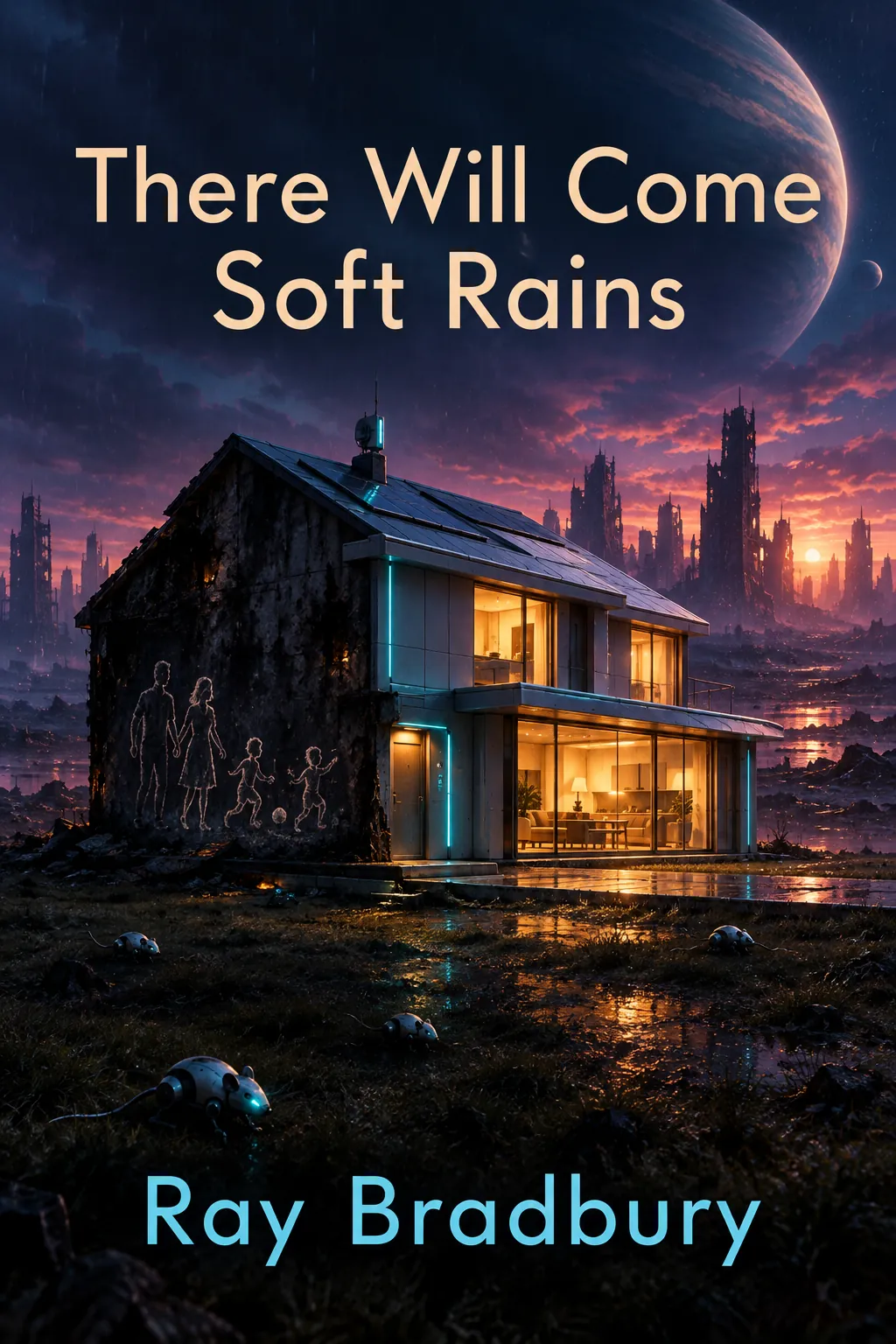
There Will Come Soft Rains
par Ray Bradbury
There Will Come Soft Rains is a short story by Ray Bradbury about a fully automated house in Allendale, California, on one day in August 2026. Voices wake no one, the stove cooks breakfast for an empty table, and robot mice scrub the floors. Bradbury follows the house hour by hour and lets small details show what happened to the family and the world beyond the garden. It is a quiet, chilling story about technology that goes on performing care long after anyone is left to receive it.
L'idée principale
"Bradbury’s 1950 story follows an automated house that keeps cooking, cleaning and reciting poetry after its family is gone, showing how machines can outlast the people they serve."
Aperçus clés
Machines can outlast their purpose
The house keeps serving people who no longer exist. Bradbury shows that a machine does its job without knowing why, so it can continue long after the job has lost all meaning. That is both the comedy and the horror of the story.
The stove cooks breakfast for an empty table, and the dishes wash themselves afterward as if someone had eaten.
Nature does not mourn us
The Teasdale poem imagines spring carrying on, unbothered, if humans disappeared. Bradbury places that idea in a house that is trying hard to keep human routines going. The result is a story about how small human worries look against a larger world.
The house reads the poem aloud while the family’s outlines still show on the outside wall.
A warning from the early nuclear age
The story appeared five years after the bombing of Hiroshima and Nagasaki. It does not preach, and it never shows the blast. It simply lets the aftermath speak, which is why it works as a warning that survives its period.
The silhouettes on the burned wall capture a whole family’s last afternoon in one image.
Comfort can make us look away
The house is full of conveniences, and nobody in it ever has to think. Bradbury hints that a world run on easy comfort can leave people helpless when something goes wrong. The same worry appears in his novel Fahrenheit 451.
When the fire starts, the house can only repeat warnings and spray water, and it cannot ask for help.
Restraint creates feeling
There are almost no human characters and no direct statement of grief. The reader supplies the sadness by noticing details the house cannot understand. Bradbury trusts a plain, calm style to carry the shock.
The dog’s death is handled as a cleaning job, and that cold detail hurts more than a long description would.
Détail des chapitres
Chapter-by-chapter summary
Spoiler warning: this section covers the whole plot, including the ending.
The story has no numbered chapters. It moves through one day, so we split it into six parts following the clock.
Part 1: Seven o’clock, and nobody wakes up
A voice in the ceiling announces the time, and the house begins its day with no one to wake. The stove makes toast and eggs, the dishes wash themselves, and the voice reads out the date, 4 August 2026, along with reminders of birthdays, anniversaries and bills.
Bradbury keeps the tone bright and busy for a while before we notice that nobody answers.
Why it matters: this opening sets up the central irony, a house that is polite, punctual and completely alone.
Part 2: The wall outside
The story then steps outdoors. The house is the only one left standing in a city of rubble, and its west wall is burned black.
On that wall, paint has been spared in pale outlines: a man mowing the lawn, a woman bending to pick flowers, and a boy and girl with a ball caught in mid-throw. We learn, with no explanation, that a blast surprised the family in an ordinary afternoon.
Why it matters: these silhouettes are the emotional centre of the story, and the house never mentions them.
Part 3: The mice and the dog
Small robot mice dart out from the walls whenever a crumb falls, and sprinklers water a garden no one will walk through. Then a thin, sick dog covered in sores stumbles in, whining, and searches the rooms for the people it belongs to.
It dies in the house, and the cleaning mice remove the body as they would any other mess.
Why it matters: the dog is the only living creature that still feels loss, and the house treats its death as housekeeping.
Part 4: Afternoon and evening routines
The house keeps its schedule. The nursery walls light up with bright animals and meadows for the children’s hour, dinner is cooked and then scraped away uneaten, and bedtime comes with warmed beds.
Each task is small and sensible, and together they feel like a ghost story told through chores.
Why it matters: the repetition makes the reader do the emotional work the house cannot.
Part 5: The poem
In the evening the voice asks Mrs. McClellan which poem she would like to hear. Getting no reply, the house chooses her favourite and reads Sara Teasdale’s “There Will Come Soft Rains” aloud.
The poem imagines the natural world carrying on calmly if humankind were wiped out.
Why it matters: the poem gives the story its title and states its theme, yet the house recites it without understanding a word.
Part 6: The fire
A windstorm hurls a tree limb through the kitchen window. Cleaning solvent splashes over the hot stove, and fire spreads through the house.
The house fights back with water from the ceiling and calm warnings in its voice, but it cannot save itself. Room by room it burns, the voices fail one after another, and in the last moments a single voice goes on announcing the date.
Why it matters: the ending echoes the opening routine, and it shows that the machine’s faithful service has no meaning without anyone to serve.
Characters
This is a story about a place more than about people. Here are the key figures and terms.
The house and its voice
The central “character”. It runs breakfast, cleaning, games and bedtime on a perfect schedule and speaks in a soft, cheerful tone.
It has no idea that its family is gone.
The family silhouettes
A man, a woman, a boy and a girl, preserved as white outlines on the blackened wall. They never speak, and their stillness is the most powerful image in the story.
Mrs. McClellan
The woman the house addresses when it offers an evening poem. She never appears, and her absence is what makes the offer sad.
The dog
An old, sick dog that comes home and cannot find anyone. It is the only creature in the story that shows real feeling.
The robot mice
Small cleaning machines that scurry out to remove every crumb and mess. They show how thoroughly the house has replaced human work.
Sara Teasdale
The American poet (1884–1933) whose 1918 poem gives the story its title. Her poem imagines a world that does not mourn humankind.
Background and context
Bradbury wrote the story in 1950, only five years after the atomic bombs fell on Hiroshima and Nagasaki. Fear of nuclear war was a daily topic in the United States as the Cold War began.
The story was later placed in The Martian Chronicles, a linked collection about people settling Mars, where it is dated August 2026.
In that book it works as a quiet interlude. The rockets have left for Mars, and this story shows what has happened to the planet they left behind.
The setting is Allendale, California, an ordinary suburban town. Choosing a familiar neighbourhood makes the disaster feel close to home instead of far away.
The story is also a good example of a form teachers like to use: a short text with one setting, one day and one strong central image. That makes it easy to analyse closely in a single lesson.
Key terms and techniques
Personification
The house is described as if it had human habits: it tries, it cares and it hurries. This makes its failure at the end feel almost like a death.
Irony
The reader understands what has happened, but the house does not. That gap between what we know and what the house knows creates most of the story’s sadness.
The nursery
The children’s room, with walls that show animals and meadows, still runs its programme for children who are no longer there. It quietly reminds us of the two figures on the outside wall.
Time as structure
Bradbury uses the clock to organise the story, from the early morning voice to the last announcement of the date. The steady rhythm makes the final collapse more shocking.
How to read it closely
Listen to the sounds. The house speaks, chimes, hums and sings, and the story ends with only a voice left in the ruins.
Watch the verbs. Machines in the story act with great energy, while the human world appears only in short, still images.
Notice what is left unsaid. The word for the weapon never appears, and the reader assembles the cause from the burned wall, the rubble and the glowing ruins at night.
Writing about this book
Start with a clear claim about what the house represents. A strong thesis might say that Bradbury uses the house to show technology’s indifference, or to show how people hide from fear behind comfort.
Choose two or three moments as evidence: the cheerful morning routine, the silhouettes on the wall, the dog’s death, and the poem. For each one, say what the detail shows and how Bradbury’s tone (calm, almost gentle) makes it more disturbing.
Pay attention to contrast. The house is bright, polite and busy, while the world outside is dead, and that gap is where most of the meaning sits.
Link the story to its time. It appeared in 1950, when many people feared nuclear war, so you can ask whether it is a warning, an elegy or both.
Finish by saying what the story leaves you with, for example whether the poem’s message about nature is comforting or cold. Use short quotations only, and explain each one in your own words.
Passer à l'action
Étapes pratiques à mettre en œuvre dès aujourd'hui :
-
Read the story slowly and note every ordinary detail, then ask what each one suggests about the missing family.
-
Use contrast as an essay tool: set the cheerful house against the dead world outside.
-
Write about tone as well as plot, since Bradbury’s calm voice is what makes the story chilling.
-
Pair this story with Fahrenheit 451 to see how Bradbury writes about technology across two works.
Citations notables
"“Tick-tock, seven o’clock, time to get up!” (Part 1)"
— Ray Bradbury
"“Today is August 4, 2026.” (Part 1)"
— Ray Bradbury
"“Mrs. McClellan, which poem would you like this evening?” (Part 5)"
— Ray Bradbury
À qui s'adresse ce texte
Students from about age 13 and up, and anyone who likes short, thoughtful science fiction. It takes only a few minutes to read, so it suits class discussion, essay practice and a first taste of Bradbury before The Martian Chronicles or Fahrenheit 451.
À propos de Ray Bradbury
Ray Bradbury (1920–2012) was an American writer who moved between science fiction, fantasy and horror. He is best known for The Martian Chronicles (1950), Fahrenheit 451 (1953) and hundreds of short stories. His clear, poetic style helped bring science fiction to readers who did not usually pick it up.
Résumé écrit par

Software Engineer & Writer
Software engineer with a passion for distilling complex ideas into actionable insights. Writes about finance, investment, entrepreneurship, and technology.
Voir tous les résumés →Avis
Pas encore d'avis. Soyez le premier à partager vos impressions !
Écrire un avis
Continuer la lecture
Explorer le thème: Auteurs et prix de SFRésumés

Out of My Mind
Sharon M. Draper
« Out of My Mind » de Sharon M. Draper est un récit poignant retraçant le parcours de Melody Brooks,…

La Stratégie Ender
Orson Scott Card
« La Stratégie Ender » d'Orson Scott Card est un roman de science-fiction captivant qui plonge le lecteur dans un…

Pachinko
Min Jin Lee
Saga historique multigénérationnelle envoûtante, « Pachinko » de Min Jin Lee retrace le destin d'une famille coréenne naviguant entre tourments…

Le Monde de Charlie
Stephen Chbosky
Le Monde de Charlie, de Stephen Chbosky, est un roman initiatique poignant raconté à travers les lettres intimes de Charlie,…
Articles

Ray Bradbury
Ray Bradbury (1920-2012) était un écrivain américain qui a fait de la science-fiction une poésie des êtres humains. Il est…

Thèmes de Un chant de Noël : générosité, isolement et responsabilité
La novella de Dickens se lit souvent comme l'histoire d'un homme qui change d'avis. Ses thèmes sont plus tranchants :…
Le Conte du coupeur de bambou (Taketori Monogatari)
Le Conte du coupeur de bambou (Taketori Monogatari) raconte l'histoire de la princesse Kaguya, une fillette trouvée dans une tige…