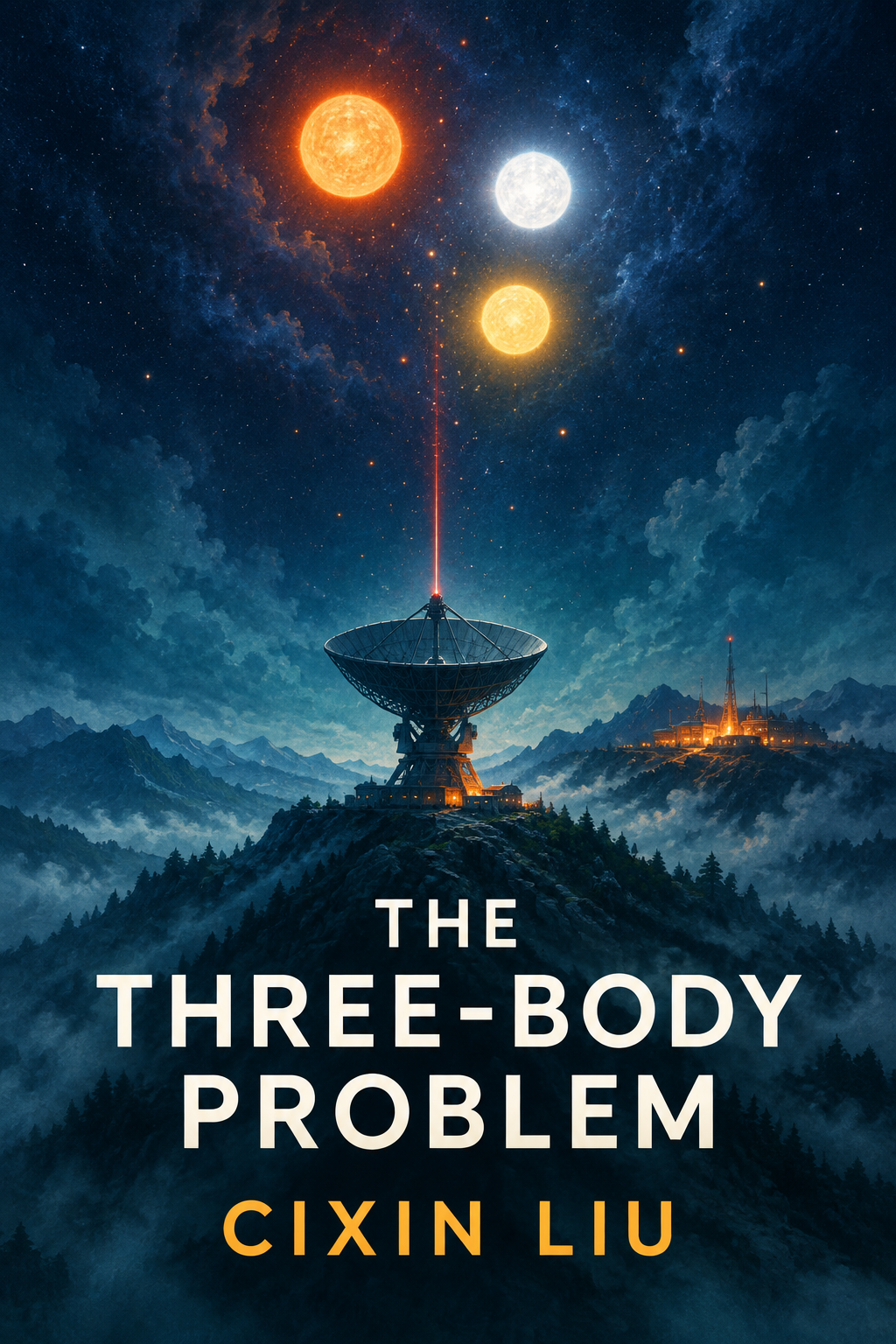
The Three-Body Problem
par Cixin Liu
The Three-Body Problem, the first novel in Cixin Liu's trilogy, opens in China during the Cultural Revolution. There, astrophysicist Ye Wenjie watches her father die and later makes a secret decision, which begins with a message sent into space and reaches far beyond Earth. Decades on, nanotechnologist Wang Miao is drawn into a mystery: prominent scientists are dying by suicide, and clues point to a virtual reality game called Three Body. The story pairs a tense investigation with a larger question: how far can humanity trust its own science?
L'idée principale
"Liu's novel follows a disillusioned astrophysicist's fateful choice, then the scientists who must find a way to defend Earth. The book argues that science is only as trustworthy as the people who use it."
Aperçus clés
Despair as a motive
Ye Wenjie is not written as a simple villain. The book shows how a person who has lost faith in people can reach a decision with enormous consequences, and it asks readers to understand that path before they judge it.
Her disillusion starts with watching her father die before a crowd and with Bai Mulin's betrayal. Her decision to answer the Trisolaran warning grows from that same loss of faith, so reading the opening chapters alongside the later decisions shows how her motives are built.
Science is made by people
Research depends on trust, time and the wellbeing of the researchers. The book first shows the human cost, as scientists take their own lives and their work stalls, and only later reveals the hidden cause. When the people who produce knowledge break, the knowledge itself becomes fragile.
Yang Dong's note says physics has never existed. As Wang Miao gathers the facts about each death, the loss spreads through the research community and becomes concrete rather than a list of names. The cause, tiny devices called sophons, is revealed much later, but the damage to people is felt from the start.
Experience can change belief
The Three Body game shows how an experience can shape what people believe. By letting players feel the chaos of Trisolaris, the ETO turns entertainment into a recruiting tool. The book asks how much trust people give to a convincing simulation, and how easily a careful mind can be drawn in.
Wang Miao begins as a cautious investigator, yet he is gradually drawn into the game and the world it shows. Reading about a danger and feeling it are very different things, and the difference matters for modern readers who spend time in virtual worlds.
A shared cause does not guarantee unity
The ETO's members all want Trisolaris to arrive, yet they disagree about why. The Adventists want humanity to end, the Redemptionists want to help Trisolaran civilization, and the Survivors want humans to live on under the new rulers. Their goals clash, and cooperation becomes harder.
Wang Miao's decision to pass information to Shi Qiang places him against the group he had joined. The moment shows how personal judgment can cut across group loyalty, and it leaves readers asking which side they would choose when a movement and their conscience disagree.
One person's choice can break a plan
A large organisation or a careful plan can be undone by one person who decides to act. Ye Wenjie answers a warning that tells her not to reply, and Wang Miao passes what he knows from inside the movement to the police. Both choices carry a price, and both change the course of events.
Wang Miao's tip leads to the raid that arrests Ye Wenjie. Later, Flying Blade, a nanomaterial thread developed from his research, is used to cut the Judgment Day ship, which shows how one person's judgment can reach far beyond a single organisation.
Détail des chapitres
About this book
The Three-Body Problem is the first novel in Liu's Remembrance of Earth's Past trilogy. It first appeared in China in the late 2000s and moves between two timelines: Ye Wenjie's life during the Cultural Revolution and Wang Miao's investigation in the present day. The sequels, The Dark Forest and Death's End, carry the story much further, so this book sets up its central threat rather than resolving it. This guide follows the novel in Ken Liu's English translation, published by Tor Books in 2014. Netflix's 3 Body Problem, which premiered in March 2024, is a separate adaptation that changes the plot and many characters, so everything here comes from the novel.
Chapter-by-chapter summary
Spoiler warning: this section covers the whole plot of the first book, including its ending.
Chapters 1–2: The Madness Years and Silent Spring
Beijing, 1967. At Tsinghua University, physics professor Ye Zhetai is beaten to death at a struggle session by Red Guards, some of them his own former students, while his daughter Ye Wenjie watches. Two years later she works with a production and construction corps clearing forest in Inner Mongolia. A journalist, Bai Mulin, lends her Rachel Carson's Silent Spring and writes a letter about the environmental damage. When the letter backfires, he blames her, and she is detained and questioned. Why it matters: she has now seen cruelty from her own society and betrayal from someone she helped, and Carson's book leaves her doubting that people can fix themselves.
Chapter 3: Red Coast I
Ye wakes on a helicopter with a fever. Beside her is Yang Weining, chief engineer of Red Coast Base and a former graduate student of her father's. The military wants her for her knowledge of astrophysics, and Yang takes her to the secret base on Radar Peak. She watches its huge antenna send a beam into the sky, and birds that fly into it fall dead. She stays and works under the base's political commissar, Lei Zhicheng. Why it matters: Ye moves from a prison cell to a place that gives her purpose, and the base becomes the stage for her later choice.
Chapters 4–6: The Frontiers of Science, A Game of Pool, The Shooter and the Farmer
In the present day, Wang Miao, a nanomaterials researcher, is summoned to a secret meeting with police and military officers, including the blunt detective Shi Qiang and General Chang. They show him a list of scientists who have killed themselves in two months. Yang Dong, a physicist, left the shortest note: physics has never existed. Many of the dead belonged to the Frontiers of Science, and Wang agrees to join it as an informant. The physicist Ding Yi uses a pool shot to show that experiments no longer give repeatable results. Then Wang's own photographs show a countdown. Shen Yufei, a member of the group, tells him to stop his nanomaterials research and promises that the universe will flicker for him. Why it matters: deaths, broken experiments and an impossible countdown all point to one hidden cause.
Chapter 7: Three Body: King Wen of Zhou and the Long Night
Wang logs into Three Body, the virtual reality game Shen Yufei was playing. Its world has a sun that rises and sets without any pattern, with long Stable Eras and deadly Chaotic Eras. The goal is to work out the sun's motion and build a reliable calendar. In this first session, King Wen of Zhou uses the hexagrams of the I Ching to predict the eras. The prediction fails, and King Wen throws himself into a pot of boiling soup. The atmosphere freezes, and the game announces that a civilization has been destroyed. Why it matters: this is Wang's first look at Trisolaris, though he does not yet know the world is real.
Chapters 8–10: Ye Wenjie, The Universe Flickers, Da Shi
Wang visits Ye Wenjie, Yang Dong's mother, and she introduces him to her former student, the astronomer Sha Ruishan. Over drinks, Sha mentions Ye's years at the Red Coast Project. At a radio observatory, at 1 a.m., the cosmic background radiation flickers, and Wang reads the pulses as the same countdown he saw in his photographs. He drives to the planetarium for a pair of 3K glasses, phones Shen Yufei, and breaks down near a church, where Shi Qiang finds him. Wang now calls him Da Shi. Da Shi takes him drinking and later describes the chaos spreading worldwide: scientists' suicides and attacks on observatories. He tells Wang to keep working and keep playing. Why it matters: the countdown is no longer private, and the universe itself seems to be sending it.
Chapters 11–14: Three Body: Mozi, then Red Coast II to IV
Back in the game, Wang plays Mozi and watches another civilization burn when the sun comes too close. Outside it, Ye agrees to tell him about Red Coast, and the next chapters are flashbacks. In the early 1970s, Ye becomes a trusted technician, and Commissar Lei grows kind to her. The base is said to jam enemy satellites, but Yang Weining then explains its true purpose: searching for alien intelligence. One chapter takes the form of declassified project documents. The last tells how Red Coast was slowly shut down, how Yang and Lei died in what was called an accident, and how Yang Dong was born afterwards. Why it matters: Red Coast stops being a rumour and becomes a place, and the origin of the first message into space comes into view.
Chapters 15–17: Copernicus, The Three-Body Problem, Newton and the First Emperor
Wang returns to the game as Copernicus in a medieval world. He argues that it has three suns, and he is sentenced to burn. Just before the fire is lit, a knight announces that the world is ending. Wang escapes, and a tri-solar day destroys that civilization. In the real world, the mathematician Wei Cheng comes to the police and tells his story. Obsessed with the three-body problem, he built an algorithm that finds stable arrangements but needs more computing power than exists. His wife, Shen Yufei, pushed him to continue, and she is killed. In the game's second level, Newton, von Neumann and Emperor Qin Shi Huang appear. The emperor builds a human computer from an enormous army, yet the suns line up, gravity shifts, and people are pulled toward them. Why it matters: the game and the investigation begin to meet.
Chapters 18–20: Meet-Up, Einstein and the Pendulum Monument, The Expedition
The game's administrator asks Wang for personal details, and his honest answers earn him an invitation to a meet-up. Seven top players gather in a coffee shop, hosted by Pan Han, who says that Trisolaris is a real place and that the group, the Earth-Trisolaris Movement (ETO), welcomes the Trisolarans' arrival even at humanity's expense. Wang quietly texts Shi Qiang. Back in the game, Einstein appears, and a pendulum monument at the United Nations marks the end of efforts to solve the three-body problem. The game's goal becomes finding a new home among the stars, and in the final scene the Trisolaran fleet departs for a star about four light-years away. Why it matters: the game is a recruitment tool built around a real world.
Chapters 21–25: Rebels of Earth, Red Coast V and VI, Rebellion, The Deaths of Lei Zhicheng and Yang Weining
At a large meet-up of about 300 people, Wang learns that the ETO's leader is Ye Wenjie. Flashbacks follow. In 1971, after Commissar Lei refuses her plan to aim a signal at the Sun, Ye sends one herself, using the Sun as an amplifier. Years later a reply arrives: “Do not answer!”, sent by a Trisolaran who pities Earth. Ye replies anyway, inviting them to come, and learns she is pregnant. In the present, soldiers led by Shi Qiang storm the meeting and arrest more than 200 people, including Ye. Under interrogation she confesses that she cut the rope holding Lei and Yang Weining on a cliff, after Lei, who had also seen the message, offered to hide it. Why it matters: her private act becomes the cause of the whole crisis.
Chapter 26: No One Repents
After the two deaths are ruled accidents, security at the base relaxes, and Ye tutors local children for the reinstated college entrance exam. She nearly dies in childbirth with Yang Dong, and villagers donate blood to save her. Later she is politically rehabilitated and returns to Tsinghua. She invites some of the Red Guards who killed her father to the place where it happened. None of them repents, and they say no one has apologised to them. Why it matters: her last hope that people might change disappears here, and it explains why she no longer wants to save humanity.
Chapters 27–29: Evans, The Second Red Coast Base, The Earth-Trisolaris Movement
Ye meets Mike Evans, an American oil heir who plants trees to protect a bird species and believes all species are equal. She tells him about Trisolaris, and he answers that they should be comrades. She is later taken to a second Red Coast base on the oil tanker Judgment Day, where Evans has founded the ETO and asks her to lead it. Membership grows among educated people, and three factions emerge: Adventists, who want humanity ended, Redemptionists, who admire Trisolaran society, and Survivors, who want to serve the invaders to keep humans alive. Three Body was built to recruit members. Why it matters: a private act becomes a movement.
Chapter 30: Two Protons
The chapter is built around Ye's interrogation transcript. She says Evans misled her about his goals and that she did not know he wanted humanity destroyed. The Trisolaran fleet is on a voyage of roughly 450 years, and Trisolaris has already sent two protons ahead at near light speed. They lock human science, so no major progress will be possible for centuries. Afterwards Ding Yi tells Wang that a civilization able to manipulate particles would see humans as no more advanced than a caveman with a fire, so humans may look like bugs. Why it matters: it explains the suicides and the countdown, and sets up the book's final question.
Chapter 31: Operation Guzheng
Representatives of the great powers, including Wang, Ding Yi, Da Shi, General Chang and U.S. Marine Colonel Stanton, plan how to seize the Trisolaran messages on Judgment Day before the crew can delete them. Da Shi proposes slicing the ship with Flying Blade, nanofilaments developed from Wang's research, as it passes through the Panama Canal. The operation, named Guzheng after a zither, succeeds. Three days later, Ye learns that Evans died on the ship. Why it matters: it is humanity's first victory against the ETO, but it only reveals how much the enemy already knows.
Chapters 32–33: Trisolaris, The Listener and Trisolaris, Sophon
The story moves to Trisolaris. A listener at Post 1379 receives Ye's message and sends back his warning: “Do not answer! Do not answer!! Do not answer!!!” The ruler judges him a criminal and sends the fleet toward Earth anyway. Later, fearing that human science will outrun the fleet, Trisolaris launches Project Sophon, which turns protons into supercomputers. Early attempts fail, but sophons are finally made and sent to Earth. They disrupt physics experiments and let Trisolaris watch humanity in real time. At a meeting of Battle Command, the words “You’re bugs!” appear in everyone's eyes. Why it matters: the reader sees the threat from the alien side.
Chapters 34–35: Bugs and The Ruins
Wang and Ding Yi, drunk and despairing, are driven by Da Shi to his hometown, where locusts are destroying the wheat. He asks whether the gap between Trisolaris and humans is as wide as the gap between locusts and humans. The two scientists sober up, pour out their wine as a toast to the bugs, and return to work. In the last chapter, Ye Wenjie visits the dismantled Red Coast Base alone and sits on the cliff where she once killed Lei and Yang, watching the sun set. Why it matters: the story ends with the threat unresolved and with Ye facing what she began.
Characters
Ye Wenjie: An astrophysicist whose losses in the Cultural Revolution shape every choice she makes. She replies to Trisolaris, later leads the ETO, and her motives are the book's central puzzle.
Ye Zhetai: Ye Wenjie's father, a Tsinghua physics professor. Red Guards, some of them his former students, beat him to death in the opening scene, and that loss shapes how his daughter sees people.
Wang Miao: A nanomaterials researcher and the reader's guide. He is pulled into the scientists' deaths, the Three Body game and the ETO, and eventually chooses a side by passing information to Shi Qiang.
Shi Qiang: A blunt but dependable police detective, called Da Shi. He draws Wang into the investigation, leads the raid on the ETO meeting, and proposes the plan behind Operation Guzheng.
Ding Yi: A theoretical physicist and Yang Dong's partner. He shows Wang that experiments have stopped being repeatable, and helps him understand what the Trisolaran threat means.
Yang Dong: A theoretical physicist, and the daughter of Ye Wenjie and Yang Weining. She takes her own life before the main story, and her note about physics starts Wang's investigation.
Lei Zhicheng: The political commissar of Red Coast. He oversees Ye's work, but after he also sees the Trisolaran message and offers to hide it, Ye kills him.
Yang Weining: Red Coast's chief engineer and a former student of Ye Zhetai. He brings Ye to the base and marries her, and she later kills him along with Lei.
Shen Yufei: A physicist in the Frontiers of Science and the wife of Wei Cheng. She urges him to keep working on the three-body problem, warns Wang to stop his research, and is killed as the ETO splits.
Wei Cheng: A gifted but unfocused mathematician obsessed with the three-body problem. With Shen Yufei's support he develops an algorithm that finds stable arrangements but needs more computing power than exists.
Sha Ruishan: An astronomer and former student of Ye Wenjie. She shows Wang the flickering signal at the observatory and tells him that Ye once worked on the Red Coast Project.
Mike Evans: An American oil heir and environmentalist who founds and funds the ETO. He dies aboard Judgment Day during Operation Guzheng.
Writing about this book
Start with one question: what makes Ye Wenjie's decision understandable even when it is frightening? Trace it back to the struggle session and the betrayal over Silent Spring, then forward to her reply to the Trisolaran warning. A good essay can argue whether a scientist's work can be judged apart from the scientist's beliefs, or whether despair changes what that work is for. Wang Miao offers a second route. He is an ordinary researcher pulled into a conflict far bigger than his field, so ask what you would have needed to know before choosing a side. The virtual reality game gives a third angle: when an experience shapes what people believe, who carries responsibility for the result? Support any argument with one scene, described in your own words, and explain why that scene matters. Avoid a plot report, and argue something about the book instead of retelling it.
Passer à l'action
Étapes pratiques à mettre en œuvre dès aujourd'hui :
-
Read the opening chapters again after finishing the book, because Ye Wenjie's later decisions are easier to understand once you have seen her loss.
-
Write the scientists' deaths out as a list with dates, names and notes, because the mystery is built from those separate pieces.
-
If you have seen the Netflix series, note each change in plot and character before you decide which version you prefer.
-
Before starting the second book, write down the three questions this volume leaves open.
Citations notables
"“Do not answer! Do not answer!! Do not answer!!!” (the listener's warning to Earth)"
— Cixin Liu
"“You’re bugs!” (the message that reaches Battle Command)"
— Cixin Liu
"“Physics has never existed, and will never exist.” (Yang Dong's note)"
— Cixin Liu
À qui s'adresse ce texte
Readers who enjoy hard science fiction, mysteries and historical fiction, and anyone interested in contemporary Chinese literature. The Cultural Revolution scenes include violence, and the physics is dense, so readers aged about 14 and up, or upper high school students, will get the most from it.
À propos de Cixin Liu
Cixin Liu, whose name is Liu Cixin in Chinese order, is a Chinese science fiction writer who worked as an engineer before becoming a full-time author. He is best known abroad for The Three-Body Problem, the first book of his Remembrance of Earth's Past trilogy. Ken Liu's English translation won the 2015 Hugo Award for Best Novel. His work brings Chinese history, hard science and big questions about humanity to readers worldwide.
Résumé écrit par

Software Engineer & Writer
Software engineer with a passion for distilling complex ideas into actionable insights. Writes about finance, investment, entrepreneurship, and technology.
Voir tous les résumés →Avis
Pas encore d'avis. Soyez le premier à partager vos impressions !
Écrire un avis
Continuer la lecture
Explorer le thème: FictionRésumés

Out of My Mind
Sharon M. Draper
« Out of My Mind » de Sharon M. Draper est un récit poignant retraçant le parcours de Melody Brooks,…

La Stratégie Ender
Orson Scott Card
« La Stratégie Ender » d'Orson Scott Card est un roman de science-fiction captivant qui plonge le lecteur dans un…

Pachinko
Min Jin Lee
Saga historique multigénérationnelle envoûtante, « Pachinko » de Min Jin Lee retrace le destin d'une famille coréenne naviguant entre tourments…

Le Monde de Charlie
Stephen Chbosky
Le Monde de Charlie, de Stephen Chbosky, est un roman initiatique poignant raconté à travers les lettres intimes de Charlie,…
Articles

Les Lumières expliquées : idées, penseurs et héritage
Le Siècle des Lumières est un mouvement intellectuel européen du XVIIIe siècle qui place la raison et les preuves au-dessus…
Histoire du monde 1700–1918 : révolutions, industrie, empires et guerre
De 1700 à 1918, révolutions, usines, empires et guerre mondiale ont remodelé les sociétés d'Europe, des Amériques, d'Asie et d'Afrique.…

Thèmes de Un chant de Noël : générosité, isolement et responsabilité
La novella de Dickens se lit souvent comme l'histoire d'un homme qui change d'avis. Ses thèmes sont plus tranchants :…