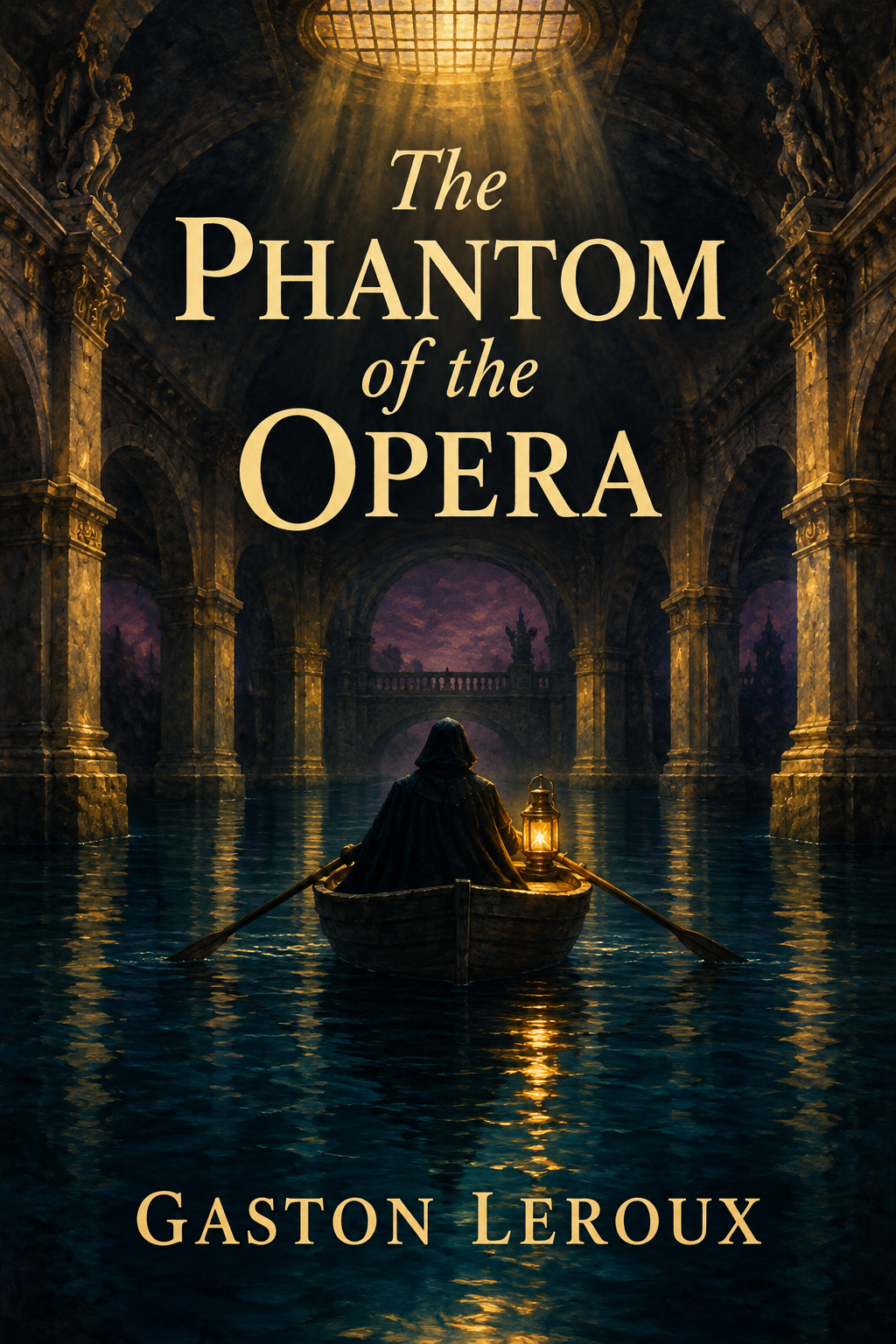
The Phantom of the Opera
par Gaston Leroux
The Phantom of the Opera is a Gothic mystery set in late 19th-century Paris, inside a grand opera house. Rumours say a ghost lives somewhere below the stage, and the new managers soon learn that the rumours are serious. The story follows Christine Daaé, a young singer being taught in secret, and Raoul, her childhood friend who fears for her safety.
L'idée principale
"Leroux's novel follows a lonely man hidden beneath the Paris Opera who turns love into control, while the managers dismiss his warnings as gossip. The book asks how anyone can tell a real threat from a rumour."
Aperçus clés
Rumour and evidence
The novel asks how we know what is real. The narrator gathers letters, testimony and papers to prove that the ghost exists, while the managers treat the warnings lightly until a chandelier crashes into the stalls. The book suggests that rumours grow where people do not look closely at the evidence.
In the money dispute of Chapters XVI and XVII, the managers are sure they understand the situation, and their pride makes the evidence easy to miss.
Love that becomes control
Erik's feeling for Christine is bound up with possession. He teaches her, shapes her career and presses her to choose between his world and Raoul's. The book keeps asking whether his feeling is love at all, or a need to control what he cannot have.
In the torture chamber he forces Christine to choose between a wedding mass and a requiem mass, turning her future into a decision he tries to make for her.
Illusion and the stage
The Opera is a place of costumes, trap-doors, mirrors and tricks, and Erik has mastered all of them. Illusion is his power and also his weakness, because the managers and the public keep believing what they see. The book shows how a stage can make people see only what they expect.
Christine vanishes through a mirror in Chapter IX, and in Chapter XIX a similar mirror carries the Persian and Raoul into the ghost's world.
Détail des chapitres
Chapter-by-chapter summary
Spoiler warning: this section covers the whole plot, including the ending.
Part 1: Rumours and warnings (Prologue to Chapter V)
Prologue. The narrator explains how he came to believe the Opera Ghost was real. After reading the memoirs of a former manager, he hears of a witness called only the Persian, who has met the ghost. The Persian's papers, including the strange correspondence of Christine Daaé, convince the narrator that the rumours are true. Why it matters: the story arrives as documents and testimony, so every event raises the question of how far the evidence can be trusted, and the reader must weigh each one.
Chapter I: Is It the Ghost? At a farewell gala for the retiring managers, dancers and stagehands trade ghost stories. Several dancers claim to have seen him, and Meg Giry reveals that her mother keeps a reserved box for the ghost. The gossip turns deadly when Joseph Buquet, the chief scene-shifter, is found hanged. The staff laugh nervously, but the mood changes quickly as the news spreads through the backstage corridors. Why it matters: his death turns a rumour into fear and starts the mystery.
Chapter II: The New Margarita. Christine Daaé, a young Swedish singer, triumphs by stepping in for the ill Carlotta, then faints after the performance. Raoul, Vicomte de Chagny, follows her to her dressing room and hears a man's voice, although the room seems empty. He also watches Buquet's body being carried away. His childhood friendship with Christine gives him a personal reason to keep asking questions. Why it matters: Raoul becomes the investigator, drawn in by a voice he cannot explain.
Chapter III: The Mysterious Reason. At the managers' farewell supper, a gaunt, deathlike guest appears and announces Buquet's death. The outgoing managers hand their ghostly demands to the incoming pair, Richard and Moncharmin. The list includes a generous allowance and the use of Box Five. The new managers laugh at first, but they keep the paper, and their reluctance to take it seriously sets the pattern for what follows. Why it matters: the list shows that the ghost is organised and expects to be obeyed, not just feared.
Chapter IV: Box Five. Richard receives a letter from the ghost complaining that Box Five has been sold, warning that the box must not be taken away if they wish to live in peace. Madame Giry tells the managers that the ghost is annoyed and that they should listen to her. The box is sold anyway, and the new occupants laugh and disturb the second act until the municipal guard is called twice. Why it matters: the managers' overconfidence is the first of many mistakes they make.
Chapter V: The Enchanted Violin. Christine asks Raoul to meet her at Perros on the anniversary of her father's death. At the inn they argue about her feelings for him and about the man's voice she heard in her dressing room. That night Christine kneels at her father's grave in the churchyard, and a violin begins to play nearby. Raoul sees a shadow with a death's head and grabs its cloak before he loses consciousness. Raoul later tells the commissary what he saw, and his account is hard to dismiss. Why it matters: the enchanted violin links the ghost to Christine's past.
Part 2: The chandelier and the masked ball (Chapters VI to X)
Chapter VI: A Visit to Box Five. Richard and Moncharmin believe they glimpse a shape in Box Five. Moncharmin describes a death's head, while Richard sees an old woman who looks like Madame Giry. A search finds nothing, but the managers decide to watch Faust from that box. Each man is certain he is right and the other is wrong. Why it matters: the managers move from disbelief to direct involvement, and the box becomes a challenge rather than just a seat.
Chapter VII: Faust and What Followed. The ghost sends the managers a letter of demands, including that Christine sing Margarita and that Madame Giry be reinstated. During Faust, Carlotta gives a toad-like croak twice, and a voice announces that Christine will bring down the chandelier. It crashes into the stalls, killing the woman placed in Madame Giry's post. Why it matters: the ghost has become a deadly force that the managers cannot control.
Chapter VIII: The Mysterious Brougham. After the disaster Christine vanishes, and the managers say she is on health leave. Mamma Valerius tells Raoul that she is with her good genius, the Angel of Music. Raoul sees Christine in a brougham and calls her name, but she does not answer. A note then invites him to the masked ball, and he decides to go. Why it matters: each clue is small, but together they show that someone is directing Christine's movements.
Chapter IX: At the Masked Ball. At the masked ball Raoul follows a black domino he takes to be Christine, and the ghost appears in red, disguised as the Red Death. Raoul confronts her, and she leaves him. Hiding in her dressing room, he hears her say 'Poor Erik!' and then a disembodied voice sings. She walks towards the mirror, Raoul tries to embrace her reflection, is flung back, and she vanishes. Why it matters: it is the clearest sign of the ghost's power, and the mirror trick returns later.
Chapter X: Forget the Name of the Man's Voice. Raoul notices a plain gold ring on Christine's finger, and she says it is a gift. Having overheard 'Poor Erik' the night before, he names the Angel of Music as Erik. Christine is alarmed, warns him that he is in danger, and asks him to forget the man's voice and stop investigating. Raoul does not agree. Why it matters: the name and the ring become clues at the end, and Raoul refuses to give up.
Part 3: The roof and the disappearance (Chapters XI to XIV)
Chapter XI: Above the Trap-Doors. Raoul and Christine playfully pretend to be secretly engaged, though Raoul's jealousy and reluctance to join her plans strain the game. Christine returns after two days away, triumphs in La Juive, and still wears the ring. She is nervous near the trap-doors, saying that everything underground belongs to 'him.' When they climb towards the roof, a shadow follows them unnoticed. Why it matters: the hidden passages show how close the ghost is, even when no one can see him.
Chapter XII: Apollo's Lyre. On the roof, beneath the statue of Apollo's lyre, Christine tells Raoul she must return to Erik once more. She asks him to come for her at midnight the next evening so they can escape. Christine hears a sigh behind them that Raoul does not hear. They kiss, and a huge night-bird with blazing eyes clings to the lyre's string before they flee. Why it matters: the ghost is felt before he is seen.
Chapter XIII: A Master-Stroke of the Trap-Door Lover. Raoul fires his revolver inside his bedroom at two glowing eyes at the foot of his bed. Count Philippe later finds a bullet hole in the window and blood marks along the balcony rail, and he suggests that Raoul fired at a cat. Christine realises that she has lost Erik's gold ring, which she thinks slipped off during the kiss under the lyre and fell into the street. That night she vanishes from the stage during Faust. Why it matters: the shot and the disappearance push the search into its most frantic phase.
Chapter XIV: The Singular Attitude of a Safety-Pin. Behind the scenes, staff speculate about Christine's disappearance and about the missing gas-man, Mauclair. They find the managers' behaviour strange: the two men walk backwards, refuse to be touched, and have ordered that no one disturb them. Remy says that Madame Giry has been locked in an office, where her shouts can be heard. The chapter ends with Moncharmin's frantic demand for a safety-pin, and then Raoul arrives and asks where Christine is. Why it matters: the pin becomes the first clue in the managers' money mystery.
Part 4: Searches and missing money (Chapters XV to XVII)
Chapter XV: Christine! Christine! Raoul searches the stage, fumbles at Christine's dressing-room mirror, and feels along the stones and bars of the Rue Scribe gate for a way underground. He meets Commissary Mifroid, who asks him to come to the managers' office. There a hand touches his shoulder, and the Persian warns him, 'Erik's secrets concern no one but himself!' before he vanishes. Why it matters: the Persian becomes the key guide to the ghost's past, someone the reader must both trust and doubt.
Chapter XVI: Mme. Giry's Astounding Revelations. Madame Giry admits that she has been the ghost's go-between, carrying his envelopes to Box Five for ten francs a delivery. The missing twenty thousand francs becomes the centre of a bitter quarrel. Moncharmin says he supplied ten thousand of it, and Madame Giry admits that she herself put the envelope into Richard's coat pocket. Why it matters: the woman the managers brushed aside becomes the most important witness, and her story shows how deeply the ghost's demands reached into daily theatre business.
Chapter XVII: The Safety-Pin Again. Richard and Moncharmin quarrel over the vanished notes, and each accuses the other of theft. Moncharmin had pinned the notes into Richard's coat pocket himself. When the clock strikes twelve and they check, the pin is still there, but the notes have gone. Why it matters: the managers look absurd, and their suspicion turns against each other rather than against the ghost, which makes the mystery harder to solve.
Part 5: Into the cellars with the Persian (Chapters XVIII to XXI)
Chapter XVIII: The Commissary, The Viscount and the Persian. Commissary Mifroid questions the managers about Christine's disappearance. He suggests that Count Philippe may have carried her off, and he says the Count's carriage has vanished on the road to Brussels. Raoul rushes out to chase them, but the Persian stops him in the first corridor. Why it matters: the suggestion turns the investigation towards Raoul's own family and pushes him into an uneasy alliance with the Persian.
Chapter XIX: The Viscount and the Persian. Raoul meets the Persian, who says Christine is in the house with Erik and offers to lead him to her. The two men step through the mirror in Christine's dressing room. After a delay the mirror turns and carries them into darkness. The Persian clearly knows the route, and Raoul follows without asking many questions. Why it matters: the reader is led into the ghost's underground world by a guide whose motives remain unclear.
Chapter XX: In the Cellars of the Opera. Raoul and the Persian descend into the cellars, where they find the gas-men drugged, Mauclair among them in a deep, drunken sleep. A rat-catcher appears with a lantern and a swarm of rats, and the animals menace the two men as they search for the ghost's house. The Persian stays calm, which unsettles Raoul more than the rats do. Why it matters: the cellars show that the Opera's working machinery is as mysterious as its ghost.
Chapter XXI: Interesting and Instructive Vicissitudes of a Persian. The Persian tells his own story of Erik and the ghost's past, including the fact that Erik kept Christine prisoner in the house on the lake. He leads Raoul through a hidden stone into the ghost's house, where they find a torture chamber and a cord the Persian calls a Punjab lasso. Why it matters: the lasso and the chamber show that the danger goes far beyond a kidnapping, and the search has become a hunt.
Part 6: The mirror room and the flood (Chapters XXII to XXV)
Chapter XXII: In the Torture Chamber. Trapped in a room of mirrors, Raoul and the Persian overhear Erik telling Christine to choose between a wedding mass and a requiem mass, meaning marriage to him or death. She is given until eleven o'clock the next evening. Erik does not know the intruders are there, and he leaves the room to answer a bell. Why it matters: the choice puts the novel's central theme, love turned into control, directly on the page.
Chapter XXIII: The Tortures Begin. Erik takes back his bag of life and death, which holds two keys, after Christine has handled it. She had wanted to look into the torture room he kept from her. He hears a cry, switches on a light in a small high window, and sends Christine up the folding steps to look. She tells him that nobody is there. Then, as the walls grow hot, he mocks her with an illusion of an African forest and says the heat comes from the forest next door. Why it matters: the chapter turns the ghost's stagecraft into a weapon.
Chapter XXIV: Barrels! Barrels! Any Barrels to Sell? The Persian explains how Erik made the sounds and illusions: a long box of stones for the rain, a rubbed resin string on a drum for the roars, and mirrors that show a forest, a desert and an oasis. When Raoul fires at a roaring lion, he breaks one of the mirrors. A barrel's bung bursts and reveals gunpowder. Why it matters: the cruelty looks planned rather than impulsive, which makes the ghost more frightening.
Chapter XXV: The Scorpion or the Grasshopper: Which? Erik tells Christine that turning the scorpion means yes, which would mean marrying him, and that turning the grasshopper means no, because it would set off the powder. Christine turns the scorpion. Water pours into the cellar, covers the powder barrels, and floods the torture chamber, and the Persian and Raoul nearly drown, clinging to the iron tree. Why it matters: her choice saves the men, but it binds her future to Erik's wishes.
Part 7: The ending and the epilogue (Chapter XXVI and Epilogue)
Chapter XXVI: The End of the Ghost's Love Story. Christine had sworn that she would become Erik's living wife if the men were saved, and Erik releases Raoul, who leaves with her. The Persian, unconscious when he was brought out, is nursed at his own flat by his servant. Count Philippe's body has been found by the lake. Erik visits the Persian and asks that Christine return after his death and bury him with the gold ring she wears. Three weeks later a newspaper notice reads 'Erik is dead.' Why it matters: the ending turns a horror mystery into a tragic love story.
Epilogue. The narrator states that Erik was a real man and sums up his life. Born in a small town near Rouen, the son of a master-mason, he was so ugly that his parents were horrified, and he ran away from home young. Showmen displayed him at fairs as a living corpse, and he also worked as a ventriloquist and magician. He built illusions in Persia and secret chambers in Constantinople, then won a contract for part of the Opera's foundations and planned a hidden dwelling there. A skeleton, still wearing the plain gold ring, is found near the little well where Erik once took Christine. Why it matters: the epilogue ends the book with a factual, unsettling image.
Characters
Erik (the Opera Ghost). A disfigured man who lives in hidden rooms beneath the Opera. He works as a magician and ventriloquist, secretly teaches Christine to sing, and becomes obsessed with her. His ugliness has shaped his whole life, and he uses illusion as his weapon.
Christine Daaé. A young Swedish singer who rises when she replaces the ill Carlotta. Torn between the voice that taught her and her childhood friend Raoul, she makes her own choices, most of all when she turns the scorpion switch to save the men in the cellar.
Raoul, Vicomte de Chagny. Christine's childhood friend and a nobleman who refuses to give her up. Jealous and impulsive, he chases shadows into hidden corners of the Opera and descends into the cellars with the Persian.
The Persian. A mysterious witness who knows Erik's past. The novel never gives him a name. He shows the narrator his papers, warns Raoul in the managers' office, and guides him through the cellars while telling his own story of the ghost.
Madame Giry. Keeper of the ghost's reserved box and mother of Meg Giry. She has carried the ghost's envelopes for years, and her revelations expose the managers' confusion.
Firmin Richard and Armand Moncharmin. The new managers dismiss the ghost's demands at first. Later they accuse each other of theft over the missing notes, and their pride and suspicion matter more to them than the ghost.
Count Philippe. Raoul's elder brother. The police commissary suggests that he may have carried off Christine, and his body is later found by the lake, which pulls Raoul's family into the mystery.
Writing about this book
A strong book report on this novel can start with a question rather than a plot list. Ask who the real monster is: Erik, the managers who ignore his warnings, or the audience that wants spectacle. Compare the novel with a stage or film version you know, and note what was changed and why. You could also follow one object, such as the gold ring, or one hidden place, and explain what it shows about the people who use it. Think about the mirror scenes too, since they show how easily people are fooled by what they expect to see. Keep quotations short, cite the chapter, and write the argument in your own words. A good structure is the question, two scenes that answer it, and a closing thought.
Passer à l'action
Étapes pratiques à mettre en œuvre dès aujourd'hui :
-
Read the novel before judging a stage or screen version, since many adaptations change characters and endings.
-
When a story rests on rumour, separate claims that have evidence from those that only circulate as gossip.
-
Notice how the narrator builds trust by gathering letters and testimony, and try the same when you cite sources.
Citations notables
"“The Opera ghost really existed.” (Prologue)"
— Gaston Leroux
"“Erik's secrets concern no one but himself!” (Chapter XV, the Persian)"
— Gaston Leroux
"“Erik is dead.” (Chapter XXVI, the newspaper notice)"
— Gaston Leroux
À qui s'adresse ce texte
Readers who want the original book behind the famous musical and films, older high school students, and anyone who enjoys Gothic mysteries with a love story at the centre. The book includes hangings, a flood and a torture chamber, so younger readers may want a guide first.
À propos de Gaston Leroux
Gaston Leroux (1868–1927) was a French journalist and novelist. He worked as a court reporter in Paris before writing fiction, and he created the young reporter Joseph Rouletabille. The Phantom of the Opera was first serialised in a Paris newspaper in 1909 and 1910, then published as a book in 1910.
Résumé écrit par

Software Engineer & Writer
Software engineer with a passion for distilling complex ideas into actionable insights. Writes about finance, investment, entrepreneurship, and technology.
Voir tous les résumés →Avis
Pas encore d'avis. Soyez le premier à partager vos impressions !
Écrire un avis
Continuer la lecture
Explorer le thème: FictionRésumés

Out of My Mind
Sharon M. Draper
« Out of My Mind » de Sharon M. Draper est un récit poignant retraçant le parcours de Melody Brooks,…

La Stratégie Ender
Orson Scott Card
« La Stratégie Ender » d'Orson Scott Card est un roman de science-fiction captivant qui plonge le lecteur dans un…

Pachinko
Min Jin Lee
Saga historique multigénérationnelle envoûtante, « Pachinko » de Min Jin Lee retrace le destin d'une famille coréenne naviguant entre tourments…

Le Monde de Charlie
Stephen Chbosky
Le Monde de Charlie, de Stephen Chbosky, est un roman initiatique poignant raconté à travers les lettres intimes de Charlie,…
Articles

Les Lumières expliquées : idées, penseurs et héritage
Le Siècle des Lumières est un mouvement intellectuel européen du XVIIIe siècle qui place la raison et les preuves au-dessus…

Histoire du monde 1700–1918 : révolutions, industrie, empires et guerre
De 1700 à 1918, révolutions, usines, empires et guerre mondiale ont remodelé les sociétés d'Europe, des Amériques, d'Asie et d'Afrique.…

Thèmes de Un chant de Noël : générosité, isolement et responsabilité
La novella de Dickens se lit souvent comme l'histoire d'un homme qui change d'avis. Ses thèmes sont plus tranchants :…