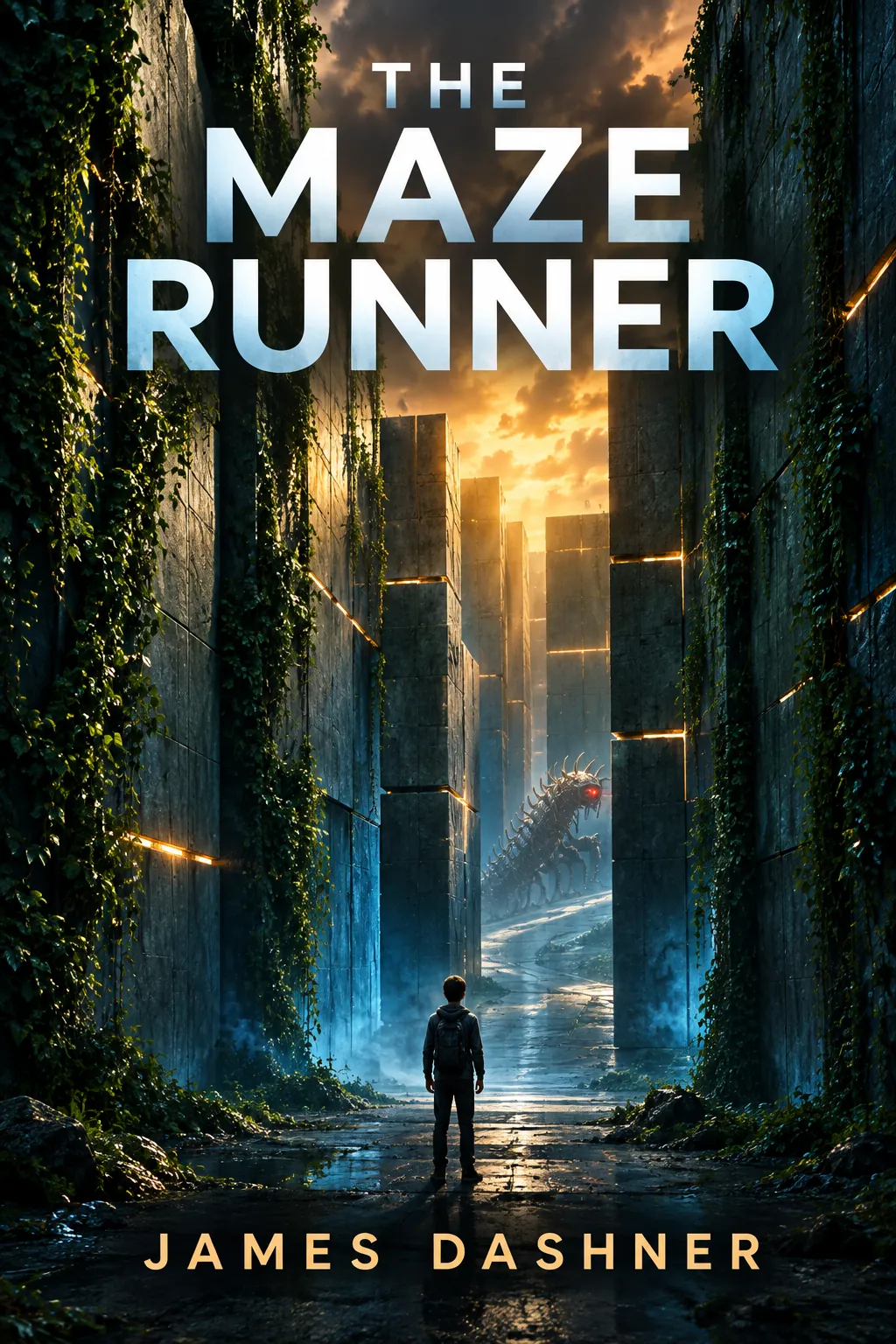
The Maze Runner
par James Dashner
The Maze Runner is a 2009 young adult dystopian novel about Thomas, a teenager who wakes in a moving metal box with no memory but his name. He arrives in the Glade, a farm-like clearing where dozens of boys live inside walls that open onto a huge maze. Each night the walls close, and monsters called Grievers roam the corridors. To escape, the boys must solve the maze, but Thomas's arrival starts changes nobody expected.
L'idée principale
"A boy with no memory wakes in a walled clearing inside a deadly, shifting maze. The Maze Runner asks what people will do, and who they will become, when the rules of survival are all they have."
Aperçus clés
Identity without memory
Thomas knows his name and nothing else, so the book keeps asking who we are without our past. Its answer is practical: character shows in the choices we make now, not in what we remember.
When Thomas runs into the Maze to help Alby and Minho, the Gladers learn more about him from that one act than from any backstory. Even after his memories return, they do not change who he decides to be.
Rules as a form of care
The Glade works because its rules are simple, shared and tied to survival. They give frightened boys a routine, a job and a reason to trust each other, which is why breaking them feels so serious.
The rule that only Runners enter the Maze protects the boys, yet it also keeps them from the answer. The book shows that the same rule can save a community and trap it.
Fear against cooperation
Pressure pushes the Gladers in two directions. Some seek a scapegoat, others try to pool what they know, and the novel suggests that fear only helps the people who run the experiment.
Gally treats Thomas as the problem and splits the group, while Newt and Minho choose to work with him. The escape succeeds only because the second group wins.
Curiosity as a survival skill
Thomas is not the strongest boy in the Glade, but he asks why the walls shift and why the Box behaves as it does. Noticing patterns, rather than accepting the way things are, is what finally opens the exit.
By comparing several days of maps, Thomas sees that the shifting walls follow a hidden order. The reader is invited to look for clues in the same way.
Who is really in control
The Maze looks like the enemy, but the closing memo reveals that people designed it. The novel moves its question from how to escape to who is watching and why they think this is allowed.
The final pages recast the Glade as a test run by WICKED, the organisation behind the Maze. This makes the earlier events, including Chuck's death, feel even more deliberate.
Détail des chapitres
Chapter-by-chapter summary
Spoiler warning: this section covers the whole plot, including the ending.
Part 1: The Box and the Glade
Thomas wakes in total darkness, rising in a metal box, remembering nothing except his first name. When the lid opens, a crowd of boys pulls him out into the Glade, a grassy square of farmland and wooden huts enclosed by four towering stone walls.
The boys call him a Greenie, the newest arrival, and they speak in odd slang he does not understand. Each of them came up in the same Box, one new boy a month, and none of them remembers life before.
This part matters because the reader learns the world at Thomas's pace, so every explanation arrives as a small puzzle.
Part 2: Rules, jobs and the Maze
The Gladers have built a working society with strict rules: everyone does a job, nobody harms another Glader, and only the Runners may enter the Maze. Alby leads, Newt is his steady second, and Keepers run each trade, from the kitchen to the Map Room.
Every morning the walls open and the Runners, led by Minho, map the corridors beyond. Every night the walls close and the Grievers come out, and no one caught outside after dark has ever come back.
The setting creates the story's pressure, because a rule about the walls is also a rule about staying alive.
Part 3: Breaking the rules
Thomas feels pulled toward the Maze and says he wants to be a Runner, which no newcomer is allowed to be. Soon after, Ben, a boy who was stung by a Griever and has turned violent, attacks him, and the Gladers banish Ben into the Maze.
Then Alby and Minho fail to return before the walls close, and Thomas runs in after them against every rule. He helps Minho get the stung Alby through the night and the two of them kill a Griever, something the Gladers thought impossible.
The episode earns Thomas respect and shows how quickly his curiosity can put him in danger.
Part 4: The girl and the warning
The next day the Box rises with no warning, carrying a comatose girl named Teresa and a note saying she is the last one ever. Before she lapses into unconsciousness she says that everything is going to change.
After her arrival the Box stops delivering supplies, and the Maze begins to behave differently. Thomas feels that he knows her, and the two soon discover they can speak silently inside each other's heads.
Fear and suspicion rise, and many Gladers begin to see Thomas as the cause of the trouble.
Part 5: The code in the walls
The Gladers allow Thomas to join the Runners, and he and Minho study the Maze day after day. Although the walls shift every night, Thomas notices that the changes follow a pattern.
When the layouts of the different sections are compared, they appear to hide a code. The Maze is not only a trap but also a puzzle that was built to be solved.
Teresa helps with the maps, and the link between her and Thomas speeds up their work.
Part 6: The Changing
As the Grievers grow bolder and invade the Glade, Thomas is stung. Anyone stung goes through the Changing, an agonising ordeal in which lost memories flood back.
Thomas sees fragments of his past and learns that he and Teresa once worked for the people who built the Maze. At the same time Gally, the Builder, blames Thomas for everything and turns the group against him.
The Glade begins to break apart from within as well as from outside.
Part 7: Escape and the final memo
In the last confrontation Gally throws a knife at Thomas, and Chuck, who has stayed close to him since the first day, is killed shielding him. It is the cruellest loss in the book.
The survivors fight their way to the opening known as the Griever Hole and enter the code that unlocks the way out. Thomas, Teresa, Newt, Minho and the others escape and are told they have been rescued.
A closing memo shows that the Maze was only the first trial in an experiment run by an organisation called WICKED, so the ending opens a larger mystery instead of closing the story.
Characters
- Thomas: The protagonist, a curious teenager who remembers only his name. He is brave to the point of recklessness, and his eye for patterns makes him the one who can crack the Maze's code.
- Teresa: The only girl in the Glade, who arrives in a coma after warning that everything will change. She shares a silent mental link with Thomas and helps him with the Maze, though both wonder why she feels familiar.
- Newt: Alby's second in command and the Glade's steady voice. Kind and dry-humoured, he keeps the peace and is the first to give Thomas a real chance.
- Minho: The Keeper of the Runners and the best mapper of the Maze. Blunt and tireless, he doubts Thomas at first and then becomes his closest ally.
- Alby: The first Glader and the founding leader. He keeps order with strict rules, and the strain of holding the group together shows once things start to change.
- Gally: A Builder who sees Thomas as the cause of the Glade's troubles. His fear and anger make him the group's most dangerous threat from within.
- Chuck: A friendly, much younger-seeming boy who befriends Thomas on his first day. His warmth shows what the Gladers are really fighting to protect.
- Frypan: The Glade's cook, who keeps everyone fed and the mood steady. His kitchen is a reminder that daily routine is what holds the community together.
- The Grievers: Biomechanical creatures that patrol the Maze at night. Their sting causes the Changing, which brings back memories and can leave a boy dangerous to his friends.
Writing about this book
A good essay or book report on The Maze Runner starts with one clear question, not a retelling of the plot. Three questions work well: how does the book treat memory and identity, what makes the Glade's rules succeed or fail, and how does Dashner use mystery to keep you reading?
Pick one and find two or three scenes as evidence, such as Thomas running into the Maze, the arrival of Teresa, and Chuck's death.
Explain what each scene shows rather than only what happens. If you compare it with other dystopias such as The Hunger Games, name one concrete difference: here the danger is a puzzle set by unseen adults, not an open tyranny.
Keep quotes short and write the rest in your own words. Do not copy summaries from other sites, because your own view is the strongest part of any report.
Passer à l'action
Étapes pratiques à mettre en œuvre dès aujourd'hui :
-
Ask questions about rules that no one explains, because the pattern behind them may be the way out.
-
When a group is afraid, look for ways to share what each person knows instead of looking for someone to blame.
-
Judge people by what they do under pressure, not only by what they say or remember.
-
Treat a simple routine as a source of strength, since shared jobs and habits keep a community together.
Citations notables
"“He began his new life standing up, surrounded by cold darkness and stale, dusty air.” (Chapter 1)"
— James Dashner
"“Everything is going to change.” (Part 4)"
— James Dashner
"“WICKED is good.” (Epilogue)"
— James Dashner
À qui s'adresse ce texte
Readers aged about 12 and up who enjoy fast, mystery-driven stories, and anyone studying young adult dystopian fiction in middle or high school. It suits fans of The Hunger Games who want a tighter puzzle. Note that it includes frightening scenes and the deaths of young characters.
À propos de James Dashner
James Dashner (born 1972) is an American author of young adult science fiction and fantasy. The Maze Runner, published in 2009, became his best-known work and the first book of a series that grew to include sequels, prequels and a film series. Its mix of mystery, survival and teenage friendship helped make it a staple of 2010s YA dystopian fiction.
Résumé écrit par

Software Engineer & Writer
Software engineer with a passion for distilling complex ideas into actionable insights. Writes about finance, investment, entrepreneurship, and technology.
Voir tous les résumés →Avis
Pas encore d'avis. Soyez le premier à partager vos impressions !
Écrire un avis
Continuer la lecture
Explorer le thème: Science-fictionRésumés

Out of My Mind
Sharon M. Draper
« Out of My Mind » de Sharon M. Draper est un récit poignant retraçant le parcours de Melody Brooks,…

La Stratégie Ender
Orson Scott Card
« La Stratégie Ender » d'Orson Scott Card est un roman de science-fiction captivant qui plonge le lecteur dans un…

Pachinko
Min Jin Lee
Saga historique multigénérationnelle envoûtante, « Pachinko » de Min Jin Lee retrace le destin d'une famille coréenne naviguant entre tourments…

Le Monde de Charlie
Stephen Chbosky
Le Monde de Charlie, de Stephen Chbosky, est un roman initiatique poignant raconté à travers les lettres intimes de Charlie,…
Articles

Thèmes de Un chant de Noël : générosité, isolement et responsabilité
La novella de Dickens se lit souvent comme l'histoire d'un homme qui change d'avis. Ses thèmes sont plus tranchants :…

Urashima Tarō
Urashima Tarō est un conte populaire japonais sur un pêcheur qui visite un palais sous la mer et revient dans…

Roro Jonggrang et Prambanan
Roro Jonggrang est la princesse javanaise d'un conte populaire qui explique le grand complexe de temples de Prambanan, près de…