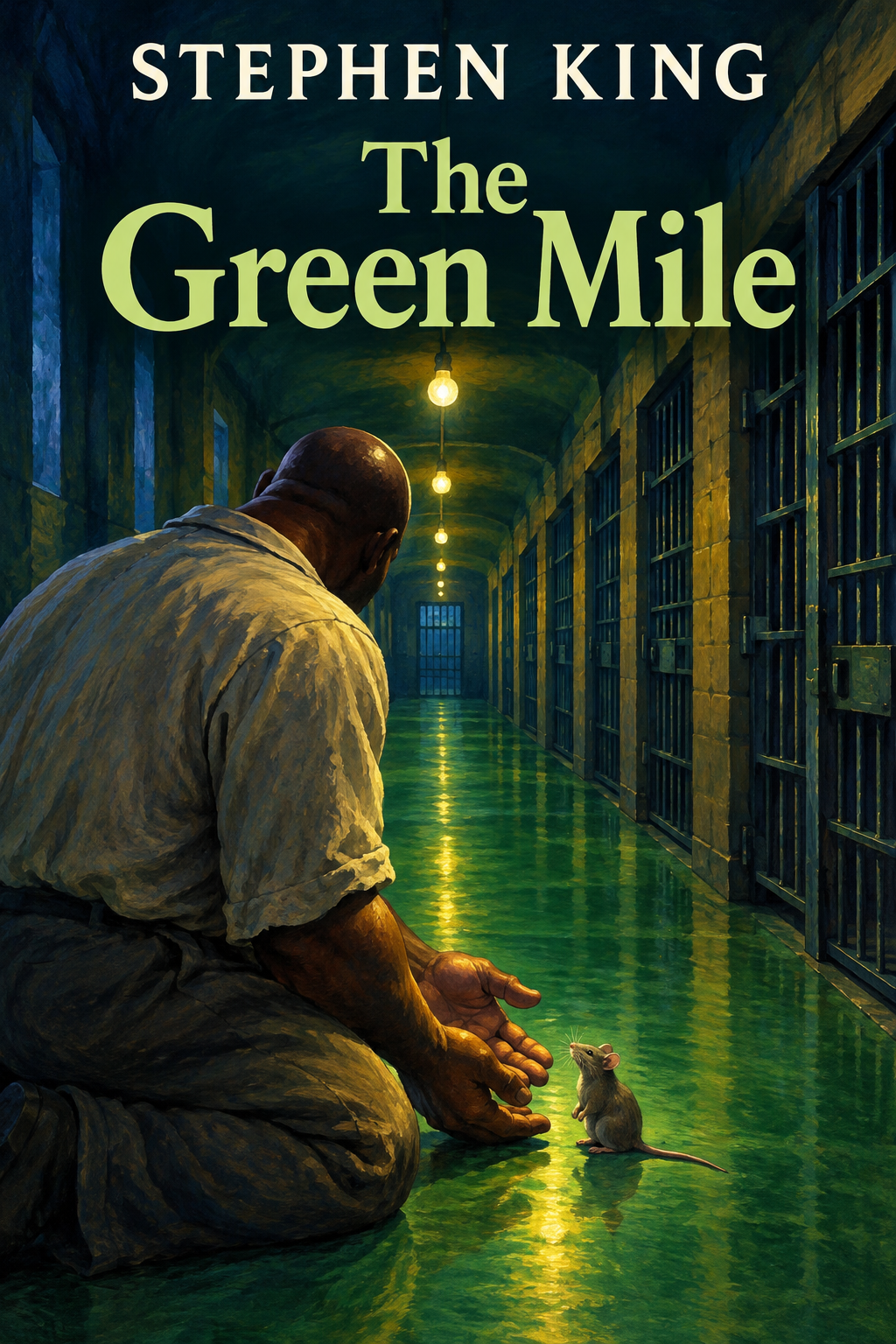
The Green Mile
par Stephen King
The Green Mile is Stephen King's novel about E Block, the death row wing of Cold Mountain Penitentiary in 1932. Paul Edgecombe, the supervisor of the block, looks back on the year John Coffey arrived: a huge, gentle prisoner convicted of murdering two girls, who seems to have healing hands. Paul has to decide what he believes, and what he is willing to do about it.
L'idée principale
"The Green Mile asks what a prison guard owes a man he believes is innocent, and what a system costs when mercy has no place in its rules."
Aperçus clés
Procedure is not the same as justice
The book asks what happens when everyone follows the rules and a man still dies. The guards do their jobs, the verdict stands and no one has to face a possible mistake. The system protects its own procedures more than it protects the truth. That gap between procedure and justice is what gives the story its tension.
Paul keeps doing his duty even after he begins to believe Coffey is innocent, and the reader feels how heavy that choice is.
Cruelty shielded by privilege
Percy is cruel because nothing in his world makes him answer for it. His family connection shields him, and the men around him tolerate his behaviour. The book shows how unchecked privilege can turn small meanness into serious harm. Power that is never questioned soon starts to feel like permission.
Percy's cruelty to Mr. Jingles and his failure to prepare the electric chair properly show how one careless person can cause a death that should never have happened.
Mercy has a price
Coffey heals others, and each healing drains him. The novel asks what it costs to keep being kind in a world that keeps producing pain, and whether a person can keep giving without being used up. His exhaustion is part of the story from beginning to end.
After he takes Melinda Moores's tumor into his own body on the night journey, Coffey is left gravely ill, and the men who helped him must carry the secret of what they did.
Living with what you have seen
Paul tells his story from a much later life, and the memory of the block has never left him. The book uses this long view to show that witnessing injustice leaves a lasting mark. Knowing what happened does not make it easier to live with.
In the final pages, Paul gives his account to Elaine. The memory stays with him, and so does the question of what he owed to the men he guarded.
Détail des chapitres
Chapter-by-chapter summary
Spoiler warning: this section covers the whole plot, including the ending.
Part 1: The Two Dead Girls
Paul Edgecombe, who supervised death row at Cold Mountain Penitentiary in 1932, looks back on the year that changed his block. The corridor that leads to the electric chair is known as the Green Mile because of its green floor, and Paul introduces the guards and daily routines that shape life there. Then John Coffey arrives: a huge, quiet man convicted of murdering two girls. Paul notices that this gentle giant seems an unlikely killer. It matters because the whole story turns on one question: is this man really guilty?
Part 2: The Mouse on the Mile
Eduard Delacroix, a Cajun prisoner waiting for his execution, has a pet mouse that he has trained to perform tricks. The guards first call the mouse Steamboat Willie, but Del renames him Mr. Jingles. Percy Wetmore has no patience for the mouse and takes out his temper on it, and Paul sees how much these small pleasures matter to men who have so little left. Paul's urinary infection gets worse, and the warden tells him that his wife, Melinda, has a brain tumor and only months to live. At the end of the part, the violent prisoner William Wharton is brought back to E Block from hospital tests. He pulls his chained arms over guard Dean Stanton's throat. It matters because the mouse shows what the condemned men still have to love, and because Wharton's arrival turns the block's uneasy calm into open danger.
Part 3: Coffey's Hands
Part 3 picks up after Wharton's attack on Dean. Brutal hits Wharton on the back of the head with his baton, and the guards drag him back to his cell. Paul's urinary infection and fever return. Coffey asks Paul into his cell and lays a hand on him, saying he only wants to help. Paul feels a jolt, and his pain and fever end. Then Coffey retches, and a cloud of black insects flies from his mouth. When Paul asks what he has done, Coffey simply says that he has helped. Paul begins to suspect that the healing is real. During a rehearsal for Del's execution, Percy walks too close to Wharton's cell. Wharton grabs him by the throat, runs his fingers through Percy's hair and kisses his ear, then lets go and calls it a joke. Del laughs at Percy, who has wet himself. On the night before Del's execution, Del throws a spool, Mr. Jingles chases it into the hallway, and Percy steps on the mouse. The mouse appears dead, but Coffey later brings him back to life. It matters because Paul's doubts about the verdict become impossible to ignore, and because Percy's cruelty reaches the one creature Del cares for most.
Part 4: The Bad Death of Eduard Delacroix
Part 4 centres on Del's execution, which goes horribly wrong. Percy is responsible for the electrode sponge, and as revenge for Del laughing at him, he deliberately does not soak it in brine. Del catches fire and dies slowly. It matters because the botched execution shows how one careless person, acting out of spite, can turn a legal process into real suffering.
Part 5: Night Journey
Part 5 begins with Paul explaining to Harry, Brutal and Dean why he believes Coffey is innocent. The guards decide to act that night, and Dean stays behind because he has young children. Melinda Moores, the warden's wife, is dying of a brain tumor. Paul gives Wharton soda with morphine dissolved in it, enough to keep him unconscious for about two days. Percy is found in Paul's office, forced into a straitjacket and locked in the restraint room. When the guards unlock Coffey's cell, Wharton wakes briefly, lunges and grabs at Coffey, then falls back asleep. Coffey is led out through the storage room and a tunnel under the highway, then driven to the warden's house in a hidden truck. Warden Hal Moores comes out with a rifle, but Melinda's voice from inside takes the fight out of him, and Coffey takes the gun. Coffey sits beside Melinda and draws the sickness out of her and into himself. Afterward she looks younger, but Coffey is weak and coughing on the floor, and the sickness stays in him. Before dawn, the group heads back toward the prison. Coffey grows worse on the drive, and Brutal fears he will die before the sickness can leave him. It matters because the night journey proves Coffey's power beyond doubt, and it makes Paul a partner in breaking the rules he has always kept.
Part 6: Coffey on the Mile
Part 6 opens in the present day. Paul sits up writing at Georgia Pines, and Brad Dolan, a man who bullies him, tries to grab his pages until Elaine steps in. Then the story returns to 1932. Coffey, close to death, is carried back to his cell. Percy is let out of the restraint room and yells at the guards, and Paul slaps him into silence. Coffey takes hold of Percy, and the sickness passes from Coffey into Percy in a black, swirling rush. Percy walks down the corridor, stops at Wharton's cell and shoots him six times while Wharton lies drugged and asleep. Coffey's health returns, but Percy's mind does not. He is sent to Briar Ridge, where he stays catatonic for the rest of his life. Paul tells Warden Moores a simplified story that hides any link to Coffey's healing. Then Coffey takes Paul's hands and, by touch, shows him that Wharton killed the two girls. Paul looks into the case himself and reaches the same conclusion, but the county refuses a retrial. At a meeting with Harry, Brutal, Dean and Janice, Janice rages that executing an innocent man would make them murderers too. Coffey tells Paul he is worn out by the pain he takes in from others and is ready to die. At the execution, Coffey dies in the electric chair with tears on his face. Years later, the elderly Paul gives his manuscript to his friend Elaine and shows her Mr. Jingles, the mouse that Coffey's power kept alive. The mouse is buried afterwards. Paul reflects on his long life and the Green Mile that stays with him. It matters because it shows that knowing the truth does not always mean being able to act on it in time.
Characters
Paul Edgecombe supervises E Block and narrates the story. He is careful, decent and proud of doing his job well. As Coffey's case unfolds, he is forced to weigh his duty against his growing doubts about the verdict.
John Coffey is the huge prisoner convicted of murdering two girls. He is gentle and frightened, and he can heal people by touching them. The healing takes a heavy toll on him, and he speaks of being worn down by the suffering he sees and feels around him.
Brutus “Brutal” Howell is the block's second-in-command and Paul's closest friend. He is a large man whose warmth gives the story much of its humanity. When Wharton attacks Dean, Brutal strikes Wharton with a baton to stop him.
Percy Wetmore is a guard and the nephew of the governor's wife. His family connection protects him from consequences, and he treats prisoners and animals with cruelty. His behaviour drives much of the story's tension.
William “Wild Bill” Wharton is a violent, unpredictable prisoner who frightens everyone around him. He is the real killer of the two girls. Coffey later shows Paul this truth by touch, in Part 6.
Eduard “Del” Delacroix is a Cajun prisoner awaiting execution. He takes care of his pet mouse and teaches it tricks. His death is one of the most painful episodes in the book.
Mr. Jingles is Del's clever pet mouse, the source of small moments of warmth on the block. Percy steps on it, and it seems dead, but Coffey later brings it back to life. Years afterwards, Paul shows it to Elaine, and the mouse is buried after that.
Melinda Moores is the warden's wife. Her brain tumor is the reason Paul and the guards take the secret risk of the night journey, and Coffey draws the sickness out of her body.
Elaine Connelly is a friend Paul makes at Georgia Pines, the nursing home where he writes his account. Paul asks her to read what he has written. At the end, he shows her Mr. Jingles, and the two of them bury the mouse.
Writing about this book
If you are writing a report on The Green Mile, start with one question rather than a plot list. Good questions include: does Paul do the right thing when he follows the rules? Is a fair process the same as a just result? Why does King let an old man tell the story from memory?
Pick one scene and explain what it reveals. The botched execution of Del Delacroix and Coffey's night visit to the warden's house are both strong choices. Support each point with a detail from the book, in your own words, and check the chapter so your references are accurate. A report should explain your reading, not retell the plot.
You could also compare Coffey and Percy. Both have power over the men on the block, but they use it in opposite ways. Ask which of them the book trusts, and what the mouse adds to that comparison.
Keep your own voice, and avoid copying phrases from reviews or study sites. Quoting one short line with its chapter is enough.
Passer à l'action
Étapes pratiques à mettre en œuvre dès aujourd'hui :
-
Notice whose judgment decides a case, and ask what evidence they are not hearing before you accept the verdict.
-
Speak up when a rule is being used to hide cruelty, even if your voice seems small.
-
Pay attention to small kindnesses from people who have little power, because they can reveal more than a verdict does.
-
Ask what you owe the people you were trained to watch, and whether the job still makes sense when you see them as people.
Citations notables
"“Do you mean to kill him, you cowards?” (Part 6)"
— Stephen King
"“I’m rightly tired of the pain I hear and feel, boss.” (Part 6)"
— Stephen King
"“He kill them with they love.” (Part 6)"
— Stephen King
À qui s'adresse ce texte
Readers who like a slow, emotional story with a clear moral question will get a lot from this book. It is best for readers aged 15 and up, because of its violence and its executions, and it suits adults too. It also works well for school reading about justice, the death penalty and what it means to be decent inside a hard system.
À propos de Stephen King
Stephen King is an American novelist born in 1947 in Portland, Maine. He is known for horror and suspense novels such as Carrie, The Shining and It, and he wrote The Green Mile as a serial of six paperback parts in 1996. Many of his books have been adapted for film, but this page covers only the novel.
Résumé écrit par

Software Engineer & Writer
Software engineer with a passion for distilling complex ideas into actionable insights. Writes about finance, investment, entrepreneurship, and technology.
Voir tous les résumés →Avis
Pas encore d'avis. Soyez le premier à partager vos impressions !
Écrire un avis
Continuer la lecture
Explorer le thème: FictionRésumés

Out of My Mind
Sharon M. Draper
« Out of My Mind » de Sharon M. Draper est un récit poignant retraçant le parcours de Melody Brooks,…

La Stratégie Ender
Orson Scott Card
« La Stratégie Ender » d'Orson Scott Card est un roman de science-fiction captivant qui plonge le lecteur dans un…

Pachinko
Min Jin Lee
Saga historique multigénérationnelle envoûtante, « Pachinko » de Min Jin Lee retrace le destin d'une famille coréenne naviguant entre tourments…

Le Monde de Charlie
Stephen Chbosky
Le Monde de Charlie, de Stephen Chbosky, est un roman initiatique poignant raconté à travers les lettres intimes de Charlie,…
Articles

Les Lumières expliquées : idées, penseurs et héritage
Le Siècle des Lumières est un mouvement intellectuel européen du XVIIIe siècle qui place la raison et les preuves au-dessus…

Histoire du monde 1700–1918 : révolutions, industrie, empires et guerre
De 1700 à 1918, révolutions, usines, empires et guerre mondiale ont remodelé les sociétés d'Europe, des Amériques, d'Asie et d'Afrique.…

Thèmes de Un chant de Noël : générosité, isolement et responsabilité
La novella de Dickens se lit souvent comme l'histoire d'un homme qui change d'avis. Ses thèmes sont plus tranchants :…