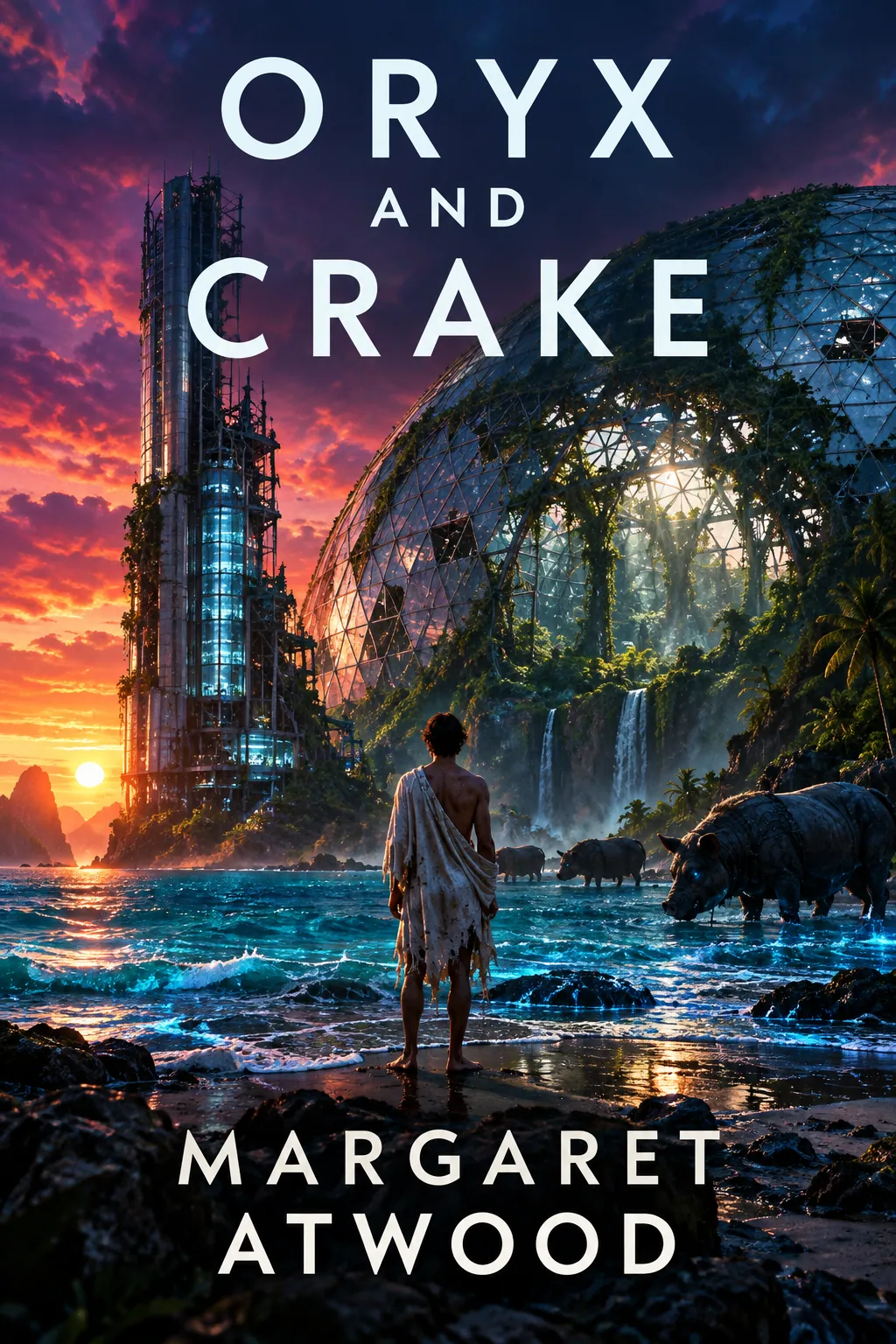
Oryx and Crake
par Margaret Atwood
Oryx and Crake is a 2003 novel by Margaret Atwood set after a global catastrophe. A man who calls himself Snowman lives alone on a beach, looking after a group of gentle, genetically designed people who know nothing of the old world. As food runs low, he remembers his childhood friend Crake, a gifted scientist, and Oryx, the woman both of them loved. Step by step, the memories show how a world of corporate science, widening inequality and casual cruelty came to its end.
L'idée principale
"Oryx and Crake asks what happens when brilliant science and a market that rewards everything, even cruelty, race ahead of human wisdom, and one man is left to tell the story."
Aperçus clés
Science without a conscience
Crake is not a cartoon villain. He sees human cruelty, waste and suffering as design faults, and he is a gifted engineer set on fixing them. The danger is that nobody stops him. Companies fund research and ask only for results, while people who raise ethical doubts are pushed to the margins. The novel does not blame science itself. It asks what happens when profit and curiosity are the only things steering it.
BlyssPluss is welcomed as a pill for health and pleasure, yet it hides the tool that ends humanity.
Words against numbers
Jimmy is a words person and Crake a numbers person. Their society rewards the second and treats the first as decoration. Yet after the collapse, the Crakers need stories, and only Snowman's language connects them to the past. The book also shows that words can mislead: the myths Snowman invents may protect the Crakers, but they also hide the truth from them.
Snowman repeats half-forgotten, unusual words to himself to prove he is still human.
Inequality and numbness
Jimmy grows up in a world split between guarded compounds and dangerous pleeblands. Inside the compounds, young people watch violence and sex online until nothing moves them. Atwood suggests that comfort and constant entertainment can wear away empathy. People had already given up part of their humanity long before the plague arrived, which makes the end feel less like an accident and more like an outcome.
Glenn and Jimmy treat footage of an execution as just another game.
Who gets to tell the story
Everything comes through Snowman's memory, so Oryx and Crake exist only as he saw them. He also reshapes the past into myths for the Crakers. Readers are left asking how far to trust the narrator. The book suggests that history and legend are shaped by whoever survives to tell them, and that the people who are missing from the story are often the ones who suffered most.
Oryx's childhood is only what she said to Jimmy, and he cannot confirm any of it.
Détail des chapitres
Chapter-by-chapter summary
Spoiler warning: this section covers the whole plot, including the ending. The novel has no neat chapter titles to rely on, so the story is grouped here into natural parts, moving between the present on the beach and Snowman's memories.
Part 1: The man in the tree
Snowman wakes in a tree near the shore, sunburnt, hungry and unsure whether the watch on his wrist tells him anything. He seems to be the last of the old humans he knows. Nearby live the Children of Crake, gentle people who eat leaves, purr to heal and treat him as their link to their makers. They ask about Crake and Oryx, and he makes up myths to answer. His foot is infected, supplies are gone and lab-bred animals roam the ruins, so he decides to walk back to the old compound for food and a weapon. This frame matters because every flashback is also Snowman choosing what the Children may know.
Part 2: Jimmy's childhood in the compounds
Before the collapse, Snowman is Jimmy, a boy growing up in OrganInc, a walled corporate compound. His father works on pigoons, pigs engineered to grow human organs. His mother, once a scientist too, grows uneasy about the work and eventually leaves to join the resistance. Outside the walls lie the pleeblands, crowded and dangerous cities where ordinary people live. Jimmy is a talker, not a numbers kid, and his mother's absence shapes him for life. The section shows a society split between those protected by corporations and those left outside.
Part 3: Glenn and the games
At a new school Jimmy meets Glenn, a quiet, brilliant boy. They play online games, including Extinctathon, a contest about vanished species, and they watch violent and pornographic footage as casually as cartoons. Glenn later takes his game name, Crake. One video shows a young girl staring back at the camera, and Jimmy becomes convinced she is the woman he will later know as Oryx. The part shows two teenagers growing numb to horror, and it makes readers wonder how much of Jimmy's fixation is memory and how much is invention.
Part 4: Two kinds of university
Glenn wins a place at the Watson-Crick Institute, an elite science school, while Jimmy lands at Martha Graham Academy, a shabby arts college. Jimmy drifts, writes advertising copy and moves through short relationships. Crake does outstanding work in biology. Jimmy's mother is arrested, and he later sees a recording suggesting she was executed. The friends drift apart but stay in touch. The point is a world that pays engineers well and treats thinkers and artists as a luxury.
Part 5: Paradice
Crake invites Jimmy to RejoovenEsence, where he runs a secret project called Paradice inside a huge dome. There he has created the Crakers: people designed without jealousy, rigid hierarchy or fear of death, who eat leaves, signal mating seasons with body colour and repel insects naturally. Jimmy writes marketing for BlyssPluss, a pill sold as protection from disease and a boost to pleasure. Slowly he realises that Crake wants to redesign humanity, not simply sell a better product.
Part 6: Oryx's story and the triangle
Oryx teaches the Crakers how to live. She tells Jimmy she grew up in a poor village in Southeast Asia, was sold as a child, then filmed and passed from place to place before Crake's world found her. She answers questions gently and with distance, so Jimmy can never be sure what is true. She becomes his lover while still working with Crake. Whether she is victim, teacher or survivor, the book mostly lets men tell her story, and that choice is part of its question.
Part 7: The end of the world
Crake reveals that BlyssPluss hides a deadly agent. The pills spread worldwide and a plague sweeps through humanity almost at once. Crake wants the old species cleared away so the Crakers can inherit the earth. Jimmy has been vaccinated and is told to protect them. In the last confrontation Crake cuts Oryx's throat and Jimmy shoots Crake. Jimmy leads the Crakers out of the dome and begins life as Snowman. Friendship, love and trust in science break all at once, which explains his loneliness.
Part 8: Back on the beach
Snowman travels back to the compound, finds supplies and returns hurt. Near the Crakers' camp he spots smoke, footprints and three unfamiliar humans. The book ends with him hiding, gun in hand, unsure whether to call out or shoot. Atwood gives no answer. The question left for readers is whether people will repeat the same mistakes. The story continues in the next novel, The Year of the Flood.
Characters
Snowman (Jimmy)
The narrator. Before the catastrophe he is Jimmy, a gifted talker who prefers words to numbers. Alone on the shore, he cares for the Crakers, invents myths for them and carries guilt about what he knew and did.
Crake (Glenn)
Jimmy's brilliant, detached best friend and a leading genetic engineer. He treats human suffering as a design flaw to be repaired, which makes him calm, persuasive and frightening in equal measure.
Oryx
A woman who tells Jimmy she was sold as a child and later filmed and trafficked. She teaches the Crakers how to live and is close to both men. Her story is told so softly that its truth stays uncertain.
Jimmy's father
A scientist at OrganInc who helps make pigoons, pigs grown to carry human organs. He puts career before family and stands for research that serves company profit rather than any larger purpose.
Jimmy's mother
A former scientist who grows disturbed by her husband's work, leaves the family and joins the resistance. She leaves Jimmy with lasting questions about what science owes the world and what love costs.
The Crakers
The Children of Crake, genetically designed to be peaceful, plant-eating and free of jealousy. They believe whatever Snowman tells them. Their innocence shows how quickly a myth can start when someone asks why.
The pigoons
Large, intelligent pigs bred to produce human organs. They begin as a medical success and end as a threat in the ruins, an example of research results returning in ways nobody planned.
Writing about this book
The best essays on this novel start from one question rather than a retelling of the plot. Choose a question you actually want to argue about, then support it with two or three scenes.
- At what point could someone like Crake have been stopped, and who was responsible for not stopping him?
- Why does Snowman tell the Crakers stories that are not quite true? Is that kindness or a way of hiding?
- Which real-world debates, such as gene editing or artificial intelligence, raise similar questions?
- Oryx is mostly seen through men's memories. How would the book change if she told it?
Open with one scene that stayed with you and say honestly what you felt. Because the ending is open, you can close by explaining what you think Snowman does next and why. Keep quotations short, put ideas in your own words, and note that the book contains violence and sexual exploitation, so it suits older teenagers and adults.
Passer à l'action
Étapes pratiques à mettre en œuvre dès aujourd'hui :
-
Ask who benefits, and who is not in the room, whenever a new technology is described as obviously good.
-
Keep reading, writing and the arts in your life; they are how we keep memory and judgment alive.
-
Notice when constant entertainment makes you feel less about real suffering, and step away.
-
Treat any single narrator as one view of events, and look for the voices that are missing.
Citations notables
""Nobody nowhere knows what time it is." (Chapter 1)"
— Margaret Atwood
""It made you feel like God." (Chapter 4)"
— Margaret Atwood
""Watch out for art, Crake used to say." (Chapter 14)"
— Margaret Atwood
À qui s'adresse ce texte
Readers who like dystopian and speculative fiction, and anyone curious about genetic engineering, corporate power or climate fears. It suits older teenagers and adults, since it includes violence and sexual exploitation. A good next step after The Handmaid's Tale or Frankenstein.
À propos de Margaret Atwood
Margaret Atwood is a Canadian writer born in Ottawa in 1939. She is best known for The Handmaid's Tale (1985) and for The Blind Assassin, which won the Booker Prize in 2000. Her speculative fiction, including the MaddAddam trilogy, builds on real science and politics.
Résumé écrit par

Software Engineer & Writer
Software engineer with a passion for distilling complex ideas into actionable insights. Writes about finance, investment, entrepreneurship, and technology.
Voir tous les résumés →Avis
Pas encore d'avis. Soyez le premier à partager vos impressions !
Écrire un avis
Continuer la lecture
Explorer le thème: Science-fictionRésumés

Out of My Mind
Sharon M. Draper
« Out of My Mind » de Sharon M. Draper est un récit poignant retraçant le parcours de Melody Brooks,…

La Stratégie Ender
Orson Scott Card
« La Stratégie Ender » d'Orson Scott Card est un roman de science-fiction captivant qui plonge le lecteur dans un…

Pachinko
Min Jin Lee
Saga historique multigénérationnelle envoûtante, « Pachinko » de Min Jin Lee retrace le destin d'une famille coréenne naviguant entre tourments…

Le Monde de Charlie
Stephen Chbosky
Le Monde de Charlie, de Stephen Chbosky, est un roman initiatique poignant raconté à travers les lettres intimes de Charlie,…
Articles

Thèmes de Un chant de Noël : générosité, isolement et responsabilité
La novella de Dickens se lit souvent comme l'histoire d'un homme qui change d'avis. Ses thèmes sont plus tranchants :…
Prix Nebula : définition, fonctionnement et lauréats célèbres
Le prix Nebula est une récompense américaine de science-fiction et de fantasy, votée par des écrivains en activité. La Science…
Prix Seiun
Le prix Seiun est le plus ancien prix de science-fiction du Japon, décerné pour la première fois en 1970. Il…