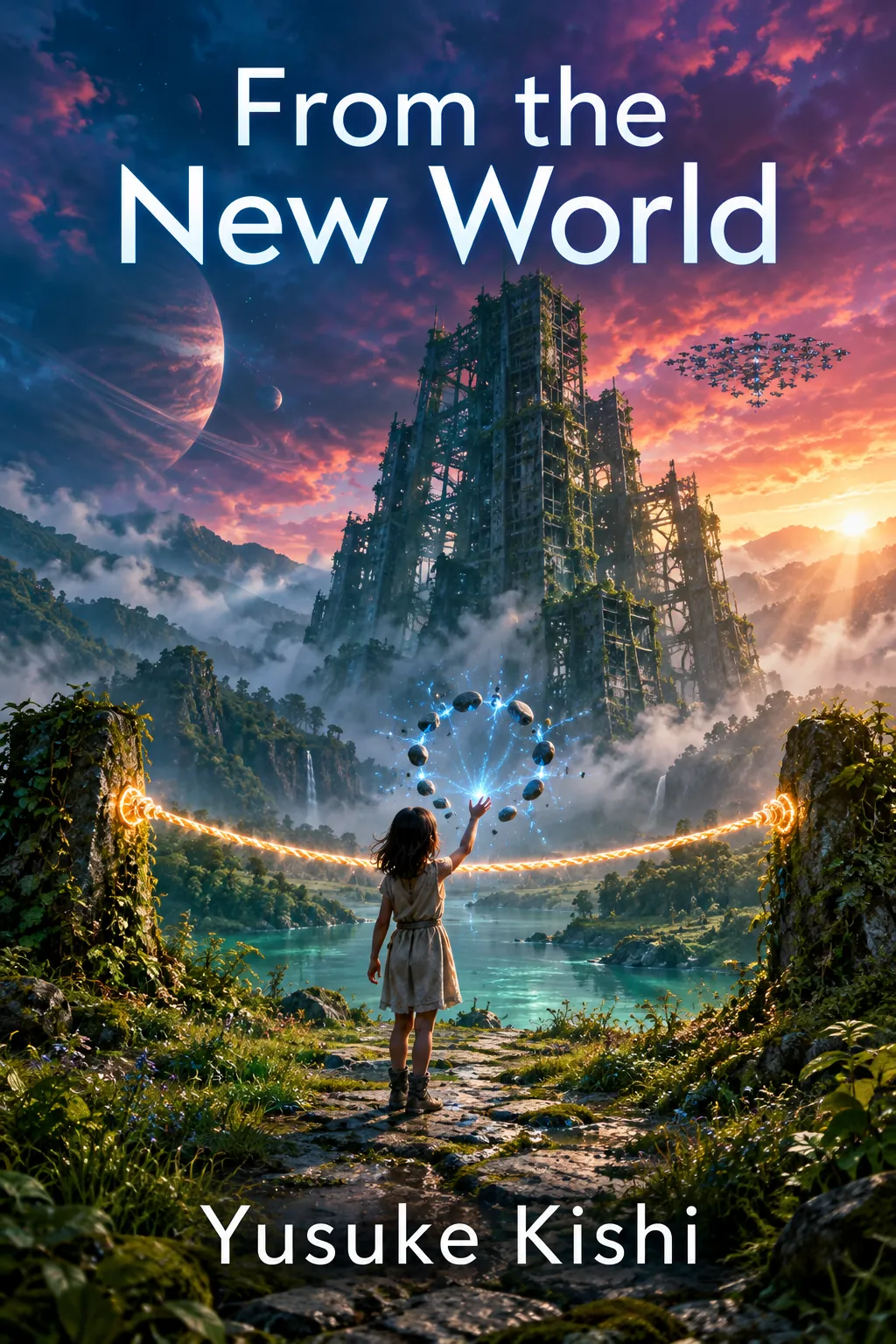
From the New World
par Yusuke Kishi
From the New World is a Japanese science-fiction novel by Yusuke Kishi, published in 2008. It is set about a thousand years in the future, in a rural village where people have psychokinetic power. Saki Watanabe tells how she and her friends grew up there, learned a forbidden secret about their world's past, and slowly discovered what the village's calm depends on. It blends coming-of-age, horror and social science fiction.
L'idée principale
"A thousand years from now, children with psychic powers grow up in a peaceful village. As they learn what keeps that peace, they must ask who pays for it."
Aperçus clés
Peace built on control
The village looks gentle, but its calm is designed. People carry built-in barriers against hurting each other, and children who seem dangerous quietly disappear along with the memory of them. The book asks whether safety is worth that much silence.
When classmates vanish and nobody notices, the scene shows how complete the village's control has become.
Who counts as human
Queerats speak, use tools and plan together, yet the villagers treat them as lesser beings and sometimes kill them without thought. As the story goes on, the line between humans and Queerats looks less natural and more like a choice people made.
Yakomaru's uprising reads as the Queerats' answer to that line.
Power and fear
Cantus is useful, but it can also kill. The society that grew from this danger chose to restrain its own members instead of trusting them. The result is a quiet order built by people who feared one another.
Karmic Demons and Fiends show what the system is trying to prevent.
The danger of knowing
In Kamisu 66, adults decide what children may learn. Once the friends meet the false Minoshiro, knowledge becomes both a gift and a crime, and each friend responds in a different way.
The machine is destroyed and the children's powers are sealed as punishment.
Growing up as losing innocence
Saki tells her story from later in life. A childhood summer that feels like adventure turns into a record of loss, and the narrator slowly understands what her younger self could not see.
Shun, Maria and Mamoru each leave her story in a different way.
Détail des chapitres
Chapter-by-chapter summary
Spoiler warning: this section covers the whole plot, including the ending.
The novel is told by Saki looking back on her life. The parts below are descriptive labels for its main movements.
Part 1: Kamisu 66 and the gift
Saki describes Kamisu 66, a farming town in what was once eastern Japan, ringed by a sacred rope boundary that children are told not to cross. At twelve she awakens her cantus, the psychic power everyone in her world must learn to control, and enters a special school where she meets Satoru, Maria, Mamoru and Shun. Classmates quietly vanish, and nobody remembers them. Why it matters: the opening feels like a gentle pastoral dream, and it plants the first clues that the calm is managed.
Part 2: The false Minoshiro
On a summer camp trip, the five friends find a strange machine-creature, the false Minoshiro. It holds records of the old world and tells them how psychic power began and how it nearly destroyed civilisation. A priest from the nearby temple, Rijin, destroys the machine and seals the children's powers as a punishment. On the way to judgement, Queerats attack, and Saki and Satoru are captured by a Queerat colony. Squealer, a Queerat from another colony, helps them escape, and the commander Kiroumaru spares them against his orders. Down in the dark, Saki restores Satoru's power, and she later restores the others', so the friends return home and keep what they did hidden. Why it matters: the children now know a past the adults hide.
Part 3: The friends who disappear
Years later, Shun becomes a Karmic Demon, a person whose power has slipped out of control, and he dies after Saki finds him. Mamoru, whom the education authorities mark for removal, flees into exile with Maria. Why it matters: friendship shows what happens to people the peaceful village cannot hold.
Part 4: Yakomaru's uprising
Saki grows up and works in the department that manages the Queerats. Squealer, now called Yakomaru by the humans, unites many colonies into one army and turns on the people who have used them for centuries. The village faces a real war for the first time. Why it matters: the creatures people treated as tools turn out to think, plan and hold grievances.
Part 5: The Fiend and the Psychobuster
Yakomaru attacks Kamisu 66, and his secret weapon is a Fiend, a human whose power is free of the usual restraints. Saki recognises the Fiend as the child of Maria and Mamoru. A message from her mother points her to the Psychobuster, an ancient weapon made to kill psychics, hidden in the ruins of Tokyo, and she goes there with Kiroumaru and others to find it. She retrieves it, but when Satoru tries to use it on the Fiend, Saki destroys it so that it cannot kill him. She then works out that the Fiend, raised by Queerats, feels Death Feedback only when it harms Queerats. Kiroumaru, disguised as a human, faces the Fiend and then reveals what he is; the Fiend attacks him and Death Feedback kills the Fiend, which ends the uprising. Kiroumaru gives his life in the confrontation. Why it matters: the village's own protection system decides the outcome, and it is the Queerats' sacrifice that makes it work.
Part 6: After the war
Yakomaru is captured and sentenced to endless torment. Satoru then learns that Queerats were once ordinary humans, altered by genetic engineering so that they could never threaten psychics. After learning this, Saki quietly grants Yakomaru a merciful death. Ten years later Saki and Satoru are married and expecting a child, hoping for a better world. Why it matters: the ending is hopeful, but Saki now knows what the peace cost.
Setting and key terms
The story takes place roughly a thousand years after our own time, in the area that was once eastern Japan. The old world of cities and machines is gone. What remains is a quiet landscape of rice fields, rivers and small towns, each protected by a sacred rope. Kamisu 66 is one of these towns, and nearly everything in the book happens in or near it.
Three ideas explain most of the world. The first is cantus, the psychokinetic power that lets a person move or change matter with the mind. It is the reason this society exists at all, because a society in which everyone can kill with a thought could not survive without strict rules. The second is the pair of safeguards built into human bodies. Attack Inhibition makes it very hard to strike another human, and Death Feedback punishes a person who does so. The third is the Queerat colonies, which work as a labour force and, in practice, as a lower class.
Notice how little of this is explained at the start. Saki, as a child, simply accepts it. The reader learns the rules as she does, and the gap between what she knows and what the older Saki now understands is where the book gets much of its tension and its horror.
How the book is built
The novel moves in a clear arc. The first part reads as a gentle school story, with outings, friendships and small rules. The middle parts show the cost of that calm, as friends disappear and secrets surface. The last parts turn to war and then to reflection. Because Saki narrates from later in life, ordinary scenes often carry a second meaning that only becomes clear afterwards.
The book also shifts genre. It starts close to a pastoral fantasy, becomes a mystery about the old world, moves into horror when the Queerats attack and the Karmic Demons appear, and ends as a political story about power and responsibility. Readers who expect one tone throughout are sometimes surprised, but the change of tone is part of the point: the village looks gentle only until you see how it works.
Finally, the book is about memory. People in Kamisu 66 forget classmates who vanish, and they forget most of their own history. Each friend, and each reader, must decide what to do with the knowledge that the adults chose not to share.
Characters
Saki Watanabe
The narrator. She awakens her power at twelve and, as an adult, works with the Queerats. Her honest account of what she saw and did gives the book its steady voice.
Satoru Asahina
Saki's friend and later her husband. Clever and calm, he often finds the practical way through a crisis. His grandmother heads the village's Ethics Committee.
Shun Aonuma
The most gifted of the group, and close to Saki. As his power slips out of his control he becomes a Karmic Demon.
Maria Akizuki
A talented girl in the group, skilled at shaping matter with her power. She and Mamoru leave the village together, and their story shapes the final war.
Mamoru Itō
A quieter friend whom the village sees as a danger. He leaves with Maria; their escape drives the third and fifth parts.
Squealer / Yakomaru
A Queerat who first helps the children, then leads the uprising under the name Yakomaru.
Kiroumaru
A Queerat commander who spares the children and gives his life facing the Fiend.
Tomiko Asahina
Satoru's grandmother and head of the Ethics Committee. She stands for the quiet authority that keeps the village orderly.
Queerats
Intelligent creatures who work for humans in colonies. They look like large hairless mole rats and are the book's mirror for the village.
The false Minoshiro
A machine in the shape of a small animal that stores the old world's records. It gives the children their dangerous knowledge.
Writing about this book
This is a good book for a report because it asks open questions rather than giving answers. Start with a question that you honestly want to answer, then use scenes to support your view.
- Is the village's peace worth its cost? Compare what people gain and what they lose.
- Where does the book draw the line between human and not human, and does it keep that line?
- Why does the narrator tell the story as a looking-back account, and what does that change?
- Which friend's choice do you understand best, Shun, Maria or Saki, and why?
Pick one scene, such as the meeting with the false Minoshiro or the confrontation with the Fiend, and explain what it reveals about power. Write what you thought before and after reading. Avoid retelling the plot; a report is stronger when it argues a point.
If you are comparing the book with another work, look at how each one handles the same question: what does a society do with people it fears? Novels such as Never Let Me Go and The Handmaid's Tale make good partners for this kind of comparison, because they also show gentle surfaces over hard rules.
Passer à l'action
Étapes pratiques à mettre en œuvre dès aujourd'hui :
-
Ask who benefits from a quiet, orderly system and who pays for it before you call it peaceful.
-
Notice how a society decides what to call human; the line is often a choice, not a fact.
-
When you read dystopias, look for the small, ordinary details of control, not only the dramatic ones.
-
Treat a narrator's hindsight as part of the story: what she says now can change what earlier scenes mean.
À qui s'adresse ce texte
Best for high-school students and adults who like thoughtful science fiction, dystopia or dark fantasy. It suits readers of Never Let Me Go or The Handmaid's Tale. The book has violence and disturbing scenes, so it is not for younger children.
À propos de Yusuke Kishi
Yusuke Kishi (born 1959 in Osaka) is a Japanese novelist known for horror and science fiction. He is also known for the horror novel Black House and the thriller Lesson of the Evil. From the New World won the Grand Prize of the Nihon SF Taisho Award in 2008.
Résumé écrit par

Software Engineer & Writer
Software engineer with a passion for distilling complex ideas into actionable insights. Writes about finance, investment, entrepreneurship, and technology.
Voir tous les résumés →Avis
Pas encore d'avis. Soyez le premier à partager vos impressions !
Écrire un avis
Continuer la lecture
Explorer le thème: Science-fictionRésumés

Out of My Mind
Sharon M. Draper
« Out of My Mind » de Sharon M. Draper est un récit poignant retraçant le parcours de Melody Brooks,…

La Stratégie Ender
Orson Scott Card
« La Stratégie Ender » d'Orson Scott Card est un roman de science-fiction captivant qui plonge le lecteur dans un…

Pachinko
Min Jin Lee
Saga historique multigénérationnelle envoûtante, « Pachinko » de Min Jin Lee retrace le destin d'une famille coréenne naviguant entre tourments…

Le Monde de Charlie
Stephen Chbosky
Le Monde de Charlie, de Stephen Chbosky, est un roman initiatique poignant raconté à travers les lettres intimes de Charlie,…
Articles

Thèmes de Un chant de Noël : générosité, isolement et responsabilité
La novella de Dickens se lit souvent comme l'histoire d'un homme qui change d'avis. Ses thèmes sont plus tranchants :…

Prix Nebula : définition, fonctionnement et lauréats célèbres
Le prix Nebula est une récompense américaine de science-fiction et de fantasy, votée par des écrivains en activité. La Science…

Prix Seiun
Le prix Seiun est le plus ancien prix de science-fiction du Japon, décerné pour la première fois en 1970. Il…