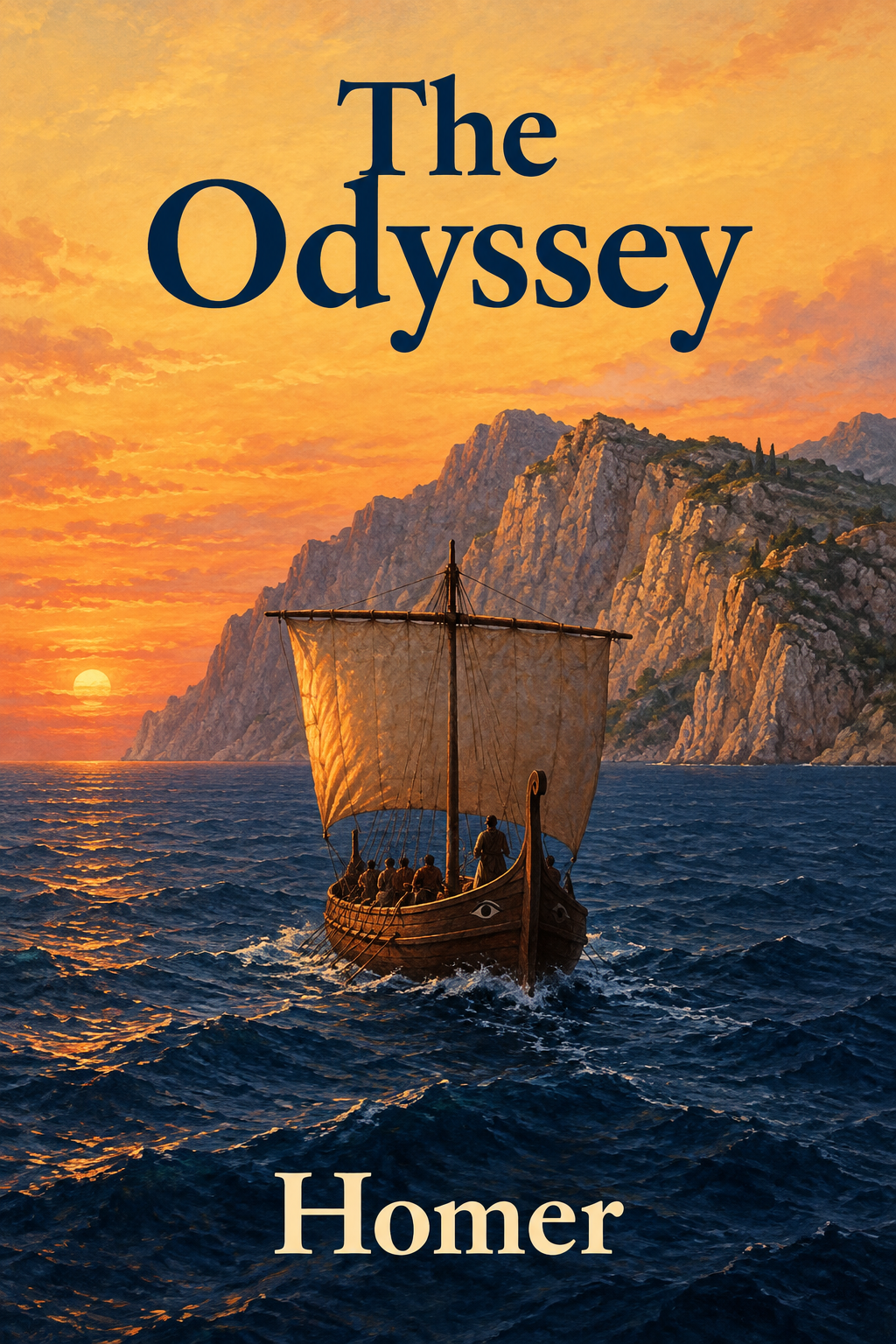
The Odyssey
Tác giả: Homer
This Odyssey summary covers Homer's epic about Odysseus, king of Ithaca, and his long journey home after the Trojan War. Ten years after the war ended, he is still far from home, held by goddesses and hunted by a god. In Ithaca, his son Telemachus sets out to learn whether he is alive, while a crowd of suitors fills the palace and courts his wife, Penelope. The poem moves between the distant adventures and the danger at home.
Ý Tưởng Chính
"The Odyssey argues that getting home takes more than strength: it takes wit, patience and humility, and it asks what a home is really made of."
Những Hiểu Biết Cốt Lõi
Hospitality as a sacred duty
In the poem, a host owes food, shelter and a safe departure to a stranger, and a guest owes respect in return. The rule is treated as more binding than a king's power, and breaking it brings a heavy cost. The suitors break it by abusing a beggar in their own hall.
The Phaeacians help a shipwrecked man they have never met, while the suitors humiliate a stranger who has come to their house. That contrast sets up the reckoning at the end.
Cunning and the disguised self
Odysseus is praised for his mind as much as for his strength. He often hides who he is, using disguise and false stories to survive. The poem asks whether such cleverness is a virtue, or a danger to the people who trust him.
Telling Polyphemus that his name is Noman saves him, but the boast he shouts as he sails away gives Poseidon a reason to pursue him for years.
Loyalty shown in daily acts
Penelope and Eumaeus show loyalty that does not depend on reward. Penelope holds the suitors off for years by stalling, and the poem measures faithfulness through steady conduct rather than through speeches.
Penelope weaves a shroud for Laertes by day and unravels the work at night, a quiet act of resistance that buys her time. Argos, the old dog, waits in his own way and dies once he has seen his master.
Home as shared knowledge
Homecoming is the poem's central goal, yet the Odyssey shows that home is a set of relationships and memories rather than only a building. Odysseus can prove who he is only through private details that his wife alone could know.
The marriage bed, built around a living olive tree, is a secret shared by the two of them, and it becomes the proof that wins her trust.
Tóm Tắt Chương
The Odyssey summary, chapter by chapter
Spoiler warning: this section covers the whole plot, including the ending.
Part 1: Telemachy (Books 1–4)
Book 1. The gods gather, and Zeus complains that mortals blame heaven for troubles they bring on themselves. Athena then visits Telemachus, the young son of Odysseus, in the shape of an old family friend. In the palace, a crowd of suitors eats through the household's stores while courting Penelope. Odysseus has been gone for twenty years, so Telemachus resolves to find out whether his father is still alive. This matters because the whole poem begins with a son acting for an absent father.
Book 2. Telemachus calls an assembly in Ithaca and asks the people to deal with the suitors, but nobody acts and the suitors brush him off. With Athena's help, disguised as an older friend, he finds a ship and a crew, then slips away at night, leaving his mother in grief. This matters because the young man starts to act on his own, and the first real journey begins here.
Book 3. At Pylos, the old king Nestor welcomes Telemachus with a feast and a sacrifice to Athena. He tells how the Greek heroes came home from Troy, some safely and some in disaster, so the reader sees many homecomings before Odysseus's. Nestor sends his son Peisistratus along, and the two travel on toward Sparta. This matters because every other return makes Odysseus's own journey look longer and harder.
Book 4. In Sparta, Menelaus and Helen welcome Telemachus with feasting and memories of Troy, and Helen slips a drug into the wine to ease sorrow. Menelaus describes how the sea god Proteus revealed that Odysseus is alive but held on an island by the goddess Calypso. Back in Ithaca, the suitors plan an ambush to kill Telemachus on his return. This matters because the reader learns that Odysseus lives while his son is now in danger.
Part 2: Calypso and Phaeacia (Books 5–8)
Book 5. Zeus sends Hermes to order Calypso to release Odysseus, who has been her prisoner for seven years. He builds a raft and sails away, but Poseidon, returning from far off, sees him and wrecks it in a storm. The sea goddess Ino gives him a veil to keep him afloat, and he swims toward the land of the Phaeacians. This matters because Poseidon's anger drives many of the hardships that follow.
Book 6. Washed up on the Phaeacian shore, Odysseus covers himself with leaves and sleeps in the bushes. Nausicaa, the daughter of King Alcinous, has come to the river to wash clothes with her maids, and Athena has put the idea in her mind. She gives the stranger clothes and food, and she tells him how to approach the palace and the queen. This matters because the first help he receives comes from a young woman, which sets up the theme of hospitality.
Book 7. At the palace, Odysseus kneels before Queen Arete and asks for help getting home. Arete and King Alcinous welcome him, and the king promises to send him home on a Phaeacian ship. The Phaeacians are famous sailors, and their world runs on guest-friendship, which the rest of the poem tests. This matters because the court shows the rules that every later host and guest must follow.
Book 8. The king hosts athletic games, and a young man insults Odysseus as a mere trader. Odysseus answers by throwing the discus farther than anyone else, and the Phaeacians are impressed. At the feast, the blind bard Demodocus sings of the Trojan Horse, and Odysseus weeps openly. Alcinous asks who he is and where he comes from, and that question opens the story of his wanderings. This matters because the tears reveal a painful past the reader has not yet seen.
Part 3: The Wanderings Told at Phaeacia (Books 9–12)
Book 9. Odysseus begins his own story at the feast. His crew raids the Cicones, then lands among the lotus-eaters, whose food makes men forget home. In the cave of the Cyclops Polyphemus, the giant eats six of his men. Odysseus makes him drunk and blinds him, then escapes by clinging under the sheep as they leave the cave. This matters because his clever trick comes with a boast that will anger Poseidon.
Book 10. The wind god Aeolus gives Odysseus a bag holding the contrary winds, but the crew opens it and the ships are blown back. Next, the Laestrygonians destroy most of the fleet. On the island of Aeaea, the sorceress Circe turns half the crew into swine. With help from Hermes, who gives him a herb to resist her magic, Odysseus forces Circe to change them back. This matters because small mistakes cost lives, and Odysseus's judgment keeps being tested.
Book 11. Circe sends Odysseus to the edge of the underworld to consult the blind prophet Tiresias. Tiresias warns him about the sacred cattle of Helios and the dangers still to come. Odysseus then meets his dead mother, and the ghosts of Agamemnon, Achilles and Ajax, who speak of their sorrows and their fame. This matters because the dead heroes question what glory is worth, and the scene makes home seem more valuable.
Book 12. Odysseus sails past the Sirens, whose song he hears while tied to the mast, as his crew has plugged their ears. He passes between Scylla and Charybdis, losing six men to Scylla. On the island of Helios, his starving crew kills the sacred cattle, and Zeus destroys the ship. Odysseus alone survives, drifts for days and washes up on Ogygia, where Calypso welcomes him. This matters because hunger and disobedience leave him alone again.
Part 4: Back to Ithaca (Books 13–16)
Book 13. The Phaeacians sail Odysseus home while he sleeps on their ship. Poseidon, angry that they helped him, turns the ship to stone just outside the harbour. Odysseus wakes on the Ithacan shore and does not recognise the place, until Athena appears and disguises him as an old, ragged beggar. This matters because he is home, but he must stay hidden if he is to act.
Book 14. Athena sends Odysseus to Eumaeus, the faithful swineherd, who takes in the stranger and feeds him. Odysseus tells a long invented story about a life in Crete, and Eumaeus listens with sympathy while he tends the pigs. This matters because Eumaeus shows a loyalty that comes from daily conduct, not from rewards, which contrasts with the suitors.
Book 15. Athena warns Telemachus about the ambush, and he sails home from Sparta and avoids it. He lands on Ithaca and goes to Eumaeus's hut while his ship sails on to the town. On the voyage he met Theoclymenus, a seer who fled his homeland after killing a man and asked to join him. This matters because the son's safe return sets up the reunion that will change the plan.
Book 16. Telemachus reaches the hut and sends Eumaeus to tell Penelope he is safe. Alone with the beggar, he is told that the man is his father. At first he doubts it, until Athena restores Odysseus's own appearance. Father and son embrace and weep, then plan together how to kill the suitors. Telemachus goes on to the palace while Odysseus waits behind. This matters because the hidden king and his son now act together, which turns the poem toward its climax.
Part 5: The Suitors' Hall (Books 17–20)
Book 17. Odysseus, still disguised, enters the palace as a beggar. His old dog Argos lifts his head, recognises him, and dies. The suitors insult the stranger, and Antinous throws a footstool at him. Penelope hears of the stranger and asks to speak with him. This matters because the house has become a place where the rightful king is treated with contempt.
Book 18. A professional beggar named Irus challenges the stranger to a fight at the gate, and Odysseus defeats him easily. Penelope comes down to the hall and asks the suitors for gifts, which they bring, while the feasting goes on. Amphinomus, one of the suitors, is kinder and warns that violence will bring trouble. This matters because it shows both the suitors' greed and a glimmer of decency among them.
Book 19. Penelope speaks with the stranger alone. He tells a story that claims he once met Odysseus, and she explains her own trick: she has promised to finish a shroud for her father-in-law Laertes, weaving by day and unravelling the work at night. Then the old nurse Eurycleia washes his feet and recognises the scar on his thigh from a boar hunt in his youth. This matters because the scar is the first solid sign of who he really is.
Book 20. Odysseus lies awake, troubled by what he has seen, until Athena sends him sleep. The suitors feast noisily, and the seer Theoclymenus warns them of blood and doom. One suitor throws an ox's hoof at the beggar, and Odysseus endures the insult without showing his anger. This matters because his restraint keeps the plan secret and raises the tension before the bow contest.
Part 6: The Bow and the Reckoning (Books 21–24)
Book 21. Penelope announces a contest: whichever man can string Odysseus's great bow and shoot an arrow through the sockets of twelve axes set in a row will win her hand. No suitor can even bend the bow. The stranger asks to try, and the suitors object loudly. Then Odysseus strings the bow with ease and shoots clean through the axes. This matters because the bow belonged to Odysseus, and the test brings the plan to its crisis.
Book 22. Odysseus throws off his rags, reveals himself, and shoots Antinous first. Telemachus, the swineherd Eumaeus and the herdsman Philoetius join him, and the suitors are killed in the hall. The servants who helped the suitors are punished, and the house is purified. This matters because justice is carried out in the same hall where the wrong began.
Book 23. The old nurse Eurycleia tells Penelope that the stranger is Odysseus, but Penelope is cautious and not easily convinced. She tests him by ordering the marriage bed moved. He is indignant, because the bed was built around a living olive tree, a secret only the two of them share, and that detail convinces her. This matters because the test shows that a home is a shared secret, not just a place.
Book 24. Hermes leads the souls of the suitors down to the underworld. Odysseus goes to his aged father, Laertes, on his farm and reveals himself. The families of the dead suitors rise to take revenge, but Athena intervenes, and Zeus brings the fighting to an end. This matters because the poem closes on a balance between justice and peace, and it leaves the reader to judge what a household and a kingdom need.
The Odyssey characters
- Odysseus: the king of Ithaca and the poem's hero. He is brave, but his main gift is cleverness, which he uses to survive gods, monsters and the suitors. Above all, he has lost his home and wants it back more than anything.
- Penelope: Odysseus's wife, who has waited for twenty years while suitors press her to choose a new husband. She holds them off with a clever trick and keeps her hope alive, testing anyone who claims to know her husband.
- Telemachus: Odysseus's son, who begins unsure of his place in the hall and grows into a man who fights beside his father. His search for news of Odysseus is the poem's first big story, and it gives the young man his own journey.
- Athena: the grey-eyed goddess of wisdom who protects Odysseus and guides Telemachus. She often appears in disguise and steers events, and her help holds the shape of the poem together. She also pleads Odysseus's cause before the council of the gods.
- Poseidon: the sea god, who is angry with Odysseus for blinding his son Polyphemus. His anger causes the long delay and wrecks both the raft and the Phaeacians' ship, so the homeward voyage becomes a long ordeal at sea.
- Calypso: a goddess who keeps Odysseus on her island for seven years, offering immortality if he stays. Hermes orders her to let him go, and she obeys, though not happily. She helps him build the raft he sails away on.
- Circe: a sorceress on Aeaea who turns men into swine and then becomes a generous host. Her advice about the underworld sends Odysseus on the next stage of his journey, and her warnings help him survive the dangers ahead.
- Nausicaa: the young princess of the Phaeacians, who finds Odysseus on the shore and gives him practical help. She is direct and practical, and she advises him how to approach her parents with respect.
- Eumaeus: the loyal swineherd who keeps the estate's animals and takes in Odysseus without knowing who he is. He stands for faithful service, and he joins the fight against the suitors.
- Antinous: the most arrogant of the suitors, who insults the beggar and throws a footstool at him. He is the first suitor to be shot in the hall, and he stands for greed and pride.
Writing about this book
A reading report on The Odyssey works best when it starts from one question: what does home mean? Odysseus wants to return to Ithaca, but the place and the people he left have changed while he was away, and Penelope has changed during her long wait. Compare how each character changes, and ask whether the reunion gives what the story seems to promise.
Choose one scene and explain what it shows about trust. The Phaeacian feast, Eumaeus's hut and the test of the marriage bed each reveal how people decide whom to believe. Use your own words, and give the book number for every quotation.
Finally, consider the gods. They help and punish, but the humans still choose how to act, and the poem asks how much responsibility belongs to each side. A short essay that answers this with two or three examples from the text will be stronger than a plot retelling.
Hành Động Ngay
Các bước thực tế bạn có thể thực hiện ngay hôm nay:
-
Read the opening book with the whole poem in mind, and notice how the gods, the suitors and the son each set the pace.
-
Track how each host treats a stranger, and ask what the poem thinks a good guest owes in return.
-
Pick one disguise scene and ask who is fooled, who knows the truth, and what the reader sees that the characters miss.
-
Compare Penelope's patience with Odysseus's adventures, and decide which kind of courage the poem values more.
Trích Dẫn Đáng Nhớ
"Tell me, O Muse, of that ingenious hero who travelled far and wide after he had sacked the famous town of Troy (Book 1)"
— Homer
"See now, how men lay blame upon us gods for what is after all nothing but their own folly (Book 1)"
— Homer
"Noman is killing me by fraud; no man is killing me by force (Book 9)"
— Homer
Ai Nên Đọc Cuốn Này
Readers aged 14 and up, including high school students studying world literature, ancient history or Greek myth. Adventure fans will enjoy the sea voyages and monsters, while readers who like slow character studies will value the scenes at home with Penelope and Telemachus. The poem is long, so reading it one part at a time makes it manageable.
Về Homer
Homer is the poet traditionally credited with the Iliad and the Odyssey, the two foundational epics of ancient Greek literature. Almost nothing certain is known about his life, and scholars continue to debate when and how the poems took their final form. The Odyssey has been read for centuries as a story of travel, loyalty and homecoming.
Tóm Tắt Được Viết Bởi

Kỹ sư phần mềm & Nhà văn
Kỹ sư phần mềm với niềm đam mê chuyển đổi ý tưởng phức tạp thành hiểu biết thực tiễn. Viết về tài chính, đầu tư, khởi nghiệp và công nghệ.
Xem tất cả tóm tắt →Đánh Giá
Chưa có đánh giá nào. Hãy là người đầu tiên chia sẻ suy nghĩ của bạn!
Viết Đánh Giá
Đọc tiếp
Khám phá chủ đề: Truyện hư cấuTóm tắt sách

Tóm Tắt Sách Vượt Qua Giới Hạn (Out of My Mind)
Sharon M. Draper
“Out of My Mind” by Sharon M. Draper is a poignant narrative that explores the life of Melody Brooks, a…

Tóm Tắt Sách Ender’s Game
Orson Scott Card
“Ender’s Game” by Orson Scott Card is a riveting science fiction novel that transports readers into a future where humanity…

Tóm Tắt Sách Pachinko (Pachinko)
Min Jin Lee
“Pachinko”, a spellbinding multigenerational historical saga by Min Jin Lee, explores the lives of a Korean family trying to make…

Tóm Tắt Sách Những Ưu Ái Của Kẻ Vô Hình (The Perks of Being a Wallflower)
Stephen Chbosky
The Perks of Being a Wallflower by Stephen Chbosky is a profound coming-of-age novel, told through the intimate letters of…
Bài Viết

Thời Khai sáng là gì? Ý tưởng, nhà tư tưởng và di sản
Khai sáng là phong trào tư tưởng châu Âu thế kỷ 18, đề cao lý tính và bằng chứng hơn…

Lịch sử thế giới 1700–1918: Cách mạng, công nghiệp, đế quốc và chiến tranh
Từ 1700 đến 1918, cách mạng, nhà máy, đế chế và một cuộc chiến tranh thế giới đã định hình…

Chủ đề A Christmas Carol: lòng hào phóng, sự cô lập và trách nhiệm
Truyện ngắn của Dickens thường được đọc như câu chuyện về một người đàn ông thay đổi suy nghĩ. Nhưng…