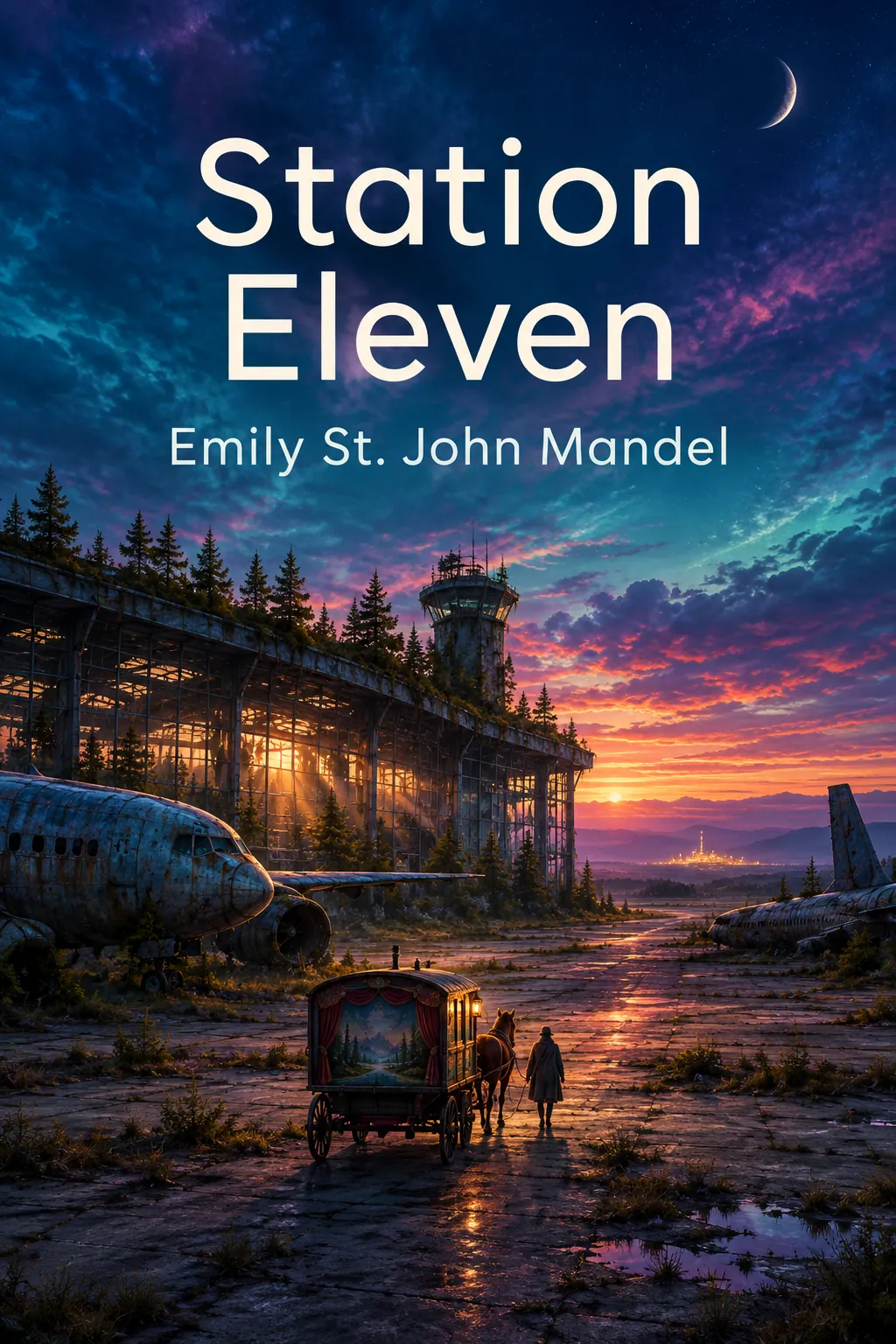
Station Eleven
Tác giả: Emily St. John Mandel
Station Eleven is a novel about what survives when civilisation collapses. A fast-moving flu wipes out most of humanity, and twenty years later a troupe called the Traveling Symphony carries Shakespeare and music between small settlements around the Great Lakes. The story follows Kirsten, an actor who remembers little of the old world, and keeps looping back to the night a famous actor died on stage. A menacing prophet stands in the troupe's way, and a rare comic book links the characters.
Ý Tưởng Chính
"After a flu pandemic ends the modern world, a travelling troupe of actors and musicians argues that staying alive is not enough: people also need art, memory and one another."
Những Hiểu Biết Cốt Lõi
Survival is not enough
The book separates staying alive from living well. The troupe risks long, dangerous journeys to perform plays, because they believe people need beauty and shared stories as much as food and shelter.
The words “Survival is insufficient” on the lead wagon give the troupe its purpose, and audiences in tiny settlements treat each performance as an event.
Memory is a form of care
Remembering the old world is shown as an act of love, not nostalgia. The characters hold on to objects, names and stories so that the people who are lost are not erased.
Clark's Museum of Civilization displays phones, credit cards and passports, so that younger visitors can see what ordinary life once looked like.
Art outlives its makers
Miranda draws her comic for herself, and Shakespeare wrote for his own time. Both works end up carrying meaning for people the creators never imagined, even after the systems around them have collapsed.
Kirsten keeps her two copies of Station Eleven for twenty years and treats them as a link to Arthur, to Miranda and to the world before the flu.
Lives are connected in unseen ways
The novel is built on connections between people who never knew they were linked. A single night in a theatre reaches forward across decades and across continents.
Arthur and the comic link Miranda, Jeevan, Kirsten and the Prophet, and it is the reader, more than the characters, who sees how closely their paths crossed.
Tóm Tắt Chương
Chapter-by-chapter summary
Spoiler warning: this section covers the whole plot, including the ending. The novel jumps between the years before the flu and the years twenty after it. The book has its own numbered parts and chapters, but the six sections below are our own grouping by story thread, not the book's divisions.
Part 1: The night Arthur Leander dies
On a snowy night in Toronto, the film star Arthur Leander plays King Lear on stage. Partway through the play he clutches his chest and falls. Jeevan Chaudhary, a former celebrity photographer now training as a paramedic, rushes from his seat to help, but Arthur cannot be saved. Kirsten Raymonde, an eight-year-old actor in the cast, is on stage and sees him fall. Outside, Jeevan gets a call from a doctor friend: a deadly flu is flooding the hospitals, and he should leave the city at once. He stocks up on food and heads to his brother Frank's apartment. This opening matters because every later thread leads back to this one evening.
Part 2: The Traveling Symphony
Twenty years on, Kirsten walks the Great Lakes region with the Traveling Symphony, a troupe of actors and musicians who move between settlements in horse-drawn wagons. The lead wagon carries the words “Survival is insufficient”. Kirsten remembers almost nothing from before the collapse, but she owns two issues of a comic called Station Eleven that Arthur once gave her, and she collects any news of him she can find. The troupe is wary of a strange man called the Prophet, who is said to rule the road ahead. This part shows why the performances matter: people line up to see a play.
Part 3: Arthur, Miranda and the comic
Between the future scenes, the book retraces Arthur's life. He grows up in a small Canadian island town, becomes a Hollywood star, and marries three times. His first wife, Miranda Carroll, works a day job and spends her private hours drawing Station Eleven, a comic about Dr. Eleven, who lives on a space station after Earth has been lost. She never plans to sell it. Arthur, who treasures it, gives two copies to the young Kirsten. Arthur's best friend, Clark Thompson, watches the marriages and the fame from close by. This part matters because it shows how a private piece of art can outlive its maker and a whole world.
Part 4: The collapse
The flu spreads faster than anyone expected. Jeevan and Frank stay in the apartment while the news broadcasts turn to static, then Jeevan sets off on foot. Clark, flying to Toronto for Arthur's funeral, is stuck on a plane diverted to the small Severn City Airport in Michigan. The passengers wait, then realise nobody is coming to rescue them, and they settle there. The book is calm and specific about these weeks, focusing on small losses such as lights, phones and ordinary routines. This part matters because it shows how quickly the old world disappears.
Part 5: The Prophet
As the troupe travels, we learn who the Prophet is: Tyler, the son of Arthur and his second wife, Elizabeth. He grew up inside the collapse and read the comic in a twisted way, deciding that those who survived were chosen. He now leads a settlement through fear and violence, and the Symphony has to run from him. Jeevan, meanwhile, has become a doctor in another small community. This part matters because it turns the book's central question sharply: what do people build from the ruins, and what do they use art for?
Part 6: Severn City
Fleeing the Prophet, Kirsten and two companions head for the Severn City Airport, where Clark has built the Museum of Civilization from items that no longer work: phones, laptops, passports and credit cards. On the way, the Prophet catches up with Kirsten. She distracts him by reciting lines from the comic, and one of his own followers shoots him dead. Kirsten is reunited with the rest of the Symphony, and at the museum Clark, who knew Arthur well, helps her see more of the man behind the comic she has kept. It is the reader, more than Kirsten, who sees how Arthur and the comic connect the threads, including Miranda and Jeevan. Clark also takes her up to the airport's control tower and shows her the electric lights of a distant town, a sign that other communities are rebuilding, and the ending stays quietly hopeful. This part matters because it answers the opening scene with memory, not victory.
Characters
Kirsten Raymonde
An actor with the Traveling Symphony, and the novel's central figure. As a child she was in the play where Arthur died. She remembers little of the old world, but she keeps his comic and searches for facts about him. She is brave, practical and loyal to the troupe.
Arthur Leander
A Canadian film star who dies on stage in the opening scene. He is not a villain or a saint: he is charming, careless with relationships and generous with a few friends. Everything and everyone in the book connects to him in some way.
Jeevan Chaudhary
A former paparazzo who is training to be a paramedic when Arthur falls. He warns his brother, survives the first winter and eventually becomes a doctor. He represents care for others in a world where there is no system left to provide it.
Miranda Carroll
Arthur's first wife and the creator of the comic Station Eleven. She draws for herself, not for fame, and her private world later shapes strangers. She shows how art can be made quietly and still change lives.
Clark Thompson
Arthur's old friend. Stranded at Severn City Airport, he becomes a leader of the settlement there and starts the Museum of Civilization. Clark is a keeper of memory, the person who insists that the old world should not be forgotten.
The Prophet (Tyler)
Arthur's son, now the leader of a violent following. His belief that survivors were chosen comes from a distorted reading of the comic. He is the book's picture of what happens when meaning is built on fear.
Frank Chaudhary
Jeevan's older brother, who uses a wheelchair. He is the reason Jeevan has a place to go when the flu arrives. Frank gives the early chapters a quiet human centre, and shows who gets left out when the world stops.
Writing about this book
The novel is easy to write about because it offers many angles rather than a single message. Start with one scene that stayed with you, and ask what it shows about the book's idea of a good life.
- The troupe's motto is “Survival is insufficient”. Do you agree? What do the characters have besides survival?
- Why does the museum matter, and what does the book say about the objects we think of as ordinary?
- Compare Miranda's private comic with Shakespeare's plays. Why do both outlive their makers?
- The Prophet reads the comic very differently from Kirsten. What does that suggest about how art can be used or misused?
- The book moves between past and future. What does the time-jumping structure do to the way you feel about each character?
For a school essay, pick one theme, such as memory, art or community, and support it with two or three specific scenes. Use your own words for the plot, and quote only a short phrase when it truly helps.
Hành Động Ngay
Các bước thực tế bạn có thể thực hiện ngay hôm nay:
-
Make time for art and stories even in a busy or difficult season, because they help people feel connected.
-
Keep one small object or story that links you to someone you miss, and share it with others.
-
Notice the quiet people who help you, such as friends, family and teachers, and thank them.
-
When you read a book, write down the one scene that stayed with you and ask why it did.
Trích Dẫn Đáng Nhớ
"“Survival is insufficient.” (Part 2: the Traveling Symphony's motto)"
— Emily St. John Mandel
"“Hell is the absence of the people you long for.” (Kirsten's part of the story)"
— Emily St. John Mandel
"“What was lost in the collapse: almost everything, almost everyone, but there is still such beauty.”"
— Emily St. John Mandel
Ai Nên Đọc Cuốn Này
Readers who like speculative fiction that focuses on people rather than technology, and who enjoy stories that move between time periods. It suits upper secondary school students and adults, and it works for a literature class on memory, art and community. It contains illness, death and some violence, so younger readers may want a parent's guidance.
Về Emily St. John Mandel
Emily St. John Mandel is a Canadian novelist, born in 1979 and raised on the coast of British Columbia, who now lives in New York. Her books include The Glass Hotel and Sea of Tranquility. Station Eleven, published in 2014, made her internationally known and won the Arthur C. Clarke Award.
Tóm Tắt Được Viết Bởi

Kỹ sư phần mềm & Nhà văn
Kỹ sư phần mềm với niềm đam mê chuyển đổi ý tưởng phức tạp thành hiểu biết thực tiễn. Viết về tài chính, đầu tư, khởi nghiệp và công nghệ.
Xem tất cả tóm tắt →Đánh Giá
Chưa có đánh giá nào. Hãy là người đầu tiên chia sẻ suy nghĩ của bạn!
Viết Đánh Giá
Đọc tiếp
Khám phá chủ đề: Khoa học viễn tưởngTóm tắt sách

Tóm Tắt Sách Vượt Qua Giới Hạn (Out of My Mind)
Sharon M. Draper
“Out of My Mind” by Sharon M. Draper is a poignant narrative that explores the life of Melody Brooks, a…

Tóm Tắt Sách Ender’s Game
Orson Scott Card
“Ender’s Game” by Orson Scott Card is a riveting science fiction novel that transports readers into a future where humanity…

Tóm Tắt Sách Pachinko (Pachinko)
Min Jin Lee
“Pachinko”, a spellbinding multigenerational historical saga by Min Jin Lee, explores the lives of a Korean family trying to make…

Tóm Tắt Sách Những Ưu Ái Của Kẻ Vô Hình (The Perks of Being a Wallflower)
Stephen Chbosky
The Perks of Being a Wallflower by Stephen Chbosky is a profound coming-of-age novel, told through the intimate letters of…
Bài Viết

Chủ đề A Christmas Carol: lòng hào phóng, sự cô lập và trách nhiệm
Truyện ngắn của Dickens thường được đọc như câu chuyện về một người đàn ông thay đổi suy nghĩ. Nhưng…

Giải Nebula là gì? Các tác phẩm đoạt giải Nebula nổi bật
Giải Nebula là giải thưởng khoa học viễn tưởng và giả tưởng của Mỹ, do chính các nhà văn đang…

Giải thưởng Seiun
Giải thưởng Seiun là giải khoa học viễn tưởng lâu đời nhất Nhật Bản, được trao lần đầu năm 1970.…