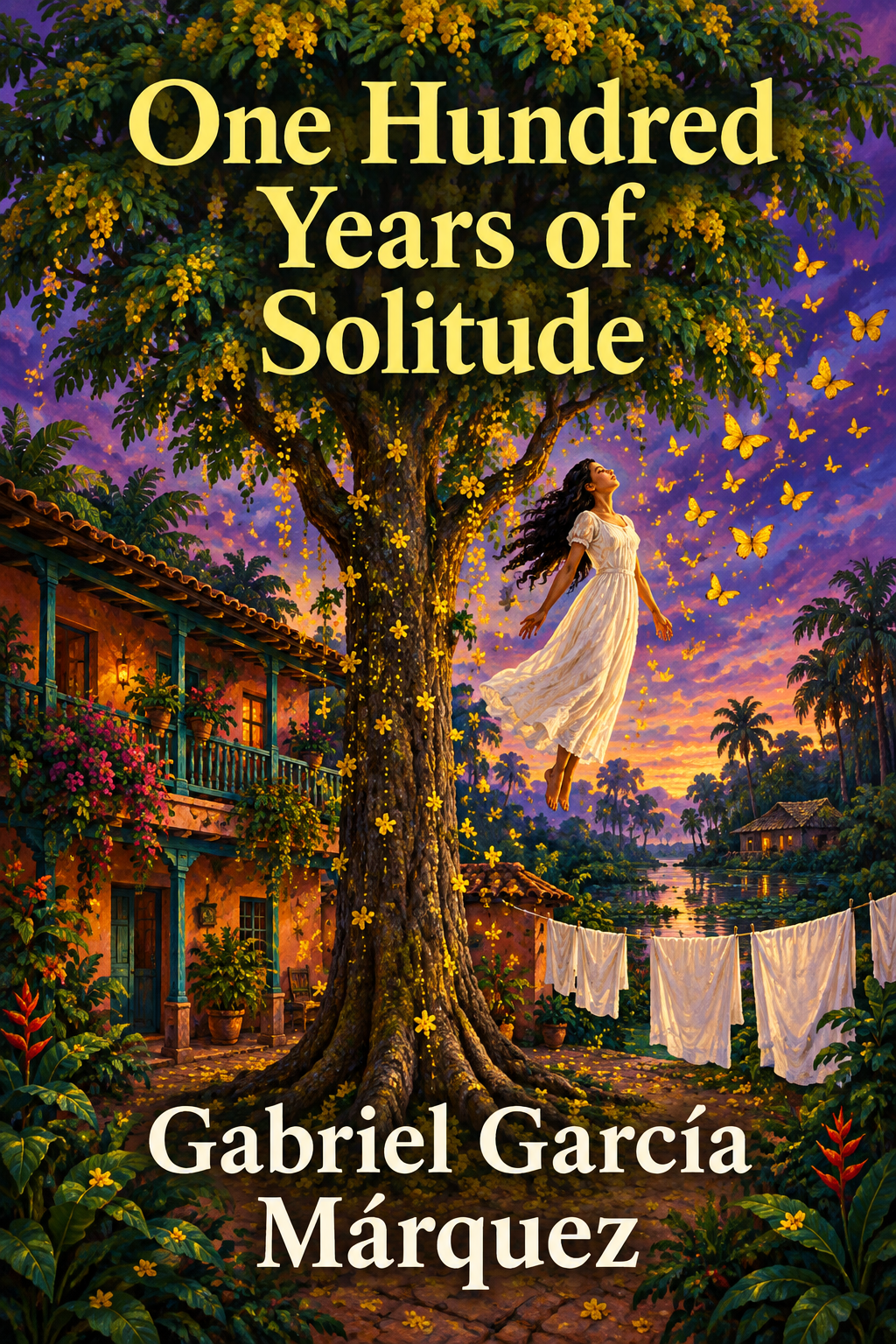
One Hundred Years of Solitude
Tác giả: Gabriel García Márquez
One Hundred Years of Solitude is a 1967 novel by Gabriel García Márquez about seven generations of the Buendía family in Macondo, a fictional town hidden among the swamps of Colombia. José Arcadio Buendía and his wife Úrsula found the town. Their descendants fight civil wars, fall into forbidden loves, welcome a railroad and a foreign banana company, and live through a rain that lasts almost five years. Ghosts, flying carpets and a girl who rises to heaven sit beside real history. Names repeat, and so do fates.
Ý Tưởng Chính
"One Hundred Years of Solitude follows a family that repeats the same names, passions and mistakes for a century. It shows that people who forget their past or cannot love freely end up alone."
Những Hiểu Biết Cốt Lõi
Solitude inside a crowded house
Every Buendía lives surrounded by relatives yet sealed inside a private obsession: alchemy, war, gold fish, a shroud, a locked room. The book suggests their loneliness comes less from being alone than from being unable to love freely.
Amaranta refuses every man who loves her, then sews her own shroud. After thirty-two wars, the colonel spends his days making the same little gold fish and melting them down again.
Time that runs in circles
The family keeps reusing the same few names, and with the names come the same temperaments and mistakes. Time in Macondo does not march forward; it circles back, which is why the family tree feels like a spiral.
Úrsula sees that Aurelianos turn inward while José Arcadios act on impulse. The founder decides every day is Monday, and in old age Úrsula feels that time has come round to the beginning again.
Magic, history and forgetting
Wonders are told flatly, while real inventions such as the train and the cinema leave people stunned. This style is called magical realism. Under it lies the book's deepest fear: losing memory, whether through illness or by official order.
During the insomnia plague people label objects so they don't forget them. Later the town denies a massacre of striking workers, an episode modelled on the real killings at Ciénaga, Colombia, in 1928.
Tóm Tắt Chương
Chapter-by-chapter summary
Spoiler warning: this section covers the whole plot, including the ending.
The novel's 20 chapters have no titles, so each label below is a short description.
Chapter 1: Ice and Magnets
Macondo is a village of twenty houses beside a clear river. Every March, gypsies led by Melquíades arrive with magnets, a magnifying glass and alchemy tools. José Arcadio Buendía, the restless founder, pours the family's savings into each wonder and hacks through the jungle looking for a route to the wider world, but he finds only a stranded Spanish galleon. His practical wife Úrsula refuses to move the town. The chapter closes with the gypsies showing the children ice. Why it matters: the opening jump forward to a firing squad warns us that time in this book loops back on itself.
Chapter 2: The Founding of Macondo
The story steps back. José Arcadio Buendía and Úrsula are cousins. A relative was once born with a pig's tail, so Úrsula refuses to sleep with her husband. When Prudencio Aguilar mocks him for it, José Arcadio Buendía kills him with a spear. The dead man's ghost haunts the couple, so they cross the mountains with friends and found Macondo. Years later their son José Arcadio gets Pilar Ternera pregnant and runs off with the gypsies. Úrsula, who has just had a daughter, Amaranta, chases after him and comes back with people who know the road to the outside world. Why it matters: a founding crime and the fear of incest shadow every generation after.
Chapter 3: The Insomnia Plague
Pilar's baby, Arcadio, is raised in the Buendía house. An orphan girl, Rebeca, arrives carrying a sack of her parents' bones, and she secretly eats earth. Soon an insomnia plague spreads: nobody sleeps, and the whole town starts forgetting the names and uses of things, so José Arcadio Buendía labels everything. Melquíades comes back from death with a cure, moves in and begins writing strange parchments. Aureliano becomes a silversmith. When a government magistrate, Don Apolinar Moscote, arrives, Aureliano falls for his very young daughter Remedios. Why it matters: losing its memory is the town's first taste of solitude.
Chapter 4: The Pianola and the Chestnut Tree
Úrsula enlarges the house, and an Italian, Pietro Crespi, comes to set up a pianola. Rebeca and Amaranta both fall for him. Rebeca wins the engagement, and Amaranta swears she will stop the wedding. Aureliano asks for Remedios Moscote's hand, though she is still a child. Melquíades dies and becomes the first person buried in Macondo. José Arcadio Buendía decides that time has stopped and that every day is Monday, and he smashes things in a rage. The family ties him to the chestnut tree in the courtyard, where he stays for years. Why it matters: the founder's madness starts the family's habit of shutting people away.
Chapter 5: A Wedding and a War
Aureliano marries Remedios Moscote, who wins over the whole family, while Rebeca's wedding keeps being postponed. Father Nicanor raises money for a church by drinking hot chocolate and floating above the ground. José Arcadio returns as a huge, tattooed wanderer, and Rebeca marries him instead, so Úrsula throws them out. Remedios dies suddenly while pregnant with twins. When her father rigs an election for the Conservatives, Aureliano sides with the Liberals and leaves with twenty-one men to fight, putting Arcadio in charge of Macondo. Why it matters: private grief and public politics merge, and a shy silversmith becomes a colonel.
Chapter 6: Arcadio's Rule
The chapter opens with the legend of Colonel Aureliano Buendía: thirty-two armed uprisings, all lost; seventeen sons by seventeen women; fourteen attempts on his life survived. Back home, the schoolteacher Arcadio turns into a petty tyrant until Úrsula whips him. He has children with Santa Sofía de la Piedad. Pietro Crespi turns to Amaranta, who strings him along and then refuses him, and he kills himself. When Conservative troops retake Macondo, Arcadio is shot by a firing squad. Why it matters: even small power twists people, and refused love becomes a lifelong wound.
Chapter 7: The Firing Squad
Captured near the end of the war, Colonel Aureliano Buendía is brought back to Macondo to be shot. This is the scene promised in the first sentence. At the cemetery wall, his brother José Arcadio appears with a shotgun and saves him, and a new war begins. Gerineldo Márquez governs Macondo and asks Amaranta to marry him, but she refuses. Then José Arcadio is shot dead in his own room, and a thread of his blood runs through the streets to Úrsula's kitchen. Finally the old founder dies, and tiny yellow flowers fall from the sky all night. Why it matters: the founding generation is gone.
Chapter 8: Aureliano José and Amaranta
Aureliano José, the colonel's son with Pilar Ternera, grows up beside his aunt Amaranta, and the two drift into a secret, forbidden closeness until she shuts him out. He leaves for the war, deserts and comes home still hoping to marry her, but an army captain shoots him dead. The seventeen sons the colonel fathered on his campaigns are brought to Macondo to be baptized. The colonel returns, captures General Moncada, the decent Conservative mayor and his own friend, and has him executed despite Úrsula's pleas. Why it matters: the war has emptied the colonel of feeling.
Chapter 9: The Surrender
Gerineldo Márquez sees that the war has lost its meaning, and Amaranta turns him down for good. The colonel burns his poems and starts getting rid of his belongings. He accepts a peace that gives up the Liberals' ideals, sentences Gerineldo to death for opposing it, then frees him after Úrsula threatens her own son. He signs the surrender at Neerlandia and shoots himself in the chest. Úrsula sees worms in a pot of milk and believes he is dead, but the bullet misses every vital organ. Why it matters: the hero wins nothing; all he does is survive his own despair.
Chapter 10: The Twins
A new generation takes over. Arcadio's twins, Aureliano Segundo and José Arcadio Segundo, look so alike that as boys they swap clothes to fool people, then grow into opposites. José Arcadio Segundo watches an execution and turns against the army. Aureliano Segundo becomes a cheerful spender, and while he is with his lover Petra Cotes his animals breed so fast that he grows rich and papers the house with banknotes. Melquíades's ghost tells him the parchments cannot be read for a hundred years. At carnival, Remedios the Beauty is crowned queen; a rival queen, Fernanda del Carpio, arrives, and shooting breaks out. Why it matters: wealth replaces war, but nobody grows wiser.
Chapter 11: Fernanda
Aureliano Segundo marries Fernanda del Carpio, raised in a cold highland city to believe she would be a queen. She brings a gold chamber pot, strict manners and a calendar that limits the days the couple may sleep together. The family never warms to her, and her husband keeps going back to Petra Cotes. They have a son, José Arcadio, and a daughter, Renata Remedios, called Meme. The colonel's seventeen sons visit, and the ash crosses marked on their foreheads at church never wash off. One son, Aureliano Triste, builds an ice factory and brings the railroad. Why it matters: the outside world is about to arrive.
Chapter 12: The Banana Company
The yellow train brings electricity, cinema, the phonograph and the telephone, which both thrill and anger the townspeople. An American, Mr. Herbert, tastes the local bananas, and soon a banana company moves in with lawyers, engineers and a fenced town for foreigners. Within months Macondo is unrecognisable. Remedios the Beauty, so lovely that men die for her, rises into the sky one afternoon while folding sheets. Then the colonel's sons are hunted down and shot through the ash crosses on their foreheads; only one escapes. Why it matters: progress arrives as an invasion.
Chapter 13: The Colonel's Death
Úrsula, now very old, has gone blind, but she hides it by memorising everyone's routines. Fernanda takes control of the house, and young José Arcadio leaves for a seminary in Rome. Aureliano Segundo moves in with Petra Cotes and almost dies in an eating contest against a woman known as the Elephant. Amaranta starts sewing her own shroud. Colonel Aureliano Buendía, who spends his days making little gold fish, melting them down and making them again, goes out to watch a circus parade, then leans against the chestnut tree and dies. Why it matters: his endless fish mirror the family's repeating history.
Chapter 14: Meme and the Yellow Butterflies
Meme finishes school as a clavichord player and makes friends with American girls from the banana company's town. Amaranta, who has foretold her own death, finishes her shroud and dies at dusk, offering to carry letters to the dead. Úrsula takes to her bed. Meme falls in love with Mauricio Babilonia, a company mechanic who is always surrounded by yellow butterflies. They meet in secret until Fernanda finds out and posts a guard, who shoots Mauricio as he climbs in through the roof, leaving him paralysed for life. Why it matters: Fernanda's pride crushes love just as Amaranta's did.
Chapter 15: The Massacre
Fernanda takes Meme to a convent in her home city, and Meme never speaks again. Months later a nun delivers Meme's baby boy. Fernanda names him Aureliano, hides him and claims she found him floating in a basket. José Arcadio Segundo leads a strike against the banana company, and the army opens fire on thousands of workers gathered at the station. He wakes on a train full of corpses headed for the sea, walks home, and finds that nobody believes a massacre happened. He hides in Melquíades's room, and the rain begins. Why it matters: forgetting by order is the most frightening solitude in the book.
Chapter 16: The Rain
It rains for almost five years. Aureliano Segundo is stuck at Fernanda's house, grows thin and calm, and tells the children stories from the pictures in an English encyclopedia. Gerineldo Márquez dies. Petra Cotes's animals drown, and Aureliano Segundo's fortune goes with them. Fernanda's complaints become so constant that he smashes everything breakable in the house. Digging for Úrsula's buried gold, he damages the foundations. When the rain stops, the banana company is gone and Macondo is a ruin. Why it matters: nature erases the company's world as easily as the company erased the town's memory.
Chapter 17: The Death of Úrsula
When the rain ends, the blind Úrsula, well past a hundred, tries to put the house in order one last time, then shrinks and dies. A heatwave follows, and the town turns superstitious. Rebeca dies alone in her locked house. Meme's son Aureliano grows up hidden away and learns to read from José Arcadio Segundo, who tells him the truth about the massacre. Aureliano Segundo sells what he has left to send his daughter Amaranta Úrsula to study in Brussels. Then the twins die at the same moment, and drunken mourners bury each one in the other's grave. Why it matters: the family loses the woman who kept its memory.
Chapter 18: Aureliano in Melquíades's Room
Aureliano shuts himself in Melquíades's room, where the gypsy's fading ghost tells him the parchments are written in Sanskrit. Santa Sofía de la Piedad, who has served the family all her life, simply walks away. Fernanda dies. José Arcadio returns from Rome without becoming a priest, finds the hidden gold and throws parties with local boys. Aureliano Amador, the last of the colonel's sons, begs for shelter and is shot by the police. Later, four of the boys drown José Arcadio in his bath and steal the gold. Why it matters: the house empties, leaving Aureliano alone with the manuscripts.
Chapter 19: Amaranta Úrsula Returns
Amaranta Úrsula comes back from Brussels with her Belgian husband, Gaston, and tries to bring the crumbling house back to life. Aureliano makes friends with a wise Catalan bookseller and four young men who argue about books in bars and brothels, and he has an affair with a local woman, Nigromanta. But he falls in love with Amaranta Úrsula. Neither knows she is his aunt. While Gaston busies himself planning an airmail service, she resists at first, then gives in. Why it matters: the family's oldest fear, a child born to close relatives, is about to come true.
Chapter 20: The Pig's Tail and the Wind
Pilar Ternera dies, the bookseller goes home, and the friends scatter. Gaston leaves for Brussels. Amaranta Úrsula and Aureliano live alone in wild happiness in the ruined house. She gives birth to a strong boy with a pig's tail and then bleeds to death. Aureliano, drunk with grief, forgets the baby; when he comes back, ants are carrying it away. In that moment he understands the parchments: Melquíades wrote the family's whole history a century in advance. As Aureliano reads the last page, a great wind wipes Macondo off the earth. Why it matters: a family that never learned from its past is ended by it.
Characters
José Arcadio Buendía: founder of Macondo. Curious and stubborn, he chases every gypsy invention and spends his last years tied to a chestnut tree, lost in his own mind.
Úrsula Iguarán: his wife and the family's backbone. She lives well past a hundred, runs the house, remembers everything and keeps trying to stop the men around her from wrecking it.
Colonel Aureliano Buendía: their second son. A quiet silversmith who becomes the Liberals' legendary commander, loses all thirty-two uprisings and withdraws into making little gold fish.
José Arcadio: the eldest son, huge and impulsive. He runs off with the gypsies, returns covered in tattoos, marries Rebeca and dies from a mysterious gunshot.
Amaranta: Úrsula's daughter. Jealous and proud, she turns away every man who loves her and dies unmarried after sewing her own shroud.
Pilar Ternera: a card reader who has a son with each of the founder's two sons and stays close to the family for about a century.
Melquíades: the gypsy sage who brings wonders to Macondo, returns from death and writes the parchments that hold the family's fate.
Aureliano Segundo and José Arcadio Segundo: Arcadio's twins. The first is a cheerful spender torn between his wife and his lover Petra Cotes; the second leads the banana strike and survives the massacre.
Fernanda del Carpio: Aureliano Segundo's proud, rigid wife from a highland city, who runs the house by strict rules and hides her own grandson.
Aureliano: Meme's son, raised in secret. Bookish and solitary, he spends years trying to decode Melquíades's parchments.
Writing about this book
Don't retell the plot. Pick one question and follow it through the generations. Some angles to try:
- Names and fate: Úrsula notices that the Aurelianos are withdrawn and the José Arcadios impulsive. Do the names decide who they become, or does the family expect them to?
- Love and pride: Why do Amaranta, the colonel and Fernanda each push love away? What does it cost them and the people around them?
- Forgetting: Compare the insomnia plague with the town's refusal to believe in the massacre. What is the book saying about official history?
- Magic told plainly: Choose one wonder, such as Remedios the Beauty rising into the sky, and explain what the calm, matter-of-fact telling adds.
A strong opening describes one vivid scene in your own words. A strong ending links the book's loops to a pattern you have noticed in a family, a town or a country. Draw your own family tree before you start; it will save you from mixing up the Aurelianos.
Hành Động Ngay
Các bước thực tế bạn có thể thực hiện ngay hôm nay:
-
Keep a family tree beside you as you read; the repeated names are part of the book's meaning, not just a puzzle.
-
Notice how calmly the narrator reports miracles and how amazed people are by ordinary inventions; that reversal is the heart of magical realism.
-
Track the moment each character becomes lonely; it usually begins with pride, fear or a refusal to accept love.
-
Read the banana massacre chapter next to Colombia's 1928 history to see how fiction can keep alive what officials want forgotten.
Trích Dẫn Đáng Nhớ
"“…Colonel Aureliano Buendía was to remember that distant afternoon when his father took him to discover ice.” (Chapter 1)"
— Gabriel García Márquez
"“The world was so recent that many things lacked names, and in order to indicate them it was necessary to point.” (Chapter 1)"
— Gabriel García Márquez
"“He really had been through death, but he had returned because he could not bear the solitude.” (Chapter 3)"
— Gabriel García Márquez
"“It rained for four years, eleven months, and two days.” (Chapter 16)"
— Gabriel García Márquez
Ai Nên Đọc Cuốn Này
Readers aged about sixteen and up: final-year high-school students, university students of literature or Latin American history, and adults who love big family sagas. It suits patient readers who enjoy rich language. Expect frank sexual scenes and some violence. If you liked Isabel Allende's The House of the Spirits, this is the book behind it.
Về Gabriel García Márquez
Gabriel García Márquez (1927–2014) was a Colombian novelist and journalist. He was born in Aracataca, the small Caribbean town that inspired Macondo. One Hundred Years of Solitude, published in Spanish in 1967, made him famous around the world and became the best-known novel of the Latin American “Boom.” He won the Nobel Prize in Literature in 1982.
Tóm Tắt Được Viết Bởi

Kỹ sư phần mềm & Nhà văn
Kỹ sư phần mềm với niềm đam mê chuyển đổi ý tưởng phức tạp thành hiểu biết thực tiễn. Viết về tài chính, đầu tư, khởi nghiệp và công nghệ.
Xem tất cả tóm tắt →Đánh Giá
Chưa có đánh giá nào. Hãy là người đầu tiên chia sẻ suy nghĩ của bạn!
Viết Đánh Giá
Đọc tiếp
Khám phá chủ đề: Truyện hư cấuTóm tắt sách

Tóm Tắt Sách Vượt Qua Giới Hạn (Out of My Mind)
Sharon M. Draper
“Out of My Mind” by Sharon M. Draper is a poignant narrative that explores the life of Melody Brooks, a…

Tóm Tắt Sách Ender’s Game
Orson Scott Card
“Ender’s Game” by Orson Scott Card is a riveting science fiction novel that transports readers into a future where humanity…

Tóm Tắt Sách Pachinko (Pachinko)
Min Jin Lee
“Pachinko”, a spellbinding multigenerational historical saga by Min Jin Lee, explores the lives of a Korean family trying to make…

Tóm Tắt Sách Những Ưu Ái Của Kẻ Vô Hình (The Perks of Being a Wallflower)
Stephen Chbosky
The Perks of Being a Wallflower by Stephen Chbosky is a profound coming-of-age novel, told through the intimate letters of…
Bài Viết

Thời Khai sáng là gì? Ý tưởng, nhà tư tưởng và di sản
Khai sáng là phong trào tư tưởng châu Âu thế kỷ 18, đề cao lý tính và bằng chứng hơn…

Lịch sử thế giới 1700–1918: Cách mạng, công nghiệp, đế quốc và chiến tranh
Từ 1700 đến 1918, cách mạng, nhà máy, đế chế và một cuộc chiến tranh thế giới đã định hình…

Chủ đề A Christmas Carol: lòng hào phóng, sự cô lập và trách nhiệm
Truyện ngắn của Dickens thường được đọc như câu chuyện về một người đàn ông thay đổi suy nghĩ. Nhưng…