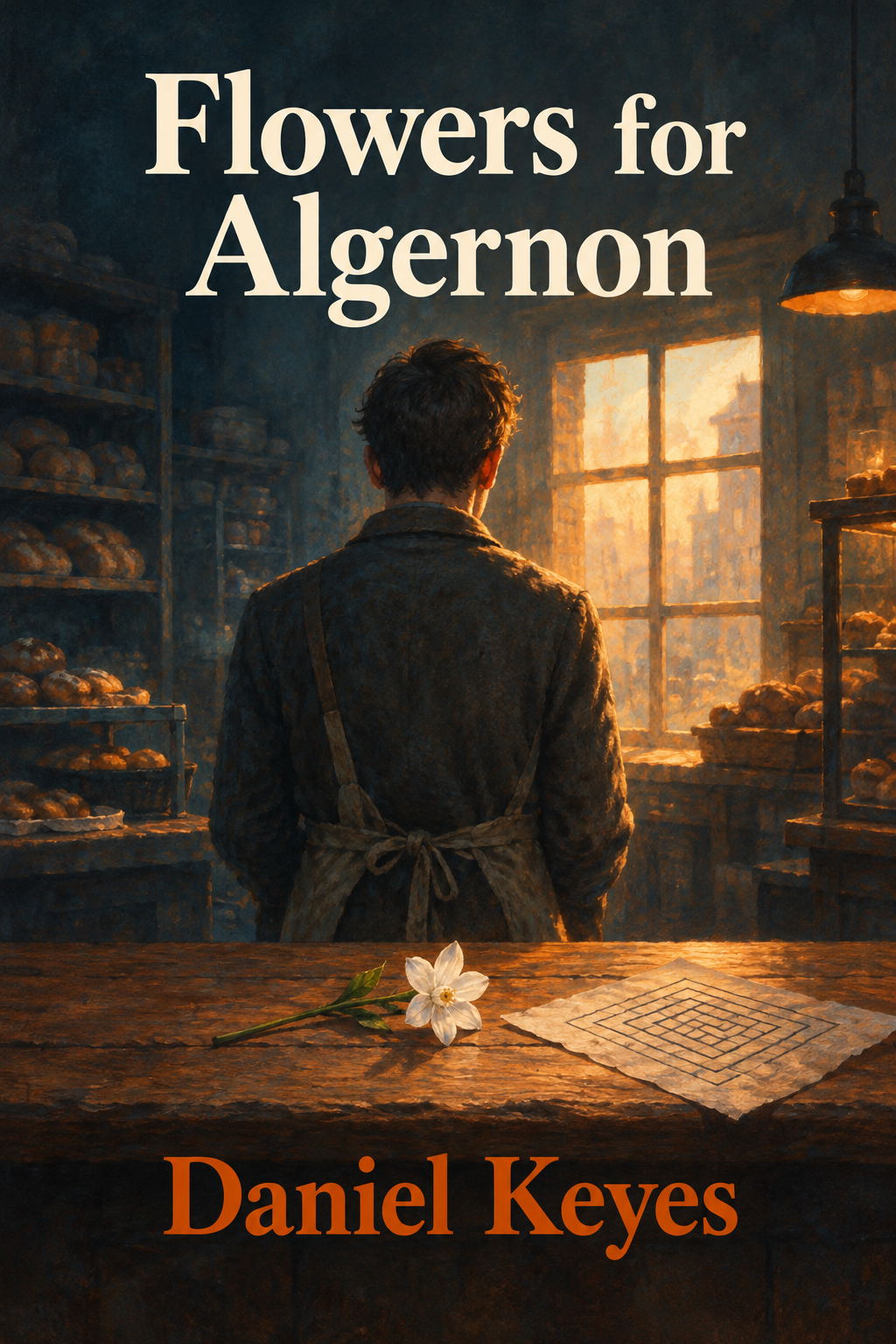
Flowers for Algernon
Tác giả: Daniel Keyes
Flowers for Algernon is a novel about Charlie Gordon, a 32-year-old man with a low IQ who works at a bakery and attends an adult literacy class. Recommended by his teacher, Alice Kinnian, Charlie becomes the first human to undergo an experimental brain operation, and his intelligence rises fast. The story is told through his own progress reports, so readers see his thinking change on the page. A laboratory mouse named Algernon, who had the operation first, hints at what may come next.
Ý Tưởng Chính
"Flowers for Algernon asks what a person is worth when others measure him only by his mind, and whether intelligence alone can decide dignity or love."
Những Hiểu Biết Cốt Lõi
Intelligence is not the same as worth
The novel asks whether a person's value depends on how quickly he can learn or solve problems. Charlie is the same person before and after the surgery, but others start to judge him by his intelligence. The book argues that dignity comes from how we treat people, not from what their test scores say.
After his intelligence grows, Charlie's co-workers move from mockery to resentment. They cannot accept a man they once looked down on, so they persuade their boss to fire him.
Being treated as a research subject
The researchers want results, and they see Charlie as proof of their work. The novel asks what consent, respect and honesty mean when a person is also the subject of a study. The book suggests that good intentions do not remove the duty to treat someone as a person.
Charlie begins to see that his reports serve the experiment more than his own life. At the Chicago convention, the reader sees the cost of research that forgets the person at its center.
Love and loneliness
Charlie's feelings for Alice show the loneliness at the heart of the book. He understands more than before, but understanding people is not the same as being understood by them. The novel shows that intelligence can deepen the distance between people rather than close it.
Alice eventually ends their relationship, saying she can no longer relate to him. His gain in knowledge has left him further from the people he loves, and the story's tenderness feels sharper because of it.
Pity and respect
Many characters respond to Charlie with pity, mockery or a mix of both. The novel asks whether pity can ever be a form of respect, or whether it simply keeps a person at a distance. The book suggests that being seen as a whole person matters more than being admired for a talent.
Think about how Charlie is treated by a friend and how he is treated by strangers who see him as a curiosity. Comparing those moments shows why the difference matters.
Tóm Tắt Chương
Chapter-by-chapter summary
Spoiler warning: this section covers the whole plot, including the ending.
Part 1: Charlie's first reports
Charlie Gordon is 32 years old, but his IQ is 68. He cleans and runs errands at a bakery, and his co-workers often mock him. In an adult literacy class taught by Alice Kinnian, he works on reading and writing. Alice puts him forward, and the researchers Nemur and Strauss choose him over smarter students for a surgery that has so far been tested only on Algernon, a laboratory mouse. Dr. Strauss asks Charlie to write down what he thinks and what happens to him. The reports are written in a simple, misspelled style, and that starting point makes the later change impossible to miss.
Part 2: The surgery and the first gains
The operation succeeds, and within about three months Charlie's IQ reaches 185. His spelling improves, his sentences grow longer and his questions sharpen. He begins to recall his childhood, including the abuse he suffered from his mother, Rose. In a maze, he races Algernon to find the way out first. Charlie reads widely, studies on his own and begins to understand the science around him. He is thrilled by his new mind, but he also starts to see the people he trusted more clearly. Intelligence becomes both the gift and the trap of the story, and the speed of the change makes what follows hit harder.
Part 3: Brilliance and the bakery
As Charlie grows smarter, the co-workers who once mocked him begin to resent him. They persuade their boss to fire him. Alice ends their relationship, saying she can no longer relate to him, and Charlie loses trust in Strauss and especially in Nemur. At a scientific convention in Chicago, he feels humiliated at being treated as an experiment, so he flees with Algernon. Back in Manhattan, he starts a relationship with his neighbor, an artist named Fay Lillman, which eases his loneliness. The Chicago episode is the turning point in how Charlie sees the researchers, and the story moves from the joy of learning to the cost of being different.
Part 4: The flaw
Someone involved in the research tells Charlie that Algernon is losing the intelligence he gained. Charlie studies the results himself, comparing the maze performance with the changes he has seen. He finds a flaw in the procedure: the gains are temporary, and he could lose the intelligence he has been given. He publishes his findings as the Algernon-Gordon effect. The triumph of the operation becomes a warning about his own future. His sharp logic shows him a truth he cannot avoid, and that is what makes this discovery the story's most painful turn.
Part 5: Algernon's death and his own decline
Algernon's condition worsens until he dies. Charlie then turns the same scrutiny on himself. He checks his memory and his reasoning, and he sees the decline starting. His sentences shorten, and his reports drift back toward the simpler style of his early entries. Each new report becomes a race against his own decline. He is frightened, but he keeps writing. Algernon's death gives Charlie a painful preview of what he is about to lose.
Part 6: Regression and the last reports
As the regression continues, Charlie visits his family. His mother, Rose, has dementia and recognizes him only briefly. His father, Matt, does not recognize him at all. His sister, Norma, is caring for Rose, and she reconnects with Charlie, but he declines to stay with them. He sees Alice again and dates her, but his frustration over his failing mind leads him to end things with her and with Dr. Strauss. He does not want pity or to depend on friends and co-workers, so he chooses the Warren State Home and Training School, where no one knows about the operation. His last report asks that someone put flowers on Algernon's grave. The ending asks what dignity means when a person can no longer prove his worth.
Characters
- Charlie Gordon: A 32-year-old man with an IQ of 68 who works at a bakery and writes progress reports. The operation makes him brilliant, and the story follows how he sees the world and how the world sees him, from the first report to the last.
- Algernon: A laboratory mouse who has the operation before Charlie. His progress in the maze shows what the surgery can do, and his decline shows what it cannot. He becomes Charlie's silent companion and a symbol of a fragile gift.
- Alice Kinnian: Charlie's teacher in the adult literacy class. She has been patient with him, and she is the one who puts him forward for the experiment. As his mind changes, their relationship grows complicated, and it ends when she can no longer relate to him.
- Professor Nemur: One of the scientists who develop the surgery. He is focused on results, and the book makes clear how he treats Charlie as a research case as much as a person. Charlie's trust in him breaks down over the course of the story.
- Dr. Strauss: The other scientist on the project, who works closely with Charlie and first asks him to keep the reports. Their relationship shifts as Charlie becomes more capable and questions how he has been treated, and Charlie eventually ends it.
- Rose Gordon: Charlie's mother. Her cruelty toward him is a central source of his pain, and in the later reports she has dementia and recognizes him only briefly. The past casts a long shadow over his choices.
- Matt Gordon: Charlie's father. When Charlie visits the family late in the story, Matt does not recognize his son, and the meeting shows how little Charlie was given by the people closest to him.
- Norma Gordon: Charlie's sister, who is caring for their mother when he visits. She reconnects with him briefly, though he declines to stay with the family, and her mixed feelings show how family can hurt and still hold something tender.
Writing about this book
If you are writing a report on Flowers for Algernon, start with the form. Because the story is told through Charlie's progress reports, the writing itself carries the change. Ask yourself how the spelling, sentence length and tone shift across the book, and what the shift tells the reader about Charlie's inner life.
Other useful questions: What does the novel say about the difference between being intelligent and being wise? Who benefits from the experiment, and who pays for it? Does Charlie's story change your view of how people with learning disabilities are treated?
A strong essay usually connects one detail of the story with one idea about people. Keep quotes short and cite the part they come from. Build your own argument. Pick one scene, one quote from the book, and explain why it matters to you. Avoid copying ideas from online summaries, and use your own reading of the text. A good conclusion returns to the question you started with and shows how your view has changed after reading.
Hành Động Ngay
Các bước thực tế bạn có thể thực hiện ngay hôm nay:
-
Track how Charlie's writing changes from report to report, and ask what each change reveals about him.
-
When you read about any experiment, ask who benefits, who carries the risk, and whose voice is missing from the story.
-
Notice how people speak to Charlie before and after his intelligence grows, and what that tells you about them.
-
Choose one scene, write a short argument about it, and check each claim against the text before you finish.
Trích Dẫn Đáng Nhớ
"“Dr Strauss says I shoud rite down what I think and remembir eand every thing that happins to me from now on.” (Progress Report 1)"
— Daniel Keyes
"“In some ways, you're so advanced, and yet when it comes to making a decision, you're still a child.” (Progress Report 11)"
— Daniel Keyes
"“Somehow, getting drunk had momentarily broken down the conscious barriers that kept the old Charlie Gordon hidden deep in my mind.” (Progress Report 14)"
— Daniel Keyes
Ai Nên Đọc Cuốn Này
Suitable for high school students and adults who enjoy science fiction or character-driven novels. It also suits readers preparing a book report, a class discussion or a first look at a classic. Readers who are sensitive to childhood abuse may want to know that the novel deals with it before they begin.
Về Daniel Keyes
Daniel Keyes (1927-2014) was an American writer born in New York City. He studied psychology at Brooklyn College and later taught English and creative writing at Ohio University. The idea for Flowers for Algernon is often traced to his years as a high school teacher of both gifted and challenged students.
Tóm Tắt Được Viết Bởi

Kỹ sư phần mềm & Nhà văn
Kỹ sư phần mềm với niềm đam mê chuyển đổi ý tưởng phức tạp thành hiểu biết thực tiễn. Viết về tài chính, đầu tư, khởi nghiệp và công nghệ.
Xem tất cả tóm tắt →Đánh Giá
Chưa có đánh giá nào. Hãy là người đầu tiên chia sẻ suy nghĩ của bạn!
Viết Đánh Giá
Đọc tiếp
Tóm tắt sách

Tóm Tắt Sách Vượt Qua Giới Hạn (Out of My Mind)
Sharon M. Draper
“Out of My Mind” by Sharon M. Draper is a poignant narrative that explores the life of Melody Brooks, a…

Tóm Tắt Sách Ender’s Game
Orson Scott Card
“Ender’s Game” by Orson Scott Card is a riveting science fiction novel that transports readers into a future where humanity…

Tóm Tắt Sách Pachinko (Pachinko)
Min Jin Lee
“Pachinko”, a spellbinding multigenerational historical saga by Min Jin Lee, explores the lives of a Korean family trying to make…

Tóm Tắt Sách Những Ưu Ái Của Kẻ Vô Hình (The Perks of Being a Wallflower)
Stephen Chbosky
The Perks of Being a Wallflower by Stephen Chbosky is a profound coming-of-age novel, told through the intimate letters of…
Bài Viết

Thời Khai sáng là gì? Ý tưởng, nhà tư tưởng và di sản
Khai sáng là phong trào tư tưởng châu Âu thế kỷ 18, đề cao lý tính và bằng chứng hơn…

Lịch sử thế giới 1700–1918: Cách mạng, công nghiệp, đế quốc và chiến tranh
Từ 1700 đến 1918, cách mạng, nhà máy, đế chế và một cuộc chiến tranh thế giới đã định hình…

Chủ đề A Christmas Carol: lòng hào phóng, sự cô lập và trách nhiệm
Truyện ngắn của Dickens thường được đọc như câu chuyện về một người đàn ông thay đổi suy nghĩ. Nhưng…