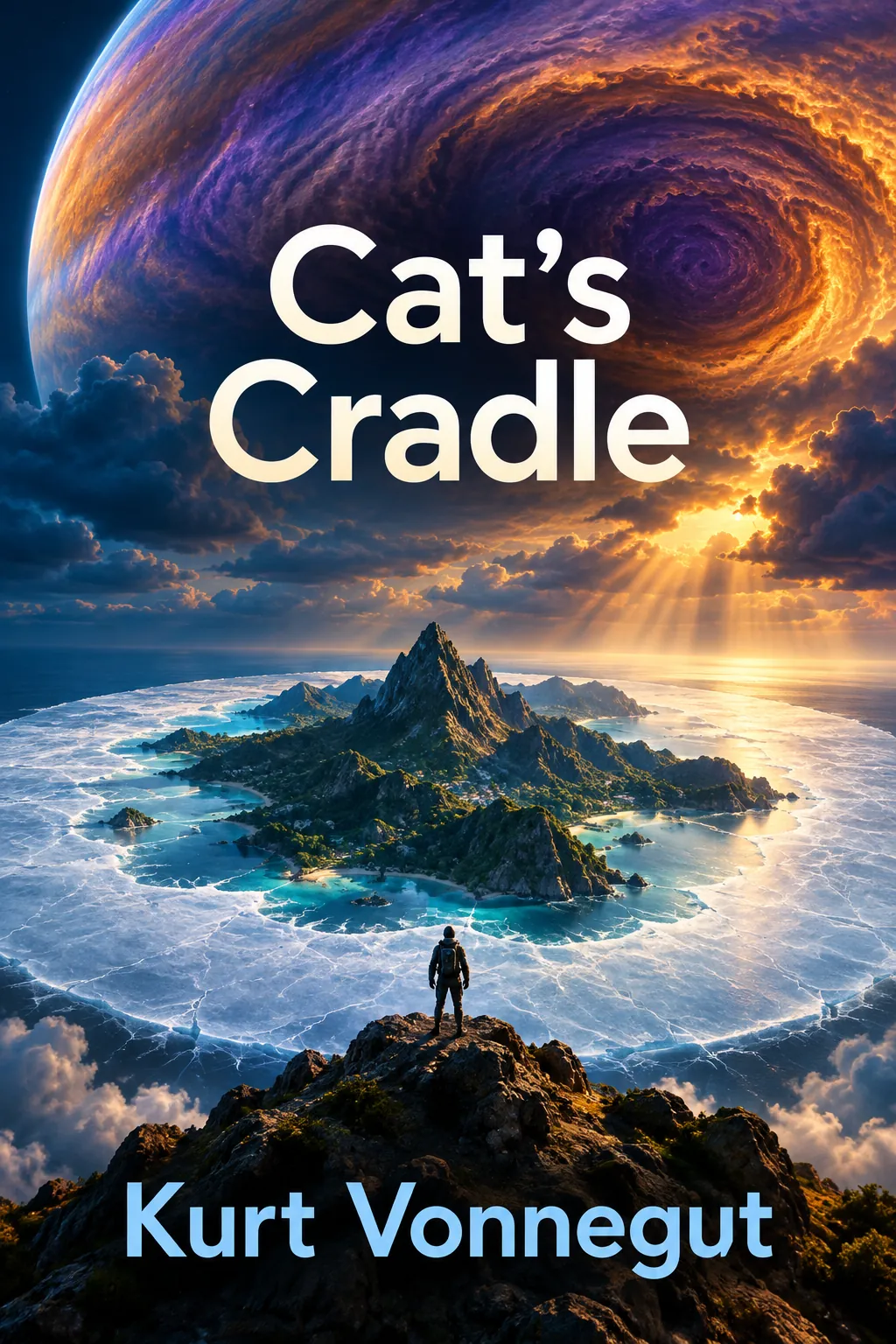
Cat's Cradle
Tác giả: Kurt Vonnegut
Cat's Cradle is Kurt Vonnegut's 1963 satirical novel about a writer who sets out to profile a dead scientist, one of the makers of the atom bomb, and ends up on a tiny Caribbean island ruled by a dictator and a banned religion. Along the way he learns about ice-nine, a substance the scientist left behind that could change the whole planet. The book is short, funny and very dark, and it asks what truth is worth when comforting lies work.
Ý Tưởng Chính
"A comic, bleak novel sets a religion built on harmless lies beside a real invention that can end the world. It asks how people live with the damage their own cleverness can cause."
Những Hiểu Biết Cốt Lõi
Science without conscience
Felix Hoenikker is not a monster. He is a brilliant, gentle man who never stops to ask what his discoveries will be used for, and that is exactly what makes him dangerous. The novel suggests that curiosity alone is not enough; knowledge needs someone to ask who will be hurt. The Hoenikker children, left with his leftovers, show how easily a dangerous idea passes from one careless person to the next.
On the day of Hiroshima, Felix is described playing with string in his study, as if the bomb were a distant puzzle, not a matter for his own family.
Useful lies (foma)
Bokonon calls harmless untruths foma and says that living by them can make people brave, kind and happy. He knows his religion is invented, yet it gives the starving people of San Lorenzo comfort and meaning that their government cannot. The book neither mocks nor fully endorses this view; it just shows that people need stories to live.
Bokonon and McCabe outlaw Bokononism on purpose so that the poor will feel their faith is brave and exciting.
Groups that are real and groups that are not
Bokononism separates a karass, a small group of people who are truly linked in doing God's work whether they know it or not, from a granfalloon, a false group such as a nation, a company or a school. The idea invites us to look at which of our loyalties are meaningful and which are mostly labels.
Jonah slowly realises that the Hoenikkers, Mona and Bokonon are all part of the same karass, even though the connections were invisible to him.
Fate and the limits of understanding
Bokononists whisper 'busy, busy, busy' whenever they think of how complicated and unpredictable the machinery of life is. The book treats the world as a set of connections no one can see all at once. That makes the disaster feel both accidental and weirdly inevitable, and it keeps the tone modest rather than preachy.
A dying dictator who swallows ice-nine, a ceremony and a plane that crashes into the palace happen together to end the world.
Dark humour as a way to look
Vonnegut writes in very short chapters and plain sentences, and he makes the reader laugh at things that are not funny. The jokes do not hide the horror. They give us a way to look at it for long enough to think, which is how the book gets its message across without lecturing.
Bokonon's closing wish to thumb his nose at God turns a world-ending scene into something between a joke and a prayer.
Tóm Tắt Chương
Chapter-by-chapter summary
Spoiler warning: this section covers the whole plot, including the ending. The book has 127 very short chapters, so they are grouped here into eight parts.
Part 1: A book about the day the world ended
The narrator, who tells us to call him Jonah, plans a book about the day the atom bomb fell on Hiroshima. He writes to people who knew Felix Hoenikker, one of the bomb's scientists, and visits the research laboratory where Hoenikker worked. Dr. Asa Breed describes a man who chased puzzles out of pure curiosity and never asked what they were for. Hoenikker's youngest son remembers his father playing with a loop of string on the day of Hiroshima. This sets up the book's first big question: what happens when brilliant people do not ask what their work will do?
Part 2: The family and ice-nine
Jonah meets two of Hoenikker's children, Angela and Newt, in the town of Ilium. They are lonely, odd adults who grew up around a father who barely noticed them. They tell him about ice-nine, a form of water that is solid at room temperature and turns any liquid water it touches into more ice-nine. Hoenikker had a piece of it when he died, and Angela, Frank and Newt each took a chip of it away in a thermos flask. This is the novel's ticking bomb, and the family's carelessness with it shows that the danger is ordinary people, not villains.
Part 3: Off to San Lorenzo
A magazine job sends Jonah to the Caribbean republic of San Lorenzo to write about the famous jungle hospital of Julian Castle. On the plane he meets the new American ambassador, Horlick Minton, and a bicycle maker, H. Lowe Crosby. He learns that Frank Hoenikker, the middle child, is now an important official there, and he first hears of Bokononism, a forbidden religion. The new religion comes with its own words, such as karass and foma, and gives the story its strange comic voice.
Part 4: A law against the only comfort
San Lorenzo is poor, hungry and run by a dictator called Papa Monzano. Practising Bokononism is punishable by death on the hook, yet nearly everyone practises it. Jonah learns that Bokonon and his friend Earl McCabe once washed up there and planned a better society, then made the religion illegal so that it would feel exciting and give the poor hope. Jonah also meets Mona, Papa's adopted daughter, and falls in love. The chapters show how a useful lie can hold a hopeless place together.
Part 5: An offer of power
Frank, who has the title Minister of Science and Progress, tells Jonah that Papa is dying and offers him the presidency. Jonah accepts once he is promised Mona as his bride. In the same stretch he sees the island's grim reality and the shabby flag-waving of its official ceremonies. The offer is a sour joke: power on San Lorenzo is a job nobody sensible wants, handed out almost at random, which echoes how carelessly the world treats the most dangerous things.
Part 6: The Hundred Martyrs to Democracy and the end of the sea
Papa Monzano, dying, swallows ice-nine and his body turns solid. Frank admits that he gave Papa his own piece of it, and he and Jonah cover up the body. Next comes the ceremony for the Hundred Martyrs to Democracy. Ambassador Minton sets aside his prepared words and attacks the kind of patriotism that glorifies war dead. During the flight display that follows, a plane catches fire and crashes into the rocks above the palace. The castle breaks apart and falls into the sea, carrying Papa's frozen body with it, and the Mintons die. The sea freezes, then the rivers and the rain. One accident ends the world's water, and the book never raises its voice.
Part 7: The survivors
Jonah and Mona survive in a bomb shelter under Papa's palace. When they climb out after days of storms, the world is frozen and almost everyone is dead. On Mount McCabe they find San Lorenzans who killed themselves by touching ice-nine to their lips, following Bokonon's advice. Mona does the same. Later H. Lowe Crosby, his wife Hazel and Newt find Jonah, and the survivors, including Frank, live together for about six months while Jonah writes the book we are reading. The scene is quiet rather than loud, which makes it hit harder.
Part 8: Bokonon at the end
Jonah sees Bokonon on a rock, writing the last page of his books. Bokonon says that if he were younger he would write a history of human stupidity, lie on top of the mountain with the book as a pillow, thumb his nose at God and die. The last mood is dark and funny at once, and it leaves us with the idea that humans are small, foolish and still worth a joke.
Characters
The narrator (Jonah, or John)
A writer who tells the story in the first person. He is curious, easy-going and a Bokononist by the end. He wants to write about Hoenikker and instead lives through the disaster.
Felix Hoenikker
A famous physicist, one of the makers of the atom bomb. He is gentle, distracted and absorbed in puzzles, and he never accepts responsibility for what his inventions do. He is dead before the story starts but shapes everything.
Angela Hoenikker
Felix's tall, unhappy daughter, who was made to take care of the household after her mother died. She marries badly and is obedient to the end.
Newt Hoenikker
The youngest son, a very small man with a sharp, bitter sense of humour. He remembers his father with the string and gives Jonah some of the clearest information about ice-nine.
Frank Hoenikker
The middle son, an inventor and a quiet, nervous man who becomes a leader in San Lorenzo. He wins his place as Papa's successor by giving Papa a piece of his ice-nine, and later helps Jonah cover up Papa's frozen body.
Bokonon
The founder of Bokononism, a gentle, funny old man who writes calypsos and hides in the jungle. He admits his religion is made of lies, and he uses it to make people brave and kind.
Papa Monzano
The dictator of San Lorenzo, a fearful man who rules with violence. Dying of illness, he swallows the ice-nine Frank gave him, and his frozen body falls into the sea with the collapsing castle, which sets off the end of the world.
Mona Aamons Monzano
Papa's adopted daughter, serene and loved by almost everyone. She is a devoted Bokononist and teaches Jonah its customs. She is the book's kindest, most hopeful character.
Julian Castle
A wealthy former playboy who now runs a hospital in the jungle. He is wry and tired, and he sees clearly that his good work cannot fix the island's real problems.
Writing about this book
The most useful way into Cat's Cradle is to choose one question and test it against a scene. You could ask whether Bokonon is right to lie to help people. Or you could ask who is to blame for ice-nine: Felix, his children, Papa Monzano or the governments that wanted weapons. A third idea is the title itself. The cat's cradle is a game in which there is no cat and no cradle, only a tangle of string, and the book suggests that many human beliefs work in the same way.
Pick one scene as evidence, such as the dying Papa, the Hoenikker children or the final talk with Bokonon, and say clearly what it shows. Then explain whether you agree with the book's view. Remember that the narrator is funny but not always reliable, so check which opinions come from Vonnegut's characters and which come from the story itself. A strong answer compares the book's jokes with the facts of the nuclear age, rather than treating it as only a joke book.
Hành Động Ngay
Các bước thực tế bạn có thể thực hiện ngay hôm nay:
-
Ask what your work, or the thing you are good at, could be used for by other people.
-
Notice which groups you belong to by label and which you belong to by real connection.
-
Treat comforting stories carefully: ask who benefits from them and what they cost.
-
When the news is grim, try plain, dry humour to see the problem clearly without shutting down.
Trích Dẫn Đáng Nhớ
"“All of the true things that I am about to tell you are shameless lies.” (Chapter 4)"
— Kurt Vonnegut
"“Peculiar travel suggestions are dancing lessons from God.” (Chapter 31)"
— Kurt Vonnegut
"“Busy, busy, busy.” (Chapter 32)"
— Kurt Vonnegut
Ai Nên Đọc Cuốn Này
Readers aged about 15 and up who like short, sharp satire, and students studying Cold War, nuclear-age or science-ethics themes. It suits high school and university literature classes, and anyone who wants a quick entry point to Kurt Vonnegut before Slaughterhouse-Five.
Về Kurt Vonnegut
Kurt Vonnegut (1922–2007) was an American novelist born in Indianapolis. He served in the US Army in World War II and survived the Allied bombing of Dresden as a prisoner of war. That experience shaped his dark, funny, short-sentenced fiction, including Slaughterhouse-Five and Cat's Cradle.
Tóm Tắt Được Viết Bởi

Kỹ sư phần mềm & Nhà văn
Kỹ sư phần mềm với niềm đam mê chuyển đổi ý tưởng phức tạp thành hiểu biết thực tiễn. Viết về tài chính, đầu tư, khởi nghiệp và công nghệ.
Xem tất cả tóm tắt →Đánh Giá
Chưa có đánh giá nào. Hãy là người đầu tiên chia sẻ suy nghĩ của bạn!
Viết Đánh Giá
Đọc tiếp
Khám phá chủ đề: Khoa học viễn tưởngTóm tắt sách

Tóm Tắt Sách Vượt Qua Giới Hạn (Out of My Mind)
Sharon M. Draper
“Out of My Mind” by Sharon M. Draper is a poignant narrative that explores the life of Melody Brooks, a…

Tóm Tắt Sách Ender’s Game
Orson Scott Card
“Ender’s Game” by Orson Scott Card is a riveting science fiction novel that transports readers into a future where humanity…

Tóm Tắt Sách Pachinko (Pachinko)
Min Jin Lee
“Pachinko”, a spellbinding multigenerational historical saga by Min Jin Lee, explores the lives of a Korean family trying to make…

Tóm Tắt Sách Những Ưu Ái Của Kẻ Vô Hình (The Perks of Being a Wallflower)
Stephen Chbosky
The Perks of Being a Wallflower by Stephen Chbosky is a profound coming-of-age novel, told through the intimate letters of…
Bài Viết

Chủ đề A Christmas Carol: lòng hào phóng, sự cô lập và trách nhiệm
Truyện ngắn của Dickens thường được đọc như câu chuyện về một người đàn ông thay đổi suy nghĩ. Nhưng…

Giải Nebula là gì? Các tác phẩm đoạt giải Nebula nổi bật
Giải Nebula là giải thưởng khoa học viễn tưởng và giả tưởng của Mỹ, do chính các nhà văn đang…

Giải thưởng Seiun
Giải thưởng Seiun là giải khoa học viễn tưởng lâu đời nhất Nhật Bản, được trao lần đầu năm 1970.…