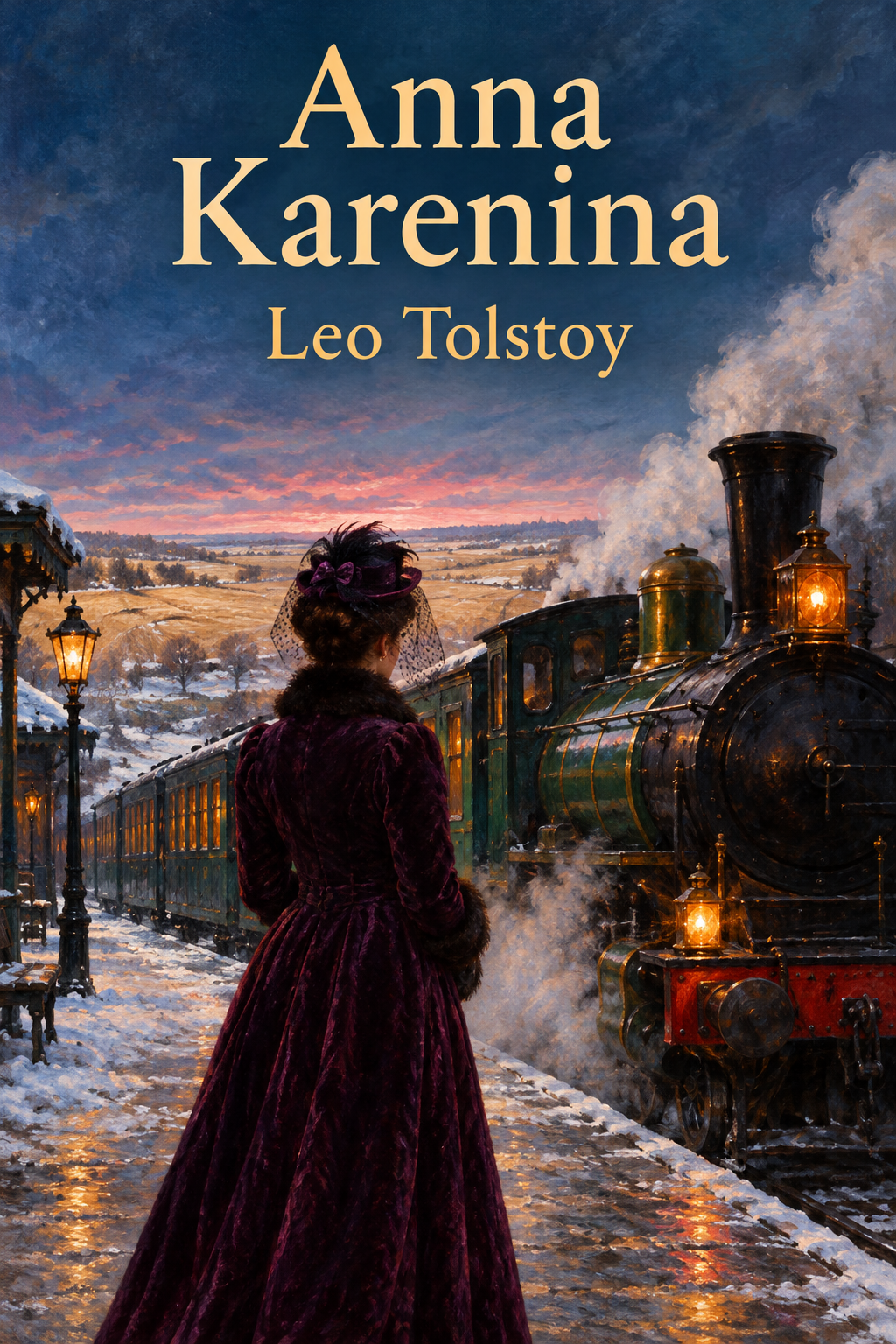
Anna Karenina
Tác giả: Leo Tolstoy
Anna Karenina is a Russian novel about a married woman in 1870s high society who falls in love with a young officer, Count Vronsky, and is pulled between desire, duty and her son. A second story runs beside hers: the landowner Konstantin Levin, awkward and sincere, tries to win Kitty, run his farm and make sense of faith and death. Tolstoy sets the two stories side by side, asking what makes a life honest, and what a person owes to love and to others.
Ý Tưởng Chính
"Anna Karenina follows two lives at once: Anna, who risks everything for passion in a society that punishes women for it, and Levin, who searches for an honest way to live, love and believe."
Những Hiểu Biết Cốt Lõi
The same act, judged differently
Stiva’s affair and Anna’s love both break the marriage vow, yet Stiva is soon welcomed back at every table while Anna slowly loses her place in society. Tolstoy does not lecture about this. He lets scenes show how a society can weigh the same act differently for a man and a woman. That is one of the book’s central questions: who gets forgiven, and who decides?
In the Part 5 theatre scene, women openly show scorn for Anna, while Vronsky is still received without trouble.
Two lives, one question
Anna tries to find fulfilment through love alone, and gradually her whole life depends on another person’s feelings. Levin looks for meaning in work, family and faith. The two stories mirror each other, and Tolstoy gives both equal weight instead of declaring a winner. Moving between them, the reader sees the shared question underneath: what can a person build a life on? That is why the novel reads like one long conversation between two answers.
In Part 4, Anna leaves Russia for Italy while Levin becomes engaged to Kitty, two opposite moves in the same part.
Meaning in daily work
Levin cannot think his way to the meaning of life. Yet when he mows hay beside the peasants, his thoughts quieten and time seems full. Later, after his brother’s death, even work feels empty. The contrast suggests that meaning grows from effort, people and ordinary duties as much as from ideas. Tolstoy still refuses to offer a formula, and shows Levin’s doubts as they are.
Compare the mowing scene in Part 3 with Levin’s recovery after his talk with a peasant in Part 8.
The difficulty of judging
The novel opens with the epigraph “Vengeance is mine; I will repay,” a biblical line often read as a warning against judging others. Tolstoy shows Anna, Karenin and Vronsky from the inside, with their reasons and weaknesses, so readers cannot comfortably decide who the villain is. Finishing the book, you may notice how hard it is to condemn anyone once you understand how they got there.
In Part 6, Dolly sees both Anna’s charm and her anxiety, and looks at her with sympathy instead of blame.
Tóm Tắt Chương
Chapter-by-chapter summary
Spoiler warning: this section covers the whole plot, including the ending. The novel has eight parts and over two hundred short chapters, so this guide goes part by part.
Part 1: A Broken Household and a Fatal Meeting
In Moscow, Stiva Oblonsky has been caught cheating on his wife, Dolly, and the household is falling apart. His sister Anna comes from Petersburg to help patch things up. At the same time, the country landowner Levin arrives to propose to Dolly’s younger sister Kitty, but Kitty turns him down because she is waiting for the dashing officer Vronsky to ask her. At the railway station, Anna meets Vronsky, and a worker is killed by a train while they are there. At a ball, Vronsky dances with Anna and ignores Kitty, who is crushed. Anna returns to Petersburg and Vronsky follows her. Why it matters: both plots begin here, and the train becomes a symbol that Tolstoy keeps returning to.
Part 2: Passion and Public Scandal
Kitty falls ill and her parents take her abroad to a spa, while Levin goes back to his estate. In Petersburg, Anna and Vronsky become lovers. Her husband, Karenin, a senior government official, warns her only about gossip, not about her feelings. At a steeplechase, Vronsky’s mare Frou-Frou falls and is badly injured, and Anna reacts so openly that Karenin notices. On the drive home she tells him the truth. He answers coldly and asks only that appearances be kept up. Why it matters: the race shows Vronsky’s recklessness, and Karenin’s reply shows how much he values form over feeling.
Part 3: The Farm and the Forbidden Affair
Levin throws himself into running his farm and thinking about Russian peasants. In a famous scene he mows hay alongside his workers and feels a rare, simple happiness. He visits Dolly and tries to forget Kitty, but a glimpse of her carriage on the road shows him that he still loves her. In Petersburg, Karenin refuses to separate from Anna and warns that he will take their son Seryozha if the affair goes on. Why it matters: honest work and love on the land are set against a marriage held together by appearances and threats.
Part 4: Illness, Forgiveness and Flight
Karenin asks a lawyer about divorce, but under the law of the time the evidence he holds, Vronsky’s love letters, is not enough. Anna gives birth to Vronsky’s daughter and nearly dies; at her bedside Karenin forgives Vronsky. Vronsky, ashamed, tries to end his life and survives. When he is posted to Tashkent, Anna leaves with him for Italy and leaves Seryozha behind. Meanwhile Stiva brings Levin and Kitty together, and they become engaged. Why it matters: one couple leaves society behind, while the other enters its most traditional promise.
Part 5: Marriage and Exile
Levin and Kitty marry, and their first months are awkward and full of quarrels. When Levin’s brother Nikolai is dying of consumption, Kitty nurses him calmly, and Levin sees her strength. Kitty becomes pregnant. In Italy, Anna and Vronsky live cut off from friends, and Vronsky grows bored. Back in Petersburg, Anna is shut out of society while Vronsky is still welcome. She secretly visits Seryozha on his birthday and Karenin finds out. At the theatre, women openly snub her, and the couple retreat to Vronsky’s country estate. Why it matters: two very different marriages show how love can deepen in one home and turn into isolation in another.
Part 6: Summer in the Country
Dolly spends the summer with her children and her mother at Levin and Kitty’s house. Levin grows jealous when the guest Veslovsky flirts with Kitty, and he asks him to leave; Veslovsky goes to stay with Anna and Vronsky. Dolly visits Anna’s luxurious estate and senses anxiety under the comfort. Vronsky asks Dolly to persuade Anna to seek a divorce. When Vronsky leaves for the provincial elections, Anna is eaten up by jealousy and writes to Karenin asking for a divorce. The couple then move to Moscow. Why it matters: Anna’s world is getting smaller while her fear of losing Vronsky grows.
Part 7: Moscow and the Station
Levin goes to Moscow for the birth of his child and is drawn into the city’s expensive social life. He visits Anna, is charmed by her, and Kitty becomes suspicious, but they make peace. Kitty gives birth to their son Mitya after a hard labour. Anna has come to depend on morphine and suspects that Vronsky will marry someone else. Stiva asks Karenin for a divorce in which Anna is not blamed, but Karenin refuses on the advice of a French clairvoyant. After a bitter quarrel, Anna sends Vronsky a telegram, visits Dolly and Kitty, and then throws herself under a freight train at a station. Why it matters: Tolstoy brings back the image of the train from the first part, with a very different meaning.
Part 8: After Anna
Sergei Koznyshev’s book is ignored, and he turns to the Pan-Slavic cause. Stiva gets the post he wanted, and Karenin takes in Anna’s daughter, Annie. Vronsky joins the Russian volunteers fighting in Serbia. Levin, after Nikolai’s death, struggles with the meaning of life and has dark thoughts. A talk with a peasant about living for one’s soul and for God gives him a new direction. During a thunderstorm, afraid for Kitty and the baby, he realises how much his son already means to him. He accepts that he will keep making mistakes but that his life can still be turned toward what is good. Why it matters: the book ends not with a solved puzzle but with a quiet decision.
Characters
- Anna Karenina: The heroine: intelligent, charming and emotionally intense, married to a senior official and mother of Seryozha. She comes to Moscow to repair her brother’s marriage and ends up changing her own life. Tolstoy shows both her warmth and her growing torment.
- Count Alexei Vronsky: A rich, handsome cavalry officer who first courts Kitty, then falls for Anna. He is brave and loyal in his way, but proud and restless, and he struggles to understand how much Anna gives up for him.
- Alexei Karenin: Anna’s husband, a senior government official, orderly, formal and uneasy with feelings. He cares about reputation and rules, and the book lets us see his hurt as well as his coldness.
- Konstantin Levin: A sincere, awkward country landowner and old friend of Stiva. He cares about his farm, about the peasants, and about big questions of faith and death. Many readers see him as partly modelled on Tolstoy himself.
- Kitty Shcherbatskaya: Dolly’s younger sister, who refuses Levin because she hopes for Vronsky, and is badly hurt when he turns to Anna. Illness and disappointment make her stronger, and she later marries Levin.
- Stiva Oblonsky: Anna’s charming, easygoing brother, a government official who loves good food and company. His affair sets the story in motion, yet he stays popular, a contrast to how Anna is treated.
- Dolly Oblonskaya: Stiva’s wife and Kitty’s older sister. Worn down by money worries and many children, she must decide whether to forgive her husband. She becomes one of the book’s most humane observers.
- Seryozha: Anna and Karenin’s young son. He adores his mother, and being separated from her is one of the heaviest costs of Anna’s choice. His birthday visit in Part 5 is one of the book’s most tender scenes.
- Countess Lidia Ivanovna: A society woman with strong religious views who becomes Karenin’s close adviser after Anna leaves. She shapes his decisions and shows how piety can be mixed with social power in this world.
- Sergei Koznyshev: Levin’s well-known half-brother, a writer and thinker who likes talking about ideas, public causes and politics, while Levin prefers practical life. Their conversations show two ways of looking at the same country.
Writing about this book
For an essay or a book-club talk, start from a question rather than a plot summary. These questions give you plenty to work with:
- Why does Tolstoy pair Anna’s story with Levin’s? What does each of them want that the other already has?
- Stiva and Anna break the same marriage vow but are treated differently. Why, and does anything like that still happen today?
- Where does Tolstoy invite sympathy for Karenin, and where does he take it away?
- Trains, horses and the countryside seem to mean more than the events around them. What might they stand for?
A simple plan: pick one scene, such as the steeplechase, the mowing or the theatre snub; explain what the characters feel and choose in it; then link it to one theme. Use your own words and keep quotes short. The novel does not give one neat answer, so writing about what puzzled you is a perfectly good way to begin.
Hành Động Ngay
Các bước thực tế bạn có thể thực hiện ngay hôm nay:
-
Notice when a society’s rules fall unevenly on different people, and ask who benefits from those rules.
-
The book suggests that resting your whole sense of worth on one person’s feelings is a fragile way to live.
-
Like Levin, look for meaning in useful work and the ordinary duties of family and friendship.
-
Before judging someone, try to imagine their situation from the inside, as Tolstoy does with every character.
Trích Dẫn Đáng Nhớ
"“All happy families resemble one another, but each unhappy family suffers in its own particular way.” (Part 1, Chapter 1)"
— Leo Tolstoy
"“Everything had fallen into confusion in the Oblonskys’ house.” (Part 1, Chapter 1)"
— Leo Tolstoy
"“Vengeance is mine; I will repay.” (Epigraph)"
— Leo Tolstoy
Ai Nên Đọc Cuốn Này
Readers aged about 16 and up who want a big, character-driven classic. It suits literature students, book-club readers and anyone preparing for a course on the Russian or nineteenth-century realist novel. The book is long and has many Russian names, but the story is easy to follow once you sort the characters into their households, which this guide helps with.
Về Leo Tolstoy
Leo Tolstoy (1828–1910) was a Russian novelist and moral thinker born into a landowning noble family. He wrote War and Peace and Anna Karenina, which first appeared in instalments in 1875–77. In later life he turned to questions of faith, ethics and simple living, and his ideas reached readers and reformers around the world.
Tóm Tắt Được Viết Bởi

Kỹ sư phần mềm & Nhà văn
Kỹ sư phần mềm với niềm đam mê chuyển đổi ý tưởng phức tạp thành hiểu biết thực tiễn. Viết về tài chính, đầu tư, khởi nghiệp và công nghệ.
Xem tất cả tóm tắt →Đánh Giá
Chưa có đánh giá nào. Hãy là người đầu tiên chia sẻ suy nghĩ của bạn!
Viết Đánh Giá
Đọc tiếp
Khám phá chủ đề: Truyện hư cấuTóm tắt sách

Tóm Tắt Sách Vượt Qua Giới Hạn (Out of My Mind)
Sharon M. Draper
“Out of My Mind” by Sharon M. Draper is a poignant narrative that explores the life of Melody Brooks, a…

Tóm Tắt Sách Ender’s Game
Orson Scott Card
“Ender’s Game” by Orson Scott Card is a riveting science fiction novel that transports readers into a future where humanity…

Tóm Tắt Sách Pachinko (Pachinko)
Min Jin Lee
“Pachinko”, a spellbinding multigenerational historical saga by Min Jin Lee, explores the lives of a Korean family trying to make…

Tóm Tắt Sách Những Ưu Ái Của Kẻ Vô Hình (The Perks of Being a Wallflower)
Stephen Chbosky
The Perks of Being a Wallflower by Stephen Chbosky is a profound coming-of-age novel, told through the intimate letters of…
Bài Viết
Thời Khai sáng là gì? Ý tưởng, nhà tư tưởng và di sản
Khai sáng là phong trào tư tưởng châu Âu thế kỷ 18, đề cao lý tính và bằng chứng hơn…
Lịch sử thế giới 1700–1918: Cách mạng, công nghiệp, đế quốc và chiến tranh
Từ 1700 đến 1918, cách mạng, nhà máy, đế chế và một cuộc chiến tranh thế giới đã định hình…

Chủ đề A Christmas Carol: lòng hào phóng, sự cô lập và trách nhiệm
Truyện ngắn của Dickens thường được đọc như câu chuyện về một người đàn ông thay đổi suy nghĩ. Nhưng…