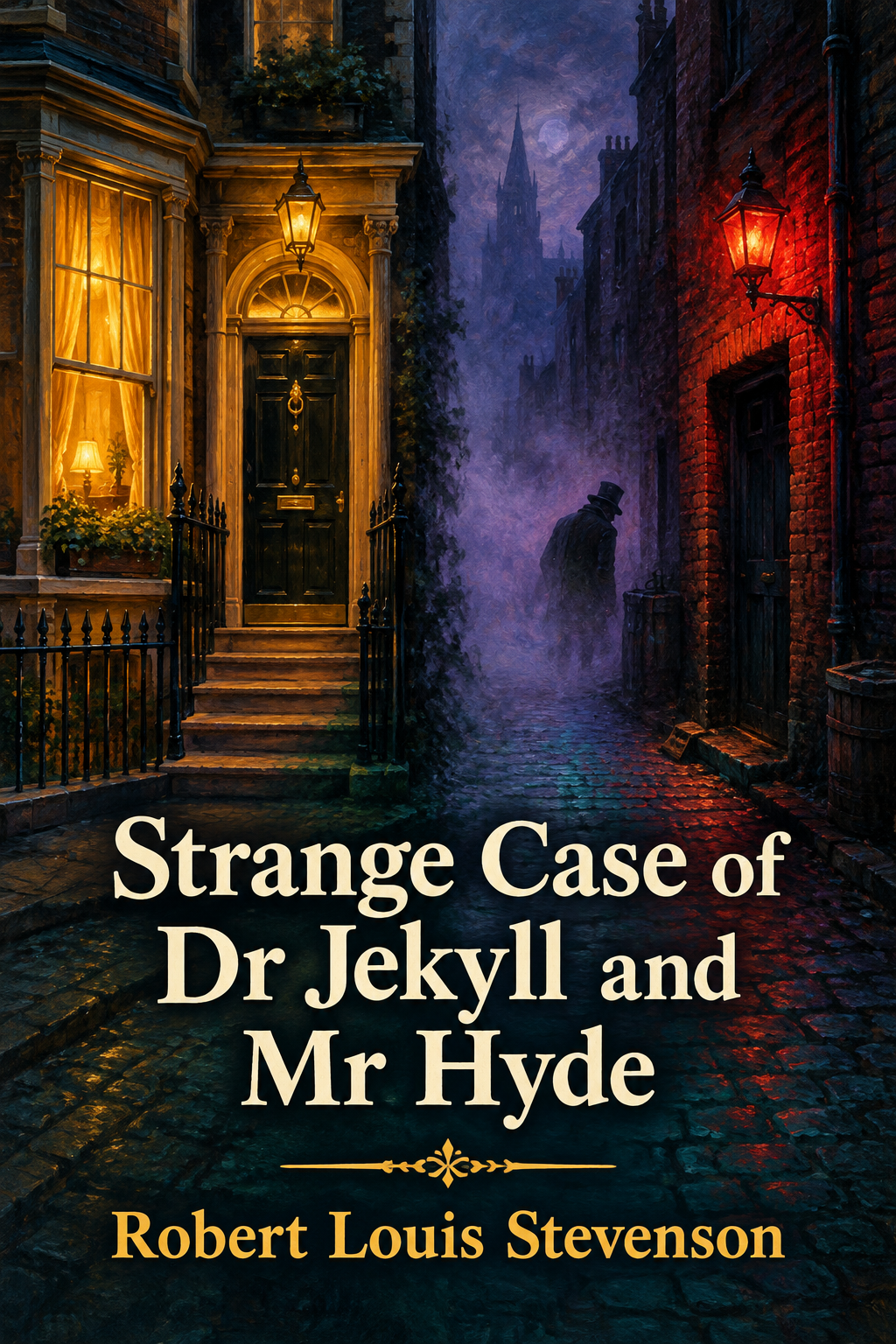
Strange Case of Dr Jekyll and Mr Hyde
par Robert Louis Stevenson
This Dr Jekyll and Mr Hyde summary covers a Victorian mystery about Mr Utterson, a careful London lawyer who fears for his old friend Dr Jekyll. Rumours circle about a violent, unpleasant man named Hyde who seems to have a strange hold over Jekyll. As troubles pile up in the foggy city, Utterson sets out to find the truth. It is short, tense and still gripping more than a century after it was published.
L'idée principale
"The book asks what respectable society hides behind its front doors, and what a loyal friend owes someone whose conduct no longer makes sense."
Aperçus clés
Reputation and respectability
Victorian society judged people by their public face, and this novella shows how much effort goes into protecting a good name. Utterson and Enfield would rather keep a disturbing story private than risk gossip, even when a young girl has been hurt. The book asks whether reputation can hide real harm, and whether a polite surface is ever a fair test of character. Readers are invited to notice how easily respectability becomes a reason to look away.
After Enfield tells his story, the two men agree never to mention it again, keeping the trouble out of sight.
The limits of knowing someone
Utterson is a careful man, but he still feels driven to pry into his friend's affairs. The story asks how well anyone can truly know another person, even someone trusted for decades. The mystery lives in the gap between what people show and what they keep hidden. Readers share Utterson's position: they only see what the characters choose to reveal, and must piece the rest together from clues and documents.
Utterson waits by a door on a dark street, hoping to see the man who has come to hold such power over his friend.
Loyalty and duty
Utterson keeps his word even when he dislikes what he is asked to do. His loyalty to Jekyll shapes almost every choice he makes, and it gives the story a quiet moral centre. The novella suggests that loyalty can be a virtue and a trap at the same time. Faithfulness keeps him close to the mystery, yet it also limits how far he is willing to go in asking uncomfortable questions.
Jekyll asks him to look after Hyde's interests when Jekyll is no longer here, and Utterson agrees, though not gladly. The promise shapes the rest of his choices.
Public face and private life
The book keeps returning to the gap between how people appear and how they really are. It asks how far a public image can be trusted, and whether a polished surface ever tells the whole story. The question still feels close to home, because most of us keep public and private lives that do not always match. Readers are left to judge each character by what they show, and by what the documents reveal later.
Utterson's calm, reasonable manner sits uneasily beside events he cannot explain, and that gap is where the theme lives.
Détail des chapitres
Chapter-by-chapter summary
Spoiler warning: this section covers the whole plot, including the ending.
Chapter 1: Story of the Door
Mr Utterson, a reserved lawyer, goes for a walk with his cousin Enfield. Enfield describes a night when a small, unpleasant man named Hyde knocked a young girl down in the street and trampled over her. Hyde then paid her family with a cheque signed by a gentleman of standing, and Enfield will not say who signed it. Enfield also points out a door on a dark street that Hyde went into. The two men agree never to mention the matter again, yet Utterson cannot let the story go. The chapter sets up the puzzle that drives the book: who is the respected man behind that cheque, and what is his link to Hyde?
Chapter 2: Search for Mr Hyde
Utterson studies the will of his friend Dr Henry Jekyll. It leaves everything to Edward Hyde if Jekyll dies, or if he disappears for more than three calendar months. Troubled, the lawyer goes looking for Hyde and waits by the door Enfield showed him. Eventually he meets Hyde face to face, and the encounter leaves him uneasy, though he cannot say exactly why. Later, Jekyll's butler, Poole, tells him that Mr Hyde has a key to the house. The chapter moves Utterson from simple curiosity to real concern for his friend. Hyde now seems a genuine threat, and Utterson's sense of duty grows with every new detail.
Chapter 3: Dr Jekyll Was Quite at Ease
Utterson raises the will with Jekyll directly. Jekyll refuses to talk about Hyde and seems calm, almost untroubled. He asks Utterson to help Hyde once Jekyll is no longer here or is taken away, and Utterson reluctantly agrees. Jekyll's ease is what unsettles Utterson most. He has no proof of anything, and a friend's calm is hard to challenge without evidence. The conversation shows how much Utterson values the friendship, and how little he can do with a suspicion alone. He leaves the house with his doubts intact, and the reader is left with the same unease.
Chapter 4: The Carew Murder Case
A maid sees a violent attack from her window. Sir Danvers Carew, a man of high position, is beaten to death in the street by Hyde, who uses a heavy walking stick. The murder shocks the city. Police bring the broken stick to Utterson, who recognises it as one he once gave to Jekyll. In Hyde's rooms, officers find clothes flung about and a pile of grey ashes, as though many papers had been burned. They also find the other half of the stick and the stub of a green cheque-book. Hyde himself cannot be found, so the hunt passes to the police. Utterson now has clear reason to fear for his friend. What began as a strange story has become a criminal case.
Chapter 5: Incident of the Letter
Jekyll gives Utterson a letter written by Hyde. In it, Hyde says he has means of escape he can rely on, and Jekyll asks Utterson to decide what to do with it. Utterson shows the note to his head clerk, Mr Guest, who compares it with a dinner invitation written by Jekyll. Guest notices a striking resemblance: the two hands are alike in many points, though they slope differently. Utterson tells Guest to say nothing, and that night he locks the note in his safe. The chapter is short, but it tightens the mystery. The handwriting clue hints at a link between Jekyll and Hyde that Utterson is not yet ready to name.
Chapter 6: Remarkable Incident of Dr Lanyon
Jekyll shuts himself away and rarely sees his old friends, Utterson included. Dr Hastie Lanyon, another old friend and a respected physician, is struck by a shock he never recovers from. He grows ill and dies within weeks. Before his death he leaves Utterson a sealed envelope, with instructions that it must not be opened until Jekyll dies or disappears. Utterson keeps the envelope and honours the request, even though it leaves him waiting. Lanyon's death makes the mystery personal and serious, and the sealed envelope sets up the written accounts that carry the story from here on.
Chapter 7: Incident at the Window
Utterson and Enfield take another walk and pass the courtyard beside Jekyll's house. Looking up, they see Jekyll sitting at a window, pale, terrified and despairing, like a man shut in. He does not come down to them, and the two men walk on, shaken. Neither can forget the look on his face. The scene is short but powerful, because a respected gentleman appears trapped in full view of his friends. For Utterson, it is a sign that something is badly wrong, even if he still cannot say what it is. The image pushes the story towards its final revelations.
Chapter 8: The Last Night
Poole, Jekyll's butler, arrives at Utterson's home in a state of fear. He says the voice he has been hearing from the laboratory is not his master's, and he believes something terrible has happened. Utterson and Poole go to the laboratory and force the door. Inside, they find a dead man, wearing clothes far too large for him, who has taken poison. It is Edward Hyde. Jekyll is nowhere to be found, but papers left in the room in the doctor's hand begin to explain what has happened. The chapter is grim and quiet, and it moves the story into its final pages.
Chapter 9: Dr Lanyon's Narrative
This chapter is Dr Lanyon's own account, written before his death and meant to be read only afterwards. He describes a letter from Jekyll, asking him to fetch a drawer of chemicals from the laboratory and to receive a visitor late at night. Lanyon does as he is asked, though the request puzzles him. The visitor mixes the chemicals, drinks the mixture in one gulp, and changes before Lanyon's eyes into Henry Jekyll. Lanyon never recovers from what he has seen. Here the long mystery of Hyde finally gets its answer: Hyde and Jekyll are one man.
Chapter 10: Henry Jekyll's Full Statement of the Case
The final chapter is Jekyll's own long statement. He begins with his birth into a large fortune and his talents, then describes his fascination with the divided nature of people, the good and the evil that sit side by side within each of us. He tells how a potion let him take on a separate form. That form, Hyde, grew stronger over time, and the changes came without warning and beyond his control. Jekyll writes that this is his true hour of death, and that he is bringing the life of Henry Jekyll to an end. The chapter is the tragic core of the book, and it asks whether anyone can truly separate their darker self from the rest of their life.
Characters
- Mr Utterson: A reserved lawyer and loyal friend of Dr Jekyll. He is careful with his words and rarely shows strong feeling, yet he refuses to abandon his friend, even when he suspects that something is badly wrong. He is the reader's guide through the mystery.
- Dr Henry Jekyll: A respected London doctor and gentleman, admired by his friends and the wider city. His calm and orderly manner makes his later withdrawal all the more troubling to those who know him. He is the figure around whom the whole mystery turns, yet he speaks about it only in part, which keeps readers guessing.
- Edward Hyde: A small, unpleasant man at the heart of the mystery. People feel uneasy around him, and his hold over Dr Jekyll drives Utterson's investigation. Hyde's background is unclear, and the book keeps his true nature hidden for as long as it can.
- Richard Enfield: Utterson's cousin, who witnesses Hyde's cruelty in the opening chapter. He tells the story that starts the investigation, then agrees with Utterson to keep it private. He is a sensible, observant man who notices the door on the dark street and remembers it, which later gives Utterson a place to start looking.
- Dr Hastie Lanyon: A respected physician and old friend of both Jekyll and Utterson. He is a rational man of medicine, and he is badly shaken by a strange request and by what he sees on one night. He leaves a sealed account behind, which becomes one of the book's key documents.
- Poole: Jekyll's loyal butler, who grows increasingly worried about his master. He notices the strange voice from the laboratory and believes it does not belong to his master. In the later chapters he raises the alarm and leads Utterson to the laboratory, where his fear becomes a call to action.
Writing about this book
If you are writing a school essay on Dr Jekyll and Mr Hyde, choose one question and follow it through the text. You do not need to cover the whole novella. Three directions often work well:
- Reputation: how does Utterson's concern for his friend's good name shape what he does, and what does he avoid asking?
- Documents: why does Stevenson tell the story through several written accounts? What changes about how much you trust each narrator?
- Setting: how does the foggy London street help build the sense of threat?
Before you write, reread the first and last chapters and note how the tone changes. A strong essay usually takes a clear position, such as whether Utterson is a good friend or a passive one, and then tests that position against the evidence. Build your own argument, support it with a short quotation, and check chapter numbers in your edition, because page numbers differ between editions.
Passer à l'action
Étapes pratiques à mettre en œuvre dès aujourd'hui :
-
Look past reputation and appearance when judging people, and ask what you might be missing.
-
Think about what each character's silence protects, and who pays the price for keeping it.
-
When a story is told through several documents, compare each narrator's view to see what the author wants you to notice.
-
Check your own assumptions about people you think you know well, and notice what you have not asked them.
Citations notables
"“I let my brother go to the devil in his own way.” (Chapter 1)"
— Robert Louis Stevenson
"“If he be Mr. Hyde, I shall be Mr. Seek.” (Chapter 2)"
— Robert Louis Stevenson
"“I only ask for justice; I only ask you to help him for my sake, when I am no longer here.” (Chapter 3)"
— Robert Louis Stevenson
À qui s'adresse ce texte
This novella suits readers aged 14 and up, especially students of Victorian literature or high school English. It is also a good choice for anyone who enjoys gothic mysteries, short classics or psychological thrillers. The language is more formal than modern fiction, so expect some older vocabulary and a slow build before the reveal.
À propos de Robert Louis Stevenson
Robert Louis Stevenson (1850–1894) was a Scottish writer from Edinburgh, known for Treasure Island and Kidnapped. Strange Case of Dr Jekyll and Mr Hyde came out in 1886 and is short enough to read in a few sittings. Its title is now a common phrase for someone with a hidden, darker side. In his last years, Stevenson lived in Samoa, where local people called him Tusitala, or teller of tales.
Résumé écrit par

Software Engineer & Writer
Software engineer with a passion for distilling complex ideas into actionable insights. Writes about finance, investment, entrepreneurship, and technology.
Voir tous les résumés →Avis
Pas encore d'avis. Soyez le premier à partager vos impressions !
Écrire un avis
Continuer la lecture
Explorer le thème: FictionRésumés

Out of My Mind
Sharon M. Draper
« Out of My Mind » de Sharon M. Draper est un récit poignant retraçant le parcours de Melody Brooks,…

La Stratégie Ender
Orson Scott Card
« La Stratégie Ender » d'Orson Scott Card est un roman de science-fiction captivant qui plonge le lecteur dans un…

Pachinko
Min Jin Lee
Saga historique multigénérationnelle envoûtante, « Pachinko » de Min Jin Lee retrace le destin d'une famille coréenne naviguant entre tourments…

Le Monde de Charlie
Stephen Chbosky
Le Monde de Charlie, de Stephen Chbosky, est un roman initiatique poignant raconté à travers les lettres intimes de Charlie,…
Articles
Les Lumières expliquées : idées, penseurs et héritage
Le Siècle des Lumières est un mouvement intellectuel européen du XVIIIe siècle qui place la raison et les preuves au-dessus…
Histoire du monde 1700–1918 : révolutions, industrie, empires et guerre
De 1700 à 1918, révolutions, usines, empires et guerre mondiale ont remodelé les sociétés d'Europe, des Amériques, d'Asie et d'Afrique.…

Thèmes de Un chant de Noël : générosité, isolement et responsabilité
La novella de Dickens se lit souvent comme l'histoire d'un homme qui change d'avis. Ses thèmes sont plus tranchants :…