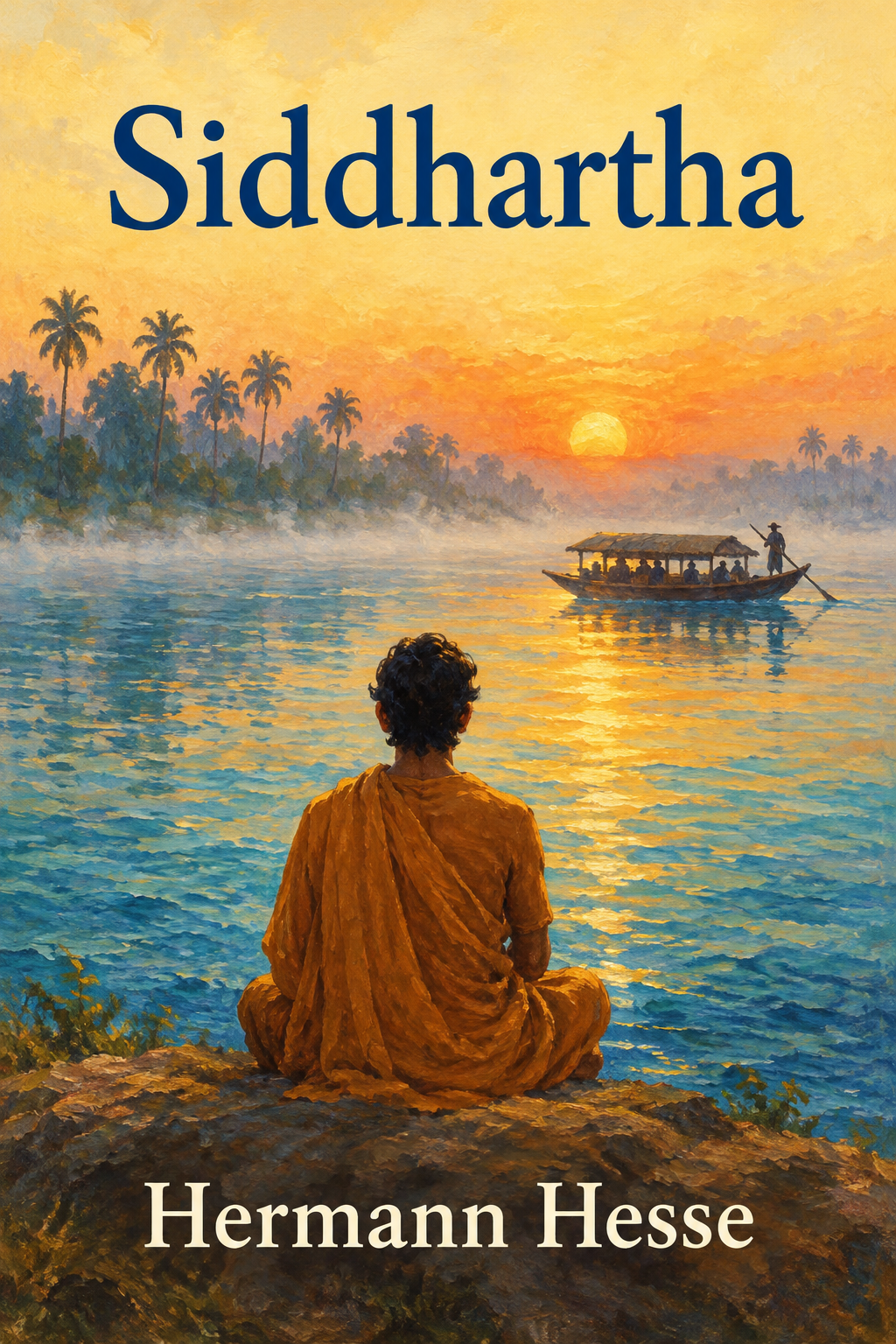
Siddhartha
par Hermann Hesse
This Siddhartha summary covers a novel about a young Brahmin's son in ancient India who leaves home to look for enlightenment. He joins ascetics, meets Gotama, the Buddha, and then chooses his own path, which takes him through love, business and a life of wealth. Along the way he learns that every path teaches something, but no teacher can give him the answer.
L'idée principale
"Siddhartha argues that wisdom cannot be handed from teacher to student; it has to be lived through, including the detours into pleasure, money and despair."
Aperçus clés
Wisdom cannot be handed over
Facts and rules can be passed from one person to another, but an understanding that changes how someone lives has to be found by that person. Siddhartha respects Gotama, yet he cannot take the answer from him. A teacher's words can light the way, but the walking is up to the learner.
A book on swimming can explain every stroke, but you only learn to swim by getting into the water. The novel makes the same point about wisdom.
Detours can still teach
The years Siddhartha spends in wealth and pleasure are not wasted. They are part of his search, because they show him what he does not truly want. The book does not treat worldly life as the enemy of wisdom.
Some people try several jobs before finding one that fits. Looking back, they may say the jobs that did not suit them taught them the most about what they value.
Listening is also learning
Vasudeva has learned from the river by listening to it closely for many years. The novel treats patient, attentive listening as a kind of wisdom that words cannot fully capture. Siddhartha learns from him that listening can matter more than speaking.
In a difficult meeting, the person who listens for the real worry, rather than the loudest argument, is often the one who finds a way through.
Running can still be running from yourself
Siddhartha first escapes his desires through discipline and then escapes emptiness through pleasure. Neither path lets him face what he really feels. The book suggests that honest self-examination is the real work.
Someone who works late every night to avoid a hard conversation, or who spends money to escape boredom, may be following the same pattern in a modern form.
Détail des chapitres
Chapter-by-chapter summary
Spoiler warning: this section covers the whole plot, including the ending.
The novel has two parts: four chapters in the first and eight in the second.
Chapter 1: The Son of the Brahman
Siddhartha is the son of a respected Brahmin in an ancient Indian town. He is clever and devout, has learned the sacred texts, and can already speak the sacred syllable Om silently. Still, he feels restless. He tells his father he wants to leave home with his friend Govinda and live as a seeker. His father says no, so Siddhartha stands in the same spot without moving until his father gives way. Why it matters: the book opens with a young man who has plenty of knowledge but has not yet found out whether it is truly his own.
Chapter 2: With the Samanas
Siddhartha and Govinda join a group of Samanas, wandering ascetics who try to free themselves from desire through fasting, self-denial and endurance. Siddhartha learns their discipline quickly and soon matches the most experienced of them. Then he realises that the discipline is another way of running, this time from the world and from himself. He has not yet found what he is looking for. Why it matters: the chapter shows that giving up pleasure can become its own trap, and it sets up the question of what he will try next.
Chapter 3: Gotama
Word spreads that Gotama, the Buddha, is teaching nearby. Govinda is moved by his words and decides to join Gotama's order. Siddhartha also meets Gotama, listens closely and respects him deeply. Yet he tells him that nobody will reach salvation by means of teachings alone, and he decides to go on alone. Govinda stays behind. Why it matters: this is the book's central tension. A teacher can show the way, but the student has to do the walking.
Chapter 4: Awakening
After leaving Gotama, Siddhartha falls into a deep emptiness. He sees that the teachings were good, but he had been looking for the answer outside himself, in rules and in teachers. He understands that he must learn from his own experience, mistakes included, and he sets out toward the towns. Why it matters: the question changes from which teacher to follow to how a person can learn for himself, which is a bigger and lonelier question.
Chapter 5: Kamala
In a town, Siddhartha meets Kamala, a courtesan admired for her beauty and wit. She teaches him the art of love and the manners of city life, and she points him toward Kamaswami, a wealthy merchant. Siddhartha learns trade quickly and begins to succeed. Why it matters: the ideas he took from ascetics and teachers now meet ordinary desire, pleasure and money, and the book begins to test them in daily life.
Chapter 6: With the Childlike People
Siddhartha lives among the townspeople, whom the book calls the childlike people. They chase pleasure, possessions and status. He copies their habits, enjoys rich food and comfort, and gradually loses the clarity he once had. He becomes respected and wealthy, yet he feels distant from himself. Why it matters: the chapter shows that success can absorb a person as easily as hardship can, and that prosperity does not answer the question of meaning.
Chapter 7: Sansara
Siddhartha goes deeper into a life of wealth and pleasure, and he takes up gambling. The title, Sansara, refers to the cycle of desire, suffering and rebirth in Indian thought. He starts to lose interest in everything he has built, and he feels sick at heart even surrounded by comfort. Nothing in his life is wrong on the surface, which makes the emptiness harder to explain. Why it matters: the chapter lets the reader feel the trap of always wanting more, which the earlier chapters only hinted at.
Chapter 8: By the River
In despair, Siddhartha goes to a river, and he is close to ending his life. At the water's edge, the sound of Om rises up inside him and his despair breaks. He sees that he has been running from himself, and he chooses to stop and listen instead of fleeing again. The river becomes the place where his old life ends and a quieter one begins. Why it matters: this is the turning point of the book, where the search moves from thinking to a real change of heart.
Chapter 9: The Ferryman
Siddhartha meets Vasudeva, an old ferryman who lives quietly by the river. Vasudeva does his work patiently, listens closely and has learned much from the water. Siddhartha asks to stay, and Vasudeva takes him on as a companion at the ferry. Over time Siddhartha starts to hear what the river says about time, change and unity. Why it matters: the teacher is now a man who does ordinary work with full attention, not a preacher.
Chapter 10: The Son
Years pass. Kamala arrives at the river with a young boy, their son, and she is bitten by a snake and dies there. The boy, used to comfort and luxury, cannot settle into life by the river and runs away. Siddhartha tries to hold on to him, but he cannot. Why it matters: the chapter brings back the love and grief that Siddhartha had tried to keep out of his thinking, and it tests what he has learned from the river.
Chapter 11: Om
Grieving, Siddhartha sits by the river and turns his attention to the sound of Om. He no longer tries to reason his way to peace. Instead he listens and lets the separate parts of his life settle into one whole, until his own pain seems to belong to the same whole as the world. Why it matters: this is the book's clearest image of unity, the idea that all living things are connected.
Chapter 12: Govinda
Many years later, Govinda, now an old monk, comes to the river and finds his old friend. Siddhartha tells him what he has learned: knowledge can be passed on, but wisdom has to be lived and found by each person. Govinda sees a quiet, kind smile on his friend's face and bows deeply before him. Why it matters: the novel ends by returning to its first question, what it means to really know something.
Characters
- Siddhartha: The Brahmin's son and the book's central figure. Clever, disciplined and restless, he tries asceticism, teaching, pleasure, wealth and finally the river. The novel follows him from confident certainty to doubt and then to a quieter kind of knowing.
- Govinda: Siddhartha's childhood friend, who travels with him and follows him into the life of the Samanas. He is devoted and loyal, and he chooses to stay with Gotama's teaching. His path is the mirror of Siddhartha's, and his visit at the end shows how far Siddhartha has come.
- Gotama: The Buddha, called Gotama in the novel. He teaches with calm authority, and Siddhartha respects him deeply. Yet Gotama's teaching cannot replace the experience Siddhartha needs, and that is why Siddhartha leaves.
- Kamala: A courtesan in the town who teaches Siddhartha the art of love and the ways of city life. She is a real person in the story, not only a figure of temptation, and she is the mother of Siddhartha's son.
- Kamaswami: A wealthy merchant who hires Siddhartha for his business. Siddhartha learns from him how the trade world works, and later sees how empty a life measured only in money and success can be.
- Vasudeva: An old ferryman who lives by the river. He works quietly, listens closely and teaches without preaching. He is the book's model of patient attention, and Siddhartha learns more from him than from any formal teacher.
Writing about this book
A good book report on Siddhartha does not have to retell the plot in order. Pick one question and follow it through the whole novel. You could ask what Siddhartha gains and loses at each stage, or how the river changes the way he listens. Some readers link the two-part structure, four chapters followed by eight, to Buddhist ideas such as the Four Noble Truths and the Eightfold Path. You can test that link yourself and say whether you find it convincing. Choose one passage, explain in your own words why it matters, and compare it with an experience of your own. Keep quotes short.
Good readers also notice repeated words, such as Om and river, and track how their meaning shifts. Ask whether the ending feels earned or whether Hesse leaves you with open questions. Either answer can make a strong essay, as long as you support it with evidence from the text.
Passer à l'action
Étapes pratiques à mettre en œuvre dès aujourd'hui :
-
Before you accept an answer from someone else, test it in your own life, because wisdom is learned by doing.
-
Notice when you run from a feeling by working harder or spending more, and ask what you are trying not to face.
-
Practise listening before you reply in your next conversation, the way Vasudeva listens to the river, and notice what changes.
-
Try a short experiment with discipline and with pleasure, then ask which one leaves you more honest with yourself.
Citations notables
"nobody will obtain salvation by means of teachings"
— Hermann Hesse
"Knowledge can be conveyed, but not wisdom"
— Hermann Hesse
"Siddhartha already knew how to speak the Om silently, the word of words"
— Hermann Hesse
À qui s'adresse ce texte
Readers aged 15 and up will find the story accessible, and it suits high school students studying world literature, religion or philosophy. Adults who feel stuck between ambition and meaning, or who are curious about Buddhism and Hinduism, will find plenty to think about. The prose is clear, but the ideas take time, so read slowly and pause at the river chapters.
À propos de Hermann Hesse
Hermann Hesse (1877–1962) was a German-language novelist and poet. He spent most of his later life in Switzerland and won the Nobel Prize in Literature in 1946. Siddhartha, written after the First World War, draws on Indian and Buddhist ideas and asks what it means to find your own way of living.
Résumé écrit par

Software Engineer & Writer
Software engineer with a passion for distilling complex ideas into actionable insights. Writes about finance, investment, entrepreneurship, and technology.
Voir tous les résumés →Avis
Pas encore d'avis. Soyez le premier à partager vos impressions !
Écrire un avis
Continuer la lecture
Explorer le thème: FictionRésumés

Out of My Mind
Sharon M. Draper
« Out of My Mind » de Sharon M. Draper est un récit poignant retraçant le parcours de Melody Brooks,…

La Stratégie Ender
Orson Scott Card
« La Stratégie Ender » d'Orson Scott Card est un roman de science-fiction captivant qui plonge le lecteur dans un…

Pachinko
Min Jin Lee
Saga historique multigénérationnelle envoûtante, « Pachinko » de Min Jin Lee retrace le destin d'une famille coréenne naviguant entre tourments…

Le Monde de Charlie
Stephen Chbosky
Le Monde de Charlie, de Stephen Chbosky, est un roman initiatique poignant raconté à travers les lettres intimes de Charlie,…
Articles

Les Lumières expliquées : idées, penseurs et héritage
Le Siècle des Lumières est un mouvement intellectuel européen du XVIIIe siècle qui place la raison et les preuves au-dessus…
Histoire du monde 1700–1918 : révolutions, industrie, empires et guerre
De 1700 à 1918, révolutions, usines, empires et guerre mondiale ont remodelé les sociétés d'Europe, des Amériques, d'Asie et d'Afrique.…

Thèmes de Un chant de Noël : générosité, isolement et responsabilité
La novella de Dickens se lit souvent comme l'histoire d'un homme qui change d'avis. Ses thèmes sont plus tranchants :…