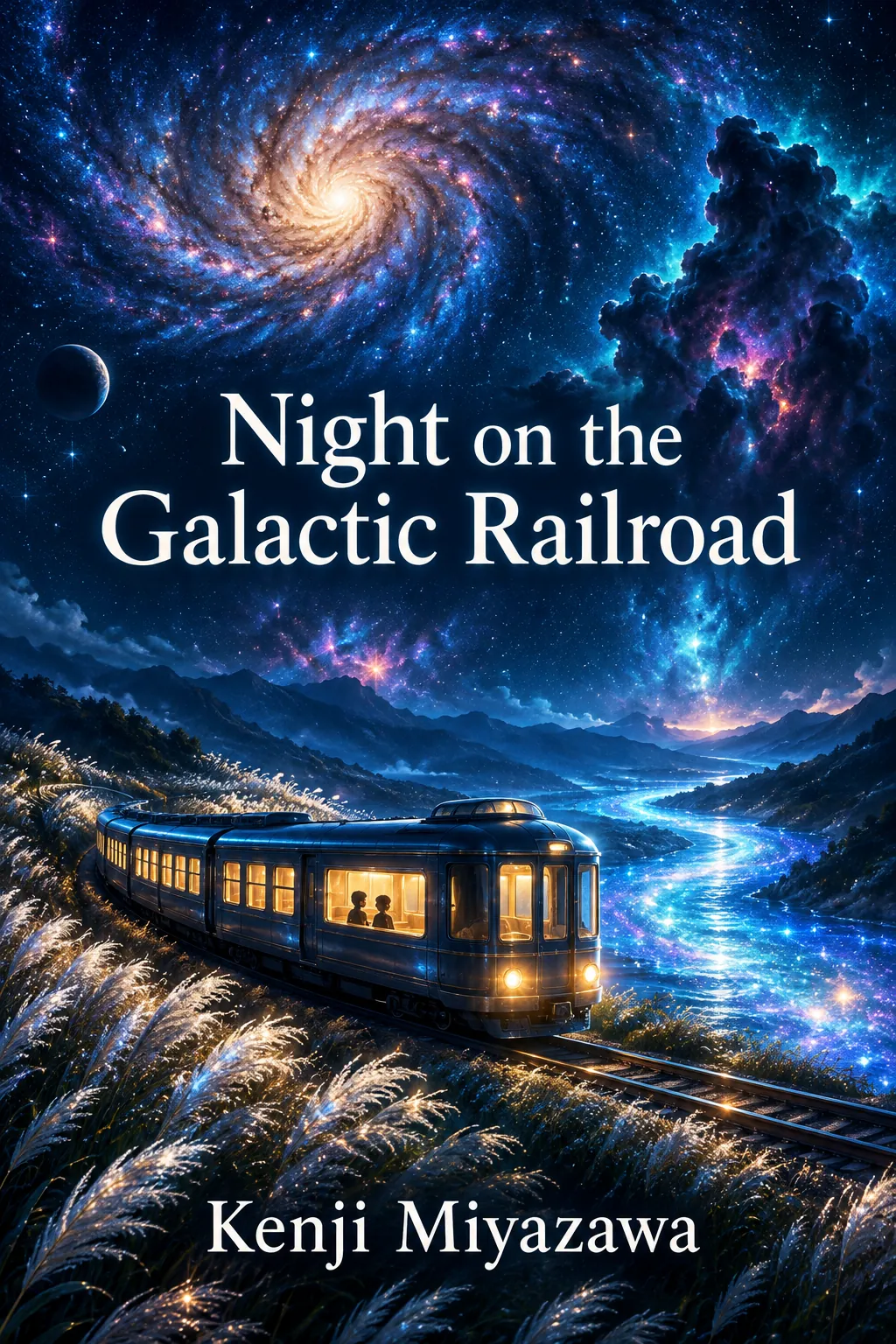
Night on the Galactic Railroad
par Kenji Miyazawa
Night on the Galactic Railroad is a Japanese fantasy novel about Giovanni, a poor and lonely schoolboy who falls asleep on a hill during a star festival and wakes on a train running along the Milky Way. His companion is his friend Campanella. Together they meet strange passengers and pass fossils, birds and constellations, asking what real happiness means when it is shared with everyone.
L'idée principale
"A lonely boy rides a train through the Milky Way with his only friend and learns that real happiness cannot belong to one person alone. The book asks what we would give up for everyone's sake."
Aperçus clés
Real happiness is shared
The central question of the book is what real happiness is. During the journey Giovanni stops thinking only about his own sadness and starts wondering what he could do for everyone.
In Chapter 9 he says he would burn his own body a hundred times for everyone's happiness, as the scorpion did.
Loneliness and a fragile friendship
Poverty and rumours about his father leave Giovanni isolated at school and in town. Campanella is the one friend who stays kind, even when he is awkward about it. The train gives their bond the space it lacks on earth.
In Chapter 1 Campanella does not answer the teacher's question, and Giovanni cannot tell whether it was kindness or distance.
Sacrifice and its cost
The scorpion story and Campanella's act show a person giving themselves for others. Miyazawa does not simply praise this: he also shows the grief it leaves behind, so beauty and pain share the same scenes.
Right after the scorpion story in Chapter 9, Campanella disappears from the seat beside Giovanni.
Science and prayer on one journey
Miyazawa studied agriculture, geology and astronomy, and he was a believer. The train carries scholars digging fossils and travellers praying, and the book never makes them rivals. Understanding the world and honouring it go together.
Chapter 7 puts the Northern Cross and the Pliocene Coast, faith and geology, in the same stretch of the trip.
Détail des chapitres
Chapter-by-chapter summary
Spoiler warning: this section covers the whole plot, including the ending.
Chapter 1: The Afternoon Lesson
A teacher hangs up a star map and asks what the pale band across the night sky really is. He explains that the Milky Way is a huge river of countless tiny stars, and he shows the idea with a lens and a model.
Giovanni knows the answer from something he once read, but he is too tired and shy to say it. Campanella seems to know it too and stays silent, and Giovanni feels pitied.
This opening shows Giovanni's loneliness. He knows more than he can say, and the one kind classmate feels out of reach.
Chapter 2: The Print Shop
After school Giovanni goes to a print shop. There he picks tiny pieces of lead type from trays with tweezers, one letter at a time, under a bright lamp.
He is paid one small silver coin for the afternoon. He closes his hand around it and goes out to buy bread and sugar.
The chapter shows the weight of his everyday life. This is a story about a poor, hardworking boy as much as it is about stars.
Chapter 3: Home
Giovanni brings the bread and sugar home to his mother, who lies sick in bed. His father, a fisherman, has been away in the far north for a very long time.
The milk has not been delivered, so Giovanni promises to fetch it. When he mentions that classmates say unkind things about his father, his mother answers gently that his father has done nothing wrong.
Here the book roots Giovanni's loneliness in his family. He keeps the house going while he waits for his father to return.
Chapter 4: The Night of the Centaurus Festival
It is the night of the Centaurus Festival, and the town glows with blue lamps. Giovanni walks to the dairy to get the milk, but no one answers his call.
On the way back he meets Zanelli and a group of classmates, who sneer that his father will bring him sea-otter fur. Campanella is with them and looks sorry but says nothing.
A festival should bring people together, yet it leaves Giovanni more alone than ever. He walks up to the hill outside town.
Chapter 5: The Pillar of the Weather Wheel
On top of the hill stands the pillar of the weather wheel, a mysterious pillar with no stated purpose. Giovanni lies down in the grass and looks up at the stars while the festival lights glow below him.
Then he hears a sound like a train and sees a light rushing toward him. Before he understands what is happening, he is sitting in a small railway carriage.
This is where the story crosses from the town into a dream. The book never says exactly where one ends and the other begins.
Chapter 6: Galactic Station
The train runs along the shining river of the Milky Way. To Giovanni's surprise, Campanella is sitting across from him, his hair still wet.
When the conductor comes for tickets, Giovanni finds a folded green paper in his pocket, and the conductor treats it with surprise. Outside the window are fields of silver grass and glowing stones.
For the first time Giovanni feels free, and he has a friend beside him. The strange details quietly tell us this is no ordinary journey.
Chapter 7: The Northern Cross and the Pliocene Coast
The train stops at the Northern Cross, where many travellers pray before they leave. Giovanni and Campanella watch quietly.
Next the train reaches the Pliocene Coast, where scholars are carefully digging up fossil walnuts and the bones of a great ancient animal. One of them explains that this ground was once a seashore very long ago.
The journey through the stars is also a journey through deep time. Giovanni begins to feel how old and enormous the universe is, and how small one life can seem inside it.
Chapter 8: The Bird Catcher
A rough, red-bearded man with a big sack climbs aboard. He is a bird catcher who snares herons as they come down along the Milky Way.
He offers the boys a soft sweet made from his catch, and Giovanni finds it good. He had felt uneasy about the man, and now he is ashamed of that feeling, because the man is only doing his work.
Soon the bird catcher is gone. A girl named Kaoru, a boy named Tadashi and their young tutor take their seats, travellers whose ship has sunk.
The chapter asks how quickly we judge people who seem strange to us.
Chapter 9: Giovanni's Ticket
As the train passes the red light of the Scorpion, Kaoru tells how a scorpion once prayed to give its body for others and became a fire in the night sky. At the Southern Cross, the girl, the boy and the tutor quietly leave the train.
Giovanni vows to search for everyone's real happiness. Campanella looks into the dark Coalsack and says he can see his mother, but Giovanni sees nothing, and when he turns around his friend is gone.
Giovanni wakes on the hill and runs to the river, where he learns that Campanella saved Zanelli and sank beneath the water. Campanella's father, a scholar, tells him that Giovanni's own father will be home soon, and Giovanni runs home with the milk.
The dream journey turns into grief and a promise.
Characters
Giovanni is the protagonist. He works at a print shop after school and looks after his sick mother.
He is shy and observant, and his longing for an absent father and a true friend drives the story.
Campanella is Giovanni's classmate and closest friend, the son of a scholar. He is gentle and well liked, and he never joins the teasing with a happy heart.
On the train, his quiet answers often seem wiser than his years.
Giovanni's mother is ill and patient, and she waits for her son to come home. She believes her husband has done nothing wrong, and her calm kindness is part of what keeps Giovanni going.
Giovanni's father is a fisherman who has been away in the far north for a long time. He barely appears in the book, but the talk about him weighs on Giovanni.
For the boy he is a hope to wait for.
Zanelli is a classmate who teases Giovanni with his friends. He is written less as a villain than as a careless child.
His fate ties him closely to Campanella's at the end.
The teacher uses a star map in the opening lesson to explain that the Milky Way is made of countless stars. His question and the boys' silence start the story.
He also brings the book's scientific way of looking at the world.
The bird catcher is a red-bearded man who sells the herons he catches. Giovanni dislikes him at first and then feels ashamed.
He is the book's question about judging people by how they look.
Kaoru, Tadashi and the tutor are passengers on the way to heaven after their ship sank. Kaoru tells the scorpion story, and the three talk with the boys about God and happiness before they leave at the Southern Cross.
Campanella's father is a scholar. At the river he accepts his son's loss with calm dignity.
He still takes the time to tell Giovanni that his father is coming home.
Writing about this book
Night on the Galactic Railroad works best when you choose one question and follow it through the text. Try one of these.
- What does the book mean by “real happiness”, and who does it belong to?
- How do the train journey and the real town mirror each other?
- Why does Miyazawa put a fossil dig, a prayer scene and a bird catcher in one trip?
A strong paragraph usually names one scene, such as the scorpion story or the Coalsack. It then explains what that scene shows about Giovanni and compares it with how he behaves in the town.
Quote briefly and use your own words for the rest. A line of a few words in Chapter 9 can do more than a long summary.
Finally, say what changed for you as a reader. Examiners and teachers respond well to an honest, specific reaction supported by one scene.
Passer à l'action
Étapes pratiques à mettre en œuvre dès aujourd'hui :
-
Notice the quiet classmate: someone who stays silent may be unsure how to help, not unkind.
-
Judge people by what they do, as Giovanni learns to do with the bird catcher.
-
Ask what would make things better for everyone around you, not only for yourself.
-
Look up at the night sky, and let the size of the universe put a bad day in perspective.
Citations notables
"“I would let my body burn a hundred times, if it were truly for everyone's happiness.” (Chapter 9)"
— Kenji Miyazawa
"“Let's go on together, wherever it leads.” (Chapter 9)"
— Kenji Miyazawa
"“Anyone who does something truly good is the happiest of all, aren't they?” (Chapter 9)"
— Kenji Miyazawa
À qui s'adresse ce texte
Readers from about twelve years old, including middle and high school students in Japan and anyone reading Japanese literature in translation. It suits fans of quiet fantasy and stories about friendship and loss. It is also a short way to meet Kenji Miyazawa, and the novel itself can be read in one sitting.
À propos de Kenji Miyazawa
Kenji Miyazawa (1896–1933) was a Japanese poet and children's author from Iwate Prefecture. He taught agriculture, advised local farmers, and drew on science, astronomy and Buddhism in his writing. He published little while he was alive, and most of his best-known stories, including this one, became famous after his death at 37.
Résumé écrit par

Software Engineer & Writer
Software engineer with a passion for distilling complex ideas into actionable insights. Writes about finance, investment, entrepreneurship, and technology.
Voir tous les résumés →Avis
Pas encore d'avis. Soyez le premier à partager vos impressions !
Écrire un avis
Continuer la lecture
Explorer le thème: Science-fictionRésumés

Out of My Mind
Sharon M. Draper
« Out of My Mind » de Sharon M. Draper est un récit poignant retraçant le parcours de Melody Brooks,…

La Stratégie Ender
Orson Scott Card
« La Stratégie Ender » d'Orson Scott Card est un roman de science-fiction captivant qui plonge le lecteur dans un…

Pachinko
Min Jin Lee
Saga historique multigénérationnelle envoûtante, « Pachinko » de Min Jin Lee retrace le destin d'une famille coréenne naviguant entre tourments…

Le Monde de Charlie
Stephen Chbosky
Le Monde de Charlie, de Stephen Chbosky, est un roman initiatique poignant raconté à travers les lettres intimes de Charlie,…
Articles

Thèmes de Un chant de Noël : générosité, isolement et responsabilité
La novella de Dickens se lit souvent comme l'histoire d'un homme qui change d'avis. Ses thèmes sont plus tranchants :…
Susanoo et le serpent à huit têtes (Yamata no Orochi)
Dans le Kojiki, le dieu de la tempête Susanoo, banni du ciel, arrive à Izumo et apprend que le serpent…
La guerre de Troie et le cheval de bois
La guerre de Troie est la légende grecque d'un siège de dix ans, conclu par un cheval de bois creux.…