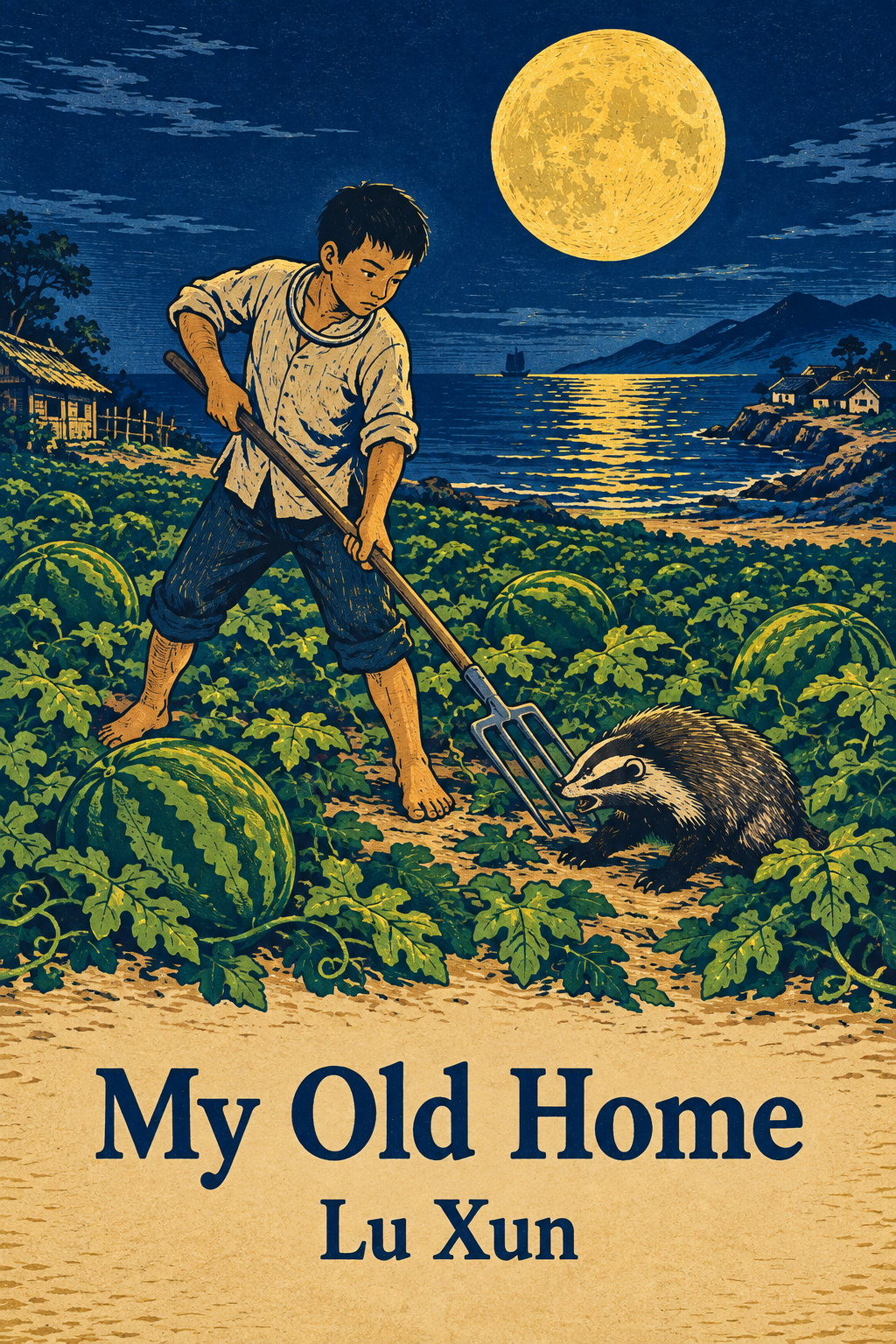
My Old Home
par Lu Xun
My Old Home is a short story by Lu Xun about a man who returns to his village in winter to sell the family house and move his mother away. When his mother mentions Runtu, he remembers a farm boy who once showed him a bright, wild world of moonlit melon fields and trapped birds. The visit becomes a quiet reckoning with what time, poverty and rank do to a friendship.
L'idée principale
"Going home after twenty years, a narrator measures the village of his memory against the real one. The story asks what separates people, and whether the next generation can live differently."
Aperçus clés
Memory polishes the past
The narrator's hometown lives mostly in his head, and years away have kept only its best picture. A golden moon over green melons stays, while hunger, rank and daily hardship are quietly dropped. The story shows how memory edits, and how an actual return tests the edited version against the facts.
Runtu's name alone makes the moonlit melon field return in full colour. The village seen from the boat, in a gloomy sky, is small and faded, though it is the same place.
A wall between people
The great loss in the story is not the old house but the friendship. Nothing dramatic breaks it. Time, class and habit build a thick, invisible wall, and both men feel it without being able to name who is to blame. The story treats this as a social fact, not a personal failure.
When Runtu says “Master!”, the narrator wants to speak but cannot. The respectful word makes the distance real in a single moment.
Poverty wears people down
Lu Xun does not blame Runtu or Yang Er-sao for who they have become. Heavy taxes, soldiers, bandits, officials and landowners press on villagers from every side, and the result shows in their faces, hands and manners. The story invites sympathy instead of judgment.
Runtu lists his troubles one by one, and the narrator sees a man who once knew everything about the fields now barely able to feed his family.
Hope can be an idol too
The narrator smiles at Runtu's incense burner, then realises that his own wish for a better life may be as unreal. Yet he does not give up. He argues that hope has no proof, but also no disproof, and that it becomes real only through shared action over time.
His closing image compares hope to a road across the earth: nothing is there until many people walk the same way.
The next generation
The two boys, Hong'er and Shuisheng, become friends in a few days and do not notice the gap that separates their families. The story does not promise that they will keep that freedom. It only says that the narrator wishes for it and that wishing is where change begins.
On the boat, Hong'er mentions that Shuisheng invited him to visit, and the narrator recalls how he and Runtu once spoke in the same easy way.
Détail des chapitres
Chapter-by-chapter summary of My Old Home
Spoiler warning: this section covers the whole plot, including the ending.
The story has no numbered chapters, so this guide splits it into seven natural parts.
Part 1: A Cold Return
It is deep winter. The narrator travels roughly a thousand kilometres to the village where he grew up. He has been away for more than twenty years, and he has come to sell the family house to another household and take his mother and his young nephew, Hong'er, to live elsewhere. Under a heavy sky the village looks poor and faded, and he wonders whether his hometown was ever as lovely as he remembers. His mother greets him, and relatives drop by to discuss the move. Why it matters: from the first page, the home in his memory and the home in front of him do not match.
Part 2: The Moon, the Melons and a Silver Ring
As they talk, his mother mentions Runtu, who has asked to see him. The name works like a key. A picture flashes up in the narrator's mind: a deep blue sky, a round golden moon, a sandy shore planted with green watermelons, and a boy of eleven or twelve with a silver ring around his neck, thrusting a steel pitchfork at a creature called a cha. The boy is Runtu. The narrator realises he has not pictured this scene in years, yet it has been waiting there all along. Why it matters: this single glowing scene is his idea of home, and every later scene is measured against it.
Part 3: A Winter with Runtu
The narrator's family was once well off. In the year it was their turn to host the great ancestral ceremony, Runtu's father, a farm labourer, brought his son along to guard the sacrificial vessels. The two boys became friends within days. Runtu taught the narrator to trap birds in the snow with a propped-up bamboo sieve and described the coloured shells on the shore and the night watch in the melon fields. The narrator, raised behind high walls, had known only a small square of sky. When the festival ended, Runtu cried and hid in the kitchen rather than leave, and later he sent a parcel of shells and feathers. They never met again. Why it matters: the friendship shows how narrow the narrator's world was and how wide Runtu's was.
Part 4: Yang Er-sao Comes Visiting
While the family packs, a neighbour called Yang Er-sao drops in. In the narrator's childhood she worked in a tofu shop and was known as the Tofu Beauty. Now she is about fifty, and she stands with her hands on her hips and her legs apart, like a drawing compass. She scolds him for not recognising her, mocks him as a rich man who pretends to be poor, and leaves with his mother's gloves stuffed into her waistband. Why it matters: she is a first hint of how a hard life can sharpen a person, and it prepares us for the meeting with Runtu.
Part 5: “Master!”
Runtu arrives. The narrator is eager and has a dozen things to say, but when he sees the man, the words stall. Runtu's face is ashen yellow and deeply creased, his eyelids are swollen and red, he wears a worn felt hat and a thin cotton jacket, and his hands are cracked like pine bark. After a long moment he says respectfully, “Master!” Beside him stands a shy boy, his fifth child, Shuisheng. Runtu lists his troubles: too many children and too little food, bad harvests, heavy taxes, soldiers, bandits, officials and landowners, all taking a share. The narrator feels a sad, thick wall rise between them. Why it matters: one word turns two friends into master and servant, and the story's pain gathers there.
Part 6: The Incense Burner and the Ashes
As the family sorts what to leave behind, Runtu is invited to take whatever he can use. He chooses tables, chairs, an incense burner and candlesticks, and a steelyard scale, and he asks for the plant ash from the kitchen stove to use as fertiliser. The narrator privately smiles at the incense burner, thinking Runtu still clings to idols. On the last day, ten or so bowls and plates turn up buried in the ash heap. Yang Er-sao announces that Runtu hid them to carry home, grabs a chicken-feeding device and hurries off. Why it matters: this is the moment the narrator looks down on Runtu, and the ending turns that judgment back on himself.
Part 7: The Boat and the Road
On the day of departure Hong'er and Shuisheng, who have been playing together, say goodbye, and Hong'er says Shuisheng has invited him to visit. The family boards the boat and the village fades from view. The narrator hopes that the boys will not live as he, Runtu or Yang Er-sao have lived. Then he stops himself: is his wish for a new life any less an idol than Runtu's incense burner? He decides that hope is neither real nor unreal. It is like a road, which does not exist until many people walk it. Why it matters: the ending turns a sad return into a quiet call to act.
Characters in My Old Home
The narrator (“I”)
A man who left the village and now works in a distant place. He tells the story in the first person and feels the gap between memory and reality most sharply. Readers often link him to Lu Xun, but he is a character in a work of fiction.
Runtu
The farm boy of the memory is bold, clever and at home in the fields and by the sea. The adult Runtu, worn down by poverty and heavy burdens, speaks to his old friend as a servant speaks to a master.
The narrator's mother
She organises the move and welcomes Runtu warmly. She is the one who names him at the start, and she lets him take furniture and ashes when he asks.
Yang Er-sao
Once admired as the Tofu Beauty, she is now sharp-tongued and quick to grab small things. She shows another way that a harsh life changes a person.
Hong'er
The narrator's young nephew. He makes friends with Shuisheng at once, without caring about rank, and he stands for the future.
Shuisheng
Runtu's fifth child. He is shy at first, but he and Hong'er soon play like old friends, which echoes the narrator's own childhood.
Runtu's father
A farm labourer who works for the narrator's family and brings his son along during the ceremony. He explains how Runtu comes to be at the house in the first place.
Writing about this book
A good book report on My Old Home starts with a question, not a plot recap. Here are some to try.
- Compare the Runtu of the moonlit memory with the Runtu at the door. Which details in the narrator's description show the change?
- Why does Runtu say “Master”? What does one word tell you about the two men's places in the world?
- Find the moment when the narrator mocks the incense burner and the moment when he questions his own hope. What has changed between them?
- Is “home” a place, a time or a feeling in this story?
- Have you ever felt a wall grow between you and an old friend? What built it?
Choose one scene, quote a few words, say what you notice and what it made you think. Your own example from life will make the report yours; a copied summary will not.
Passer à l'action
Étapes pratiques à mettre en œuvre dès aujourd'hui :
-
Check your memories against the present before you decide what an old friend, place or time was really like.
-
Notice the small words, such as titles and forms of address, that quietly build distance between people.
-
Look at the pressures behind someone's behaviour before judging the person.
-
Test your own hopes for the same blind spots you notice in other people's beliefs.
-
Treat hope as something built by many people acting together, not a prediction.
Citations notables
"“Hope is like a road across the earth: there was none at first, but when many people walk it, a road appears.” (Part 7)"
— Lu Xun
"“In the deep blue sky hung a round golden moon.” (Part 2)"
— Lu Xun
"“I felt a sad, thick wall rise between us.” (Part 5)"
— Lu Xun
À qui s'adresse ce texte
Students aged 13 and up, especially those meeting Lu Xun in a literature class, and anyone who wants a short, quiet story about friendship, class and memory. It takes only a few minutes to read, and it rewards a second reading.
À propos de Lu Xun
Lu Xun (1881–1936), the pen name of Zhou Shuren, was a Chinese writer born in Shaoxing, Zhejiang. He studied medicine in Japan before turning to writing. His short stories and essays, including the satire “The True Story of Ah Q”, made him a founder of modern Chinese literature. Call to Arms (1923), which includes My Old Home, was his first story collection.
Résumé écrit par

Software Engineer & Writer
Software engineer with a passion for distilling complex ideas into actionable insights. Writes about finance, investment, entrepreneurship, and technology.
Voir tous les résumés →Avis
Pas encore d'avis. Soyez le premier à partager vos impressions !
Écrire un avis
Continuer la lecture
Explorer le thème: FictionRésumés

Out of My Mind
Sharon M. Draper
« Out of My Mind » de Sharon M. Draper est un récit poignant retraçant le parcours de Melody Brooks,…

La Stratégie Ender
Orson Scott Card
« La Stratégie Ender » d'Orson Scott Card est un roman de science-fiction captivant qui plonge le lecteur dans un…

Pachinko
Min Jin Lee
Saga historique multigénérationnelle envoûtante, « Pachinko » de Min Jin Lee retrace le destin d'une famille coréenne naviguant entre tourments…

Le Monde de Charlie
Stephen Chbosky
Le Monde de Charlie, de Stephen Chbosky, est un roman initiatique poignant raconté à travers les lettres intimes de Charlie,…
Articles

Les Lumières expliquées : idées, penseurs et héritage
Le Siècle des Lumières est un mouvement intellectuel européen du XVIIIe siècle qui place la raison et les preuves au-dessus…

Histoire du monde 1700–1918 : révolutions, industrie, empires et guerre
De 1700 à 1918, révolutions, usines, empires et guerre mondiale ont remodelé les sociétés d'Europe, des Amériques, d'Asie et d'Afrique.…

Thèmes de Un chant de Noël : générosité, isolement et responsabilité
La novella de Dickens se lit souvent comme l'histoire d'un homme qui change d'avis. Ses thèmes sont plus tranchants :…