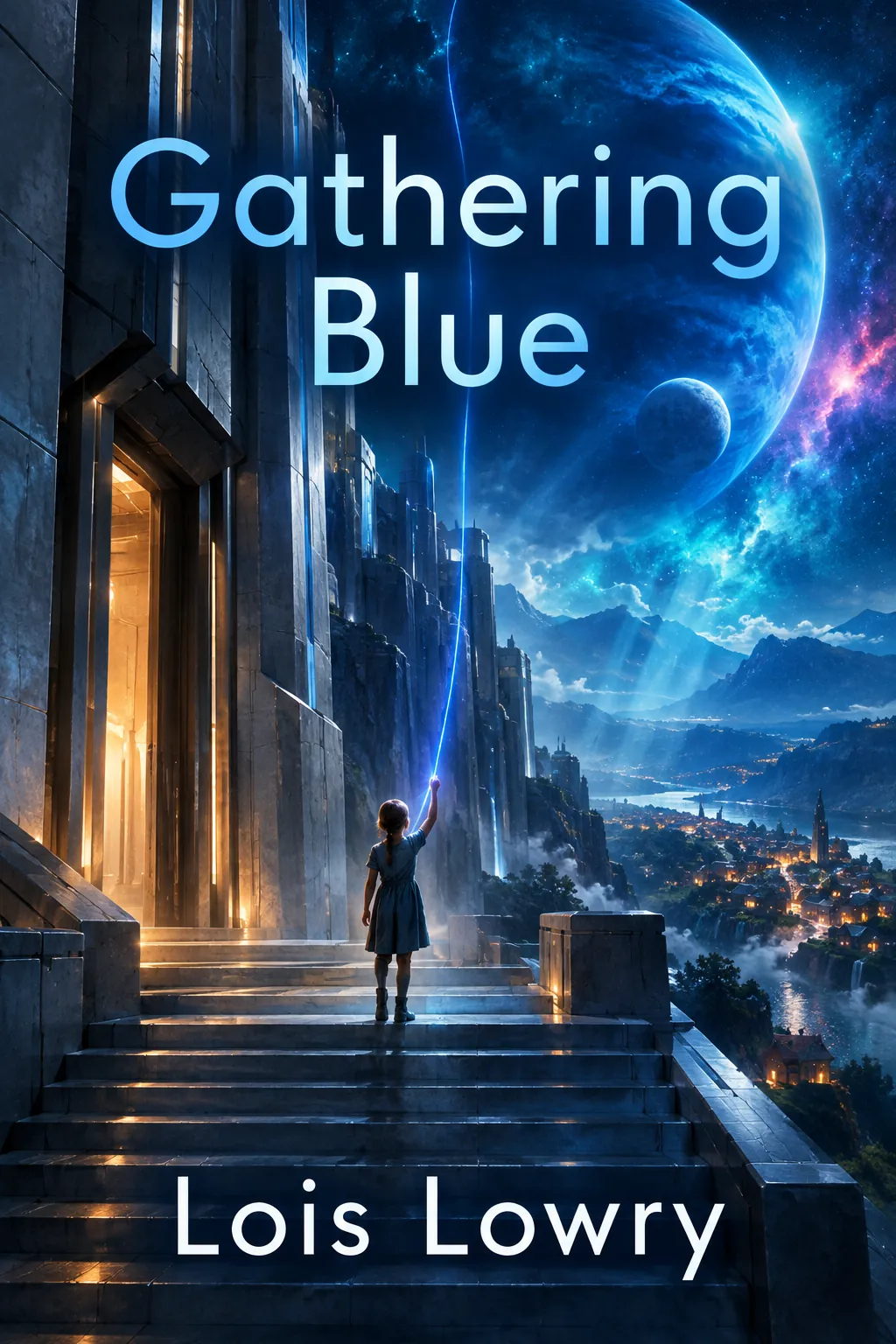
Gathering Blue
par Lois Lowry
Gathering Blue is a 2000 novel by Lois Lowry about Kira, a young orphan with a twisted leg who lives in a harsh, rule-bound village. When her mother dies, Kira expects to be cast out. Instead the village Council takes her in because she is a gifted weaver of thread. She is given a comfortable room and an important job. The longer she stays, the more she wonders what that comfort costs.
L'idée principale
"In Gathering Blue, a village protects its gifted children by also controlling them, and a girl with a twisted leg learns that being valued is not the same as being free."
Aperçus clés
Being useful is not the same as being free
Kira is saved because she is talented, and that makes the Council's kindness feel suspicious. The more comfortable her room, the more she depends on people who may not have her interests at heart. Lowry asks a hard question: what does a community owe its gifted members, and what does it take from them?
Kira is given food, a room and respect for mending the Singer's robe, but she is never asked whether she wants to stay.
Whoever controls the story controls the people
The robe records the past, and the Singer performs it. Because the Council decides what the pictures show, it shapes how the village understands its own history. The book suggests that art can serve truth or serve power, depending on who holds the thread.
The Council's tale about beasts keeps the villagers fearful and obedient, until Annabella's words and the chain on the Singer's leg show Kira that the story is false.
Pain can make you stronger and clearer
Kira's twisted leg could have been a source of shame, and the village treats it that way. Her mother's lesson is to take pride in the pain instead. By the end the leg has become part of how Kira sees: she knows what it is to be unwanted, so she notices who else is being used.
Katrina tells Kira to take pride in her pain, and Kira carries that advice into every hard choice she makes.
A longing can point to what is missing
Blue is the colour Kira cannot make and the colour the robe lacks. Her search for it is a craft problem, but also a search for something the village has pushed out: gentleness, truth and a wider world. The colour gives the story a quiet, steady image to build on.
Kira learns about dyes from Annabella and keeps asking how blue could be made, because she wants a colour nobody around her seems to have.
Détail des chapitres
Chapter-by-chapter summary
Spoiler warning: this section covers the whole plot, including the ending.
The novel has 23 numbered chapters, which we group into seven parts with short labels of our own.
Part 1: A girl alone in the village
Kira's mother, Katrina, has died of a sickness, and Kira is left alone with a twisted leg that makes walking hard. In her village, babies born with such a defect are usually left in the Field to die.
Kira survived only because her mother fought for her. With Katrina gone, the neighbours want Kira out and her cottage taken over.
This opening shows a society that throws away anyone it thinks is weak. It also shows how little Kira has to lose.
Part 2: Summoned to the Council Edifice
Kira is called before the Council of Guardians and expects to be punished or sent away. A guardian named Jamison speaks up for her skill, and she is taken into the grand Edifice, given a room, good food and time to work.
She is asked to mend the robe worn by the Singer, a garment that records the history of the world in stitched pictures.
The offer feels like a rescue, but it comes with a condition: Kira is useful, so Kira is kept.
Part 3: Thomas and the other gifted ones
In the Edifice Kira meets Thomas the carver, an orphan who carves and looks after the Singer's staff. The two become close friends and allies.
Like Kira, Thomas is treated well and given good work, and both of them live under the Council's eye.
The friendship gives Kira someone to trust, and it hints that the Council collects talent the way a collector collects objects.
Part 4: The robe and the missing blue
Kira studies the robe closely and learns that its pictures tell the story of the past, including the great ruin that destroyed an earlier world. She also longs to add blue to it, so she learns to make plant dyes from Annabella, an old dyer.
Nobody in the village knows how to make blue, and Kira's wish to find it becomes a private goal.
The dye work gives her something that belongs to her, not to the Council.
Part 5: Annabella, Jo and Matt
Annabella tells Kira that there are no beasts, the danger the Council uses to explain deaths and keep the villagers afraid. Annabella dies soon afterwards.
Jamison says she died in her sleep, but Matt later says Jamison's men dragged her body to the Field. Kira starts to suspect Jamison and the Council.
Kira also meets Jo, a young girl with a fine singing voice who is kept locked in a room to become the next Singer. Kira secretly befriends her and sneaks in at night to comfort her, but Jo stays a prisoner of the Council's plans.
Matt, a lively boy from the Fen, the poorest and dirtiest part of the village, is loyal to Kira and sets out to find blue for her.
Part 6: The Gathering
At the yearly Gathering the Singer performs the Song, the long history of the world, while wearing the robe Kira has repaired. Kira notices a chain on the Singer's leg and understands that the Singer is a prisoner.
Kira and Thomas compare what they know: each of the gifted children is an orphan, and each was brought to the Edifice. They begin to suspect that the Council lied about the beasts, and perhaps about how their parents died.
The scene shows that the Council controls what the artists make, and so controls how the village sees the world.
Part 7: Matt's return and Kira's choice
Matt comes back from a long journey with a blind man from a hidden community of gentle, broken people called the Village of Healing. The man is Kira's father, Christopher, whom she believed had been killed by beasts.
Christopher explains that he was clubbed and stabbed in a fight with a rival and left for dead in the Field, and that Jamison was behind the attack.
He has come to take Kira away, but she chooses to stay and weave the robe her own way, adding blue. Christopher gives her blue thread unravelled from his shirt, and Matt leads him home.
Characters
Kira
The heroine. She is a young orphan with a twisted leg and a rare talent for threadwork.
She starts out afraid and alone and becomes the one who sees through the village's lies.
Katrina
Kira's mother, who dies at the start. She shielded Kira from the village's cruelty and taught her to take pride in her pain.
Her influence stays with Kira all the way through.
Thomas the carver
An orphan with a gift for woodcarving who looks after the Singer's staff. He becomes Kira's close friend and ally.
Like her, he is both honoured and controlled.
Jo
A small orphan with a wonderful singing voice. The Council keeps her locked away to train her as a future Singer, and Kira secretly visits her at night to comfort her.
She is the most vulnerable of the gifted children.
Matt
A cheerful, restless boy from the Fen, the lowest and poorest part of the village, who has a small dog, Branch. He is loyal and curious, and his journey brings Kira's father back to her.
Annabella
An old dyer who teaches Kira to make dyes. She tells Kira that there are no beasts, and she dies soon afterwards.
The accounts of her death differ, and they make Kira suspicious.
Jamison
A guardian on the Council who speaks up for Kira and then guides her work. He is stern and controlling, and Christopher later reveals that Jamison attacked him.
Christopher
Kira's father, whom she believed was killed by beasts. He is alive but blind after an attack and was cared for in the Village of Healing.
His return proves that the Council has lied.
The Council of Guardians
The group that rules the village. It protects gifted children and also keeps them under control.
It hides the truth because the truth would loosen its hold on them.
Writing about this book
Teachers often ask about the theme of freedom against safety. A strong essay names the trade Kira is offered, protection in exchange for obedience, and shows how the Council uses her talent to keep her.
Look closely at the robe, the staff and the dye. Each is a made object that carries a story, and each shows who controls the story.
A good paragraph follows a simple pattern: claim, short evidence, then your own comment. For example, you might claim that the missing blue stands for something the village lacks, point to Kira's longing for the colour, and then explain what that longing says about her.
If you compare this book with The Giver, ask how each society hides the truth from its people. The Giver does it through sameness, Gathering Blue through fear and gifts.
Keep quotations to a few words. Use your own words for plot, and say which part of the book you mean.
Passer à l'action
Étapes pratiques à mettre en œuvre dès aujourd'hui :
-
Ask what a comfortable offer might cost you before you accept it.
-
Check whether a story you have been told has actually been tested.
-
Treat your own difference as part of how you see, not only as a weakness.
-
Use a skill to tell the truth, not just to please the people in charge.
Citations notables
"“The future will be told here. Our world depends upon the telling.” (Chapter 7)"
— Lois Lowry
"“There be no beasts.” (Chapter 11)"
— Lois Lowry
"“So we are each artists, and we were each orphaned, and they brought us each here.” (Chapter 15)"
— Lois Lowry
À qui s'adresse ce texte
Gathering Blue suits readers from about age 11 or 12 upward, including middle-school and early high-school students who enjoyed The Giver. It is also useful for anyone studying how stories can be used to control people. The language is simple and the book is short.
À propos de Lois Lowry
Lois Lowry (born 1937 in Honolulu) is an American author of young adult fiction. She won the Newbery Medal twice, for Number the Stars (1990) and The Giver (1993). Gathering Blue, published in 2000, is the second book in the Giver Quartet. It is a companion to The Giver, set in a different community.
Résumé écrit par

Software Engineer & Writer
Software engineer with a passion for distilling complex ideas into actionable insights. Writes about finance, investment, entrepreneurship, and technology.
Voir tous les résumés →Avis
Pas encore d'avis. Soyez le premier à partager vos impressions !
Écrire un avis
Continuer la lecture
Explorer le thème: Science-fictionRésumés

Out of My Mind
Sharon M. Draper
« Out of My Mind » de Sharon M. Draper est un récit poignant retraçant le parcours de Melody Brooks,…

La Stratégie Ender
Orson Scott Card
« La Stratégie Ender » d'Orson Scott Card est un roman de science-fiction captivant qui plonge le lecteur dans un…

Pachinko
Min Jin Lee
Saga historique multigénérationnelle envoûtante, « Pachinko » de Min Jin Lee retrace le destin d'une famille coréenne naviguant entre tourments…

Le Monde de Charlie
Stephen Chbosky
Le Monde de Charlie, de Stephen Chbosky, est un roman initiatique poignant raconté à travers les lettres intimes de Charlie,…
Articles

Thèmes de Un chant de Noël : générosité, isolement et responsabilité
La novella de Dickens se lit souvent comme l'histoire d'un homme qui change d'avis. Ses thèmes sont plus tranchants :…
Le Conte du coupeur de bambou (Taketori Monogatari)
Le Conte du coupeur de bambou (Taketori Monogatari) raconte l'histoire de la princesse Kaguya, une fillette trouvée dans une tige…
Ragnarök : la fin des dieux nordiques
Le Ragnarök est la fin du monde dans la mythologie nordique : une bataille finale où dieux, géants et monstres…