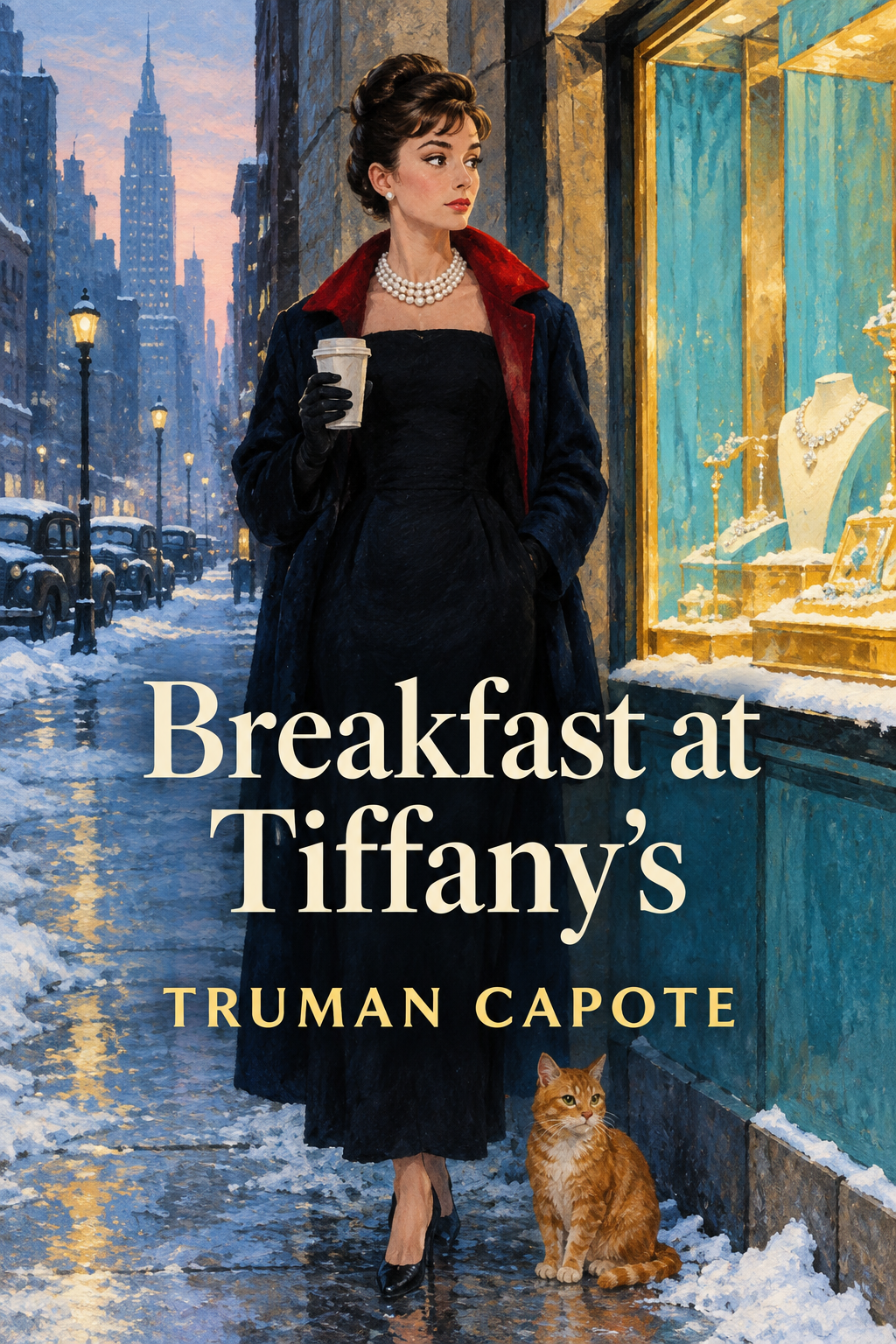
Breakfast at Tiffany's
par Truman Capote
Breakfast at Tiffany's is a short novel by Truman Capote, set in New York during the Second World War. An unnamed young writer moves into a brownstone and becomes fascinated by his neighbour, Holly Golightly, a glamorous country girl who lives on the attention of rich men and treats nothing as permanent. As he gets closer, he starts to see who she was before New York and what she is running from. The story is his memory of her, told years later.
L'idée principale
"A young writer remembers Holly Golightly, a charming New York girl who invents herself to escape her past and keeps refusing to belong to any person or place, even when she most needs to."
Aperçus clés
Reinventing yourself has a price
Holly drops her name, her accent, her marriage and her brother's home, and builds a glamorous New York life. The book admires the nerve of that, but it also shows that a self built to hide something has to be guarded every day.
When Doc arrives, Holly can be Holly with strangers but not with the one man who knows Lulamae. Her kindness at the bus station shows how much she still carries.
Freedom and belonging pull against each other
Holly wants to be free of every cage, yet she also wants a place where she and her things belong together. The novella never settles which wish is stronger, and she loses something with each choice.
She refuses to name her cat, saying she and he do not belong to each other yet. When she finally sets him loose in Harlem, she regrets it at once.
Memory makes a person larger than life
The narrator is telling this story years later, after Holly is gone. That means Holly arrives already shaped by longing, and we only ever see her through what one man noticed, forgot or hoped.
The book opens with Joe Bell's phone call about a carving that resembles her, so every scene afterwards is coloured by the question of where she ended up.
Glamour can be a kind of shelter
Holly's rich men, parties and jewels are not just vanity. They are her way of feeling safe in a world that has hurt her. Tiffany's stands for the calm she cannot find anywhere else.
When the “mean reds” hit, she goes to the jewellery store, not to a friend, because nothing bad seems able to happen there.
Détail des chapitres
Chapter-by-chapter summary
Spoiler warning: this section covers the whole plot, including the ending. The novella has no numbered chapters, so the story is split here into six natural parts.
Part 1: A phone call and a brownstone
Years later, the narrator gets a call from Joe Bell, the bartender at Holly's old hangout. Joe has seen a photograph of an African wood carving of a woman's head that looks exactly like her. That sends the narrator back to autumn 1943, when he was an unpublished writer renting a room in a New York brownstone. His neighbour was Holly: slim, light-haired, about nineteen, with a card on her mailbox reading “Miss Holiday Golightly, Traveling.” They first meet when she is locked out and rings his bell. Why it matters: the opening turns the whole book into a memory, so Holly reaches us already half lost.
Part 2: Holly's New York
Holly's flat has almost no furniture, but it is full of parties and men. Mr. Yunioshi, the photographer upstairs, is furious every time she buzzes him at night. She calls the narrator “Fred,” after her brother. Holly also keeps a cat she refuses to name, saying neither of them belongs to anyone yet. When she feels the “mean reds,” a fear with no clear cause, she takes a taxi to Tiffany's, because nothing bad seems able to happen there. Every Thursday she visits Sally Tomato, a gangster in Sing Sing. Why it matters: we see both her freedom and the fear underneath it.
Part 3: Rich men and “weather reports”
Holly wants to marry a rich man and feel safe. Her candidates include the millionaire Rusty Trawler and José Ybarra-Jaegar, a young Brazilian politician. Rusty suddenly marries her friend Mag Wildwood instead. Meanwhile the narrator sells a short story and grows closer to Holly. During her prison visits she collects “weather reports” from Sally Tomato, passes them to a lawyer, and is paid for it. The narrator never asks what they really are. O. J. Berman, the Hollywood agent who once tried to launch her, calls her a phony, but a true one, because she believes her own act. Why it matters: Holly's charm is real, and so is the performance.
Part 4: Doc from Texas
A middle-aged man turns up at the narrator's door: Doc Golightly, a horse doctor from Texas. He explains that Holly's real name is Lulamae Barnes. After she and her brother Fred were left on their own, Doc took them in, and he married her when she was only fourteen. She ran away, and now he has come to bring her home. At the bus station Holly is gentle with him but clear. She will not go back, and Doc leaves alone. Afterwards, at Joe Bell's bar, she says Doc's mistake was loving a wild thing. Why it matters: it shows that Holly's new self is something she built, and that it costs her something to keep it up.
Part 5: Fred's death and the Brazil plan
A telegram from Doc says Fred has died in the army. Holly wrecks her flat, then goes very quiet. Soon afterwards she tells the narrator that she will marry José and move to Brazil, and that she is pregnant. Then she loses the baby while out riding in Central Park. The narrator, who loves her without quite saying so, can only watch. Why it matters: Fred was her only family, and his death pushes her to look for a home faster than she can think it through.
Part 6: Arrest and goodbye
The police uncover Sally Tomato's drug ring and arrest Holly as one of its messengers. José writes to the narrator that he cannot be with her because of the scandal. O. J. Berman posts her bail, and she decides to leave for Brazil rather than face prison. On the way to the airport, she makes the taxi stop in Harlem and puts her cat out onto the street, then bursts into tears and cannot find him again. She leaves anyway. Later the narrator hears from her once, from Buenos Aires, with no permanent address. Later still he sees the cat in a warm window and hopes Holly has found a place like it. Why it matters: she runs again, and the book leaves it open whether she ever arrives.
Characters
Holly Golightly
Born Lulamae Barnes in rural Texas, she hides her past and lives as “Holly” in New York. She is funny, blunt and magnetic, and she will not be owned by anyone. She is the heart of the book.
The narrator
He is never named. He is a young writer who watches Holly closely, helps her when he can, and tells the story as a memory. Holly calls him “Fred.”
Doc Golightly
A Texas veterinarian and Holly's first husband. He comes to New York to take her home and returns without her. He is the one person who knows exactly who she used to be.
Joe Bell
The bartender at the place Holly frequents. He cares for her quietly, and his phone call at the start sets the whole memory going. He misses her more than most.
Mr. Yunioshi
The photographer who lives upstairs and is woken by Holly's late-night buzzing. A photograph he took of an African carving is what brings Holly back to Joe Bell's mind.
Rusty Trawler
A rich, spoiled man who is a leading marriage prospect for Holly. He suddenly marries her friend Mag Wildwood, showing how fragile Holly's money plans are.
José Ybarra-Jaegar
A Brazilian politician and Holly's most serious romance. He is the reason she imagines a future in Brazil, and he drops her when scandal arrives.
Sally Tomato
A mobster serving time in Sing Sing. Holly visits him each week and carries his messages. Through him she is pulled into a crime she barely examines.
O. J. Berman
A Hollywood agent who once tried to make Holly a star. He sees her more clearly than most and is the one who posts her bail.
Fred
Holly's brother, a soldier. He is the only family she loves, and she gives his name to the narrator. His death breaks something in her.
Writing about this book
Capote's novella works well for a book report because it is short and gives you clear questions. Use the ones below to build your own view rather than copying anyone else's.
- Is Holly truly free, or is she running from fear? Which scene made you decide?
- Why does the narrator stay nameless, and how does that change the way you read him?
- When Holly lets her cat go, what is she protecting and what does she lose?
- Where is your own “Tiffany's,” the place where you feel calm?
A simple way to start is to pick one scene that stayed with you, such as Holly's goodbye to Doc at the bus station, and write one sentence about how it made you feel. Then explain why, using one thing Holly says or does. Finally, connect it to something from your own life or school year. Because the book includes drinking and adult relationships, check that the edition and the assignment suit your age.
Passer à l'action
Étapes pratiques à mettre en œuvre dès aujourd'hui :
-
Notice when you are performing a version of yourself, and ask who it is protecting.
-
Give yourself a calm place or routine for anxious days, as Holly does with Tiffany's.
-
Treat the people you care about as people, not as wild things you can only watch.
-
When you tell a story about someone, remember you are telling your version of them.
Citations notables
"“… it's better to look at the sky than live there.” (Part 4, Holly to Joe Bell after Doc has left)"
— Truman Capote
"“Never love a wild thing, Mr. Bell.” (Part 4, Holly at Joe Bell's bar, speaking of Doc's mistake)"
— Truman Capote
"“I want to still be me when I wake up one fine morning and have breakfast at Tiffany's.” (Part 2, Holly on what she wants)"
— Truman Capote
À qui s'adresse ce texte
Readers who like short, voice-driven novels set in a glamorous past, and anyone studying 20th-century American fiction. It suits upper high school and above. It is also a good read for people who loved the film and want to see how different the book is.
À propos de Truman Capote
Truman Capote (1924–1984) was an American writer born in New Orleans. He wrote the novel Other Voices, Other Rooms, the novella Breakfast at Tiffany's (1958) and the 1966 non-fiction novel In Cold Blood. He spent much of his adult life in New York and moved in its social circles.
Résumé écrit par

Software Engineer & Writer
Software engineer with a passion for distilling complex ideas into actionable insights. Writes about finance, investment, entrepreneurship, and technology.
Voir tous les résumés →Avis
Pas encore d'avis. Soyez le premier à partager vos impressions !
Écrire un avis
Continuer la lecture
Explorer le thème: FictionRésumés

Out of My Mind
Sharon M. Draper
« Out of My Mind » de Sharon M. Draper est un récit poignant retraçant le parcours de Melody Brooks,…

La Stratégie Ender
Orson Scott Card
« La Stratégie Ender » d'Orson Scott Card est un roman de science-fiction captivant qui plonge le lecteur dans un…

Pachinko
Min Jin Lee
Saga historique multigénérationnelle envoûtante, « Pachinko » de Min Jin Lee retrace le destin d'une famille coréenne naviguant entre tourments…

Le Monde de Charlie
Stephen Chbosky
Le Monde de Charlie, de Stephen Chbosky, est un roman initiatique poignant raconté à travers les lettres intimes de Charlie,…
Articles
Les Lumières expliquées : idées, penseurs et héritage
Le Siècle des Lumières est un mouvement intellectuel européen du XVIIIe siècle qui place la raison et les preuves au-dessus…
Histoire du monde 1700–1918 : révolutions, industrie, empires et guerre
De 1700 à 1918, révolutions, usines, empires et guerre mondiale ont remodelé les sociétés d'Europe, des Amériques, d'Asie et d'Afrique.…

Thèmes de Un chant de Noël : générosité, isolement et responsabilité
La novella de Dickens se lit souvent comme l'histoire d'un homme qui change d'avis. Ses thèmes sont plus tranchants :…