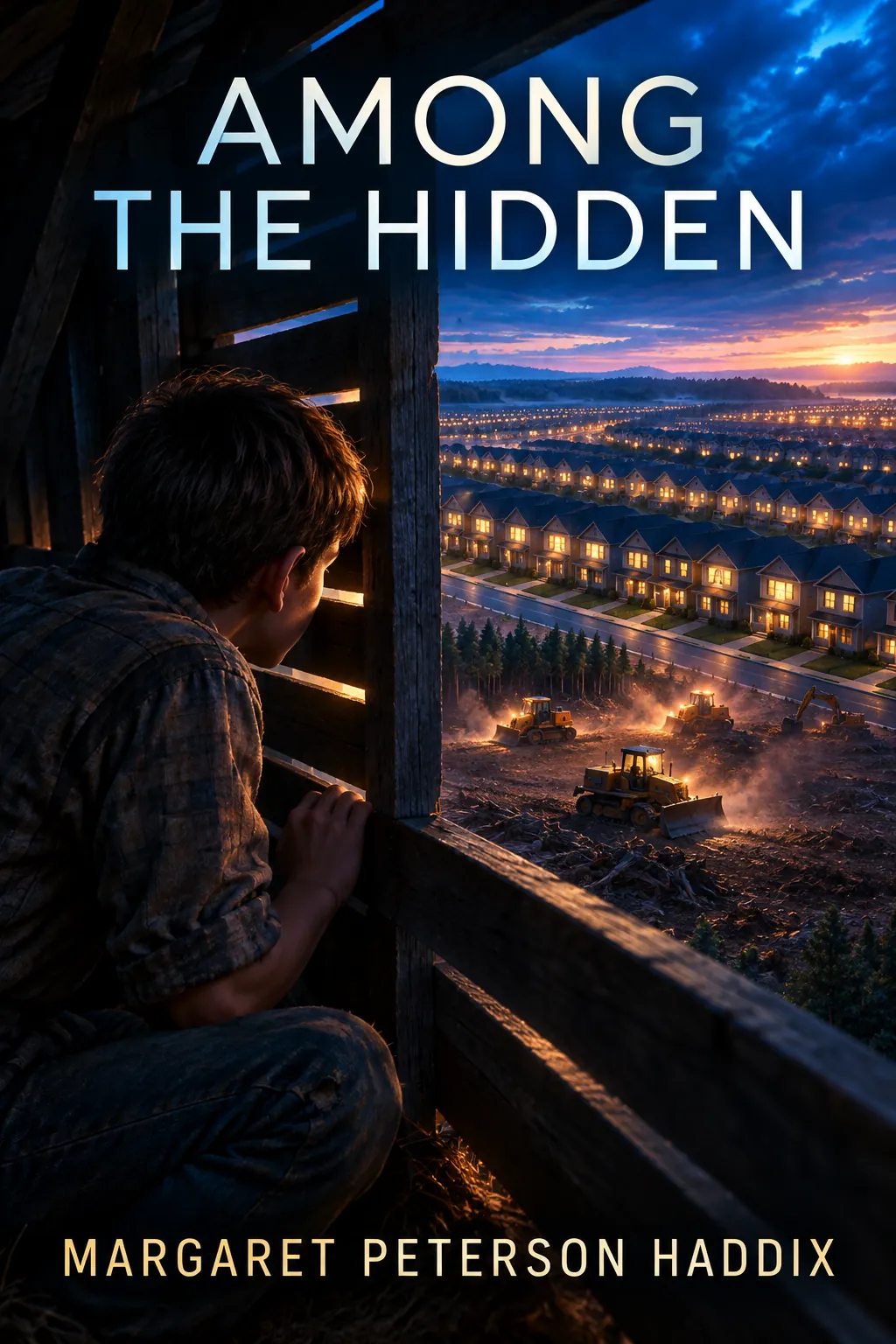
Among the Hidden
par Margaret Peterson Haddix
Among the Hidden is a 1998 dystopian novel for young readers. Luke Garner is a third child in a future America where the government limits families to two children, so he has spent twelve years hidden on his family's farm. When new houses rise where the woods once stood, he sees a face at a neighbour's window and discovers that he is not the only one in hiding. That meeting forces him to decide what his life is for.
Essayer Audible · En tant que Partenaire Amazon, nous percevons une commission sur les achats éligibles. Détails
L'idée principale
"In a country that allows only two children per family, a twelve-year-old third child learns that staying safe and staying silent are not the same as being free."
Aperçus clés
Fear can become a way of life
Luke is not caught by anyone at the start of the book, yet he lives as a prisoner because he has been taught that being seen is dangerous. The novel shows that a threat does not need to appear every day to shape a person; the possibility is enough.
Once the woods are cut down, Luke stays inside and watches through the attic vent, while Jen, protected by her parents' bribes, moves through her world with far less fear.
A government can decide who counts
The Population Law does more than limit family size. By making third children illegal, it treats some lives as having no value, and the book asks readers to notice how easily a rule can turn people into problems.
Luke has never been to school or met anyone outside his family, and the only way he can finally live openly is to take the name of a boy who has died.
Caution and courage both have costs
Luke and Jen answer the same problem in different ways. Jen's courage leads to action and danger, while Luke's caution protects him but keeps him small, and the book does not pretend either choice is easy. Jen's wealth as a Baron's daughter also shapes how safe she feels.
Jen invites Luke to the rally and he refuses out of fear; the next morning she is missing, and he learns she was killed with about forty other children.
Friendship makes a bigger life possible
Luke's world changes the moment he meets someone like him. The story suggests that people often find the strength to act through other people, not alone.
Before Jen, Luke only wants to stay safe; after the chatroom shows him other shadow children, he starts to ask what he could do with his life.
Small details carry big ideas
The rules of this world are simple, yet the book never feels distant because the author shows them through ordinary things. A vent, a window and a chatroom make a huge social question feel personal, and the same trick works in your own essays: start from a concrete scene.
The vanished woods, the big new houses seen through the vent and the face in a window make Luke's closed-in world easy to picture.
Détail des chapitres
Background: the Population Law
The story is set in a near-future United States where food shortages have led the government to pass a Population Law. Each family may have two children, and the Population Police enforce the rule.
A third child has no legal existence, so families who have one must keep that child out of sight. The book calls these children shadow children, and the same name gives the whole series its title.
The idea is partly inspired by real population-control policies of the late twentieth century. The novel does not argue about the policy in detail; it asks what such a rule does to the people it hides.
Chapter-by-chapter summary
Spoiler warning: this section covers the whole plot, including the ending.
Part 1: A boy nobody can see
Luke Garner is twelve and has never been to school or a friend's house. He is a third child in a country that allows only two, so his family keeps him out of sight.
The Garners live on a farm beside a stretch of woods, and the woods are where Luke can move about unseen. His older brothers, Mark and Matthew, go to school and have friends, which shows Luke exactly what he is missing.
This part matters because it makes hiding feel ordinary, so the reader understands how fear can become a habit.
Part 2: The woods disappear
The government has the trees behind the Garner farm cut down to make room for large houses for rich and powerful families. Luke loses the cover that let him go outside.
From then on he stays indoors, and his window on the world shrinks to a vent in the attic. He watches the big houses go up and, later, the new families move in.
This part matters because it shows that the state controls more than the number of children; it also takes the land and changes how people live on it.
Part 3: A face in the window
From the attic vent Luke notices a child's face in a window of a house where he knows only two children live.
After watching and wondering for a while, he decides that the family must be hiding a third child, just as his own family hides him.
This part matters because it turns a lonely story into a mystery, and it gives Luke a reason to take his first risk.
Part 4: Meeting Jen
Eventually Luke gives in to curiosity and sneaks over to the neighbouring house, where the girl from the window, Jen Talbot, catches him. She is also a third child, but her family belongs to the wealthy Baron class, so she has guards, computers and parents who can bribe people to keep her safe.
Jen is bold, talkative and angry about being hidden. She introduces Luke to an online chatroom where shadow children, as they call themselves, talk to one another, and he never knew so many existed.
This part matters because friendship makes Luke want more than safety, and Jen's money helps explain why she feels sure the government can be defied.
Part 5: The rally and the quarrel
Jen tries to persuade Luke that the government is wrong, and he begins to feel guilty about the food and supplies he uses. She invites him to a rally of shadow children against the Population Law.
Luke refuses because he is too afraid, and Jen angrily tells him to leave. In his own anger he wishes the Population Police would shoot Jen at the rally, and he regrets it at once.
Jen comes back to Luke's house that night, and the two make up before she says goodbye.
This part matters because it sets the book's central question against its two main characters, and because Luke's last memory of Jen is both a quarrel and a farewell.
Part 6: What happened at the rally
The next morning there is no news of any rally, and Luke grows frightened. He breaks into Jen's house, finds no sign of her and posts in the chatroom asking where she is.
A man with a gun comes in and demands to know who Luke is. When Luke says he is Jen's friend and asks where she is, the man lowers the gun.
He is Mr. Talbot, Jen's father, a Baron and a government official, and he tells Luke that Jen and about forty other children were shot and killed at the rally.
More Population Police arrive soon afterwards, because the government has been watching the chatroom since the rally. Luke hides while Mr. Talbot deals with the officers.
Mr. Talbot then forges identification for Luke, who becomes Lee Grant, a boy who had died, and starts at a boarding school.
This part matters because Jen's courage becomes a challenge Luke takes up, although he can only leave hiding by taking another person's name.
Characters
- Luke Garner: the twelve-year-old protagonist and a third child. He is cautious, observant and lonely, and over the book he learns to want a life outside the attic.
- Jen Talbot: another shadow child, who lives in the new development in a wealthy Baron family. Bold and impatient, she organises a rally and pushes Luke to see that hiding is not the same as living.
- Mr. Talbot: Jen's father, a Baron and a government official. He tells Luke what happened at the rally and forges the identification that turns Luke into Lee Grant.
- Mr. Garner: Luke's father, a farmer. He loves his family and protects Luke by hiding him, but he is worn down by fear and by the loss of his land.
- Mrs. Garner: Luke's mother. She keeps Luke's secret and tries to give him a normal home, and her anxiety shapes the household.
- Mark and Matthew: Luke's older brothers. They attend school and have a normal social life, and they show Luke what he cannot have.
- The Population Police: the government's enforcers. They are mostly a threat in the background until they come to the Talbot house, which is what makes them so frightening.
- The shadow children: the hidden third children who meet in Jen's chatroom. They are a group rather than one person, and they stand for everyone the law refuses to count.
How the book is told
The story follows Luke closely, so readers only know what he knows. That limited view keeps the danger close and unclear, just as it feels to a boy who has never been allowed outside.
The chapters are short and the language is plain, which suits readers aged about 10 to 14. The simple style also lets the big questions about freedom stand out.
Notice how often Luke looks through something: a vent, a window, a gap in the trees. These openings show a boy who watches life instead of taking part in it.
The setting changes along with him. The farm, the cleared land and the crowded new development work as three stages of Luke's world, from open and free to watched and boxed in.
Readers often compare the book with The Giver, where a community also controls what people may know and choose. In both books a young person begins to question the rules he was raised under.
Questions to think about
Use these questions for class discussion or to plan an essay. There is no single right answer, so support your view with a scene.
- How does the loss of the woods change what Luke feels and does?
- How does Luke's first visit to Jen's house show the difference between his family and hers?
- Which scene shows the difference between Luke and Jen most clearly?
- How far can a government go in limiting family size because food is short?
- Is Luke's decision to leave hiding as Lee Grant a fair answer to what Jen tried to do?
Writing about this book
Teachers often assign this book in middle school, so essay questions usually ask about theme, character or the world the author built. Start with a claim about what the book says, then support it with a specific scene.
For a character essay, compare Luke and Jen. Luke chooses caution and Jen chooses action, and the book lets you ask whether either is simply right.
For a theme essay, you can write about freedom and fear, or about how a government decides who counts. Name one scene for each point, such as the face in the window or the quarrel before the rally, and explain what it shows instead of retelling it.
A strong response also looks at how the author makes a simple rule feel real. Luke's attic vent, the lost woods and Jen's chatroom are small details that carry big ideas.
If you need a short model paragraph, use this shape: state your claim, give one scene as evidence, then explain in two sentences why that scene supports the claim. Always write the final version in your own words.
Passer à l'action
Étapes pratiques à mettre en œuvre dès aujourd'hui :
-
When you write about a theme, tie it to one scene and explain what the scene shows.
-
Compare two characters who face the same problem and make different choices.
-
Look for small details, such as the attic vent, that carry the book's larger ideas.
-
Read for the question the author asks, not only for what happens next.
-
Link the book to your own experience, then state your conclusion in your own words.
Citations notables
"“It wasn't a sanctuary. It was a prison.” (Chapter 13)"
— Margaret Peterson Haddix
"“Who wanted to meet strangers, anyway?”"
— Margaret Peterson Haddix
"“Am I just supposed to sit in this room the rest of my life?”"
— Margaret Peterson Haddix
À qui s'adresse ce texte
Readers aged about 10 to 14, and anyone studying middle-grade dystopian fiction in school. It suits students meeting dystopia for the first time, before The Giver, and teachers looking for a short book that opens discussion about freedom and fairness.
Envie du livre complet ?
Lisez ou écoutez Among the Hidden en entier.
Essayer Audible · En tant que Partenaire Amazon, nous percevons une commission sur les achats éligibles. Détails
À propos de Margaret Peterson Haddix
Margaret Peterson Haddix is an American author of books for children and young adults. A former newspaper reporter and teacher, she is best known for the Shadow Children series, which began with Among the Hidden in 1998, and has written many other novels, including the Missing and Under Their Skin series. Her books are widely taught in middle schools.
Résumé écrit par

Software Engineer & Writer
Software engineer with a passion for distilling complex ideas into actionable insights. Writes about finance, investment, entrepreneurship, and technology.
Voir tous les résumés →Avis
Pas encore d'avis. Soyez le premier à partager vos impressions !
Écrire un avis
Continuer la lecture
Explorer le thème: Science-fictionRésumés

Out of My Mind
Sharon M. Draper
« Out of My Mind » de Sharon M. Draper est un récit poignant retraçant le parcours de Melody Brooks,…

La Stratégie Ender
Orson Scott Card
« La Stratégie Ender » d'Orson Scott Card est un roman de science-fiction captivant qui plonge le lecteur dans un…

Pachinko
Min Jin Lee
Saga historique multigénérationnelle envoûtante, « Pachinko » de Min Jin Lee retrace le destin d'une famille coréenne naviguant entre tourments…

Le Monde de Charlie
Stephen Chbosky
Le Monde de Charlie, de Stephen Chbosky, est un roman initiatique poignant raconté à travers les lettres intimes de Charlie,…
Articles

Thèmes de Un chant de Noël : générosité, isolement et responsabilité
La novella de Dickens se lit souvent comme l'histoire d'un homme qui change d'avis. Ses thèmes sont plus tranchants :…

Proxima du Centaure
Proxima du Centaure est l'étoile la plus proche du Soleil, à environ 4,25 années-lumière. C'est une petite naine rouge, trop…

Dilatation du temps
La dilatation du temps est un effet prédit par la relativité d'Einstein, puis mesuré : les horloges battent à des…