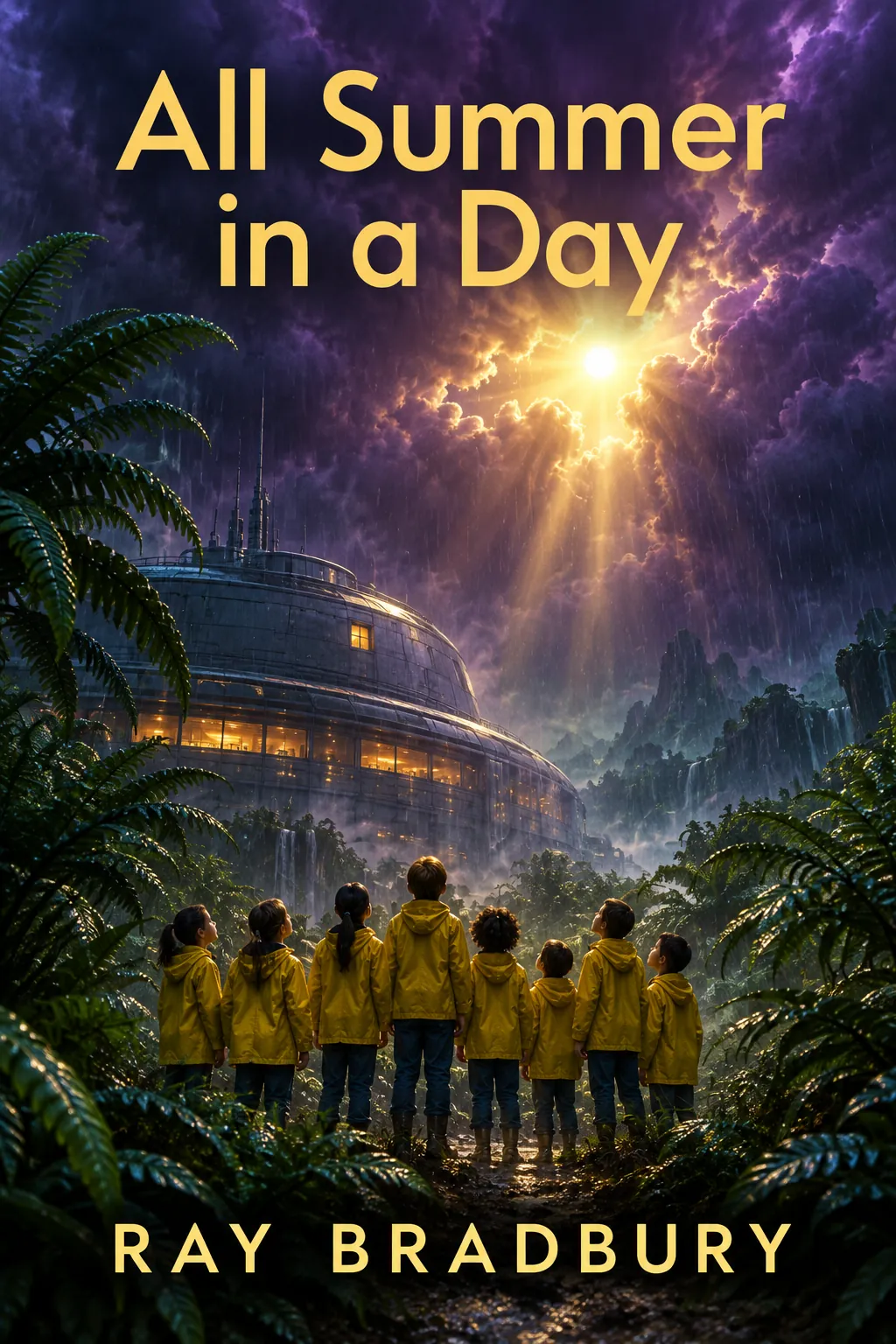
All Summer in a Day
par Ray Bradbury
On Venus, where it rains almost without stopping, a class of nine-year-olds waits for the one hour when the sun appears, something that happens only once every seven years. One girl, Margot, remembers the sun from her early childhood on Earth, and her classmates cannot forgive her for it. Ray Bradbury's 1954 short story is about envy, cruelty and what it costs to take away someone else's joy.
Essayer Audible · En tant que Partenaire Amazon, nous percevons une commission sur les achats éligibles. Détails
L'idée principale
"Ray Bradbury's story shows how a group can turn its own disappointment into cruelty, and how understanding often arrives only after the harm is done."
Aperçus clés
Envy can look like a crowd's cruelty
The children do not lock Margot away because they are evil. They do it because she has something they cannot have, and being together makes the cruelty feel easier. Bradbury shows how a group can turn private disappointment into public bullying, where everyone shares the act and no one feels fully responsible for it. It is a quiet reminder that ordinary people, not only villains, can take part in harm.
In the story, William leads, but the whole class takes part and none of them speaks up when the teacher calls them to the door.
Memory can isolate a person
Margot is lonely because she knows something the others do not. Her memory of the sun is a gift, but it makes her different, and difference is the thing children often punish most. The story suggests that a person who carries a rare experience can end up carrying it alone, because others find it easier to doubt her than to admit what they are missing.
Her classmates call her a liar when she describes the sun, because accepting her words would mean admitting their own lack.
Understanding arrives too late
The children feel sorry only when the rain returns and the light is gone. Bradbury places the lesson after the damage, which makes it more painful and more believable. Real regret often works this way: we see what we did only when the moment that could have changed it has already passed, and the story lets the reader feel that weight without any lecture.
The class falls silent when someone says Margot's name, and the shared guilt is shown by their slow walk to the closet.
A science fiction setting can magnify a human truth
Venus here is not about real science. It is an extreme version of a world with almost no joy, so that one hour of sun feels huge and the cost of losing it feels huge too. Because the setting is so unusual, readers can look at familiar feelings such as envy, longing and guilt as if through a magnifying glass.
By making the sun appear only once every seven years, Bradbury turns an ordinary sunny day into a once-in-a-childhood event.
Small joys gain value when they are scarce
The most vivid moment in the story lasts about an hour. Because it is so short, the children use every minute of it, and the reader understands how much it is worth. The same scarcity makes the theft of that hour from Margot feel serious, since what was taken cannot be given back later.
The children tear off their jackets and lie in the warmth, while Margot, locked away, misses the only sun she may see for years.
Détail des chapitres
All Summer in a Day: chapter-by-chapter summary
Spoiler warning: this section covers the whole plot, including the ending.
The story is short and has no numbered chapters, so this guide splits it into six natural parts.
Part 1: Seven years of rain
The story opens in a school on Venus, where rain has fallen for as long as the children can remember. Bradbury describes it as a drumming, flooding, endless weather that fills every day.
Today is special, because the scientists have said the sun will come out. The class crowds near the window, whispering and checking the sky.
The sun appears for only about an hour every seven years, so for most of these nine-year-olds this will be the first time they truly see it. Why it matters: the setting turns something we take for granted into the most precious thing in the world, and it creates the pressure that drives everything after.
Part 2: The girl who remembers
Margot stands apart from the others, small, pale and quiet. She is the only child who came from Earth, five years earlier, and she remembers the sun from when she was four.
She tries to tell her classmates what it was like, but they do not believe her and call her a liar. Her family has talked of taking her back to Earth, and Venus seems to be wearing her down.
She has also written a short poem about the sun as a flower that blooms for just one hour. Why it matters: Margot knows what everyone is waiting for, and that knowledge makes her both a precious witness and an easy target.
Part 3: The closet
The children's resentment has been building for a long time. They cannot stand that Margot has something they lack, and a boy named William leads the attack.
Just before the sun is due, they drag her to a closet and lock her in, ignoring her protests. Then the teacher calls the class together, and in the excitement they say nothing about it.
Why it matters: this is the cruelty at the heart of the story, and Bradbury shows it as something ordinary children do when they feel hurt and are part of a crowd.
Part 4: The hour of sun
The teacher opens the doors and the children burst outside into sudden silence. For the first time in their memory, the rain has stopped.
They run, shout and tear off their jackets, lying in the warmth and watching the jungle glow with colour. The joy is described so fully that the reader feels it too.
Why it matters: the happiness is real, and that is what makes the next part hurt. While they are playing in the light, they have forgotten the girl they locked away from it.
Part 5: The rain returns
A clap of thunder sounds, and the first drops fall. The children groan, then are herded back inside as the rain returns to its old roar.
The sun will not come again for another seven years. In the quiet that follows, one child says Margot's name, and everyone suddenly remembers.
Why it matters: the turn is sharp. The thing they wanted most is gone, and the thing they did to someone else rushes back at the same moment.
Part 6: Opening the door
The children stand in silence and look at the closet door. None of them wants to be the one to move.
Slowly, they unlock it and let Margot out. Bradbury ends the story there, without a speech or a lesson.
Why it matters: the ending leaves the harm done and the apology unspoken. The reader is left to feel what the children now feel.
Characters
Margot. A quiet, pale girl who moved from Earth five years earlier and still remembers the sun.
Her memories make her the class outsider, and she is the story's victim.
William. The classmate who leads the teasing and the closet plan.
He is angry and jealous, and he shows how one confident child can push a group toward cruelty.
The teacher. An adult who keeps order and guides the class toward the sun.
She does not see the closet scheme until it is too late.
The classmates. They act as a group more than as individuals.
They are not monsters, only children who give in to envy and to the crowd.
Margot's parents. They are mostly in the background, but talk of taking her back to Earth shows that her unhappiness on Venus is real.
The sun. A symbol of warmth, memory and what is missing.
Because it is so rare, it becomes the story's most valuable thing.
The rain. It is both the setting and a mood of grey endurance, and its return at the end closes the story's brief window of light.
Background and how to read the story
Bradbury published the story in March 1954 in The Magazine of Fantasy & Science Fiction, and it was gathered into the collection A Medicine for Melancholy in 1959. It is one of his best-known short stories and is often assigned in middle school.
It is a science fiction story, but the science is not the point. Venus is a stage where one simple thing, sunlight, becomes the most precious object in a child's life.
Notice how short the story is and how little it explains. Bradbury gives us a few vivid images, a small cast and one cruel act, and trusts the reader to draw the meaning.
Pay attention to the narrator's voice. It stays close to the children and describes the rain and the jungle in rich, sensory language, so the sudden quiet in Part 4 feels like a physical change.
It also helps to read the story as a story about time. Seven years is a huge span for a nine-year-old, so the wait feels like a lifetime, and the hour of sun feels like a whole summer packed into one day.
Finally, compare Margot's position with the children's. She has known warmth and now lives without it, while they have never known it.
Both groups are missing something, but only one group chooses to make the other suffer for it. That difference is what keeps the story from being only sad.
Writing about this book
A strong essay on this story starts with a clear claim. For example: Bradbury uses a world without sun to show how loss can make people cruel to anyone who reminds them of what they are missing.
Choose two or three moments as evidence, such as the closet, the hour outside and the silence at the end. For each, explain what it shows, not just what happens.
Look at contrasts. Light and dark, warmth and cold, noise and silence, and Margot's memory against the children's lack of one all carry the meaning.
Be careful with the ending. Bradbury does not say what the children say or how Margot feels, so discuss what the silence suggests rather than inventing a conversation.
If your teacher asks you to compare this story with another text, look at how Bradbury treats ordinary people under pressure and how a single image can carry a whole idea.
Use short quotes, one sentence at most, and put them in your own sentences. Finally, say what the story is really about: not Venus, but how people treat each other when they are hurting.
Passer à l'action
Étapes pratiques à mettre en œuvre dès aujourd'hui :
-
Notice when a group is turning on one person, and be willing to speak up before the moment passes.
-
Treat someone's different experience as something to learn from, not something to doubt.
-
Remember that excitement can make us forget the people we have hurt, so check before you celebrate.
-
When you write about a story, use the ending to ask what is left unsaid, not only what happens.
Citations notables
"“It had been raining for seven years.” (Part 1)"
— Ray Bradbury
"“I think the sun is a flower, / That blooms for just one hour.” (Part 2)"
— Ray Bradbury
"“Do the scientists really know? Will it happen today, will it?” (Part 1)"
— Ray Bradbury
À qui s'adresse ce texte
Readers aged about 10 and up, including middle-school students, will find this a quick and affecting read. It suits English classes studying theme, setting and symbolism, and anyone who wants a short science fiction story with a strong emotional punch.
Envie du livre complet ?
Lisez ou écoutez All Summer in a Day en entier.
Essayer Audible · En tant que Partenaire Amazon, nous percevons une commission sur les achats éligibles. Détails
À propos de Ray Bradbury
Ray Bradbury (1920–2012) was an American writer best known for science fiction and fantasy, including The Martian Chronicles and Fahrenheit 451. His short stories, often set on other planets or in near futures, focus on ordinary feelings such as wonder, fear and loneliness.
Résumé écrit par

Software Engineer & Writer
Software engineer with a passion for distilling complex ideas into actionable insights. Writes about finance, investment, entrepreneurship, and technology.
Voir tous les résumés →Avis
Pas encore d'avis. Soyez le premier à partager vos impressions !
Écrire un avis
Continuer la lecture
Explorer le thème: Science-fictionRésumés

Out of My Mind
Sharon M. Draper
« Out of My Mind » de Sharon M. Draper est un récit poignant retraçant le parcours de Melody Brooks,…

La Stratégie Ender
Orson Scott Card
« La Stratégie Ender » d'Orson Scott Card est un roman de science-fiction captivant qui plonge le lecteur dans un…

Pachinko
Min Jin Lee
Saga historique multigénérationnelle envoûtante, « Pachinko » de Min Jin Lee retrace le destin d'une famille coréenne naviguant entre tourments…

Le Monde de Charlie
Stephen Chbosky
Le Monde de Charlie, de Stephen Chbosky, est un roman initiatique poignant raconté à travers les lettres intimes de Charlie,…
Articles

Thèmes de Un chant de Noël : générosité, isolement et responsabilité
La novella de Dickens se lit souvent comme l'histoire d'un homme qui change d'avis. Ses thèmes sont plus tranchants :…

Proxima du Centaure
Proxima du Centaure est l'étoile la plus proche du Soleil, à environ 4,25 années-lumière. C'est une petite naine rouge, trop…

Dilatation du temps
La dilatation du temps est un effet prédit par la relativité d'Einstein, puis mesuré : les horloges battent à des…